|
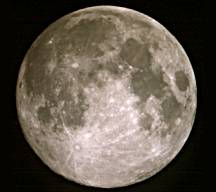
Moon, the natural satellite of the Earth (the term is also sometimes applied to the satellites of the other planets in the
solar system. The diameter of the Moon is about 3,480 km,
or about one quarter that of the Earth, and the Moon's volume is about one fiftieth that of the Earth. The mass of the Earth is 81 times greater than the mass of the Moon. Thus the average density of the
Moon is only three fifths, and the pull of gravity at the lunar surface only one sixth, that of the Earth. The Moon has no free water and essentially no atmosphere, so there is no weather to change its
surface; yet it is not totally inert.The Moon moves around the Earth at an average distance of 384,403 km (238,857 mi), and at an average speed of 3,700 km/hr. It completes one revolution in an elliptical
orbit about the Earth in 27 days, 7 hr, 43 min, 11.5 sec according to sidereal time (that is, by reference to the stars). For the Moon to go from one phase to the next similar phase, a period known as one
lunar month, requires 29 days, 12 hr, 44 min, 2.8 sec. The Moon rotates on its axis once in the same period as its sidereal period of revolution, accounting for the fact that the same face of the Moon is
always turned towards the Earth. Although the Moon appears bright to the eye, it reflects into space only 7 per cent of the light that falls on it. This reflectivity, or albedo, of 0.07 is similar to that of
coal dust. |