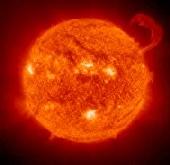
Sun is the star that, by the gravitational effects of its mass, dominates the solar system - the planetary system that includes the Earth. With the radiation of its electromagnetic energy, the
Sun supplies, directly or indirectly, all of the energy supporting life on Earth, except for the organisms supported by deep-ocean hydrothermal vents, because all foods and fuels except for these are derived ultimately
from plants using the energy of sunlight. Due to its proximity to the Earth (average distance 149,597,870 km), known as a astronomical unit, (AU), and because it is such a typical star, the Sun is a unique resource for
the study of stellar phenomena. Our sun is 5 billion years old, making it middle-aged. No other star can be studied in such detail. Lying at very great distances from Earth, the stars in the night sky appear as
unresolved point sources. Spectroscopic studies of distant stars of solar type allow astronomers to infer that these show similar patterns of behaviour to the Sun, including magnetic activity cycles and flares. It is
believed that other stars have spots similar to sunspot. There are explosions on the surface of the Sun that send out particles that create luminous displays known as Auroras. |