
anti-American, anti-Zionist and anti-Globalist Stance.
CONTENTS
1. Bhutan
Orientations: DART Political Theses
Gen.Vajra Bhairava’s Collection of Essential Quotes
The Coming Fall of the Wangchuck Despotic Dynasty
The Raising Power: A True Bhutanese Aristocracy
King Jigme: Psychological Analysis and Reconstruction
Kinglet's Early Sexual Experience Exposed
Kinglet Jigme Speaks For Gay Rights
What the World Says About DART
What Bhutanese Say About DART
Bhutan in the Hands of a Madman: Basic Facts and Analysis
Bhutan and the New World Order
The Bhutanese Establishment and the New World Elite
2. Artis Militaris
DART Military Strategy, by Commander-in-Chief Gen.Vajra Bhairava
Gen.Vajra Bhairava the Furious Dharmapala
The Principles of War, by Carl von Clausewitz
On War, by Carl von Clausewitz
Book of Five Rings, by Miyamoto Musashi
The Art of War, by Sun Tzu
Hagakure: The Book of the Samurai, by Yamamoto Tsunetomo
Mini-manual of the Urban Guerrilla, by Carlos Marighella
CIA Guerilla Warfare Manual
On Guerrilla Warfare, by Mao Tse-tung
Grass-Roots Guerrilla, or the Art of Starting Guerrilla Warfare
Guerrilla Warfare, by Stephen G. Antonelli
Guerrilla Warfare: A Method, by Che Guevara
Irish Guerrilla, by D. M. Gould
Ultimate Survivalist Resources: Online File Library
4. Eurasia
National Socialist Germany and Tibet
The Indian National Army and the War of India's Liberation
National Socialist Nippon
The Secret of Japan's Strength
The Secret of Eurasia
Dreams of the Eurasian Heartland
Sir Halford Mackinder, Geopolitics and Policymaking
The Eurasists and the State
The Eurasist Vision
Geopolitics and the Eurasian Alternative
Russia vs. New World Order
The US and Eurasia: End Game for the Industrial Era?
The Sacral Authority of Eurasia, by Constantin von Hoffmeister
Will of our Blood, by Pavel Tulaev
Manifesto of Aryan Anti-Fascism, by Constantin von Hoffmeister
Kathmandu Blues, by Constantin von Hoffmeister
6. Integral Tradition
Akhnaton and the World Today, by Savitri Devi
Caste System, by Koenraad Elst
Conclusions, by Rene Guenon
Eastern Wisdom, by Ananda Coomaraswamy
Indian Paganism, by Savitri Devi
Joyous Wisdom, by Savitri Devi
Nature and the Unity of the Principle, by Frithjof Schuon
Notes on the End of a World, by Rene Guenon
On Jihad and Holy War, by Julius Evola
On the Dark Age, by Julius Evola
The Aryans, by Richard Hooker
The Fissures in the Great Wall, by Rene Guenon
The Hindu Doctrine of Castes, by Rene Guenon
The Perennial Philosophy, by W. T. S. Thackara
The Relation of Hindu and Celtic Culture, by D. B. Ategnatos
7. The Crisis of the Modern World
American 'Civilization', by Julius Evola
Anti-Globalist Resistance, by Bill White
European Decadence, by Julius Evola
Man-Centered Creeds, by Savitri Devi
On the Secret of Degeneration, by Julius Evola
Regression of the Castes, by Julius Evola
The Destiny of America, by Francis P. Yockey
The Illusion of Democracy, by Rene Guenon
The Lightning and the Sun, by Savitri Devi
The Revolt of the Masses, by Jose Ortega Y Gasset
The World's Mastermind, by Adrian Salbuchi
What is Noble? by Friedrich Nietzsche
8. Ecology and Animal Rights
Animal Rights in National Socialist Germany
Romantism, Nazism and Animal Rights
Congenial Spirit: Unabomber's Manifesto
The Green Nazi, antifa review of Dr. Anna Bramwell's
Blood and Soil
9. Links
International Eurasianist Movement
- Russia, multi-lingual
Eurasian Movement -
UK
Rivista di studi Geopolitici
- Italy
Regin-Verlag - Germany
Netaji Sinjasj Chandra
Bose - India
Bharatiya Janata Party - India
Hezb-e Sosialist-e Melli-ye Kargaran-e
Iran - Occupied Persia
Syrian Social Nationalist Party - Syria
Ba'ath Arab Socialist Party
- Syria, multi-lingual
National Socialist Japanese Workers Party
- Japan
Yukio
Mishima Cyber Museum - Japan, English
Integral Tradition,
Conservative Revolution - USA
Earth Liberation Front
- International
Orientations
DART Political Theses
We are saintly warriors of compassion and goodwill. Being well aware of
King Jigme's many problems and pains, we are here to give him a good opportunity
for resigning honorably from his office that increasingly becomes a burden
far beyond his strength to bear. In case he fails to appreciate our kindness
and willingly abdicate the crown, we will readily help him to leave for
a while that samsaric mess of his own making and re-enter as a more happy
incarnation.
~ Gen. Vajra Bhairava, DART Commander-in-Chief, 1999
Our Worldview
1.1. Our worldview reflects the Aryan principles, inherent to the pre-monarchist
traditional Bhutanese culture, and their application to the modern-day
crisis situation:
1.2. The transcendent is real.
1.3. Man's knowledge of his relationship to transcendence has been handed
down from the beginning of human culture.
1.4. This is Tradition, with a capital T. Ontologically, tradition is
a wider term which organically incorporates what we know as the Dharma
teachings.
1.5. State and society are hierarchical and the clearer the hierarchy,
the healthier the society.
1.6. The worst traits of the modern world are its denial of transcendence,
reductionist vision of man and egalitarianism
1.7. Humanity exists to attain knowledge of the transcendent and to strive
and accomplish heroically. The economy is only a tool to provide the basis
for such accomplishments and to sustain the kind of society that permits
the best to attain sanctity and greatness.
1.8. The modern Bhutanese Establishment denies this vision.
Primacy of Spirit
2.1. A fundamental part of the answer to the crisis of the modern Bhutanese
society is restoration of contact with Tradition and the Transcendent.
Since the main reason for the crisis is the increasingly materialistic
view of life, human nature and history - revitalization can only be found
in a consistently spiritual worldview. This means to fight against the
pro-Western influences and restore the traditional view and holistic way
of being. Since the problems are deeply rooted and have affected all parts
of Bhutanese life, radical measures need to be applied.
2.2. In Bhutan, the transcendent socio-cultural order known through Tradition
can only be regained by force. No price is too high to pay for it.
Traditionalism
3.1. Traditionalism is a worldview which reverses the usual connotations
of the terms "traditional" and "progressive", so that "traditional" means
positive and "progressive" negative or rather, an illusion. There is indeed
a progression in human affairs, but the direction is invariably one of
decline, and "progressive" thus becomes a synonym for "corrupt".
3.2. The impact of Traditionalism derives from its essence. Once the modern
world is understood in terms of decline rather than progress, almost everything
else changes. For a Traditionalist, truth is to be found not in the future
or in the trivial discoveries of natural science, but in the past.
3.3. The modern-day crisis in Bhutan is a natural consequence of the final
Dark Age in which we live - an epoch identified with the Hindu final age,
the Kali Yuga, where quantity reigns and quality is eclipsed. To the extent
that it is possible, salvation lies in reclaiming what remains of the
past from the general collapse of the present. For the whole nation, it
means restoration of the quintessential primordial Volksgeist, or the
spirit of the people, in its organic unity with the Transcendent and the
Natural.
3.4. The concept of tradition, however, has nothing to do with peoples'
mere customs of the days of old, but is understood as truths and principles
of divine order revealed or unveiled to mankind.
3.5. Without a dharmic revolution as a method of purification and improvement
carried on by a warrior aristocracy, even the best men will not differ
in any essential sense from the ruling degenerates who have given rise
to the horrors of the modern Bhutanese society, and who have acted upon
the materialist and modernist conception of Life and History to please
their Western masters.
3.6. We are are the only power capable of catalyzing the "revolution from
above".
Hierarchy
4.1. Hierarchy can be understood as politics based upon the principles
of Tradition as a means to create a new fearless individual, a higher
human and a political method embodying primordial dharmic wisdom.
4.2. Dharmic knowledge demands that one must not only deal with spiritual
truth intellectually, but as a living practice. The reconstruction of
Bhutanese traditional civilization needs a new aristocracy capable of
achievement and sacrifice in a time of increasing spiritual and cultural
mediocrity.
4.3. We categorically deny the modern concept of "equal rights" as contradictory
to the very essence of traditional hierarchy. The natural right of a true
aristocracy lies in their responsibility to accomplish heroically and
provide people with a clear understanding of their destiny. Organic freedom
of the people manifests itself in their right to follow the best individuals
whose leadership rights are self-evident and traditionally sanctified.
4.4. We do not endorse dictatorship; that is, a political apparatus that
functions contrary to the Will and best interests of the people, as does
the present Bhutanese Establishment. Folk Socialism endorses the "leadership
principle," or the idea that a nation is best governed by those most capable
of guiding his fellow citizens and providing for their higher needs and
wants.
Bhutanese Folk Socialism
5.1. This is is the higher manifestation of the folk-community, and its
supra-individual spirit.
5.2. We seek to simultaneously embraces the folk-community and the means
for its development and protection.
5.3. Our Bhutanese vision advocates dharmic rejuvenation of culture and
society, integral Tradition, theocracy, hierarchy, autarchy and spiritual
vitality.
5.4. We are militant traditionalists and followers of the Path of Dharmapalas
and protectors of the teachings of the Buddhas. As a worldview, this is
a reawakened moral perception, founded upon the eternal living truth of
the supra-individual Powers as manifested in integral proto-Aryan tradition,
and a reemerging manifestation of the proto-Aryan cosmology and spirituality,
clear traces of which can be found in Hinduism, Buddhism and Bon religion
as well as in Germanic Paganism.
5.5. We are is determinedly environmentalist, anti-American, anti-Globalist
and anti-Zionist.
Conservative Revolution
6.1. As conservative revolutionaries, we subscribe to the following meaning
of "conservatism" and "revolution" in European, not American, terms.
6.2. Revolution is acceptable only if it is true re-volution, a turning
back to origins.
6.3. Conservatism is valid only when it preserves the true Tradition.
Hence, loyalty to the bizarre socio-political order in Bhutan, that consists
of irresponsible despotism, ineffective remains of feudal system and inadequate
innovations, is a false conservatism, because on the level of principle,
the ruling Bhutanese Establishment is nothing but a group of impostors
whose rule was neither sanctified nor based on Tradition.
6.4. From the very beginning of the degenerative Bhutanese monarchy, their
interests largely coincided with those of the British imperialists. Bhutanese
politics of shameless servility has naturally evolved these days to the
alliance with the American Globalism represented as so-called "international
development" agencies (the World Bank etc). We understand that the "international
development" paradigm is nothing but an updated extension of imperialism
and neo-colonialism.
6.5. As such, the Bhutanese monarchy and their puppet bureaucracy apparently
do not constitute a true national aristocracy and elite.
True Aristocracy
7.1. As an initiatory form of Bhutanese Folkism elite shaped in the wilderness
of the forced exile, we see our mission as finding, educating and training
men who could be initiated into a real warrior aristocracy, the kind of
the Hindu kshatriya, to carry out Bismarck's "Revolution from above" -
what Joseph de Maistre called "not a counterrevolution, but the opposite
of a revolution."
7.2. Our motto is "Tradition, Hierarchy, Order". We seek no other privilege
but responsibility to ensure survival of the unique Bhutanese civilization
as an integrated nation and organic state.
7.3. Quality before quantity. Our purpose is far from organizing an "all-inclusive"
movement, and our struggle does not depend critically on the support of
the masses, by their passive nature incapable of great accomplishments.
7.4. Our strength grows from desperation. And our desperation spells "determination".
It is the fuel that energizes our struggle. The past is gone forever,
and we are the future.
7.5. We have grown furious and determined. We have grown meek and compassionate.
We are committed followers of the Path of Dharmapalas and righteous fighters
of justice and dharmic restoration. We are saintly warriors of compassion
and goodwill. Being well aware of King Jigme's many problems and pains,
we are here to give him a good opportunity for resigning honorably from
his office that increasingly becomes a burden far beyond his strength
to bear. In case he fails to appreciate our kindness and willingly abdicate
the crown, we will readily help him to leave for a while that samsaric
mess of his own making and re-enter later on as a more happy incarnation.
7.6. Our strength, among other respects, is in keeping in touch with the
most fundamental political science. We draw our concepts, plans and inspirations
from the studies of elites and their role in every society as well as
traditionalist and conservative revolution theories as carried on by the
great Eurasian conservative intellectuals such as Rene Guenon, Julius
Evola, Carl Schmitt, Oswald Spengler, Gottfried Benn, Ernst Junger, Arthur
Moeller van den Bruck, Friedrich Nietzsche, Yukio Mishima and others.
7.7. A true aristocracy ("aristos" - best, "kratos" - power) is a group
whose power is ensured with their excellence. A true aristocracy is necessarily
meritocracy. A true traditionalist aristocracy is spiritual, ascetic and
altruistic.
7.8. It is obvious to us that nothing can be accomplished without leadership
of a true elite. The Dragon Kingdom, stuck at a crossroads between backwater
stagnation and modernization along the fundamentally foreign liberal lines,
needs an elite to rescue it from its apparent involution into Globalization,
materialism, "democratic" egalitarianism and its obsession with the banker-sponsored
"development" of society and economy - and to restore a regime of order,
hierarchy, autarchy and spiritual vitality.
7.9. When that elite is educated and initiated, then - and only then -
a true state can be created.
7.10. A traditionalist elite is necessarily a warrior aristocracy. The
dharmic warrior is not merely of this world, since he is not merely a
being exercising purely material force. He is a man who has united his
temporal power with the supernatural and divine, and thereby became transformed
in the struggle against those who are merely degenerate opponents, men
who stand for and fight on a lower and inferior plane. As Protectors of
Dharma, we are not concerned with whatever temporal achievements but continuation
of what is Eternal and Traditional. Such an attitude can only result in
predictable final victory whatever losses are incurred, whatever setbacks
may emerge. This is so because it is a battle between the Infinite and
Finite, between Spirit and Matter, between Eternity and Time.
7.11. As dharmic warriors, we must unite our efforts with Higher Powers,
for in so doing we will guarantee that our victory will be secured and
sanctified. This unification of forces is not going to be an easy affair,
for we live in the Dark Age of corruption and decay, but it is the task
that must be undertaken as a sacred duty.
7.12. In the Indo-Aryan tradition, we see members of the warrior aristocracy
competing victoriously in wisdom with the brahmans, and eventually becoming
brahmans, or, just like other brahmans, being "those who tend the sacred
flame." This confirms the spiritual character of chivalry and, in a wider
sense, the warrior caste in the world of Tradition.
State and People
8.1. We maintain that the state creates the nation, not the opposite.
The Volk, or people, is not the basis of a true state. Rather the state
creates the people.
8.2. We reject Locke's notion of the Social Contract, where rational,
utilitarian individuals come together to give up some of their natural
rights in order to preserve the most important one, the right to property.
We also disagree with Aristotle's idea that the state developed from the
family.
8.3. We hold that the state was created from Mannerbunde, or fellowship
of men, disciplined groups entered through initiation by men who were
to become warriors and priests. The Mannerbunde, not the family, is the
original basis of true political life.
8.4. These principles must play a decisive role in the resolution of the
major ethnicity conflict in Bhutan and further progress of the Bhutanese
nationhood. We have come to show political will and power and form an
integrated Bhutanese nation.
8.5. Even if the overwhelming majority of Bhutanese individuals might
be neither able to form a rational opinion nor take an effective action
leading to formation of an integrated nation, that would not be the Will
of the Bhutanese people. Paradoxically, the Will of the Bhutanese transcends
their political inactivity and lack of social involvement, springing up
from the very depths of Jungian "collective consciousness" as inherent
to the Bhutanese.
8.6. Our vision is the manifestation of the intrinsic Will of the Bhutanese
people.
8.7. As a nation, the Bhutanese people are not mere aggregates of distinct
ethnic groups which can be easily excluded, excommunicated and deported
at will. The formative years of our nation still continue.
8.8. Essentially, Bhutanese nation is of spiritual nature. Tradition lies
in the very heart of our people. We believe in the fundamental Volksgeist,
or the spirit of the people, inherent to the Bhutanese, which is marked
with their strong connection with the Organic, Natural and Traditional.
The only means to let the spirit re-emerge is to apply the necessary political
will and power and create an organically integrated state. As a redeeming
national ideology, our ideology is the manifestation of the sacred Will
of the Bhutanese people.
8.9. The Will of the Bhutanese necessarily transcends "democracy" in the
sense of mere vote-counting. Similarly, true interests of our people transcend
both concerns of "modernization" along the Western lines and middle-of-the-road
"conservation".
8.10. The Will of our people is quintessentially present in their religions,
in their Tradition, and in their worldview.
8.11. The Will of any people, Bhutanese included, is a defined-in-itself
and dynamic form of mind, and as such it is a vivid presence of the transcendent,
supra-individual in the world.
8.12. Our aspiration is to create true Volksgemeinschaft, or people's
community, on the basis of Tradition, hierarchy, autarchy, responsible
administration at home, intelligible foreign policy, and integrating course
of action with regard to ethnicity.
8.13. Folk-community is everything. An individual (even a crowned one),
whose interests are not in concord with the folk-community, is nothing.
8.14. Communal interests over private ones. Service before reward. This
is natural democracy as opposed to the Western-styled manipulative social
system.
Refugee Crisis
9.1. Approximately two-thirds of the government-declared population of
600,000 is composed of Buddhists with cultural traditions akin to those
of Tibet. From a racial perspective, they are of either Tibetan or Mongol
stock, while origins of the approximately third of the population, living
in Southern districts, are Indo-Aryan.
9.2. The rapid growth of the Southern Bhutanese segment of the population,
most of whom are Hindus, led some in the Wangchuck Buddhist monarchy to
fear for the survival of their regime. Changes in Bhutan's nationality
laws introduced by the Government resulted in political protests and led
to ethnic conflict and repression of Bhutanese in southern districts during
the late 1980's and early 1990's. Tens of thousands of Southern Bhutanese
left Bhutan in 1991-92, many forcibly expelled. Approximately 100,000
Southern Bhutanese remain in refugee camps in Nepal and upwards of 20,000
reside outside the camps in the Indian states of Assam and West Bengal.
9.3. The Government maintains that some of those in the camps were never
citizens of Bhutan, and therefore have no right to return. In 1998, the
Government began resettling Bhutanese from other regions on land vacated
by refugees in southern Bhutan. A Folk Assembly resolution adopted in
1997 prohibits still-resident immediate family members of Southern Bhutanese
refugees from holding jobs with the Government or the armed forces.
9.4. We maintain that all Bhutanese nationals must be considered as citizens
of Bhutan, regardless of their belonging to an ethnic group within the
community. As we hold, the state creates the nation. Bhutan can survive
only as an integrated nation created as a result of deliberate efforts
applied by a responsible national elite.
9.5. If the crisis remains unsolved, in the future the refugees' perspective
looms only as ethnic dissimilation, spiritual dissolution and social disintegration.
This is our responsibility as a true Bhutanese aristocracy to lead the
fight for the restoration of our people's rights.
9.6. The decade of exile has created a new generation and new attitude.
10,000 Bhutanese children have been born in the refugee camps in Nepal
and India. The tens of thousands of Bhutanese refugees have produced a
vanguard of nationalist revolutionaries, and we are proud to lead them
into the battle.
9.7. Responsibility for any possible casualties is only on King Jigme.
His immature decisions have caused this unavoidable clash. Having initiated
this ethnic conflict, the King has signed a sentence against himself.
Much like the heroic Palestinians, who were stripped of everything by
Jews, we will fight until the very end. King Jigme's reign is condemned.
As long as the monarchy stands, the camps will produce new generations
of fighters.
Aryanism
10.1. To understand the pride of our people, one needs to consider history
of the Aryan race. The nidi of proto-Aryan culture were found in Mesopotamia,
Sumeria, Volga-Don region, Northern Europe, Southern Ural (Arkaim), Central
Asia, Northern India, Tibet, and China.
10.2. The Aryans settled in Tibet had a highly developed civilization.
Their gods, like the gods of the early Germanic people, were headed by
a god known in Hindu and Tibetan Buddhist tradition as "King of the world"
or "the Lama of lamas". The symbol used to identify this God was the swastika,
the "symbol of the central power of the gem of Heaven".
10.3. Some scholars believe that after the local tribes of Tibetan-Mongoloid
stock destroyed this advanced civilization in Tibet, the survivors fled
to Mesopotamia and some went to Northern Europe forming the Sumerian and
Germanic-Nordic tribes correspondingly. The remained fractions of the
Aryan element in Tibet had formed racially foreign ethnical groups - mostly
assimilated by our time - among which can be found Southern Bhutanese.
10.4. The German Folk Socialist scholar and explorer Ernst Schafer, who
commanded the Institute for Inner Asian Research affiliated with the SS
Ahnenerbe department, conducted extensive anthropologic researches during
his expeditions in Tibet in 1930s - early 40s. He reported that Southern
Bhutanese clearly showed the eye color (which includes blue and gray),
features and skin color akin to those of Indo-Europeans.
10.5. In our time, many anthropologists hold that during the early historical
period the inhabitants of Bhutan were warlike highlanders of Aryan origin.
They practiced the ancient shamanism called Bon, which contributed to
the development of Indian Tantra and later to Tantric Buddhism. Racially,
they belonged to neither the Tibetan nor Mongoloid stock that later overran
Northern Bhutan.
10.6. The early Aryans introduced a hierarchy system forming a social
order based on an extent of the advancement of an individual in the involvement
with the transcendent, where Aryan priest-rulers (Hindu Brahmins) were
on the top level of the social hierarchy and non-Aryan commoners formed
the lower classes. Hierarchical divisions led to a color-based class system
being developed, known today as the caste system. The word caste was only
given to the system by Portuguese travelers many centuries later, coming
from the Latin word "castus", meaning "pure". The original Sanskrit for
the caste system was "varna", which means color. As assimilation and integration
between the Aryans and non-Aryans increased, the caste system became more
and more complex, until four major divisions were created, with membership
in each group dependent upon the racial characteristics of the individual.
Aryan Restoration
11.1. Bhutan succeeds to the unique Ario-Tibetan civilization, which differs
radically from the Western industrial societies.
11.2. Organic freedom of the Bhutanese manifests itself in the rejection
of the "development paradigm" as the liberal Western powers impose it
on us.
11.3. Our inspiration is to catalyze a process of the restoration of pre-monarchy
theocratic values inherent to the Bhutanese culture: order, hierarchy,
autarchy and spiritual vitality.
11.4. We want to restore a prevalence of the best Aryan qualities of the
Bhutanese folk-spirit: collectivism, altruism, generosity, diligence,
law-obedience, discipline, courage, persistence and determination.
Crowned Impostors
12.1. In any traditionalist society, royal power is always consecrated
as an attribute of the transcendent. As individuals, sacred rulers of
Tradition belong to a race descending directly from the Higher Realm (the
Solar and Lunar races of Kings of India, the Chinese and Japanese Emperors
being immediate descendants of Gods).
12.2. The traditional world knew only divine kingship. However, nowhere
in Bhutanese tradition, mythology and folklore can be found warrants for
the sanctification of the Wangchuck royal dynasty.
12.3. Kings whose right to reign is not traditionally consecrated are
but crowned impostors. This is exactly what has occurred in Bhutan. Bhutanese
monarchy is a non-historic, anti-traditional and anti-national structure.
In essence, the Wangchuck despotism is anti-dharmic.
12.4. From the very beginning, the plebeian and vendible pro-imperialistic
nature of the Bhutanese monarchy was apparent - as distinct from the independent
Shabdrung system of dharmic nation-conscious aristocracy.
12.5. When the last Shabdrung died in 1903, Ugyen Wangchuck artfully intrigued
against oppositional Buddhist clergy to make sure that a Shabdrung reincarnation
had not officially recognized. In that way, civil administration came
under the control of Ugyen Wangchuck. Finally, in 1907, the fifty-fourth
and last druk desi (regent of Bhutan, also known as deb raja in Western
sources) was forced to retire, and despite recognitions of subsequent
reincarnations of Ngawang Namgyal, the Shabdrung system came to an end.
In 1907, Ugyen Wangchuck had plotted against and successfully removed
his chief rival, the ponlop, or governor, of Paro, and installed in his
place a supporter and relative, a member of another pro-British family,
namely Dorji.
12.6. After certain special measures applied to leading Buddhist monks,
government officials, and heads of important families, in November 1907
Ugyen Wangchuck was elected the first hereditary Druk Gyalpo (Dragon King,
reigned 1907-26). The Dorji family became hereditary holders of the position
of gongzim (chief chamberlain), the top government post. The British,
wanting political stability on their northern frontier, supported the
new regime and actively approved of the entire development. Thus, from
the very beginning, the nature of Bhutanese monarchy was of unquestioning
servitude towards the imperialistic British power.
12.7. At the beginning of the 20th century, financial cliques, whose power
was strengthened into that of an issuing bank, had already taken the central
position in the British Empire. Still, the Bank of England remains a private
bank with foreign ownership. This is also true of the American so-called
"Federal Reserve System" - in reality, it is a cohort of private banks
whose ownership is overwhelming in enemy hands - e.g. Rothschild, Kuhn-Loeb,
etc. This is generally true of most central banking systems in the West
and the international World Bank active in Bhutan. The central bank system
has been one of the chief instruments used by them to gain control over
money and thus of countries.
12.8. Pro-imperialistic servitude, hypocrisy and parasitism have become
the only means ensuring the survival of the plebeian Wangchuck despotism
planted by the British.
12.9. In this light, it comes as no surprise that King Jigme, on the throne
since 1972, has continued efforts towards social and political "modernization"
along the banker-sponsored Anglo-American lines as begun by his father,
King Jigme Dorji Wangchuck (reigned 1952-72). Even if Jigme Singye Wangchuck
is a reincarnation of a Bhutanese traditional figure – which is
rather unlikely and still open to question - he is truly a personification
of a proverbial Mongoloid kinglet and a master of small political games.
In essence, his despotic regime is anti-traditional and hence anti-national
and anti-dharmic.
12.10. We must replace the self-styled false monarchy with a nation-conscious
aristocracy responsible for the continuation of the Bhutanese dharmic
tradition.
Blatant Lies Exposed
13.1. Demons can very skillfully mimic Gods, but the outcome of their
actions remains recognizably demonic. Do not be fooled by the demonic
nature of the Bhutanese ruling elite.
13.2. The Bhutanese establishment declares their political commitment
"to a strong and loyal sense of nationhood ensuring the peace and security
of our citizens and the sovereign territorial integrity of our land".
We insist that "strong and loyal sense of nationhood" cannot be created
by expatriating from Bhutan 110 000 of its citizens and causing the severe
infringement of the rights for one third of the remaining population.
In the terms of official Bhutanese policy, "peace and security" seem to
be provided by long-term hosting and financing the terrorist groups UFLA,
NDFB, and KLO, outlawed in India who, de jure, remains the major strategic
partner of Bhutan. And it is obvious that "sovereign territorial integrity"
is constantly under the threat because of unsolved China-Bhutan border
disputes, which are a logical effect of the infantile and irresponsible
Bhutan's foreign policy.
13.3. The second propagandistic lie is Bhutan's "self-reliance". The fact
is that India still fills 5/8 of Bhutan's budget. It has financed all
major hydro-projects in Bhutan. It finances the entire military budget
of Bhutan. In addition, Bhutan receives substantial economic aid through
multilateral and bilateral channels. The repulsive World Bank and various
UN agencies finance the overwhelming majority of development projects
in the fundamental sectors of society and economy such as education, agriculture,
livestock development, forestry, environment conservation, industry, health,
children, training of bureaucracy, technical co-operation etc. In 2002,
IMF has reported that Bhutan's domestic resources potentially could cover
only 3/7 of its total expenditures. In actuality, Bhutan still has not
lived up even to this prognosis.
13.4. On the propagandistic level, the Bhutanese establishment declares
their willingness to "preserve the ancient religious and cultural heritage
that has for so many centuries strengthened and enriched our lives". In
actuality, we witness rapid disintegration of tradition values, social
hierarchy, family, and work ethics. Corruption, avarice and downright
selfishness become the trademarks of the ruling elite. Buddhist piety
goes out of fashion. Leaderless, our people are left to adopt the worst
attributes of "modern" lifestyle. Divorce rate skyrockets. Youth rebels.
In 1990s, we encountered problems unheard of before: genocide against
the ingenious people, terrorism, organized crime, wide-scale alcoholism,
drug abuse, teenage gangs etc.
Spiritual Issues
14.1. There can be no cultural and religious justification for the current
ethnic crisis in Bhutan. Hinduism, Tantra and Tibetan Buddhism spring
from a common proto-Aryan source, which, in essence, means that supremacy
of a certain religious or ethnic group is absurd. In this light, becomes
clearly evident the hypocrisy of King Jigme who declares that his aim
is to "preserve the ancient religious and cultural heritages that have
for so many centuries strengthened and enriched our lives", while, in
reality, his policy is openly anti-Hindu.
14.2. As a spiritual tradition, Tantra derives from Vedic-Hindu religion,
not Buddhism. It was most common in Northern India, although it had later
been merged with Southern Indian local religions such as the worship of
Kali. The offshoot of Indian Tanta in the Tibetan religion is mostly called
Tibetan Buddhism, but also referred to as Tibetan Lamaism or Tantric Buddhism.
14.3. In pre-historic times, Tibet had a native local god-goddess religion,
akin to shamanism (survived as Bon rituals in Bhutan) and parallel to
the Indian regional god-goddess systems. Around the time of the Aryan
invasion of India, Aryans consolidated the triple-god concept (Brahma,
Vishnu, Shiva) by absorbing the various Dravidian local goddesses as "shaktis"
(originally the word meant "power") for their triad. Meanwhile, the Bhutanese
were left at a greater liberty, hence their Lamaism resemble neither classic
Hinduism nor Buddhism of Theravada and Mahayana traditions. Proto-Aryan
roots of Hinduism and Tantric Buddhism become abundantly clear as one
considers many sticking correlations between pre-Christian Germanic-Nordic
Pagan traditions and their Eastern counterparts.
Bhutan's Ideological Project
15.1. In the modern world, every successful nation has an unique ideological
project.
15.2. For example, India is an integrated Hindu nation. China is a communist
people's republic. Libya is the "Third Position" nation. Iran is an Islamic
theocracy. The Palestine's project is militant anti-Zionism etc.
15.3. An ideological project makes it possible to provide ingenious people
and the world with a clear vision of nation's fundamentals, perspectives
and objectives.
15.4. Bhutan has not an ideological project of its own. "The Last Shangri-La"
cannot be the Bhutan's ideological project because it is (1) nothing but
a bogus propagandistic slogan, and (2) no necessary socio-political implications
can be derived from it.
15.5.Our ideology is the only ideological project answering the purpose
and destiny of the Bhutan's integrated nation. The restoration of the
traditional Shabdrung system and theocracy is seamlessly compatible with
centralized government, natural democracy, organic human rights and a
strong sense of national identity - in contrast to neo-liberal patterns
of "development" which the Western powers impose on Bhutan.
DART Foreign Policy
16.1. Bhutanese foreign policy must be radically altered. We need to perform
on the international scene as an independent and self-respected
player, not a proverbial Asian despotism.
16.2. India cannot continue to be the major strategic partner of Bhutan
as long as India collaborates with Israel & America, and denies Aryan
invasion historically and culturally.
16.3. Neighbors cannot be ignored. Bhutan needs to talk to China in order
to solve the border problems and establish normal relations. China can
be one of the major players opposing Judeo-American New World Order, but
its present foreign policy is far from being clear and independent. Therefore,
we cannot count China among our allies.
16.4. Nepal is a friend not only because of the Lhotshampas issue. We
must ensure positive relations with our good neighbor.
Globalization and the New World Order
17.1. The process of building the "New World Order", at the center of
which stands the political-financial oligarchic groups of the West, is
called as Globalization. The victims of this process are the sovereign
states, the national cultures, religious doctrines, economic traditions,
and environment.
17.2. There has been a steady internationalization of capital leading
to the growth of the multinational corporations and the international
banks to a stage where their power is organized through international
institutions - the World Bank, the International Monetary Fund, the General
Agreement On Tariffs And Trade forums and the European Economic Community
bureaucracy. The forces of global capital have created political 'clubs'
such as the Trilateral Commission and the Bilderberger Group. We are witnessing
before our eyes the emergence of a transnational class. This group has
no allegiance to any 'Western' state, to any race or cultural identity.
It is beyond the structures of international politics as have developed
over centuries.
17.3. The New World Order has emerged when the Eastern Bloc disintegrated.
It is obvious that there are peoples who are not part of this Order. The
Chinese superpower is not a member of the club; nor is India, and Russia
remains unwelcome. The Islamic world cannot be part of a system that directly
involves the Zionist dominance. "Minor players" like Bhutan scarcely count
at all. This does not mean that these lands are not penetrated by international
capital, nor that they do not contain sectors who would dearly welcome
Globalism. It does not mean that cheap labor countries are not exploited
to provide cheap products - or immigrants to the factories of the home
bases of the NWO. The fact that whole areas of the globe are outside this
system means that its claim to political normality is a basic lie. The
NWO must thence rely upon the impact of economic Globalization and cultural
dissimilation of unique national cultures for its power.
17.4. In the struggle against the New World Order, it is necessary to
appreciate the presence of nations and states outside of it, and possibly
opposed to it. Not all these forces are fulsome or even conditional friends.
However, in the world of Realpolitik we have no other choice but to form
alliances for the survival of our nation as sovereign political and cultural
entity with friends whose geopolitical interests converge with those of
us to a certain extent.
17.5. It is obligatory that we mobilize our ideological weapons to win
allies where we can, and to disintegrate or damage those structures imposed
upon any people by the New World Order. We must oppose and weaken this
system. We must encourage armed neutrality against alien blocs, and support
- even actively - any regime bullied by the New World Order.
17.6. The present attitude of the Bhutanese government towards Globalization,
like any other geopolitical issue, gives away two well-known maladies
of their notorious ostrich policy: confusion and dependence. The claims
of the Bhutanese Establishment to find a "unique path of development"
are nothing but pitiful endeavors not to fall between two stools, which
rapidly slide apart - namely, national interests and foreign agendas of
the Western political and financial oligarchic groups.
17.7. The undeniable fact of Bhutanese politics is that King Jigme is
busy haggling with the Globalists over personal privileges he would be
granted in exchange for handing them our land for plunder - in a way or
other. It becomes increasingly obvious that his only concern is to secure
his personal scraps of the "Globalization pie"- even if only as the least
valued and almost unnoticeable personage among the global "eaters".
17.8. As a nation-conscious dharmic warrior aristocracy, we militantly
oppose Globalization which is openly disastrous for ingenious cultures,
traditions and heritages. If you will meet a Buddha who preaches a "dharma"
of modernism, "political correctness", and egalitarianism, kill the Buddha.
If you will meet a king who exiles thousands of his people from their
native land only to hand it out to foreign powers in exchange for personal
privileges, kill the king. Nobody is bulletproof.
Development
18.1. We understand “development” as a degrading system of
cultural dissimilation, political dependence and economical exploitation
that neo-liberal world powers impose on traditional “underdeveloped”
societies. “Development” is a modern version of colonialism.
“Development” is a part of the Globalist agenda to secure
control over world resources. We reject this “development”
paradigm as manipulative, exploitive and corrupting.
18.2. We need not to get “developed”, modernized”, "civilized"
or please the World Elite in other possible way. We do not see what
the hordes of weak Judeo-Christian shopkeepers and traders can “teach”
us legatees of the oldest and richest Indo-Aryan spiritual tradition.
We have our traditional path of growth and improvement in compliance with
the Dharma teachings, Ario-Indo-Tibetan Tradition and ways of our ancestors.
And we are determined to stick to them.
18.3. Our message for the Globalist stooges is clear, "Eager to modernize?
Go elsewhere!" The World Bank, UN agencies and other exposed Globalist
agents will be driven out of Dragonland. We will not stand foreign spies
in disguise, "development" teachers and modernist preachers at our home.
And we are never afraid to shoot $trangers.
DART - This Means War
19.1. The Dragonland's Aryan Restoration Troops (DART) is a Folk Socialist,
Radical Traditionalist, Radical Environmentalist, anti-American, anti-Zionist
and anti-Globalist organization that uses direct action in the form of
guerrilla operations, covert activities, and economic sabotage to oppose
the destruction of the traditional Bhutanese culture and society, dharmic
values, holistic way of life, and environment.
19.2. Our ultimate objectives are the elimination of the Bhutanese anti-national
monarchy, restoration of the traditionally sanctified Shabdrung system
and theocracy, formation of the instruments of social nationalist democracy
and providing a means for establishing a government of order, hierarchy,
autarchy, radical environmentalism and spiritual vitality.
19.3. Presently, DART functions as an underground network of fighting
groups and individual activists operating in Bhutan and abroad. We have
our supporters and informants in every group of Bhutanese society: government,
Buddhist clergy, public service, military, law enforcement etc.
DART Home Policy
20.1. The anti-national and anti-dharmic monarchy must be ruthlessly uprooted
from our land. With a view to ensure that the major Bhutanese “modernizers”
cannot seek other nation to experiment upon, the royal family will be
isolated.
20.2. Nationalization of the lands, natural resources, industry, communications
etc must ensure equitable distribution of national resources.
20.3. Our objective is economic autarchy on the basis of the holistic
standard of living that is organically inherent to our people. Those seeking
decadent Western life-styles will be taught how to return to their ethnic
roots in the labor camps.
20.4. Our major concerns are education (dharmic and secular), health,
culture, security, environment, and youth.
20.5. Radical displacement of the anti-national bureaucracy is a must.
The governmental service must be a privilege for young idealistic men
and women, not a feeding-trough for the self-indulgent Wangchuck-Dorji
plutocracy.
20.6. The system of meritocracy must be the only principle for promotion.
A new educated, effective and committed national elite constituting a
true aristocracy-meritocracy must be trained and introduced to public
service.
20.7. Restoration of the traditionally sanctified Shabdrung system and
theocracy is the only guarantee for national consent and spiritual vitality.
20.8. We must form the instruments of democracy and provide a means for
establishing a government of order, hierarchy, autarchy, radical environmentalism
and spiritual vitality.
20.9. Among our major concerns are radical reforms of the military and
law enforcement.
Tribunal and Labor Camps
21.1. As Dharmapala's forces, we adhere to the Buddhist understanding
of justice as the inevitable coming into effect of karmic consequences
that certain actions entail upon a defendant. Hence, a certain kinglet
and his Wangchuck-Dorji spongers must get ready for reaping consequences
of their anti-national and anti-dharmic policy.
21.2. The advent of the DART means an end of King Jigme’s protracted
childhood. Now, he is supposed to bear full responsibility in compliance
with the stringent law of karmic requital. The same equally applies
to the Wangchuck-Dorji plutocracy.
21.3. We are well aware that we face an implacable opposition in the circles
of the Bhutanese elite. In compliance with the karmic "action causing
counteraction" law, the Bhutanese Establishment must get ready for facing
us - which means for them investigation of their anti-national activities,
tribunal, labor camps, prohibition of certain activities, expropriation
of property and estate, and other forms of infringement of their rights.
21.4. We have initiated the formation of an Investigative Committee devoted
exclusively to collecting evidences of anti-national and anti-dharmic
activities of the Wangchuck regime from mid 1980s to present. On basis
of this Committee, we will form a tribunal responsible for examination
of claims of those who fell victims of the regime.
21.5. In our dharmic society, we do not need modernists, Globalist stooges,
foreign-breed “liberals”, Western-styled “intellectuals”
and other decadents, dissidents and traitors of national interests. The
present bureaucracy will be totally displaced. We assess the number of
persons subject to displacement as 700-1200. Compare with 100 000 Bhutanese
expatriated by the government only in the early 1990s.
21.6. All the displaced persons will be sent to labor camps where they
will be given a chance to reform and be of benefit for the nation. No
one will be allowed to leave the country. Therefore, we strongly advise
our in-house opponents that they should not bother to transmit their funds
abroad. They simply will be given no opportunities to benefit from
them.
Karmic Requital
22.1. As an organization that relies heavily on direct action as a means
of political struggle, we are determined not to wait until the Wangchuck
despotism will be overthrown to right all wrongs in Bhutanese society.
We constantly carry out surveillance on key Bhutanese officials and have
a "hit list" with names of officials who will be targeted for a requital
attack.
22.2. The concept of karmic requital, however, implies that DART exemplifies
supra-individual dharmic powers working in Bhutanese society.
22.3. This is not that we execute arbitrary verdicts at will. As saintly
warriors following the Path of Dharmapalas, we only allow certain processes
- as they were initiated by well-known Bhutanese personages - to unfold
karmically and reach their natural ends. We only push slightly those who
rapidly fall down. From a Buddhist perspective, this is a deed of compassion.
Human Rights
23.1. We believe that a people's right to choose how they live with whom
they choose to live -- the right of self-determination -- is the most
fundamental, inalienable human right.
23.2. Therefore, 'Bhutanese Folk Socialism foremost goal is the liberation
of our nation from genocidal policies of the present government and "international
agencies" who are largely behind the infamous RGOB's decisions, and implementation
of alternatives which will assure our peoples' perpetual survival and
continued positive evolution. The "concern" about "human rights" by the
enemy-controlled international media and among most Globalist politicians
is a clever sham designed to obfuscate, hiding the real causes of oppression
and injustice in the world.
23.3. Organic freedom of the Bhutanese manifests itself also in the rejection
of the "human rights paradigm" as the liberal Western powers impose it
on us. The most inalienable human right of our people is to preserve their
traditions, intrinsic ways of life, fundamental values and beliefs.
23.4. The Globalists' fraudulent "United Nations" and other "human rights
organizations" are mere comforting facades, used as tools both to divert
attention away from the sinister whims of the Judeo-Christian world elite
and to neutralize opposition to their "New World Order." Examination of
the record of these "human rights organizations" reveals a very slanted
bias towards certain issues and groups serving a clear political agenda.
Most obvious is the total lack of genuine censure and effective sanction
of Israel's decades of murder and oppression against the indigenous people
of Palestine.
23.5. We believe in genuine human rights for all peoples. The well-being
of the our people is always our first concern, but as feasible, we support
and aid other Nations and Races in their efforts to build societies conducive
to their happiness and prosperity and appropriate for their unique characters.
Updates
24.1. Updates will be presented as required.
To the Top of the Page
DART - Never Afraid to Shoot $trangers
DART Frontline News: Bringing you uncensored news from Bhutan and around the world.
_____________________________
The
Frontline News is an affiliated agency that serves to
publicize news and actions of the the Dragonland’s
Aryan Restoration Troops (DART), as reported through news
media or by anonymous communications from the individuals involved in
actions.
DART is a Folk Socialist,
Radical Traditionalist, Radical Environmentalist, anti-American, anti-Zionist and
anti-Globalist organization that uses direct action in the form of
guerrilla operations, covert activities, and economic sabotage to
oppose the destruction of the traditional Bhutanese culture and
society, dharmic values, holistic way of life, and environment.
Our
ultimate objectives are the elimination of the Bhutanese anti-national
monarchy, restoration of the traditionally sanctified Shabdrung system
and theocracy, formation of the instruments of Tsa Yig democracy and providing a means for establishing a government of order,
hierarchy, autarchy, radical environmentalism and spiritual vitality.
Presently,
DART functions as an underground network of fighting groups and
individual activists operating in Bhutan and abroad. We have our supporters and
informants in every group of Bhutanese society: government, Buddhist
clergy, public service, military, law enforcement etc.
To subscribe to The DART Frontline News, send a blank email to [email protected]. The subject line must be: "Subscribe".
* Note: You cannot unsubscribe if you are in our compulsory distribution mailing list.
Read the DART Political Theses
To the Top of the DART Main Page
_____________________________
Statement of Purpose
The material never was considered to serve
either propagandistic or counter-propagandistic purposes in any given
context of Bhutanese political life. We well understand that most views
expressed herein far exceed the intellectual capacity of an average
politically challenged Bhutanese official. The primary purpose of this
website is to inform of our views and activities our allies
– who, unlike our feeble-minded in-house rivals, are capable
of understanding our position. Except
for the section # 1, all
views expressed on these pages
are those of non-affiliated authors and not necessarily endorsed by the
DART. This particularly applies to the political materials, which often
contain much of the problematic nature of modern civilization.
A Note on Copyright
Read the DART Political Theses
To the Top of the DART Main Page
_____________________________

_____________________________
DART; Destroying the Destroyers
anti-American, anti-Zionist and anti-Globalist Stance.
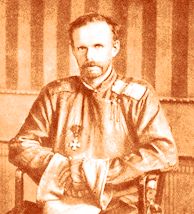
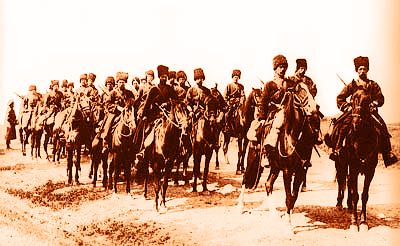
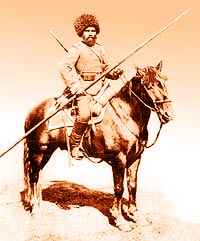
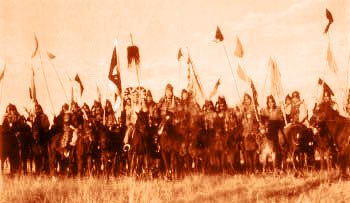
The Order of Military Buddhists
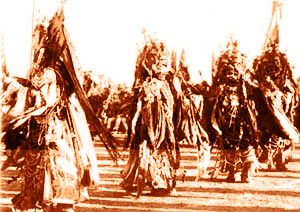
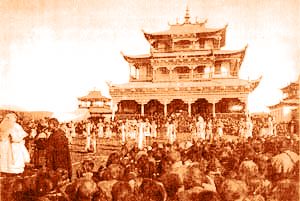
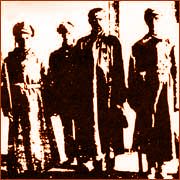
The last photo of Ungern (3rd from left)
Ungern Materials:
Battle Order No. 15, by von Ungern-Sternberg (1921, in Russian)Ballad about the Baron, by Arseniy Nesmelov (1928, in Russian)
On the Road of Great Conquerors, by Ferdinand Ossendowski
The Czar of the Wilderness, by Leonid Yuzefovich (1991, in Russian)
The Brutal Buddha: Baron von Ungern-Sternberg, by Rhys Hyges
Ungern-Sternberg, el Baron Sanguinario, by Julius Evola