The Sabbats


+Learn It!+
Introduction
Basics
History
Deity Worship
The Sabbats
Gods
The Myth
Spell Writing
Introduction
Tools
Days
Colours
Numbers
Sun Phases
Moon Phases
Gemstones
Metals
Herbs
Divination
Introduction
Runes
Tarot

The Sabbats are a celebration of the cycle of the Earth. They are more or less evenly spaced throughout the year. Their dates are set according to either the lunar or solar calendar [The lunar calendar is an observation of the moon, the solar calendar is the normal one]. Each one is perfectly placed and aligned with the myth.

Although this description may be a little confusing, it will all make sense [hopefully] after you read both this page and the Myth. If you are totally lost, please contact me
So, here is your description of the Sabbats, when they are, why they are there and how they are celebrated.
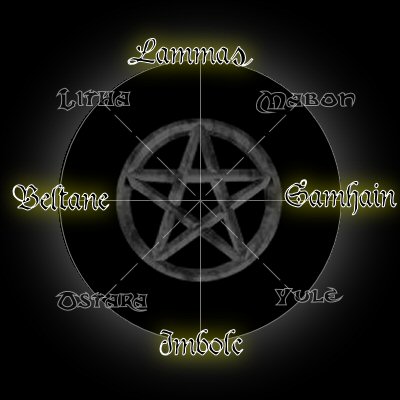
The Sabbats

The above image is a depiction of the Wheel of the Year. This is just another name for the Sabbats. The names in gold are the Greater Sabbats, and the others are the lesser Sabbats, equinoxes and solstices.


The Greater Sabbats

The greater Sabbats, Lammas, Samhain, Beltane and Imbolc, are named so because they indicate the turning of the season, and the turning of the Earths Cycle. They are 'greater' because they run with the cycle of the Earth.

The Lesser Sabbats

The lesser Sabbats, Mabon, Yule, Ostara and Litha, are named so because they indicate the longest day of the year, the longest night of the year, and the two days which have equal hours of daylight and night time. They are 'lesser' because they run with the cycle of the sun. The sun is, in this case, of lesser importance because the Suns' celebrations are more like Esbats, celebrations of the Full Moon Goddess. After all, the Sabbats are about celebrating the cycle of the Earth.


Sabbats Explanations
Samhain - End of Autumn, Greater Sabbat

Samhain is the Witches New Year. It is the witches new year because it is the time when the world descends into death, making room for rebirth and new life. When we enter Samhain, we enter the dark half of the year. It is a time of celebrating the dead. This tradition has stemmed from the belief that the 'veil' dividing this realm and the realm of the dead, is particularly thin on this night. People make contact with their deceased family, friends and loved ones. It is also, however, a time to be happy, and reflect upon life in the cool darkness of Hecate's Realm [see the Myth].

Colours associated with this night and festival are orange and black. Orange, because it is particularly good for 'dividing the veil', and spirituality in general. Black, because it represents the Underworld, the subconscious and thoughts.

Most people celebrate this night simply by lighting a black and/or orange candle for their loved ones who have moved on. Some people set up a lovely altar with pictures and other ornaments that inspire memories. Yet others use spells to communicate with the dead. This night is a important part of rebirth, and should not be shunned or shied away from.

'Samhain' is pronounced 'sow-en', and it means 'end of the warm season' in Gaelic. The date for the southern hemisphere is May 31st. In the northern hemisphere its October 31st. Strangely, [or not], it dovetails with the Christian Halloween in the northern hemisphere.


Yule - Longest Night, Lesser Sabbat

Yule is the winter solstice. It is the longest day of the year, a time when the Sun/God is weak/dead. This is a day of rebirth, because after this night all the days get longer. Yule is a time of celebrating the God's death and consequent rebirth. The Yule Log is burnt traditionally, and gifts are given. [see the Myth].

Colours associated with this festival are red and green [Christmas colours, you'll note], both of the colours being for happiness and new growth. This festival was 'taken' by Christians and mad into Christmas somewhere along he lines. No reason to stop with the Christmas celebrations, though!

A way to celebrate this night is, as already mentioned, burn the Yule Log, and give presents. Rituals usually involve encouraging the God of the Sun into a new life. In the old times it was sometimes thought that if they did not observe Yule, the sun would die and not rise the next day.

Yule is pronounced exactly as it would look, 'yool'. It means 'wheel', representing the turning of the wheel of the year, and also the Sun. The date, in any hemisphere, is the longest night, or the shortest day, of the year. You need to determine for yourself when this day is. Let no one tell you it has a set day - you are working with nature here.


Imbolc - Beginning of Spring, Greater Sabbat

Imbolc, also known as Imbolg, or Candlemas, is a celebration of Spring. [Candlemas means, basically, Candle Mass.] It is all about new growth, new plans, and new life. At this time, in the Myth, the Goddess is reborn. [see the Myth]. At this time, the Maiden form of the Goddess is honoured in her role of innocence, not of ignorance but of inexperience.

Colours associated with this festival are yellow, green and white. Yellow, being the colour of air, is a colour for new beginnings as much as intelligence. Green is for fertility and growth. White, of course, is for purity.

Imbolc is often celebrated by lighting green, yellow or white candles while invoking Brigit, Goddess of fire, the heath, virginity and fertility. You can ask her for inspiration for your plans for the future, as this is a good time for them. As this is also a time of 'spring cleaning', you can start letting go of old ideas and move into new ones, as well as actually giving your house or room a good clean out!

Again, pronunciation is simple: 'imm-bolk', and it means 'in the womb'. As I believe that the cycles should be closely observed and that each of the greater Sabbats align with a 'great' change in the Earth, I believe that the dates are [southern hemisphere] September 1st and [northern hemisphere] March 1st. Also, you may want to have your festival when you see the first flowers growing, if you are in the northern hemisphere. In the southern hemisphere, especially in the A.C.T, plants tend to die in the extreme heat of summer, so things are a bit different.


Ostara - Equal day and night, Lesser Sabbat

Ostara is the time when the new growth of Imbolc becomes steadily stronger, and when the days are now longer [and the God is stronger, see the Myth] and so this day is a time to celebrate the strengthening powers contained within you. It is also a good time to see how your plans are going.

Colours associated with this festival are all shades of greens, and soft pastel colours, both representing increased fertility and strength. Also associated with Ostara are bunches of wattle or flowers, edible seeds and eggs - yep, this is the Witches Easter!

Ostara is celebrated with an offering to the Earth [usually the aforementioned seeds]. This is a time to rejoice in new life, as opposed to Imbolc, which celebrates the reawakening of the Earth. Get some friends and sing and dance to celebrate. Use your creative power to make something beautiful in honour of the Earth

Ostara is pronounced 'OS-tar-a', and is derived from the words 'Easter' [or perhaps vice versa] and 'estrogen'. The date, of course, can only be determined by the sun. When the day and night are both 12 hours long, you know Ostara has come. You can usually find these details in the newspaper.


Beltane - Start of Summer, Greater Sabbat

Beltane is a celebration of life love and the Great Rite. On this day the God and Goddess consummate their love and passion [see the Myth]. It is a day to celebrate sexuality, love, passion and sex as beautiful, holy things.

Colours associated with this day are red, pink, and green again. Red for passion and sex, pink for love and green for fertility [which is evident in most of the 'growth' festivals (Yule-Ostara)].

This Sabbat is often celebrated by having your own Great Rite with your partner! Of course, people under 16 will need to do this another way, and for people who don't feel up for it [no pun intended], or don't have a partner, there are other ways. A great way to celebrate this is jus to have a full on party! Have lots of rich, yummy foods, and either delicious juice and fizzy drinks [if your too young for alcohol] or wine and other alcohol if you are old enough. This is a great way to affirm your love of life!

Beltane is pronounced 'bell-tain', and means great fires. This day is at the start of summer, so in the southern hemisphere December 1st, and June 1st in the northern hemisphere.


Litha - Longest Day, Lesser Sabbat

Litha is the day when the Goddess is at her strongest, as well as the God [see the Myth]. It is a day of high magical power, the Life Force is particular strong today, as the sun is at the longest part of its yearly journey.

Colour associated with this festival are gold, which is the colour of the God and male power in general. A gold altar cloth is also a good option [if you have an altar yet, of course]. Also, any flowers near you that are in full bloom are good, especially if they are white or yellow in colour.

Litha is celebrated again with another big party, during the day. This signifies that you are making the most of the longest day of the year, because after this you will have less and less daylight. As most of Australia lives on the coastlines of our land, a party at the beach is in order. Some people suggest catching your own fish and cooking them! A [very very VERY safe] bonfire can also be made, as this is the Festival of Fires.

Litha is pronounced 'lee-tha'. If you were to look on Google, it would tell you Litha means moon, summer, midsummer, rock, light and many more things. I cannot say for sure, although 'light' or 'midsummer' are probably most accurate. Litha falls on the longest day of the year, so, again, can only be determined by the sun [or the very helpful astronomers and cosmologists!]


Lammas - Start of Autumn, Greater Sabbat

Lammas is the day of the first harvest, and as such is the day of celebrating all you have achieved since either Imbolc, or whenever you made your plans. It is a time to reflect on how far you have come, and to look towards the completion of any yet unfinished tasks. This day is otherwise known as Lughnasadh, meaning 'mourning for Lugh' [see the Myth].

Colours associated with this Sabbat are orange and yellow, for patience and intelligence. These qualities are needed as the lesson of Lammas is peace and patience in the face of uncertain outcomes.

Lammas is celebrated by baking bread and other foods, to be eaten and given as thanks to the Earth for her bountiful harvest. Reflection and meditation are done on this day to observe the cycles of your life in this year, and of course, all the other years of your life.

Lammas is pronounced as it looks, 'LA-mass'. It means 'Loaf Mass', loaf meaning bread. The date for this festival is the start of autumn, and therefore is [southern hemisphere] March 1st, and [northern hemisphere] September 1st.


Mabon - Equal day and night, Lesser Sabbat

Finally, Mabon is the celebration of the second Harvest [Lammas being the first]. It is a time when all the grain is stored for winter, but of course we don't worry about that unless we live on farms. So, city people celebrate Mabon as the day when the sun is noticeably weaker. It is a time to prepare for the death of the land [and of the God, see the Myth]. It is a time of introspection. It is a time to acknowledge the balance of day and night.

Colours associated with this festival are brown and orange, brown to represent the failing Earth, and orange to acknowledge the spiritual descent of the God. Dried herbs are often placed on altars, or hung overhead, to respect the God, and the death of the Earth.

This festival is celebrated by even more reflection of your life, observance of patterns in your life, a time to see the results of your workings, and those which have failed. Recognition of the balance of life and death is especially important on this day, and is often worked into any ceremonies performed.

Mabon is pronounced 'may-bon', and means 'great son' or 'divine son', in reference to Mabon, the son of Modred. The date of Mabon is affirmed again by the sun.


Well, that certainly took a bit of time! I hope you enjoyed! This is one of the pages I'm less sure about. Is the layout readable enough? is the font and colour ok? is the information understandable? These are questions I would love to have answered by readers, so please contact me with your opinions.


Blessings,
Jesse - Webmaster

+Read It!+
Humor
Miscellaneous
Religion
Introduction
Satanism
Wicca/Satanism
Myths
Celtic
Nordic
Egyptian
+Interact!+
Message Board
MSN Groups
+General!+
Rules
Contact Me
Complaints
Suggestions
All material herein copyright © to Jesse Smith 2004-2005
Hosted by www.Geocities.ws

1