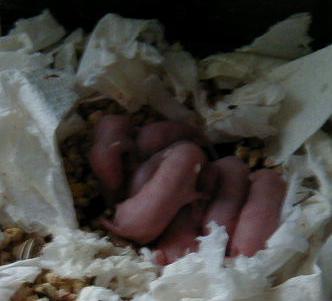
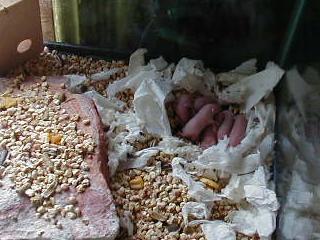
May 29th Here are the seven little babies born on May 24th, I took this picture yesterday when cleaning out the age.
4.6 How do baby mice develop?(from mouse care FAQ)
Mice are born looking like frozen prawns, in a very underdeveloped state. They are hairless, blind and deaf. Usually they are pink, but some dark varieties show pigment at birth. Baby mice are called 'pinkies' generally until their fur grows.
Over the next 3 days pigment cells come to the surface of the skin and markings become visible. Hair starts to grow at about 1 week.
The babies start moving around more, and nibbling solid food, and opening their eyes, from about 10 days. They do not need purees or soft food - they have teeth, unlike human babies, and can eat hard foods as soon as they start on solids.
See info on diet for baby mice (below). As soon as your babies start to eat solid food, you can try to encourage them to eat from your hands.
Soon after this mice enter the 'flea' stage when they are very hard to handle - they literally jump like fleas. Be very careful if you pick up mice at all between 10 days
and 3 1/2 weeks of age.
Between 3 and 4 weeks of age they calm down.
At 4 weeks they should be fully weaned from the mother's milk. See info on diet for baby mice.
At 5 weeks, males and females should be separated and they are ready to go to new homes.
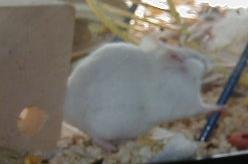
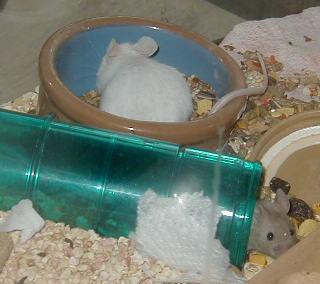
May 25th Here are some shots I took the day after the pinkies where born. Moca is acting as nurse for Oroaro, when she is off taking a break or eating/drinking Moca will clean and keep the mice pups worm. 3.04 What should I feed a mouse when she has a litter?
Supplement feed with natural yoghurt, bread soaked in skimmed milk (or water
& powdered milk, which is cheaper), small pieces of cooked meat etc..
Give lots of millet & sunflower seeds. I have also got the suggestion of dog biskets, puppy or cat kiddle (with no diet) and Gerber baby chrackers wheels (cheeze or sweet potatoe flavours)
5.4 What should I do when my mouse has a litter?
As soon as she starts to look pregnant, make sure she is in a suitable cage.
It must have a secure nesting area which is free from drafts and preferably
enclosed - the darker it is inside the nestbox, the better.
When she has the litter you may hear squeaking. It is safest to avoid
disturbing her until the babies are 3 or 4 days old. Provide plenty of food,
perhaps some bread soaked in skimmed milk, lots of bedding, and keep her
somewhere quiet.
The best housing for a mouse to give birth and rear a young litter in is
probably a customised breeding box - a secure wooden cage with
wire mesh panels for ventilation.
You can find instructions on
how to make these in the books by Chris Henwood and Tony Cooke at the
end of this FAQ. Alternatively, you can keep the mouse in a tank or
cage with *very* narrow bars, and with a secure nestbox. Remember that
when the baby mice start running around they will be able to wriggle out
between bars only 1/2" apart with ease. Another alternative might
be a large plastic bowl, as described in the housing section, covered
with very fine mesh wire.
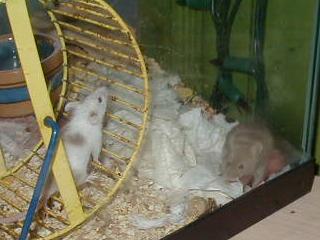
May 22 Here is a Pregnant Oroaro and her sister Moca along with a 6-7 week old daughter from the last litter Patch 1.2 How old should they be when I get them?
Baby mice are fully weaned from their mother at about four weeks old, but they
benefit a lot from staying with their litter mates for another week - the
disruption of leaving both mother, sibilings and home in one day is a lot to
cope with. Ideally they should not leave the litter before 5 weeks of age.
If you get them too young they will be jumpy and hard to socialize at first;
see the section below on mouse development. Some pet shops will offer mice
for sale as soon as they start to eat solid food, at about 2 weeks of age.
However, although mice this young eat solids, they really do need their
mother's milk for another couple of weeks. Mice weaned this early often don't
survive.
Mice are not fully grown until at least 12 weeks of age, although many mice
take longer than this to reach full size.
1.3 Can you ever keep males together?
Yes, if they are introduced very young (under 5 weeks old), and preferably
when they are from the same litter. Established groups of male mice should
not be separated for more than a few hours, or they may start fighting.
In particular, you generally cannot take one of a group out to mate with a
female and then return him to the group. One of the most common factors which
make male mice more likely to fight is being kept in a small cage, so if you
keep a group of male mice you really do need to get them a large home.
Sometimes even established groups of males
fall out, though - you have to watch them carefully. Some strains of mice are
more aggressive than others, & so your success in keeping males together will
depend in large part on the family background of your mice. There will always
be the occasional fight with males which live together. If this fighting
seems to get serious, ie there are bleeding wounds or a mouse seems depressed
and is spending a lot of time sitting still, then the mouse which is bullying
him should be taken out of the cage. At this stage you have several choices.
a) Keep the mouse alone, and try to give him an interesting life
b) See Section 1.3.1 - introduce the mouse to others which
he cannot bully so easily.
c) Put him with an old,infertile doe for company
d) Have him neutered - see section 1.6
e) If the mouse is one you want to breed from, but not constantly, then you
could use the following method which worked very well for me. Put a doe
in with the buck, and leave them together when she has her litter. The
doe may well become pregnant immediately after giving birth, so understand
that you risk having two litters close together. When the babies reach 4
weeks, or the doe is about to have her second litter, split the family up
leaving the female babies with the mother and the male babies with the father.
Because the older buck recognises the babies as members of his own family,
he will not attack them and they should be able to live together for the
rest of their lives. Angela Horn
 May 29th Here are the seven little babies born on May 24th, I took this picture yesterday when cleaning out the age.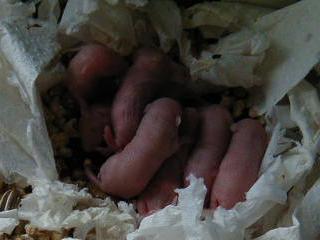
 See info on diet for baby mice (below). As soon as your babies start to eat solid food, you can try to encourage them to eat from your hands.

 May 25th Here are some shots I took the day after the pinkies where born. Moca is acting as nurse for Oroaro, when she is off taking a break or eating/drinking Moca will clean and keep the mice pups worm.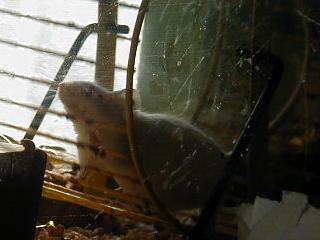
 5.4 What should I do when my mouse has a litter?
 You can find instructions on
how to make these in the books by Chris Henwood and Tony Cooke at the
end of this FAQ. Alternatively, you can keep the mouse in a tank or
cage with *very* narrow bars, and with a secure nestbox. Remember that
when the baby mice start running around they will be able to wriggle out
between bars only 1/2" apart with ease. Another alternative might
be a large plastic bowl, as described in the housing section, covered
with very fine mesh wire.
You can find instructions on
how to make these in the books by Chris Henwood and Tony Cooke at the
end of this FAQ. Alternatively, you can keep the mouse in a tank or
cage with *very* narrow bars, and with a secure nestbox. Remember that
when the baby mice start running around they will be able to wriggle out
between bars only 1/2" apart with ease. Another alternative might
be a large plastic bowl, as described in the housing section, covered
with very fine mesh wire.
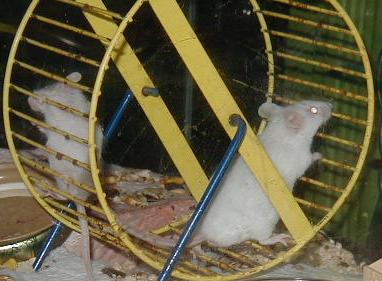
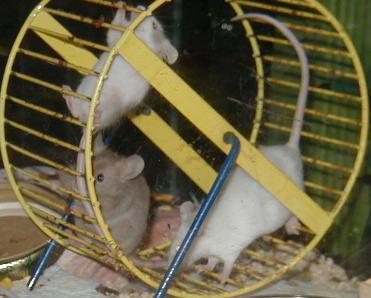 May 22 Here is a Pregnant Oroaro and her sister Moca along with a 6-7 week old daughter from the last litter Patch
 1.3 Can you ever keep males together?
