|
PROFILE
OF THE PLANTATION VILLAGE

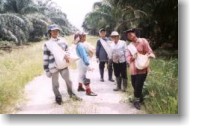 Labuhan
Batu regency consist of 22 districts , which
one of them is Bilah Hilir district with
Negeri Lama as the capital of the district.
The district consist of 2 sub-district and 11
villages, some of them are Sidomulyo village,
Negeri Lama Seberang village and Sei Tarolat
village, which are close one-another and also
an enclave plantation area. Labuhan
Batu regency consist of 22 districts , which
one of them is Bilah Hilir district with
Negeri Lama as the capital of the district.
The district consist of 2 sub-district and 11
villages, some of them are Sidomulyo village,
Negeri Lama Seberang village and Sei Tarolat
village, which are close one-another and also
an enclave plantation area.
Located
60 km from the central regency Labuhan
Batu-Rantau Parapat and 20 km from central
district Bilah Hilir-Negeri Lama, a big river
called Bilah River flow through these three
villages; with Malaka Strait as the empties
(on Labuhan Bilik, which has a small
anchorage).
To
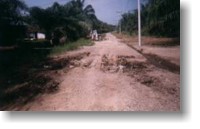
get to the village, one will need 3 hours
journey from Rantau Prapat, caused by the bad
condition of the road between Aek Nabara until
Simpang HSJ, the crossing of the public
transportation. Then, to enter the village,
one has to travel another 5 km by using ojek,
one kind of public transport.
The
bad condition of the road and the limitedness
of the public transportation causing to a high
transportation fares, to and from the village.
i.e., one has to pay Rp.5000,- from the
crossing until entering the village, which is
actually only 5 km away.
The
village located between 2 big plantations, one
belongs to PT. Hari Sawit Jaya (HSJ) and the
other one belongs to PT. SOCFINDO with oil
palm as the commodity.
|
|
 These
three villages have
almost the same patterns as other
enclave plantation villages. Sidomulyo
village, as a comparison, is 3,743 ha wide,
with 2,650 ha private plantation, 119 ha
villagers’ rice field, 37 ha villages and
937 ha others (villagers’ plantation, wakaf-
area-property donated for religious - or
community use, and Bilah river bank). These
three villages have
almost the same patterns as other
enclave plantation villages. Sidomulyo
village, as a comparison, is 3,743 ha wide,
with 2,650 ha private plantation, 119 ha
villagers’ rice field, 37 ha villages and
937 ha others (villagers’ plantation, wakaf-
area-property donated for religious - or
community use, and Bilah river bank).
VILLAGERS
The
village has population of 4,399 persons, with
762 house leaders (KK) and density of 119
persons per square, with 12% toddlers (age
0-4), 6,5% children (age 5-9), 26% teenagers
(age 10-19), 55% adult (age 20-54), 0,6 %
advanced age (age >55).
EDUCATION
 The
high percentage of people without education
(43,8% minus toddler 12% equals 31,80%) shows
how poor the education level of the villagers.
High school level
is 43,39% and university/college level
only 12,41% and even worse, some of the
villagers (0,39%) can not even read nor write. The
high percentage of people without education
(43,8% minus toddler 12% equals 31,80%) shows
how poor the education level of the villagers.
High school level
is 43,39% and university/college level
only 12,41% and even worse, some of the
villagers (0,39%) can not even read nor write.
The
low educational level related to the minimum
education facility. The village has only 1
unit of elementary building (in a very poor
condition), which built by the villagers, self
supportedly.
With
only 1 teacher for 6 classes and a very
minimum tools, the educational process can not
be run when the rain is pouring. This is due
to the leaky roof and the backup of water.
If
one would like to go on with his education, he
must travel about 15 km, which is impossible
to go by foot. On the other hand, the
villagers are so poor to take public
transportation.
SOURCE
OF INCOME
 The
majority of the villagers are plantation
laborer (55,44%) and farmer (29,95%). Almost
every farmers here are also working as
daily-labor/laborer for the plantation. From
these two sources of income, the Sidomulyo
village can be categorized as a poor village,
as a result of the low level of income for the
job (as labor/laborer and farmer). A daily
labor/laborer only get Rp.260,000,-/month or
Rp.10,100,-/day, lower than the minimum
provincial wages which is Rp.14,900,-/day.
Meanwhile, farmers also have to deal with the
high-price of farming tools, yearly flood,
plant diseases and pests and the low price of
agricultural product. The
majority of the villagers are plantation
laborer (55,44%) and farmer (29,95%). Almost
every farmers here are also working as
daily-labor/laborer for the plantation. From
these two sources of income, the Sidomulyo
village can be categorized as a poor village,
as a result of the low level of income for the
job (as labor/laborer and farmer). A daily
labor/laborer only get Rp.260,000,-/month or
Rp.10,100,-/day, lower than the minimum
provincial wages which is Rp.14,900,-/day.
Meanwhile, farmers also have to deal with the
high-price of farming tools, yearly flood,
plant diseases and pests and the low price of
agricultural product.
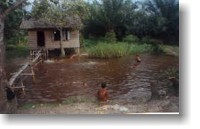
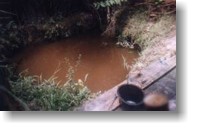
The
poor condition of the village can also be seen
by looking at the types of the houses (very
simple houses), without any clean water supply
and no convenience bathroom. Even two out of
five villages do not have any electricity.
Next
>>
|