|
BHL,
A SLAVERY
Since
1970s, the cycle of rough-workers –BHL—happened
for the plantation. The first grand-children
generation of the coming ancestor had still
became daily laborer, without any capability
–by oneself or collectively--to reach to a
better position on the plantation. As the
consequences, they keep dependent to the
plantation and they keep the poor condition.
The
arogance of the plantation seems to be
something natural, something that is no need
to be bothered. The feudalism on the
plantation turns out to be something which is
still powerful to keep the laborer –BHL—quiet,
and not demanding their rights. Collective
anxiety becomes natural because the lower
position of the laborer means power to the
plantation company. No rules. No law. The
plantation company is the law-makers. And it
happens with the backup from the state
apparatus who gained something from the
plantation company.
If
the company
fired their daily laborer, it can not
be described as Pemutusan Hubungan Kerja or
PHK (severance of work relations), because
the relations between them is slavery; the
plantation company as the master – the owner
of the full authority, of the live of the
laborer and the laborer family.
In
some cases found, daily laborer which
dominated by women, also be the target of the
sexual harassment from the plantation
watchers. Even when the laborer’s family
knew about this, they still do not do
anything.
They
think very rational even though very
un-respectful to women’s rights; that it is
better to keep silent and go on working
instead of doing a protest and end-up losing
the job.
From
a participative study held by LSPL, almost
every women who work as pesticide syringe,
complains poisonous symptoms i.e. watery eyes,
cough, itchy, headache, vomit/throw up and
some of them even died.
On
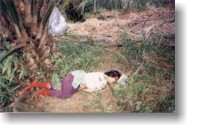
February 2001, a pesticide syringe laborer
called Suparni (age 17) died, estimated by
pesticide poisoning. It was hard to reveal the
cause of her death due to the family’s big
anxiety to run an autopsy to her body. So her
family accept her death as a faith only.
From
the health vision, this whole tragedy related
to the need of protection such as mask, shoes,
special clothes, and gloves.
Almost
all of the daily syringe laborer is not
equipped with the tools needed. They don’t
even have any awareness of the danger of
pesticide, so it will be no surprises if this
kind of case keep happening or even increase
in the future.
DAILY
LABORER, MAY NOT ALWAYS BE THE LOSER
In
the complexity of the situation, it is very
hard to find a solution. To invite the
–always lose- community needs some serious
and related effort.
Non
formal educational approach and organization
becomes the basic thing to make the community
involved and participate in gaining their
winning.
The
first step is how to devaluate their
collective anxiety through some effort to
defense and restore their rights as a human
being who really appreciate their life. They
need friends to help them, for sure.
Start
from a real action for a change in the system
of plantation, simplicity, humanity and
fairness.
To
develop collective critical awareness, in the
relation of solidarity to show that the chain
of pauperization on the plantation can be
stopped by doing a deconstruction of the
feudalism system without force.
BHL,
get together..!
Acknowledgement;
The
article was written by Poltak Simanjuntak
|












 he
plantation, and it is very limited. The
Javanese ethnic is more dependent on the
plantation due to their ancestors’
historical presence as a plantation laborer.
he
plantation, and it is very limited. The
Javanese ethnic is more dependent on the
plantation due to their ancestors’
historical presence as a plantation laborer.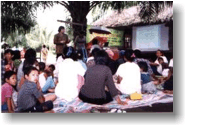 This
condition is being worse by the minimum public
facility like school, health facility and
clean water facility which actually is the
local government’s responsibility.
This
condition is being worse by the minimum public
facility like school, health facility and
clean water facility which actually is the
local government’s responsibility.