Chinese Astrology
The plot of Fushigi Yuugi is based off of actual ancient Chinese legend/mythology concerning the 28 constellations and the four beast gods. The following are exerpts from Derek Walters' "An Encyclopedia of Myth and Legend: Chinese Mythology" and Donald A. Mackenzie's "Myths of China and Japan."
Creation Myth
"Nu Kwa, a mythical empress of China, was reputed to have become a goddess after she had passed to the celestial regions...When the demons of water and fire, aided by rebel generals of her empire, set out to destroy the world, Nu Kwa waged war against them. Her campaign was successful, but not until a gigantic warrior had partly destroyed the heavens by upsetting one of its pillars and the flood had covered a great portion of the earth. The empress stemmed the rising waters by means of charred reeds, and afterwards rebuilt the broken pillar...Thereafter she created the guardians of the four quarters, placing the Black Tortoise in the north, and giving it control over winter; the Blue Dragon in the east, who was given control over spring; the White Tiger in the west, who was given control over autumn; and the Red Bird in the south, who was given control over summer, with the Gold Dragon, whose special duty was to guard the sun, the moon being protected by the White Deity of the west. The broken pillar of heaven was built up with stones colored like the five gods (Mackenzie)."
Celestial Emblems
"The Four Directions, East, South, West and North, represent the four seasons, Spring, Summer, Autumn and Winter. Together with the Center, which in Chinese is synonymous with China itself, they form the five cardinal points. The Four Directions have been represented at least since the second century BC, by four celestial animals, the Dragon for the East, the Bird for the South, the Tiger for the West, and the Tortoise for the North. Each animal has its own color: the Dragon is the Green of Spring, the Bird the red of Fire, the Tiger of Autumn the glittering white of metal (of ploughshares or swords), and the Tortoise Black, for night, or water. The four celestial animals, which have no connection with the twelve animals of the Chinese zodiac, are also the names of the four divisions of the sky. The Dragon's Heart, the Pleiades, and the Bird Star are the names of three of the lunar mansions which marked the central position of the Dragon, Tiger and Bird. As there was no identifying star at the center of the Black Tortoise, the appropriate place (the eleventh mansion) was called Void (Walters)."
The Tortoise
Colour: Black
Cardinal Point/Direction: North
Season: Winter
Planet: Mercury
Element: Wind/Ice
Chinese Name: Gui Xian
Japanese Name: Genbu
"One of the Celestial Emblems, the symbol of longevity and wisdom. It is said that its shell represents the vault of the universe. A common symbol for longevity is the Tortoise and Snake, whose union was thought to have engendered the universe.
The reason why the tortoise symbolism has been superseded by the Black Warrior as the emblem of the North, is probably due to the fact that 'tortoise' is a term of abuse (Walters)."
"In China the tortoise had divine attributes. Tortoise shell is a symbol of stability, and a symbol or rank when used for court girdles. The tortoise was also used for purposes of divination.
A gigantic mythical tortoise is supposed, in the Far East, to live in the depths of ocean. It has one eye situated in the middle of its body. Once every three thousand years it rises to the surface and turns over on its back so that it may see the sun (Mackenzie)."
Fushigi Yuugi: The beast god Genbu protects the country of Hokkan, where Miaka and the others had to travel to in order to obtain the first of the two Shinzaho. Hokkan is located in the north, where the weather is cold and wintery.
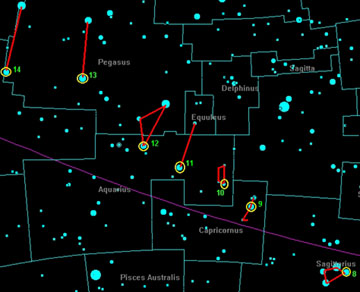
Constellations: Hatsui, Hikitsu, Inami, Namame, Tomite, Umiyame, Uruki
 The Phoenix
Colour:
The Phoenix
Colour: Red
Cardinal Point/Direction: South
Season: Summer
Planet: Mars
Element: Fire
Chinese Name: Feng-huang
Japanese Name: Suzaku
"Phoenix is used as a translation for Feng, or Feng Huang, the sacred bird of Chinese mythology. It has many miraculous attributes, but not self-rejuvenation, and does not possess the Arabian phoenix's propensity for self-immolation. It is usually portrayed as a beautiful bird, virtually identical to an ornamental pheasant. Few illustrations match its verbal description, as it is said to have the front of a swan, the hinder parts of a unicorn, the throat of a swallow, the bill of a chicken, the neck of a snake, the stripes of a dragon, and the arched back of a tortoise. Its plumage is of the five mystical colors - black, white, red, green and yellow, and it has twelve tail feathers, except in years when there is an extra month, when there are thirteen. It feeds on bamboo seeds, lives in the branches of the dryandera tree, and drinks from fountains of fresh water.
It is one of the four emblems of royalty, usually associated with the Empress. The expression Dragon and Phoenix signifies wedded bliss. In many respects its symbolism has been confused and merged with that of the Red Bird, one of the four Celestial Emblems (Walters)."
Fushigi Yuugi: The Phoenix is the god of Konan, a country in the south where the weather is practically the opposite of snowy Hokkan. Its royal attributes are exemplified in the emperor of Konan, Hotohori—an image of 'perfection' for his subjects to look up to. Konan’s people are as diverse as the many colors of the phoenix’s plumage.
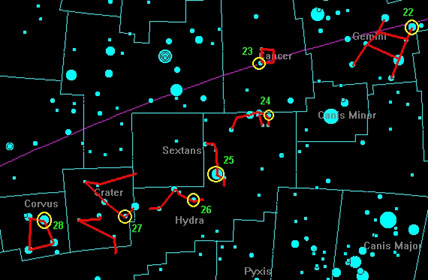
Constellations: Chichiri, Chiriko, Hotohori, Mitsukake, Nuriko, Tamahome, Tasuki
 The Dragon
Colour:
The Dragon
Colour: Green
Cardinal Point/Direction: East
Season: Spring
Planet: Jupiter
Element: Water
Chinese Name: Long-wang
Japanese Name: Seiryuu
"One of the oldest symbolic animals, stylized forms of which are a feature of the decoration of ancient bronzes cast before the invention of writing. In complete contrast to Western mythology, however, Dragons are rarely depicted as malevolent. They may be fearsome and very powerful, and all stand in awe of the dragon-kings, but they are equally considered just, benevolent, and the bringers of wealth and good fortune. There are, of course, legends of the various immortals battling against evil dragons, but such monsters would be foreign ones. Local dragons are to be respected, feared, and petitioned as one would petition a just and honest ruler. For this reason, the dragon symbol is the sign of authority, being worn on the robes of the Imperial family and nobility.
Dragons are generally considered to be aquatic, living in lakes, rivers and the sea, the larger the expanse of water, the more powerful the dragon. Nevertheless, there are dragons which inhabit the heavens, one quarter of the sky being called the Palace of the Green Dragon, in reference to the stars which in Chinese astronomy constitute the constellation of the Dragon. Even so, the appearance of the Dragon constellation is said to herald the rainy season (Walters)."
Fushigi Yuugi: The Kutou empire lies to the east. Despite the eastern views of benevolent dragons, the Seiryuu seishi (except Amiboshi) are more representative of the western views of malevolent dragons, although both depict dragons with extremely formidable and mystical powers, which the Seiryuu seishi possess.
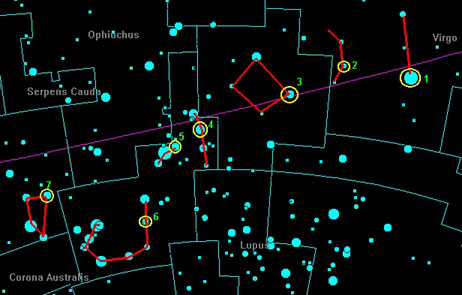
Constellations: Amiboshi, Ashitare, Miboshi, Nakago, Soi, Suboshi, Tomo
 The Tiger
Colour:
The Tiger
Colour: White
Cardinal Point/Direction: West
Season: Autumn
Planet: Venus
Element: Wood
Chinese Name: Bai Hu
Japanese Name: Byakko
"...The White Tiger of the West, for instance, is associated with metal. When, therefore, metal is placed in a grave, a ceremonial connection with the tiger-god is effected. 'According to the Annals of Wu and Yueh, three days after the burial of the king, the essence of the element metal assumed the shape of a white tiger and crouched down on the top of the grave.' Here the tiger is a protector - a preserver.
...As we have seen, white jade was used when the Tiger god of the West was worshipped; it is known as 'tiger jade'; a tiger was depicted on the jade symbol. To the Chinese the tiger was the king of all animals and 'lord of the mountains', and the tiger-jade ornament was specially reserved for commanders of armies. The male tiger was, among other things, the god of war, and in this capacity it not only assisted the armies of the emperors, but fought the demons that threatened the dead in their graves (Mackenzie)."
Fushigi Yuugi: Sairou, the country of the west, is protected by Byakko. Sairou is mostly desert, a country that has seen much warfare. Subaru, of the Byakko Seishi, was able to control time in that her spells were able to keep Tatara youthful as well as revert herself and Takoki back to their younger selves. In this way, she was the "preserver." Tatara could control plants, an opposite of metal, but he does remain behind to protect the shinzaho, therefore being the "protector."
Constellations: Amerufi, Ekie, Kagasuki, Subaru, Tatara, Tokaki, Toroki
 +Home
+Home