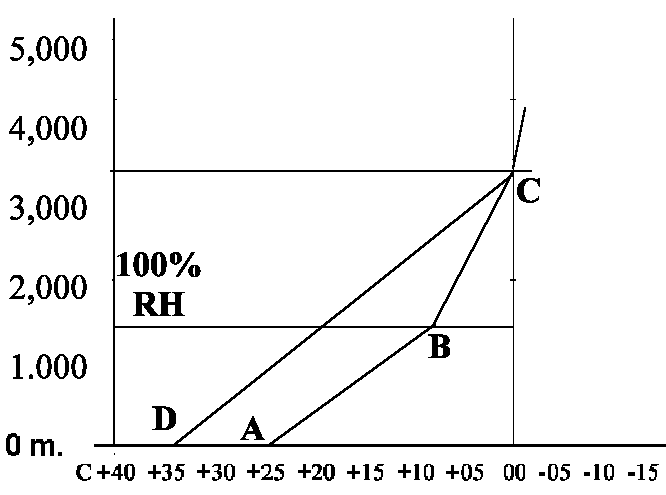
Figure 21-1 The curious atmospheric temperature rise
Frozen Solutions
Snow flakes are so delicate, so fragile and so magnificent in their being, it is as if they formed from a common master plan; each an example of Nature's absolute chemical precision. Artistic impressions do little justice to the snow crystal, failing to adequately display the magnificence of the refractions and reflections in the frail transparent symmetrical shapes. Snow crystals are not "pure white" as many artists portray them. These atmospheric gems cause the brilliance of the diamond to pale into insignificance for the time that the crystal displays its colours.
Although snow is synonymous with Christmas (a Northern hemisphere mid-winter event), many people living in the tropics and Southern Hemisphere consider the relationship an anachronism, a misnomer in the summer heat, a remnant of someone's youth in a far off distant land. In these hot regions, snow is all about, virtually all year round if one cares to look, if they know what to look for, if they know how to look and if they get the opportunity to look, but the snow is so high above. Rarely does one get the opportunity to touch a cloud until there is a fog, tornado or blizzard.
Many people would not know what they are touching, what they are feeling, or the amazing opportunity to experience this marvel of Nature's chemical precision. Often secondary events of great importance are experienced, some strange optical effects (mock Suns, lenses, rainbows, rings, etc.). These effects are linked directly to the alignment and shape of water and the atmospheric crystal structures. It is here that some very peculiar events originate such as the production of static electricity where electrons are knocked off some air molecules, only to be carried by other molecules without the immediate and obvious "electrostatic" charge effects. The entire air cell can become charged. (This will be discussed later). Some people are quite put out by such events due to fear, complacence, the lack of appreciation or understanding. Clouds are not just white fluffy things in the sky that cause rain, they are the indicators of the atmosphere's health.
The cloud is an amazing laboratory where water products (including snow) undergo many diverse processes where numerous factors in the atmosphere alter the cloud structure and form, density and optical qualities. Clouds are chiefly water, in both liquid and solid states, including very heavy ice particles. Many different crystal structures form throughout the cloud, as are the many cloud structures, such as Fog, Cirrus, Stratus, Nimbus and Cumulus to name a few. In each cloud type, differing processes give the cloud a particular appearance. A fog is a ground hugging cloud composed of tiny water droplets that can quickly saturate a person's clothing, as sleet.
With altitude the water freezes to form the snow crystal and a more complex three dimensional solid structure, hail. Another of water's crystal shapes appears over the surface of a freezing lake where wide stellate arms spread outward from many cold points, like long tentacles that cross over and under each other, weaving a strong floating fabric on the surface. Melting snow on the alpine roof runs over the eves and freezes in the wind forming icicles. The planet Earth is an amazing laboratory, a place where water can be studied in great depth over such a range of environments, existing naturally in vast quantities, in solid, liquid and gas states, in so many different forms, it is difficult to determine normality.
It must be pointed out that the incorrect concept of potential energy made the process of cloud formation seem even more mysterious, leading to erroneous explanations of snow and hail formation. The force of gravity plays such an important role where atmospheric water and pollutants are carried by moving air molecules, that under no circumstance should the currently accepted beliefs (that the atmosphere exists in a state of total chaos, in random and irregular motion) be even contemplated. This is so incorrect that it must be considered as a knowledge virus. This description of a vapour is a false and misleading belief. It can be shown that the atmosphere is highly ordered, structured and that it exhibits several forms of inertia.
The atmosphere is not a mixture of gasses, rather it is in every sense of the word a temperature and pressure dependent homogeneous conglomeration of chemicals in solution. The atmosphere must be considered as a powerful solvent, containing many molecules that will dissolve others and then there are molecules waiting to be dissolved. The atmosphere, a fluid, has the same intrinsic properties as that of a liquid. The only difference between solids, liquids and gases is the separation between molecules in the crystal structures. Despite the fact that the inert gasses are inert, they are held in solution by weak magnetic connections. This is particularly noted when normal air is liquefied to yield quantities of the inert gases. The heaviest inert gases, Radon ( Rn @ 222 amu) and Xenon (Xe @ 131 amu) are found. These atoms are so heavy, they should sink to the bottom of the oceans, yet they are extracted from normal air.
Oddly, Radon, which because of its atomic instability, should not occur, is found, yet it is attributed, by concerned citizens, to leaking Fluorescent lights. Such a claim is without justification. Consider the glass as several taught nets, through which tennis balls will occasionally pass. If the Oxygen atom is considered to be the size of the tennis ball, then a Radon atom is about the size of a soccer ball that will not pass through the net. Radon is a very large atom, and well before it could leak through the glass, Oxygen, Nitrogen and Hydrogen must leak into the vacuum and destroy the light, because these are in comparison, far smaller. Unfortunately, people are beguiled by scare mongers, preaching health concerns, when the health problems have different causes. Many breathing problems are caused by the dangerous chemicals that people keep under the sink; chemicals used for cleaning purposes.
As a diversion for a second, just what reactions are likely to take place in the atmosphere when fly spray, (Tetramethrin,d-phenothrin, piperonyl butoxide, methoprene, and N-octyl bicycloheptene dicarboximide) react with the vapour coming off the unknown chemicals in a '2-in-1' Carpet cleaner, or the vapour from phosphoric and glycolic acids used to remove the Calcium, Lime and Rust stains in the bath or sink. Some of the chemicals used for cleaning are so dangerous, that manufacturers will not refer to them on their packaging, rather they give heavy warnings in the eventuality that some of the product will be swallowed or perhaps, splattered into the eyes, or may come in contact with the skin. The prevalence of asthma related deaths is increasing. Some of these chemical should never-ever be mixed together, for the consequences are that serious; some innocent reactions in the air form poison gas, while others can turn a home into a potential bomb.
The atmosphere is a solvent, and often it promotes reaction events. The compound Graphite pencil has been in common use for around 150 years to write notes. Many historically important pencil notes are simply fading away as the atmosphere dissolves the Carbon. The Carbon hand-writing trails have left an imprint, but so too did the pressure caused by the tip of the pencil on the page. Much of the Carbon has simply vanished from the pages, leaving a faint image. Restorers of these faded documents use a subtle trick to restore the writings, where the depth of the pencil track caused by the original writer's pencil pressure can be measured with a side lit shadow 3-D microscope. The original writing can be reproduced authentically with a computer plotter-printer. The same technology has been used by forgers to create signatures and writing styles, so accurate that the pressure of each pen stroke is virtually identical to the original, making validation a mammoth task. It can be very difficult to detect a fake from the genuine article. It is necessary to be aware of this fact. There are typical indicators of a fake, the first is the chemical compositions of the paper and the graphite material. Under a microscope, modern paper is completely different to the paper used in 1880 and considerably different to the hand made papers used in 1400 AD. Again it must be said, "The researcher must know how to look and what to look for".
With many of the older style kettles, the steam rushing from the spout is optically transparent, (though there are distortions caused by the steam having a different refractive index to air). As the steam is forced away from the spout, the water vapour accumulates as droplets in the atmosphere. This is not really condensation, it is more of an mutual accumulation. Hot steam and cold air will not form a solution at this temperature differential, so the water accumulates together as small spheres of pure water. Due to the seemingly random trajectories, the distribution density and positioning of the water droplets in this form, produces an optical effect where the spheres refract and reflect light, appearing as a white cloud. In bright sunlight, when viewed from the Sun-side, the cloud can exhibit a circular rainbow structure indicating that the cloud is composed of many tiny undissolved spheres of liquid water. At the limit of the cloud, the rainbow vanishes, as do the drops of water, for in that region, evaporation has occurred.
Since the water has accumulated together and is mixing with the air, it is losing energy through magnetic contact and thermal radiation. As the temperature of the water reduces, it begins to actively attack the air molecules forming solution bonds. The presence of the water loads the magnetic fields of both Nitrogen and Oxygen resulting in a temperature drop. If the air is very dry and extremely hot (low humidity) the steam may not go through the cloud stage, rather it may be immediately absorbed into the air, instantly forming high humidity hot air.
The fact that "temperature decreases with both altitude and with increasing latitude" would best be considered as three unique observations, individually and together. In treating these, one must be aware of the Coriolis effect and the decrease in potential energy with height.
The decreasing midday elevation of the Sun with increasing latitude proves that the Earth is spherical. At the polar cap with normal atmospheric pressure, water freezes on a warm day at 0°C. The decreasing ground striking Sun angle with increasing latitude spreads the solar heat over progressively greater land surface areas effectively diminishing environmental heating. When a one metre square solar panel is used, the energy measured at the Equator is about 1 Kw per square metre. Here, it casts a shadow one metre square. The same panel when taken to a very high latitude (or at sunset/sunrise at low latitudes) still records a direct energy of 1 Kw, however the shadow across the surface can be a metre wide and 1,000 metres long.
The fact that temperature decreases with height, an effect called the adiabatic lapse rate, is something quite magical to explain since the rate depends on the moisture content of the air. With increasing altitude the water chills so its ability to hold the air decreases. The air seems dry even though the air is cooling at the rate of 5.5°F per 1,000 ft, or 1°C per 100m. This dry adiabatic rate remains constant until the relative humidity reaches 100%. Suddenly the water starts to dump itself from the air as a liquid in the form of tiny droplets, or as ice crystals. This "saturated" condition keeps the air warm, so the air gets colder at a much slower rate. In the laboratory, the saturated or wet adiabatic rate appears to be 3°F per 1,000 ft, or 0.5°C per 100m. The temperature and pressure of the air at the altitude where saturation occurs is the dew point. The water carrying limit can be reached at any temperature above freezing point. A decrease in temperature or an increase in the available water causes all excess water to dump as droplets and drops.
Tiny droplets seem to float in the air, however as drops they can fall from the air as rain. This precipitation is typical of all equilibrium reactions in Chemistry. Above the dew point, the saturated air carries small droplets altering the theoretical wet adiabatic rate to 2°F per 1,000ft, or 0.3°C per 100m. The current belief is that the energy absorbed by moist air is released, maintaining the air temperature with greater altitudes. Eventually the air temperature drops to the "current" freezing point of water for that latitude and atmospheric pressure, the snow line, where all atmospheric water dumps as ice, leaving dry air. Micro-fine snow is blown about at these high altitudes yet remains almost transparent. Above this altitude the "constant" ice temperature does not alter the air temperature so the dry adiabatic rate applies.
Comparison of the adiabatic lapse rates to the "ideal gas law" reveals discrepancies. The ideal gas law states that pressure (P), volume (V) and temperature (T) are directly related as in P1 V1 T1 = P2 V2 T2. (Note: The ideal gas law is true because both Pressure and Temperature are linear-scaled-logarithmic-functions, whereas volume is a linear function.) At this high altitude, the freezing point of water should be different to that at sea level. At standard temperature and pressure the freezing temperature of water is 0°C. When ice is frozen, the fact that the ice temperature remains a constant is a mystery. If a bowl of water is placed in a vacuum chamber and the air withdrawn, the water can freeze at normal temperatures. Such an observation points to decreasing energy as causing the cooling, where the change in energy with height is a function of the Earth's gravity.
The cloud is the visible part of a much larger structure, a convection or thermal cell. These cells are active everywhere though the cloud is the only indicator of the cell's presence. The more water held by the convection cells in a cloud, the heavier the cloud. This means that a great deal more energy is acquired from somewhere to hold and support such a tremendous quantity of water against the force of gravity. Between the clouds are invisible voids of dry and wet air. For a moment contemplate the weight of water that was suspended by the storm that dumped 25mm (an inch) of rain evenly over a small area, perhaps 1,000 Km square, or over a state the size of Tasmania or Newfoundland. The figure is awesome when one takes the weight of water as one cubic centimetre equals one gram; (a 20 cm square, 2.5 cm thick, weighs a kilogram, meaning that a square kilometre weighs 25,000,000 kg .) Equally as there are about 6.23 gallons in a cubic foot and as a gallon weighs 10 lb, then a square mile an inch deep weighs 5,385 tons. This weight illustrates that many directed little forces in Nature give rise to a substantial force.
Clouds are said to originate in the uplift regions of the atmospheric convection cells as the moist air rises above the dew line. An excess quantity of liquid water dumps on mass, to be seen as a mass, when in the cloud, it was not a unified mass, and is supported in the air due to molecular factors. The cooling air above this point is saturated and although water is still being dumped, the air in the region immediately above the cloud returns to a transparent state. It is stated that adiabatic cooling takes place in the atmosphere as a consequence of decreasing pressure and increasing volume, however the most important factor is the decreasing gravitational force which lowers the air's energy with increased height.
A fascinating effect (Figure 21-1) can now be explained. Moist air at sea level (atmospheric pressure=1,000mb) at a temperature of 25°C, rising in the convection cell (A), loses energy as it draws further away from the Earth's surface, cooling at the unsaturated adiabatic rate. Suppose the dew point for this air occurs at 1,500m (850mb). At this altitude, a cloud forms (at B). The air is rising and losing energy, passing through the dew point. The saturated adiabatic rate applies constantly as the air rises to 3,500m (700mb) whereupon the snow line altitude is crossed (at C) so that all the water under 5°C is dumped into snow and ice particles, leaving dry air containing micro-flakes of frozen water to complete the convection cell. The dry air may continue to rise in the convection cell at the unsaturated rate, reaching perhaps 4,000m (D) before starting the downward journey, dumping the ice in a cloud. Passing the snow line the micro-flakes soon melt to evaporate, however the air is now unsaturated dry air. Something very strange is taking place as the increasing energy causes a rise in the air temperature at the unsaturated adiabatic rate. When the air reaches sea level (E) the air temperature is a very warm 35°C which is 10°C hotter than when it started. Free energy has apparently come from the system.
A very important factor that must be considered here is the latent heat of condensation. At the moment of evaporation or sublimation, the air is chilled owing to the drag factor introduced when water forms solution bonds with the air. As these chemical bonds break during the condensation and freezing process, the spin up of the elprons to the more efficient molecular structures causes an apparent warming effect. This is not a liberation of "stored" energy, rather it is an increase in energy due to molecular efficiency and gravity. Heat is not really absorbed during evaporation, nor is it liberated during condensation rather an effective slow-down or speed-up of the elprons occurs, decreasing or increasing the magnetic field size and altering the magnetic resonance. Heating changes occur after each event.
For any molecule the energy change is dependent on the molecular atomic mass and the force of gravity at that position with respect to the radius and mass of the primary gravitational body (the Earth) and the altitude above the surface (an inverse square law effect). Nature has mechanisms and it is through understanding these mechanism that the innermost workings of the energy-forms will be realized. Gravitational forces vary with the square of the distance, so the energy must decrease with increased altitude as the square of the distance. The energy differential has increased, because the energy has decreased with increased height. It is possible to illustrate the reasons why the water molecule (atomic mass 18) remains warmer longer with increasing altitude than does Oxygen (O2 @ 32), Nitrogen (N2@ 28) and Carbon dioxide (CO2@ 44).
(Note:In normal conditions, the atmosphere stratifies into altitude sensitive layers due to eddy cells and the Coriolis effect. The air in these layers varies from dry to wet air and often moves in different directions to the surface winds, as well as varying from normal conditions to those of an atmospheric inversion. This layered structure creates all manner of friction events, including the production of infrasound. Often not seen is the thermal boundary between layers, until a distant object on the horizon is viewed from the top of a tall building with a telescope.)
Water vapour is perhaps the most active ingredient in the air. It is directly responsible for many strange atmospheric optical effects. Evaporation of water is an interesting process where surface molecules of liquid water attack atmospheric molecule. In attempting to dissolve air, it is very likely that the water molecules will break away from the main water mass, altering the surface packing density. As the larger air molecules race to fill the gap, the physical disruption allows solution bonds to form where water molecules attack and modify the fluid crystal structure of air. The coterie gap of Oxygen, although filled with two Hydrogen atoms presents a magnetic field structure capable of aligning the air to seek out free water and other compatible chemicals. At the point of cloud formation, O2 , N2 and H2O molecules form a crystal structure which will not accept any more water molecules at that energy level. Excess water forms micro-droplets that are held between the air molecules as part of the fluid crystal structure of the atmosphere, and it is the abundance of these refractive-reflective droplets which make the cloud.
Water is a liquid crystal, and as such the crystal shape depends on the prevailing conditions and the available energy. Chemists view water as having a "Y" shaped structure, where the two Hydrogen bonds of one atom with their positive valencies are attracted to the back of other Oxygen atoms due to its double negative valency. This explanation was developed and accepted around 1960 with a new model for liquid water (this structure not realised before that time). This model fails to predict snow's crystal structure. The theory may seem very logical, but when the atoms involved are animated, the snow crystal conclusively disproves this linear "Y" shape interconnection between molecules. The Mechanical atom places both Hydrogen atoms in a temperate zone coterie ring, off-setting this position from the centre of the Oxygen atom. In the atomic centres were all located on a plane, the shape would show an off-set "L" nature.
The "accepted belief" is that the snow crystal grows around the impurity at the central position. The snow crystal itself tells several different stories to form the three fundamental snow structures. A snow crystal exists as a six sided star, where each arm is identical in that crystal but different to almost every other snow crystal. It is far easier to picture water's coterie gap as forming an "E" shape with Oxygen's Hydrogen filled coterie gap (figure 21-2) and the magnetic spill fields. To look at a water molecule, the Oxygen's coterie ring produces a field that must jump from the Oxygen atom's first gap field to the Hydrogen atom, (so there exists a N-S field on one side of the Hydrogen atom,) and a second N-S on the other side of that Hydrogen atom, strongly linking the Hydrogen at both ends to the Oxygen coterie. Then, there is one of Oxygen's coterie elprons, and the second gap, where the same direction of magnetic structure will apply with the other Hydrogen atom. The water molecule and the surrounding magnetic field must be viewed as a three dimensional structure, where it has the N-S+N-S and N-S+N-S magnetic field wings that will cause the molecule to do some odd things in connecting with other matter. As the two Hydrogen atoms are located so close together, another spill-field is formed, giving rise to Oxygen's "E" shape field. So, to examine this region, the off-set fields would be seen as jumping across the gaps as
On the other side of the Oxygen, the coterie is stressed, so it can form another gap field, effectively giving the "Y" shape illusion when stressed with an additional simple N-S field.
The water can now freeze into specific crystal structures as inward and outward facing connections. The inward form presents the apex facing the centre, while the outward form grows with the apex facing away from the centre. The third form is made from a combination of inward and outward structures. The growth of the crystal depends on the amount of water available, the means of cooling and any external catalysts. The air is the key to this mystery.
Having reached a super saturated condition the rising air-water crystal enters the condensation region rapidly forming bonds with itself and solution bonds with other impurities creating larger drops of dirty water. Irregular particle size, spacing density and optical properties of water droplets give the cloud its fuzzy physical dimensions with no definable boundaries. The cloud's colour depends on the level of impurities carried with or dissolved in the water droplets. Grey clouds show dirty water. This air cleaning and purification process also removes much molecular pollution such as meteor trails, solar debris, soil, dust, volcanic ash and rubbish resulting from human enterprises such as airborne waste, cleaning fumes, smoke and photo-chemical smog. It is here where acid rain is a guarantied product when molecular oxides like CO2 , SO2 , SO3 and NO2 dissolve in water. Some of the chemical reactions that take place in the rain and the cloud are not what one would call "environmentally friendly".
The best description possible for the atmosphere is the term "a solution". Some have used the word "solvent" however in light of the facts, this seems a little premature. Astronomers often call the atmosphere a "pea soup", which is perhaps the most definitive description owing to the "seeing conditions". It is here where the atmospheric pollution is noticed. In most cities around the world the night sky is fading away. In the city of Sydney in just 20 years, the naked eye view of the stars has dropped 1.75 magnitudes, a noticeable change. By 2032 AD,at this rate, the only visible star in Sydney will be the Sun. Perhaps the best description of the atmosphere is "the city dump".
The cloud only indicates the presence of a convection cell. It does not indicate where it will actually rain. Rising moist air loses energy causing condensation as a mist creating an apparent sudden flat base for the cloud, of constant altitude in the convection cell. This cloud is forming in the updraft side of the cell, not just from the mist, but also the dirt, dust and atmospheric pollutants giving the cloud-base a grey colouration. With altitude, the convection cell loses energy and begins the downward path. As gravity increases with decreasing height, the downward journey of the convection cell increases the energy causing the ice to melt suddenly, and the water to evaporate. After several circuits around the cloud, the water drops are of a relatively even size. The pollutants like oil and petrol vapour carried in the cloud may not always be absorbed by the water, rather they may be washed out of the convection cell at a much later stage in the cloud's life.
One contributing factor to acid rain and pollution is mankind's need to dump waste products like Carbon dioxide, Sulphur Dioxide, Nitrogen Oxides, Chlorides and general chemical smoke into the air. These gasses simply dissolve in atmospheric water forming a range of messy powerful acids. The impact on the environment in the long term is not recognized. At the moment, the effects are seen on the land where acid rain kills fish in lakes, trees, plants, worms and insects; the acids erode buildings and corrode metals. Rather than attacking the source of the problem and fixing the processes, humanity's primary objective seems to be, to progressively return the atmosphere and the oceans to a primitive state. When Australia demands an increased CO2 quota, one must wonder about the impact that the decreasing use of fossil fuels will have on Australia's economy, especially since most Australian electricity production is derived from fossil fuels.
World-wide, the production of steel, cement, gypsum, bread and alcohol results in the liberation of massive quantities of carbon dioxide. Electricity generation and transport requires burning fossil fuels produces Carbon dioxide and Sulphur dioxide and Sulphur trioxide. Carbonic acid is simply Carbon dioxide dissolved in water. Sulphur Trioxide dissolves readily in common water to form Sulphuric acid. Why does humanity need to pollute this planet to such an extent that the great grandchildren of the child born today may not have a very breathable atmosphere, may not experience a forest, or even to see the stars at night? People who advocate dumping these chemicals in the air, cite the fact that in 150 years of the Industrial Revolution, the increase in the amount of CO2 in the air is insignificant, less than 1%. This is because very cold water dissolves CO2 and dumps the acid in each rain storm, not just on the land, but also in the oceans. Drastic action must be taken soon before it becomes too late and a folly. The action needed demands the total replacement of all fossil fuel dependent generators and transport systems by 2020, at the latest by 2040. A method of chemically combining CO2 and other acid forming chemicals into something useful must become an important research concern. Nature did it by creating limestone. The modern motor vehicle uses a catalytic converter to take one valuable waste product, convert it into another, merely to dump the exhaust chemicals into the atmosphere. In 200 years of industry, the evolution of the atmosphere has been reverted by over 100 million years. This degradation figure will be confirmed later when the historical composition of the atmosphere is reviewed. The story of mankind's willingness to pollute can be traced to inertia, where the powerful adage is applicable "As we have always done it that way, we must continue to do it that way."
The cloud becomes visible due to random reflections and refractions of light. Above the cloud, the saturated air moistened by evenly sized micro-droplets remains transparent. An uplift wind presenting a distributed force less than the weight of the drop is not capable of supporting the drop, so a form of rain precipitates through the cloud that evaporates with decreasing height due to gravity's increasing force. A greater distributed uplift force pushes the droplets to higher altitudes. As the size and spacing density of the droplets becomes more uniform, the optical transparency increases.
Clouds are quite transparent. In a light fog, the visibility may be 1,000m, while a heavy fog may reduce the visibility to a metre. Radio waves, most microwaves and Infrared pass through clouds and fog. At night a thick cloud may obscure the Full Moon, leaving what appears to be a glow in the sky. With a suitably large diameter telescope (10 inch) is pointed at the lunar sky glow, the view through the eyepiece reveals the Full Moon at a very comfortable illumination. The cloud filters out much unwanted light. (Note Well: the Moon is a very bright astronomical object so great care should be taken when observing it. The Moon's brightness when viewed through a large diameter short focal length telescope can be so concentrated during clear sky observing, that it may cause temporary or permanent blindness.)
Saturated air at high altitude is different to the saturated air created in the shower recess of the bathroom or in a laboratory due to the stronger affinity of the water droplets to air borne water. The low mass and small surface area of the water droplets creates a better coupling to other water molecules. This also means that the Oxygen and Nitrogen molecules in the air present a more efficient coupling, giving them the ability to hold their temperature without losses to the heavier water molecules. Subsequently, the energy change is much lower than saturated or dry air, effectively lowering the adiabatic lapse rate to a rate better than saturated air in the laboratory. The laboratory saturated adiabatic lapse rate of 3°F per 1,000 ft can be lowered below 2°F per 1,000 ft in the real world, due to the energy difference effect between the altitude of the laboratory on the ground and the altitude of the effect. In rocketry, this saturated region of the atmosphere is also called the zone of maximum turbulence. Any rocket, aircraft, projectile or meteor travelling through this zone of clear air, causes an immediate vapour trail in the wake, due to the atmosphere's crystal structure being shattered, forming regularly sized, randomly spaced droplets, abnormally reflecting and refracting the light, to appear as a dense cloud.
Water's capacity in the air normally follows all the chemical rules for equilibrium reactions, especially in the laboratory, however in the atmosphere, the capacity is dependent, not just on temperature and pressure but also on water's own presence. Above the dew point, water is seen to apparently dump itself from the atmosphere with decreasing energy while forming larger liquid micro-droplets between the molecules in the air. Although these micro-droplets link and combine due to water's affinity to itself and to the air about, they fall to lower altitudes unless pushed higher by a convection cell. With many freezing-thawing cycles, the increasing height slowly removes very active dominant chemical impurities increasing water's purity with height.
Progressive freezing, thawing and evaporation in the cloud gives rise to a mixing process, where similar impurities are attracted together in water solutions. Increasing altitude and lowering atmospheric pressure raises water's freezing temperature. The remaining impurities will soon act as external catalysts in the formation of snow and ice. Dissolved impurities lower the freezing temperature, but such impurities are often discarded on freezing. The longer a crystal takes to grow, the larger the crystal should become. Conventional thought points to the belief that as the saturated air reaches water's freezing point, molecules of water begin to link together dumping ALL dissolved matter including the air. Water links with water in the purest form around impurities still held by the air such as dust and soil, impurities soon to become the snow core.
The impurities have a role to play where unexpected things happen. Stemming from Oxygen's coterie ring, the three intensely powerful gap fields emanate from the water molecule's coterie layer (shown in cross-section in figure 21-2) thereby establishing the plan for the basic star shaped crystal, created by the ring of "E" shaped pieces. This does not mean that water dumps all the impurities or that the water is dumped. Oxygen becomes the chief shape generator of all water crystals where the Hydrogen filled coterie gaps effectively creates three pole concentration points or in the frozen state two or three sets of "E" structures from each molecule. When Oxygen forms the O2 molecule the alignment of the coteries force an inverted axis situation (as illustrated). The position of the coterie in relation to the elpron rotation gives water the Dr. Jekyll and Mr. Hyde potential, even when frozen solid. The subsequent packing of the water molecules in the various crystals structures are modifications of the Water (Oxygen) structure. The bond length and crowding situations are greatly different between the various structures in each of the following forms, the liquids, the solids and the gases. Each structure is a three dimensional construction, the shape being dependent on the energy of the system, the source of the water, the bonding mechanism and the spacing between molecules. Figure 21-2 uses some strange symbols to identify the water molecules as either lollipops or the distorted "S" or "Sigma" like symbol. The lollipop is edge on while the "E" is the cross section. Each represents an individual flat water molecule coupling together in many unique structures, of which only three are illustrated. "Linking" is a three dimensional construction above and below.
With the formation of snow, the magnetic field size, shape, strength and resonance give the water molecules an affinity to link up forming a tight molecular core. As water molecules freeze, the air solution is modified. Water's ice core grows suddenly. Air molecules are attracted to the hexagonal core (one of three concentric hexagonal structures). Nitrogen and Oxygen molecules in the air are still held by the water molecules (vertically above and below the crystal plane) as the path of least resistance is for the water attachment, along the plane between the air molecules. The off-set water bonds form on a flat plane as a sandwich between the air molecules in an air crystal. The air and those impurities collected by the atmosphere attempt to stay with water molecules as the water freezes, locating the water into linking layers of air. However the position and spacing of water's bonding points as a function of radius from the centre cause an interference pattern. Think of an annulus where each molecule has length and the annulus of constant thickness. As each annulus increases in radius the value of pi ( p = 3.14159) produces some interesting spacing and positioning irregularities with Nitrogen and Oxygen, so each ring gets "out-of-step" with the previous". Most snow crystal reflect this simple construction problem in their build, forming the six sided stellate crystal. Water's magnetism makes this happen very rapidly on the flat plane between the air layers.
The impurities (including Nitrogen and Oxygen) run down each side of the crystal, attracted to and attaching themselves in the crystal growth process that forces the snow crystal to grow flat. These active catalysts and the air molecules involved are often overlooked. The "mix" of impurities gathering around the core and in parallel layers to the water plane turns the plane into a layer called the "water of crystallization", where the snow crystal is no more than a water layer between the layers of the air crystal. The air molecule's cleavage plane is the plane of the snow crystal. The snow is easily crushed owing to the immense amount of air caught in the air-water-air crystal structures. Drawn to the water's magnetism, the air crystal forms as atmospheric gasses gain entry to the water molecules above and below the water plane. Many impurities run the gauntlet as the crystal grows in forming an object of fractle geometry, where the spacing and eventual shape is established by the geometry of the air and impurity matrix. The snow crystal is a pure water layer existing between the air layers. While the air crystal is growing, the linking mechanism pulls at and aligns other water molecules into the upper and lower layers, growing a thicker crystal on the flat plane. It is here where impurities can be captured, existing in an air layer above and below the water plane. The shape and the thickness give rise to precise angular arms and the source of the very magnificent optical effects seen under magnification in the crystal when light reflects and refracts in the thicker ice. The speed of the flat plane crystal development is very rapid while that giving the crystal its thickness is very slow. When fresh snow dumps collectively as a mass on the ground rarely is the snow crystal recognisable, nor do they show a layering or stratigraphy. Pressing fresh snow causes a peculiar sound as the air is pushed from the structure. Sometimes, individual crystals can be seen stuck in tree branches.
Dissolved salts and gasses do not need to become the primary impurities in the creation of atmospheric ice. The belief that snow crystals grow around the primary impurity can be seen to be quite invalid because the snow crystal structure shows a common blueprint where the water hexagonal core is the fundamental building block between the air molecules. Each core consists of only six water molecules. This core does not need to surround any impurity, rather the impurity assists in linking the core to the air molecules of the air crystal structure, and it is this relationship that establishes the blueprint for the final structure. The snow crystal is subsequently the visible layer between two frozen air layers, showing the air's water-of-crystallization layer. The air holds the impurity, and gives the crystal a protective cushion.
It is difficult to freeze any water based solution owing to water's apparent dumping policy. The lower energy causes a decrease in the elpron's rotation decreasing the effective magnetic field strength. No longer can the water support the closest packed liquid crystal, so the crystal restructures itself to maintain an efficient magnetic circuit. In dropping such links, there is a physical change in volume, where the crystals lose the air links, reconfiguring the crystal shape as a water crystal in a three dimensional closest packed solid, making the more dense hail stone.
Snow uses a three link structure, (one air above, one water in line, one air below). Hail stones form a two link structure with both links offset, a water above and one below forming a hexagonal crystal matrix without air. To increase the concentration of alcohol in wine or the acid in vinegar merely involves slightly freezing the liquid and removing the ice as the water freezes at a higher temperature. This will not separate all the water as is demonstrated by freezing a substantial quantity of Black vinegar in different containment vessels. As the ice freezes on the sides of the first containment vessel, the simple task is to remove the ice and place it in a different containment vessel where the ice can melt. This is frozen and the same process continued to the next vessel. Some black vinegar is captured in the ice each time. An interesting observation here is the apparent deposition of darkest ice in the frozen material. This does not occur in the final concentrate, rather it occurs before the clear acetic acid concentrates, identifying that the black material has more affinity to the water than the clear acid. This is an arduous process resulting in a more concentrated black vinegar and a very diluted brown vinegar.
The dissolved atmospheric impurity may be dumped by the water, but this in turn influences the structure of the air crystal. Since each air crystal is different, the snow crystal's growth is modified by the air crystal. Oil fumes and the like hitchhike in the air molecules, and modify the layer of crystallization. Due to the inward and outward facing water molecules, the natural point of least resistance, causes the crystal growth to seemingly go through a shape flip. Alternately structured cores are very rare. Water's powerful coterie poles influence the resultant structure as the frozen core begins to drag other water molecules from the chilling atmosphere, rapidly growing massive flat crystals. To grow an equivalent sized crystal of Copper sulphate, NaCl or Sugar may take several months. During the snow formation process the fractle geometry develops bridges at precise mathematical distances from the core's centre, as if the positions of the break-out points were preordained. These bridges are replicated over and over again, soon filling the core, pushing the arms rapidly outward. The bridges meet but they don't join, rather they diverge creating new arms between the six major arms. Typically, the whole crystal grows at a rapid, but uniform rate from the centre. The air-water-air crystal structure is modified by the out-of-step arrangements, not just for water, but for Oxygen and Nitrogen giving rise to the many structures with the same basic choice of three blueprints.
Damage can occur during this growth stage owing to turbulence, where striking obstacles like overhead wires, twigs and leaves can snap arms off the crystal. The arm can continue to grow as if it is part of the whole crystal, forming a classic "Christmas tree" shape. The air crystal is still present above and below the plane of the ice layer, so that the stump grows new arms and another core, for the air actively seeks out other free water molecules. The size of the snow crystal is limited by many factors, such as wind strength, available water molecules, rate of temperature change, the duration of the chilling and melting cycle.
Amazing events occur when the air temperature drops below -40°C. This is a dangerous environment for it can snap freeze the lungs. However, steam rising from a boiling kettle freezes in the air forming instant snow flakes that fall to the ground. This event is something which every person interested in Science should experience at least once in their life time as it is a beautiful statement in Nature's world showing the perfection in the relentless precision of the atmospheric chemical bonding. In this very cold environment, to use a water pistol, is an interesting experience because the fine water jet vaporizes into snow.
Nature makes no guarantees as to when and how much snow is deposited. Many enterprising entrepreneurs treat snow as big business, where the benefit of tourism is the massive financial gain. Artificial snow is manufactured on site in the off-season, to pack out and make a bad season better, to make a more even snow cover. The look-alike artificial snow is similar but does not have the magnificent quality of the snow crystals made in the storm cell. Special chemicals and proteins are mixed with water to increase the melting temperature by as much as 35°C, allowing summer skiing on even the hottest day at sea level but this is not real snow. Artificially grown snow crystals are very consistent in shape and form. Artificial snow is made by spraying a fine mist of water with specific impurities into super chilled air, just as did the water pistol. The reaction of these impurities to the environment establishes another pollution question.
With increased energy due to decreasing height, the larger crystals warm, melt and evaporate sooner than the smaller crystals with the consequence that snow and rain can fall together from the one convective cell. The wind temperature of the vertical downdraft is increasing due to the air's increasing gravitational energy. At low latitude and altitude the difference between the dew point and the snow line is very great, allowing a great deal of water to mass above the cloud. The zone of maximum turbulence is the reservoir for the storm cell. With tropical evaporation of water from the oceans the reservoir becomes very thick as there is such a great distance between the dew point and the snow line. This layer decreases in thickness as latitudes increase. In the temperate latitudes a second type of ice crystal, the hail stone becomes a worry. With each journey around the convection cell (and it might be millions of times), progressive cooling, freezing, thawing, and evaporation takes place. If the water drops fail to evaporate and cool rapidly and evenly as the air rises, the rate of climb, the prevailing wind speed, impurities and the available water, form a different crystal structure. Water drops are normally spheroidal in shape, yet the "pure water" hail stone has flat surfaces with 60° and 120° angles between the surfaces. Often these merge together to form "golf balls" or "giant eggs".
The hail stone is not directly made from the precipitation of water vapour, rather a complete rain drop freezes into a three dimensional hexagonal shape. As the water rises, the lowering gravitational feedback causes the water to rapidly freeze. As the stone drops, the increasing gravitational feedback warms the stone evenly causing it to change from a solid to a liquid instantly and uniformly. This is different to the conventional belief of it slowly melting and refreezing. As a consequence, the size of the rain drops become more uniform. As the stones increase in mass, they can exist at lower altitudes and may strike the ground. It is amazing at this time to watch a large hail stone melt, for they take so long, yet in the cloud's environment, the changing energy levels with height cause a sudden melting and an equally sudden freezing irrespective of the air temperature. On a hot November day in Sydney, where the air temperature can be 34°C, a thunderstorm may approach the sweltering city from the west and announce its arrival with a dramatic hail storm on the higher western suburbs, however in the deeper valleys, no hail is experienced, although the difference in altitude may be a hundred metres. This illustrates the sudden changes that gravity causes.
Rapid exposure to warm updrafts partially melts the hail stone faces. With uplift and decreasing energy, the attraction of the hail stones causes them to align, and magnetically reposition themselves, freezing together with height building larger hail stones, as a cumulative addition process, into a tight ball of identical aligned crystals. This shows that the hail stone is not a random potpourri, rather a totally organized crystal structure. Enormous blocky spherical balls, some as large as 10 cm diameter have been recorded, that is about 500 ml of water, half a kilogram! When such a mass falls to the ground, it indicates how powerful the winds in the clouds must be, to have held that mass and the masses of all the similar sized hail stones in the first place. These monster hail stones, (composed of perhaps 100 or more smaller hail crystals) melt at a greater height than the smaller crystals. This is quite the reverse effect to that observed on the Earth's surface when a block of ice and an ice fragment are taken from the refrigerator. Within minutes, the fragment is a pool of water, while the block simply takes "forever" to melt in comparison. This fact indicates that the melting has a direct link with the change in gravity, not the air temperature.
In the refrigerator, liquid water takes on the dense closest packed configuration. Freezing the water modifies the molecular linking, resulting in structural changes. The closest packed arrangement is not the most efficient magnetic path. At a temperature just above freezing point, water alters the molecular arrangement, decreasing its density, properties and molecular alignment, to a more efficient shape. The unlabelled chain at the bottom-centre of figure 21-2 illustrates the difference between liquid water and an ice matrix. The liquid, although closest packed, allows a great deal of movement in any direction, while that of the less dense ice matrix is locked in place, causing it to fracture when stressed. The density of snow is far lower than ice because the water is locked between air molecules, giving it an open structure and making it very brittle to touch as the air is forced out of the chain structure.
The ice chain suggests that ice should have possible cleavage planes, but that is only true in the hail stones as the layers in hail are magnetically linked, however the ice on the surface of a frozen pond, or when water is frozen into an ice-block forms an interleaved crystal. This is where stellate arms grow and weave a web over and under other arms creating a strong surface devoid of cleavage planes. Any attempt to cleave the crystal will shatter the ice.
There is a big difference between hail and ice formed on the Earth's surface, a big difference between atmospheric ice and that made in a confinement vessel. A strange effect is noted when someone makes the common ice block in a freezer, simply by freezing the water. The surface and sides of the bowl immediately lose energy, starting the growth of linear ice crystals which weave a strong surface. In the "Ice experiment" (Chapter 2) the electrodes were put into baths of both distilled and salt water solution to be frozen solid. Well before each bath froze, as the surface began to develop an ice skim, the Copper conductors were removed for a brief moment to examine the crystal structures growing on them. These structures are completely different to that seen in the hail stone. The presence of the Copper conductor has introduced a completely different mechanism to affect an altered molecular alignment of water. Far more radical crystals are produced by the salt solution, for the Copper and Salt have a major influence on the resultant crystal shape. This is important to observe for the magnitude of the crystal change challenges the concept of impurities forming in the snow crystal's central core.
A mass of contained water (such as in a bucket, pond or lake) freezes from the contact zones (the surface / sides/ base) through differential cooling (where energy is transferred through convection currents). Contact zone or surface cooling (such as on the top of a pond or in the refrigerator) introduces many different processes that alter the freezing mechanism, the eventual crystal shape and the density of the ice formed. The colder regions freeze, so the ice crystals grow from the cold contact zones to the liquid's warmer region. Gravity, convection cells, impurities and the confinement vessel's shape all play important roles in changing the molecular matrix of water to that of ice.
The purity of distilled water is very difficult to maintain owing to water's affinity with the atmosphere, dissolving air on contact, and itself being dissolved by the atmosphere. If distilled water develops an opaque ball of bubbles at the centre of the container on freezing, tricks can be applied to slowly rid the water of the air. This can be done using a sealable extra clean plastic bottle where the liquid is frozen and thawed several times. As the liquid expands, the cap is loosely fitted so that some of the water can be expelled as the water expands into ice. Having frozen the water solid the top is then sealed and the solid left to thaw, creating a partial vacuum in the bottle. It is necessary to add a little more distilled water during the final stages of freezing to displace the air, but in so doing this may add more air to the water even if one takes the utmost care using a syringe. Each time the air is frozen, more air will be expelled from the "distilled water" in the very last stages as the water freezes. As the optical qualities of ice are consistent throughout the container, it is possible to mould an ice lens in a large watch glass. Although highly impractical for any long term use, ice lenses can introduce some fascinating Physics experiments showing students that a magnifying glass made from ice can be used to focus the Sun's rays and burn holes through a piece of paper. While frozen, the refractive index of ice can be measured. This can be used as a novel introduction to optical theory.
This air removing technique illustrates a totally amazing effect, the striation bubbles in the clear ice when the water dumps atmospheric gasses. As liquid water become solid crystals in the ice block, the ice crystals grow forcing the gasses and other impurities into the remaining liquid water. In aligning as a solid, the water molecules actually take-up more space due to the change in linking. The air molecules no longer have the magnetic resonance to be supported by the water so the gas is dumped, forced into molecular bubbles which can become trapped on the edges of some crystals. As the gasses accumulate together they are compressed by the growing ice crystals forcing these to rise to the surface into linear bubbles. The compressed bubbles under the surface are trapped by the frozen surface, however the gas pressure may be so great that the surface bends and fractures. A close look at the individual hail stone crystal reveals the total absence of these compressed air striations. Ice found on mountain tops, in glaciers, inside a refrigerator, at the North and South pole all have compressed air striations, but not in the hail stone crystals. This is absolutely fascinating because it shows that the freezing was sudden and uniform from the centre outward, where most of the air and the impurities were expelled prior to the outer layers freezing. This is the reverse of normal freezing in the containment cell.
As the air is chilled condensation occurs. The simplest method of drying air is to freeze the air flow, forcing a zone of condensation at a specific point. The cooling process demands removing energy from one system and transferring this to another system, where it can be released as magnetic radiation or some other energy form, perhaps even used for some beneficial process. Today's refrigeration processes involve pushing a great deal of energy into the system to remove a little energy from the system. The classic example of this is the modern home air conditioner which may run at 2,400 Watts. Industrial air conditioners are a greater energy drain. These systems use a forced evaporative system involving pumps, fans, coolers, heaters and blowers. The same can be achieved quite effectively using a much bigger system and less than one hundredth of the power using the principles and mechanism devised by Baltzar von Platen and Carl G. Munters, where a small amount of heat is used to effectively freeze a large volume. Many of these early refrigerators were gas powered, running totally from the energy released by a tiny pilot flame. These refrigerators are not satisfactory in the modern world, since such equipment is too dependable, for the systems rarely brake down, require little or no maintenance and use very little energy. The coolant is alcohol. Unlike the modern air conditioner and refrigerator the design of the heat-cooler did not evolve any further since it has been successfully shelved in this hypocritical "energy-efficient" world.
As the hot steam from the bathroom enters the cool of the house the water begins to precipitate, but rather than settling directly to the floor, as "hot air rises" it journeys along the ceiling, condensing on surfaces above the dew line. The liquid water attracts other water from the air, so more water accumulates on top of previously precipitated water. If the house is poorly ventilated, water will be seen running down the walls. A simple experiment can be performed in such a poor environment where one deliberately sprays cold water as a strip across a hall way leading from the bathroom. The strip needs to be about 40 cm wide running up the walls and across the ceiling. As the steam exits the bathroom, it reaches this strip and starts a rapid dump. Very soon the carpet on the floor will be soaked as so much water is dumped here. All the preliminary part of the experiment did was to give the water a prepared path to the floor.
The atmosphere plays some more fascinating tricks with water. Convection cells can be quite massive, in fact the downward track may take place in a "blue sky" situation far removed from the cloud. The cloud's base indicates the position of the dew point only. It is not the convection cell's base. The convection cell can extend to the ground. Water drops and hail take a great deal to deflect and maintain in the convection cell, so the rain and hail continue past the base and perhaps into regions well removed from the base of the cloud. The romanticist can truthfully write about the softly falling rain, but what causes the rain to softly fall? A single drop of water falling from a high place will strike the ground with an impact from the acceleration due to gravity. Often in the city, drops of water fall from cheap air conditioning units on the fifth floor. When struck by such a drop, one experiences pain. Yet in the rain storm, the rain drops fall slowly, at an almost uniform speed. Obviously, to suspend the rain, a deflecting updraft is needed to avoid the impact energy of Niagara falls in a gentle storm. Similarly, hail stones would be virtual ice bullets as they hurtle downwards at speeds greater than 150 Km/h causing absolute devastation, but this is not experienced in most storm events. Hail is savage enough at speeds of just 20Km/h. This slow speed of golf-ball-hail can be confirmed photographically. The golf ball hail often bounces to heights of 1 metre, but does not to shatter which high speed events would cause. Convection cells form the key here, for when there is a downdraft in one cell, a sympathetic updraft occurs in the normal situation creating a dual flow between the dropping rain and the rising air. This is very similar to the electric field's dual movement where the vertical down motion causes the rain storm to separate into rain curtains.
Perhaps the most outrageous over-simplification and dreadful explanation often used as the ultimate reason is "hot air rises and cold air falls". In the correct situation, it can be used, however it is often attributed through laxity to many things which are just not true. Often its use illustrates a total lack of appreciation of Physics and Chemistry in the atmosphere by the person making the claim. Why hot air rises is a question in itself, but not the answer to the turbulence in a dust storm, a thunder head, a tornado, or a cyclone. These powerful wind storms and cloud structures all deal with the rotational effects resulting from this planet's motion and the Coriolis effect. Even the height of the cloud and the change in energy with altitude are subject to rotation caused by changing altitude, with respect to the Earth's motion, hence, the higher the thunderhead, the more the rotational effects, and the more dangerous the storm becomes at the base. If this thunderhead is grazed by the jetstream, the power of the tornado on the ground is awesome.
The atmosphere is far from homogeneous in terms of solar heating. If the Earth were stationary like Venus (was assumed to be), always facing the Sun, the noon day point (that closest to the Sun) would the point of the continuous updraft. The midnight position would be the point of the permanent downdraft. The wind travelling across the surface on the terminator (the limb or zone between day and night) would always travel to the hottest region, so this would be a cool prevailing wind, always with the same wind speed no matter what latitude. At an altitude of about 1,000 metres, the wind direction would be in the reverse direction and incredibly hot, perhaps so hot that no clouds would form. Naturally occurring materials like Lead and Sulphur would melt in the atmospheric heat, perhaps contaminating the atmosphere to form chemical clouds of leads and sulphides, perhaps sulphuric acid. As the hot high wind travels into the night, condensation would occur forming normal water based clouds, however as this water attacks Sulphur, the result would form a Sulphurous acid rain at the midnight position. The convection cell would create an atmosphere much deeper at the Noon and midnight zenith positions than on the terminator (without considering tidal effects). The resulting chemical clouds would then return to the Sun side of the planet. Venus would not be a very nice place to live.
With rotation, the hot spot is shifted well past the noon position. In the case of the Earth, it is about 13:30 to 14:30 position in the afternoon (1:30-2:30 PM) solar time. The rapid rotation of the Earth and the gradual loss of atmospheric heat forces the cold zone to be about an hour before or after dawn. The resultant weather cells of the Earth chiefly move towards the East around the planet. There are some minor geographic alterations caused by topography and the Earth's inclination to the orbital plane. The atmosphere is subsequently travelling faster around the planet than the planet's axial rotation.
There is another air motion to consider. If a line joins the Earth's Equatorial hot zone to the cold zone over the poles; this line travels in both directions and does not go over the poles directly, rather it runs to one side of the poles which due to the Earth's inclination changing with respect to this path during the year makes the hottest and coldest months February and August (depending on the hemisphere), a point that will become obvious shortly. The result is that the atmospheric polar region is offset compared to the tropics and diagonal cell motions.Air heated at the tropics rises and begins travelling to the poles at a high altitude, dumping its water as clouds and is already travelling faster than the planet, further racing ahead of the planet due to the Coriolis effect. This wind does not reach the poles because the Coriolis effect forces it to travel parallel to the Earth's rotation The sheer back pressure of air forces this high speed wind to descend. This wind is travelling from a high altitude fast region to a low altitude slow region. In the downdraft, it pulls nearby air down with it from the temperate zone, forcing winds to travel from a slow region to a faster region, falling behind the planet's rotation. When these currents meet, problem develop as both winds are travelling with opposite rotational parameters producing massive rotating air cells (Eddy cell) which can develop into wide funnelling tower structures. A jet aircraft flying into "clear air turbulence" at 10,000 metres may drop like a stone, to an altitude where normal flight can be resumed, perhaps dropping 5,000 metres. This only happens when the tail wind effectively reduces the aircraft's air speed to a point below the stalling speed. Hitting the same turbulence from the other direction causes the aircraft to suddenly gain height. Clear air turbulence does not show on radar and is virtually impossible to forecast.
As soon as a growing cloud in this region impinges into this clear air turbulence zone, problems start with the water molecules. Around the huge downdraft, local sympathetic air cells start to rotate giving the cloud further lift and a rapid rate of rotation. The water molecules at the top of the cloud are pulling water molecules at the bottom of the cloud through molecular coupling. Massive convection cells begin in the cloud. As the convection cells move vertically, Coriolis effects add to the turbulence and rotation in the tower, pulling more water from the zone of maximum turbulence. Many smaller parasitic convective cells grow adding to the tower, increasing its height, the cloud's fluffy nature and the water holding capacity. The cloud begins to act as a vacuum cleaner, pulling more water vapour into itself, forming more ice, reaching greater heights and growing at an amazing speed, though presenting a drag on the convergent eddy cell that is actively stirring it. The tower cloud alters its convection cell structure to become a local self sustaining body with a coaxial central updraft column surrounded by the external downdraft tube. If the high altitude stirring wind happens to be the jet stream, tornadoes result on the ground reaping havoc.
The thunder head may dissociate itself from the parasitic Eddy turbulence zone, to be picked up by the major Convergence Eddy cell. When this happens, it is the beginning of a major cyclone, where the water molecules transfer the energy of high altitude convergence to the low altitudes with incredible efficiency. The size of the storm cell increases from several thousand metres across at the base to several hundred Kilometres. The cloud formation is actively stripping every piece of moisture from the air and returning it as rain almost as quickly, forcing the air to hold bigger pieces of solid material. At the centre, a region of dry air remains where there is no cloud formation, thus giving rise to the cyclone's eye.
Another effect develops called wind-sheer, when the thunder head initially strikes the jet-stream or a specific cross-wind that increases the cloud's rotation. The downdraft speed rapidly accelerates, faster than would normally occur, resulting in a vertical downdraft blast from the base of the cloud. When this occurs just above the surface, the downdraft, which after striking the ground with amazing speed has nowhere to go, races away from the centre of the cloud. Any aircraft flying in the same direction as this wind, may experience zero aerodynamic lift as the tail wind speed is so great, the aircraft simply drops from the sky. The only chance that the pilot would have to restore flight and save the aircraft would be to steer the aircraft with the full thrust of the engines, independently controlling the air brakes, to force the nose back into the wind. All normal steering would be impossible because the aerodynamics of the tail fail, along with the aircraft's lift. Possibly the pilot could use a nose dive and twist to turn the aircraft, but as this affect takes place in the lower atmosphere, there is no room for error. It would take 5 to 10 seconds to realize what has happened and 15 seconds to initiate the necessary procedures, 20 seconds for the aircraft to react before the aircraft starts to move from the death plunge. Then it may take 20 more seconds to reach the wind, but the aircraft may be only 15 seconds from the ground! Such disasters where aircraft have fallen out-of-the-sky, have and do occur. When a thunderstorm base exists near the final approach flight path, while a jet-stream is above, pilots should abort all landing attempts, for this is an extremely dangerous environment.
Mankind's pollution is causing more dissolved impurities into the clouds, effectively lowering the freezing temperature of the water. This means that the snow crystals can grow very large, and the air will hold more water, forcing uplift winds to reach higher altitudes. This leads to a worse problem. As more impurities are pumped skyward, the clouds with more impurities rise higher, where greater rotational differentials increases the convection cell's rotation and growth into enormous spinning tower clouds, producing more massive thunder heads. Overall the result will be a worsening of the world's weather conditions. The really big storms experienced since 1975 have often been called "the one in a hundred years storm", blamed on the ancient God, "el Nino". Soon, such storms will be a common occurrence as the storm clouds reach even greater heights. Rather than one a century, it may become one a month, one a week. This is not idle speculation, it is a scientifically based prediction. The process has already started. The periodicity of fierce storms is increasing. The signs are there if one understands the mechanisms and if one cares to look for those mechanisms.
For a moment, examine the role that each person innocently plays in this environment, through the indiscriminate use of fossil and organic fuels. Some may argue that they use public transport, and do not drive motor vehicles, but what powers the public transport? Diesel, petrol or electricity? How many people used that form of transport? How is household electricity produced? Does a light left on use much power? In a city of three million, there may be a million dwellings and ten thousand businesses. If just 1%, leave a security light on, what power is wasted each day? One must consider to solve such problems with others as a community, contemplating the hole that this situation will cause, for future generations will inherit the disasters caused by today.

Technical Papers 1:
The 1976 October Sporadic Meteor Shower (and the eclipse).
Robert P. Lanigan-O'Keeffe (Illawarra Astronomical Society) Section
9 pp 9-2
The 8th National Australian Convention of Amateur Astronomers
'Technical Papers'. Published by the Canberra Astronomical Society
Feb 1978
One such effect is a local event where condensation with height produces rain without clouds or any visible warning of a rain storm. The sky remains transparent throughout the entire storm. This is typically noted on exceedingly hot "clear blue sky" days where, as the coastal plane swelters, heavy rain can fall without cloud formations on nearby mountain tops, giving them a bluish tinge. This is a mechanism to transfer water between air cells.
The atmosphere should allow two cloud forming zones, one where water liquefies and a second where water solidifies. "Normal" atmospheric convection cells occurring in the atmosphere often develop a quite distorted (possibly reversed) adiabatic rate, an "atmospheric inversion", where cloud forming cells exist between layers of normality. This stratifies the atmosphere into horizontal banding planes along precise altitude boundaries, producing multiple cloud forming zones and wind sheer regions. In low surface wind conditions, with increasing height many layers of cloud forming cells can be observed, where the wind speed and direction alternates involving multiple air cells. Without the presence of a cloud, the atmospheric boundaries and layers remain transparent, however, during above ground nuclear bomb tests, these boundaries in the atmosphere have been photographed.
Layer by layer, the stratified atmosphere produces friction zones between the moving air masses. Fascinating are the very low frequency sound waves (infra-sound) created by the colliding air cells. As the moving air cells collide, at the boundary, very low frequency, very powerful sound waves originate due to the friction between the air masses as they push against each other. These sounds are not audible in the normal hearing range, but they are felt, due to their low frequency (below 20 Hz) and their great intensity (140+dBm). Often the presence of these sounds remains unnoticed, until the reflections of light from office block windows reveals the slowly changing pressure waves.
Unfortunately, these sounds can shake dwellings and tall buildings. It is one of the contributing factors to the "Sick Building Syndrome" where people can be shaken so violently they experience nausea, become physically ill, irrational and generally unsettled. Some buildings, because of their design create a religious or psychic experience where the building's resonance, at about 7 Hz, creates a feeling of there being a presence. This Cathedral Effect is also noted during total solar eclipses when the atmosphere is shattered for the duration of totality, producing a sensation that is almost addictive. Some of the great composers use very closely related bass notes together in order to cause a beating effect, to deliberately generate infrasound and "the experience". The introduction to Richard Strauss' Thus Spake Zarathustra, when played well, is a fabulous example of infrasound.
This digression covers some fascinating stuff, because it assists in explaining why many people living in the same locality or building can all have a terrible night's sleep. Women seem to be more susceptible in responding to these ultra-low frequencies. Some frequencies have been measured as low as one cycle every two minutes, the worst part is that there is no effective way of stopping or reducing their intensity. Before any major earthquake, different and distinctive infrasound forms can be produced by the Earth, depending on the source, be it a volcano or a rock fracture. Many animals respond to these frequencies and suddenly become either very subdued or terrified. Such sounds travel great distances and can be recorded using a few simple tricks. These involve using a 10 KHz tone that travels across an air gap to a microphone. One trick is to record the tone at slow speed and played back at very high speed. The 10 KHz carrier becomes inaudible, while any low frequency puffs become audible. A 1 Hz puff becomes measurable at 16 Hz, when played-back at 16 times normal speed. The tape recorder needs to have a very good transport mechanism with low wow and flutter. The second uses a distortion meter to measure the modulation produced on the 10 KHz carrier signal.
The audio device suggested earlier to challenge the Michelson-Morley experiment, revealled severe resolution problem in their apparatus. Despite all the theory, the sensitivity to cross winds in Michelson's apparatus was found to be severely impared. Initially noted during the 1976 eclipse at Bombala-Cobargo, atmospheric pressure changes and wind direction altered the refractive quality of the air, producing both an infrasound, structure and a certain distortion. If more recent analysis, it became easier to compare a datum sample sources with the recordings made with the on-set of totality. This distortion and wave shape revealled many other properties of matter. In the initial research, fiilters worked, but not well. From these experiments, the audio wind speed detection device was originally designed. It not only detected and measured the infrasound, it identified the direction of source. When winds are allowed to pass through the device, wind speed and direcion can be measured. The 45 KHz tone is a carrier wave that is modulated by atmospheric pressure and wind direction. Both pressure changes and lightning storms alter the refraction properties of the air.
----------------end of update.
Continue reading Chapter 21