The Question of:
Background Radiation from Space?
Although the subject of this Chapter seems to have been treated in another section dealing with relativity, there are actually several connotations carried by the title, related to one's definition of space, for one could argue about any radiating subject from the empty space in the Universe, the space between atoms, to the enormous spaces in knowledge and the available space in one's mind to accept new knowledge.
There is yet another stage to the Scientific Method, one that many educators, philosophers and scientists fail to address when describing research methodology. This stage is quite unlike any other, for it is the half-way house between science fact and science fiction. In the predictive stage, great care must be taken in negotiating the traps that one will step into. Much of Quantum Mechanics is science fiction that has come from the mis-use of this research stage. Once the initial researcher enters the primary causal stage, by drawing the observational conclusion, the predictive stage can be activated with a degree of certainty, allowing predictions to be made on all manner of things, but related to the observational results. To activate this stage any earlier, could cause problems, for the work could be discarded and considered as science fiction, especially when predictions are at logger-heads with Nature or with conventional scientific beliefs. Then again, if the predictions are so bizarre, so highly complex and totally unfounded, where there is a link to something that is already believed, presenting a basis in apparent truth, many will accept the theory and the predictions made without question, because the theory and predictions are too sophisticated to be understood, so they must be true.
Human Nature is such a strange thing, for it is impossible to predict what people will believe; what they will accept; what they will uphold; what they will protect; what they will fight for; and what they will die for. Some are prepared to fight for a piece of ugly coloured cloth hanging on a pole that represents some political, cultural, or religious bias. Others fight over a piece of inflated leather that is being kicked and smashed about a playing field, and then the spectators are violently opposed to anyone supporting those people kicking that leather object in the wrong direction. Some are convinced that when two sticks are tied together at right angles, the symbol formed will provide the ultimate protection, for them and their family, since the sticks form a communication system to a higher being.
Violence and fighting are futile, for many innocent people will suffer, be hurt and some may die. It does not matter how valid the reason may seem, violence is a no-win situation, since all the parties involved are losers, even if the reason is claimed to be, to protect the truth. Many people do not want to know the truth, for when they are faced with the truth, there is so much grief, remorse and hostility that they cannot accept the truth. Then there are those who remember some incident, or through education were told about some incident that occurred a-long-time-ago, yet this is accepted as a valid reason to inspire the hatred of another race of people, as a grudge to be held for several centuries. Some cultures, like the English, actually promoted nationalistic grudges, turning past grief around, channelling a nation's loss into absolute hostility against a neighbouring country, to build and strengthen the British Empire, based on the principle of "divide-and-conquer." But having won, they maintained the hatred, and thus controlled knowledge and their territory. The problem with History is the political slant of the historian, for often history is changed to protect the guilty, to hide the greed, to make a nasty situation presentable, to win popular appeal at home, and to make, even the down-trodden and oppressed, feel good. Sport, religion, politics,sex and property initiate violence, because violence is part of the predatory nature of humanity. Exploration is commonly called "conquering", for often, history shows that one race of humanity invaded another's land, for reasons of exploration, when the truth is that the territory and its peoples were conquered, pillaged and raped, for the glory of the mother country,(under the banner of that rotting piece of ugly coloured cloth hanging off the pole) and in the name of some God, made-in-man's-image. History keeps repeating as the world keeps revolving.
Some may argue that this work is throwing-the-gauntlet-of-truth at the feet of Science, when this work was not written for the scientific community. It was written in response to a request, by a close friend who demanded on his death-bed, that the work started (as a consequence of a 36-hour argument,) be finished and published in a suitable format. In this argument, Peter Bogaard, a rather ordinary person challenged the author on Blackholes. Peter adopted and supported the attitudes and beliefs that he was taught. Since Peter's passing, this work has been written by the author, for both the author and the future, because very few people today will pay attention to its contents, no matter how true. If people do pay attention, the first prediction made in this work, 'Science will need to be re-written from start...' will become fact. The author has only gained satisfaction from writing this work, for the Universe makes sense. This maybe the fundamental revision Science needed, for the more that is learnt, the more it will be realized, that a great deal more is not known, and must become known. No matter how perfectly a theory encompasses the Universe, there is always something else which needs to be explained.
The predictive stage of research has the aim to extend the truth, as reasonable assertions are made based on the revealed truth. Predictions should not be used as a proof of the believed truth. Predictions are a guide to tell other researches where to look. When the researcher looks, it is necessary to be scientific, to use the scientific method, and to determine the validity of the prediction with respect to Nature, the science, and the theory, in that order. Because Einstein made several predictions, it came to be, that when the researchers looked to satisfy these predictions, some observations fitted, other predictions seemed to be true, and observations which had nought-to-do with the predictions or the theory were claimed as being the proof, to be accepted and believed, as the truth, without further investigation. Many researchers did not look for the obvious causes because the theory, and those wishing to promote the theory, made it so. The logic style now runs like this, "Because the theory is true, then all the other predictions are true and above Nature." But this is erroneous and self-deluded; creating a dangerous form of propaganda that causes many to accept unproven speculation as the truth, for in promoting the theory, it is now above God and Nature. No theory can have that position in the scheme of things, for a theory is just an explanation of a mechanism, or a series of inter-connected mechanisms forming a system in Nature.
When any theory is used to make a prediction, time is a factor, because the prediction is looking into the future. When the prediction comes to pass, it does not mean that the prediction is proof of the theory, despite the demands made by various bodies, religions and mystics, that the predictions prove something. Many factors could be involved, for when any scientific author makes a prediction to suite the flavour-of-the-month situation, the reason could be to gain popular support. Just how many mystics, clairvoyants and astrologers accurately predicted the tragic event that shocked the world in 1997, the passing of Princes Dianna? The flavour-of-the-month was churned out, over-and-over again by them, predicting that Princess Dianna would be involved in more arguments with the palace, a long love affair, more scandals and a probable marriage, a tremendous achievement, and a great year, but 1998 would be better. Somehow, the events of that September night truncated all that was predicted, for all those involved, jumped-on-the-band-wagon, without looking at the obvious.
How many interpretations are there concerning the predictions of Nostradamus, for each author has expressed different solutions to the vague quatrain's and their possible meanings. Scientifically based predictions can be just as inaccurate, for the flavour-of-the-month is a powerful persuader, presenting a climate of distraction. In the year 2028, there will be a total Solar Eclipse passing over Sydney, Australia. This is a scientific prediction, based on the orbital parameters of the Earth and the Moon. It is quite possible to educate people, to accept as fact, that on that precise date, 22 July at 1:00PM, God will take the light of the Sun away from Sunny-Sydney, as God contemplates the sins of that city. If the people of Sin-Sydney do not repent, then the Sun will stay black forever. As the prediction will come to pass, the city will be overjoyed when the Sun reappears, for the city will be spared. Unfortunately, gullible people think this way, and as there are many charlatans who will do anything to cash-in on every available opportunity for personal gain, be it profit, power, or fame, so care must be exercised in accepting such dangerous predictions.
In cosmology, the scientific community's publish-or-perish mentality has reached the lowest levels of religious prediction , taking from science fiction much speculation which is woven into science as fact, where the gullible exert peer-pressure to make it so, to force others into believing their faith and dogma, when so much is deluded and wrong. Charlatans actively seek and receive research grants, because no one can understand what they are talking about, treating woffle as the cutting edge of technology and science. As this religion within cosmology defies Physics, one must dispute the value of the qualifications gained, their dogma, theology and their faith, by simply demanding proof.
When Newton suggested firing a cannon so that the shot would continue to fly around the Earth on an elliptical orbit, many believed this to be absolute science fiction, for it could never be. It was almost 40 years into the rocket age that someone decided to place a small object into orbit, to prove the military might of their piece of cloth. Many considered that an artificial satellite was impossible, until they looked skyward (1957) and saw this tiny star-like object travelling from North to South at Sunset, and then 90 minutes later it passed over-head again. Scientists of the USSR placed Sputnik 1 in the most strategic orbit of all, waking the world to a beeping box, an alarm clock that began the greatest endeavour of all, to reach for the stars. Never believe that this was the first step to the conquest of the Universe, rather, everyone should take-stock of the situation, to look at this tiny, this finite-frail planet that is called home. It is necessary to look at the past and into the future, to protect the "now", so that there will be a future, because space needs to be explored, and mankind must survive.
On July 12th 1995, a draft copy of a small portion of an earlier version of this Chapter, was handed to the astronomer-curator of Sydney Observatory, Mr. Nick Lomb. A second copy was sent to the United States for safe keeping and a third bound into a volume. Due to the many questions that the various referees have since raised with this section, a great deal has been added to clarify some of the remarks made about the predictions, without altering the context.
From satellite observations, astronomers can research almost all of the magnetic spectrum. There are active spectral lines in the various petitions of the spectrum, from low frequency radio to high frequency X-rays. Fearing that we are not alone in the Universe, astronomers began looking in the microwave region for intelligent life existing elsewhere in the Universe, but the microwave region is not a good place to look, for it assumes that "they" have similar technology to "us" when just 150 years ago, humanity did not possess sufficient technology to send an audio signal along a wire. Hertz, Bell, Edison and Marconi were experimenting with all nature of electrical devices, and when the breakthrough came to Marconi, his solution used such brute force power, it could have lit-up the Universe. The Æther was saturated by Marconi's power as the Morse Code flashed on long wavelengths across the Atlantic Ocean.
Astronomers really need to look at the radio spectrum from 0.001 MHz to the microwave region, but today, the Earth is far too polluted with radio signals. Perhaps, by the year 2050, technology should be advanced and distant sites established (such as lunar or planetary bases) where the entire radio spectrum can be researched with large directional aerial arrays, looking further into the Universe than one could ever contemplate. If there is a P-wave component to light, then Marconi could have breached it, for the power of his trans-Atlantic transmitters were awesome. This would infer that radar technology should (at the time of writing) establish radar returns from the early Morse Code signals at distances of 45 light years, for S-wave radiation and over 90 light years for P-waves. The Hydrogen bomb experiments of the fifties and sixties could also have created P-wave events, but to claim radar returns from these would be difficult to prove, whereas Marconi's Morse would be the proof needed, however, no one in their right mind would accept the proof as the distances are so great. However, to some intelligence "out-there" with the same level of technology, wait till they hear Charlie McCarthy and World War II. It is doubtful whether they would want to come near this planet.
Astronomers also chose the microwave region to look for proof of relativity. History tells a different story to Science at this point, for in Einstein's theories, the Big Bang was not mentioned. These predictions came much later, once microwaves had been discovered. It was a convenient scenario that fitted in with the expanding Universe theory, as all matter exploding from a central point, sped off to burn out with distance, leaving an echo behind that would be heard today 1,800,000,000 years later in the radio spectrum. At that time, Hubble's estimation of Big Bang's time zero was just 1.8 US billion years. Today, the distance is taken as 15 billion years.But the logic goes on, that the echo would still be heard because the Universe is spherical and a closed system. Someone needs to teach cosmologist's about sound propagation and the production of echoes.
Radio Astronomy had not even been envisaged. It was not until Karl Jansky linked the strange peaks in the detected radio noises to positions and objects in The Galaxy, and other events to the Sun, that Radio Astronomy came to be in 1931. The first parabolic aerial to study the radio sky was not made until 1936, but then came the World War, and with it, some amazing changes to radio technology, allowing much better reception. Radio astronomy really didn't switch on until 1960. Einstein's microwave predictions should have been thrown out back then, for these radio noises were at much lower frequencies, when the observations showed the structure of the Universe in graphic detail. Many object could be correctly matched up as common optical and radio sources, but other sources were different, strange structures around and near other galaxies. Some optical components are well removed from their radio component with respect to nearby common components, showing where these objects are heading, since the radio map is much fresher than the optical view. (Radio signals travel faster than the light component due to refraction in the interstellar medium.)
Microwave analysis from satellites supports both the Big Bang and Steady State theories. Cosmologists state that the Steady State theory dies at this point because the theory cannot explain what is happening. Relativity predicts a temperature about 1°K just above absolute zero. The Steady State theory actually predicts that matter exists between galaxies and because very little energy from the galaxies is absorbed by this matter, the temperature, should be near absolute zero, since there is nothing nearby to heat it up. Tired light predicts that absorption spectral lines exist that truncate the view, and that to look through an absorption line, the temperature would be well below 1°K and no structure would be seen. Astronomers chose to look in the microwave region for a band of frequencies devoid of radio spectral lines. The microwave bands can be selectively tuned to find such dark spectral lines, (absorption lines and voids). The tired light theory predicts that objects should be in this region unless absorbed. At such enormous distances the background radiation temperature would be near to absolute zero and at an almost constant level. However, the precise structure of the Universe would be present as astronomical objects must be seen, from close objects to the most distant. Most objects will have an optical counterpart. But if the astronomer is actually observing the Universe through a microwave absorption line, observing a fuzzy sky without structure, to claim this as proof, then the astronomer is a fool, and all those who believe the observation are gullible.
As the atmosphere filters out the dangerous X-ray spectrum, the only way that astronomical objects in this region of the spectrum can be observed is to use a special camera placed in orbit above the Earth. The challenge to the Tired Light theory seems to be those objects which emit extremely high frequency magnetic radiation. Obviously, because of distance, gamma rays must slip down the spectrum as they loose energy. Gamma rays emanate from many areas in the Universe and are observed as a particle event. Although gamma rays differ to X-rays, they are both produced by extremely hot stars and very high energy sources. The question that will need to be answered shortly is, "are gamma rays packets of magnetic radiation or are they high speed particles in their own right, presenting traits of magnetic radiation when matter is encountered?" The gamma ray is supposed to have a wavelength shorter than 10-10 m perhaps 10-14 m, but what happens when a gamma ray slows down and is stopped? Does it settle as a dust?
Gamma rays and X-rays are often claimed to be associated with supernovae events. A Supernova is the sudden detonation of a star. There are perhaps ten possibilities as to why a star explodes, from reaching critical mass to a galactic catastrophe involving a collision of two or more stars. There could be a sudden detonation of "heavy matter" within a star at regular intervals, where a supernova is seen to regularly occur, or it could be as a once only cataclysm. A star may suddenly change its nuclear processing environment, where the nuclear mechanisms switches from light elements to the heavy elements. What-ever the cause, Supernova are generally not predictable events because of Astronomy's lack of knowledge. There has been no serendipitious research linking any star that is going to explode; and as supernova occur without warning, the astronomer has not had the opportunity to observe the initial phases before the blast. In the past thousand years, there have been some spectacular explosions as illustrated by the following list. This list only includes a few of the recorded events. Many events are unseen. Some astronomers predict that there should be one supernova seen in this part of the Galaxy every two hundred years, however, throughout the visible Universe, many supernovae are photographically observed in other galaxies. Astronomy has only had the necessary tools to research a supernova since 1985. Astronomers missed the development of the most recent supernova in the Magellanic cloud (1987), in an external galaxy. There is no way that this list can indicate any frequency or suggest a cause.
On July 4, 1054 The Crab Nebula exploded cataclysmically.
November 1572 March 1574, lasted 18 months. Cassiopeia, directly
over the pole from the big dipper (Tycho's star)
1604 Kepler's
star
12th May 1866 Corona Borealis + 24th Nov 1876 + 24th Jan 1892
1898 RS Ophiuchi
1901 Feb Nova Persei
1908 & 1918 ? Nova Aquila
1912 Nova Geminorum
1913 Nova Sagitatae
1925 Nova Pictoris
1933 RS Ophiuchi (again)
1934 Nova Herculis
1942 Nova Puppis
1946 Corona Borealis (again)
Nova Sagitatae (again)
1958 RS Ophiuchi (again)
In recent times, photographic searches have observed many more, however there are few local events and none while the observer is actually examining the star's spectra.
It is interesting to note how many objects apparently exploded several times. There are theories to explain such behaviour from regular nuclear instabilities where shells are apparently blown off, to the star's planets being engulfed as the star expands in its death throws. Some novae last but a few days, while others persist in the sky for months, like Tycho's star and the Crab nebula. The supernova and the common nova both liberate X-rays and gamma rays, but so do many other astronomical sources. The Sun, gives off X-rays, as do most stars, but certain objects give off a great deal more X-rays than most known natural processes allow. These other bright objects (like Cygnus X-1) are extremely interesting because they do exist.
The wavelength of the X-ray spectrum is from 10-12 to 10-8 metres. These are extremely short wavelengths. The ultraviolet spectrum ranges from 10-8 to 10-7 m. Light is from 10-7 to 10-5 m while infrared is from 10-5 to 10-3 m. Longer wave lengths extend as microwaves from 10-3 to 10-1 m, into the radio spectrum with wavelengths extending to over a kilometre (103 m).
| ??? | --- | X-rays---- - | - U.V. | Light | Infrared | Microwave | Radio Bands | Power |
| 10-18 | 10-14 | 10-1210-1010-8 | 10-7 | 10-6 | 10-5-10-3 | 10-3-10-1 | 101m-103m | 105m-106m |
But here, refraction theory states that between different mediums, the same number of wave lengths travel in the same period of time, irrespective of the speed, unless the speed of the source or the observer is altered with respect to the universal stationary position and the observers (such as a Doppler shift). In a medium like glass, where the speed of light is 1/3rd slower, the same number of wave fronts pass in one second as they do outside the glass. (In a PAL Television receiver, this speed change is used to phase shift one line to the next in order to produce the colour signals.) So, a P-wave light signal with a speed of perhaps 600,000 metres per second should produce a much longer wavelength, but with exactly the same frequency as the S-wave signal. But this speed differential could produce different effects in matter.
Even though the two frequencies are identical, their speeds differ, and on entering a refractive medium, the difference will be greater. Either the super fast signal will be stopped, or it will refract through the medium to a completely different focal point, even though the colour is the same. The refractive index change in optical quality glass between Red and Blue light is quite small. Suppose, the mean refractive index for a piece of Crown Glass in air is 1.5195 with a mean dispersion of 0.00858, then the change in refractive index over the spectrum is 1.5195 ± 0.00858. Effectively, from Blue to Red, the refractive indexes are 1.52808 and 1.51092. (Often, opticians wrongfully assume that the speed of light for Red and Blue in the atmosphere are equal.) Taking this uniform speed as 299,792,400 m/s, the speed of Blue is 196,188,942.9 ms and for Red, the speed of light is 198,417,123.3 ms, a difference of only 2,228,180.4 ms. This small difference alters the focus between the Blue and the fast moving Red Light. The standard thin lens makers' equation is written as
So, in a plano-convex lens, the radius of curvature of r2 is flat , and is ignored, thus
1/f = (n-1) (1/r1 )
Selecting r1 as being 100 units, determine the length of dispersion from each value of the refractive indexes (n).
The length of dispersion is the difference between the Red and the Blue focal pints (f).
(0.51092) (1/100) and (.52808) (1/100)
197.725 and 189.365
= 6.36 units
These questions are not for the reader to even contemplate resolving, unless the reader is going to research the P-wave predictions, for the questions being put are the prediction. The author has identified conflicts in the theory that only improved technology and further research can solve, perhaps in the next twenty years. Many may look and not see P-waves, because they may be prevented from "seeing" them. The P-wave form of light is a prediction, for its nature escapes the author because it is not something easily defined or tangible with the current technology. Just as the prediction of the electric light was made in the middle of last century, P-wave light is a prediction that may not be realised for a thousand years. Credit will be bestowed on the discoverer who makes the breakthrough. It will then be up to that researcher, to use the scientific method, to challenge the theory proposed here, and to correct that theory for all time, so that there is truth in Science. At the moment the speculation points to a speed twice that of normal light, so what speed will P-waves travel?
Thus, the predictive research stage is part of the on-going-causal-research stage. To look for P-waves and not find P-waves to discredit the author will not prove anything but sour grapes, unless one discredits Sound and Seismic P-waves. The foolish researcher must discredit Nature. It could be that the researcher is having a problem with opacity in the atmosphere, in the equipment, or in the production of the wave form. Thus, P-wave fast light is a difficult concept to disprove, and a damn good one to throw-into-the-ring, for it will have so many advantages over normal radio propagation, if found to be technologically possible.
Depreciation of frequency due to tired light would allow detection of false X-ray events and stars from neighbouring galaxies. If the X-ray satellite detects a super novae, well before it is visible in the light spectrum, an event delay must have occurred that reversed Tired Light's effects. It could be, no one was looking when a star exploded. In the normal conditions, the radio event should occur, then the optical event, and finally, the X-ray event. But there should also be a difference in the passage of the P-waves and the S-wave events. The P-wave event should arrive years ahead of the S-wave event if the event occurred on the other side of the Galaxy. In such a situation, X-rays may be seen without any S-wave event if the atmosphere is opaque. Many years later, the S-wave events will be seen, beginning as a radio events to rapidly rise into the X-ray spectrum. This is just what happens in both sound and seismic events. Knowing the speed of one component and the time difference, yields the speed of the other component. But what region of the spectrum is being viewed all the time? The X-ray satellite is a robot that is always looking, so it should see every event, but then it is too late, for astronomers have missed observing the actual event.
As this section was being written, news came to hand reporting, from satellite data, a huge on-going gamma radiation storm. Its brightness is claimed to be extremely powerful, about 100 Mev (Million Electron Volts). The location given was 16h 28' 57.7" and South declination of 49°36'25". This information was taken from the satellite information published by the IAU (International Astronomical Union) in the circular of July 6th., 1995. The brightness indicates the fore runner of a supernova. How long this takes to reach the Earth, if at all, will indicate the reality and speed of the P-waves. It may take a week, a month or a year, or it may even occur a hundred years after this work is published.
An event was observed about July 4-7 1995, but there were complications in determining which object it could have been, since no object exists at that point in space; astronomers around the world were notified to confirm the Gamma/X-ray event. The brightness recorded by the satellite was just so great, it was argued that there must be an optical component. None could be found.
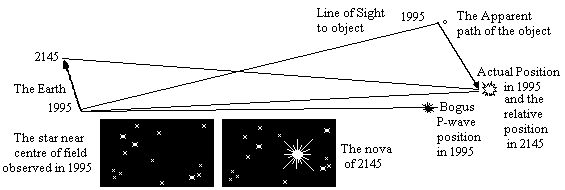
Consider this. As astronomical telescopes look back in time (due to the S-wave speed), so if this happened to be a P-wave event, then this becomes a geometric exercise, complicated by the view of the unknown P-wave transmission speed. The rotation of the Galaxy ensures a continuous positional change. Suppose that the S-wave event is not seen for another 150 years, and when it is observed, the event is seen at position "x". This could be far removed from the position seen on July 7th, 1995. This object was at that location, say, two hundred years ago. In its history, it would not be for about another 150 years before the detonation event is seen on the Earth. So, its true position will be at the convergence point where the two positional lines intersect, in relation to the Earth's parallax position in the galaxy at the time when the S-wave event is seen.
The P-wave light has already reached the Earth so the conclusion today, is that an event has happened. Since there is currently no optical or radio component in that region of the sky, then it must mean that an object will drift into that region of the sky at some future date, however, at that date, the Earth will not be at the same position, so the detonation will occur in a nearby region of sky. The S-wave view of the event travels slowly and will reach the Earth when it reaches the Earth, for it is anyone's guess as to what object inspired such a burst. There are several motions which must be considered in determining which star will explode, if one did explode. The apparent proper motions can be caused by:
| NGC | ... 1950 | epoch .... | .... 1992 | epoch ... | difference | object type |
| ------ | R . A . | Declin. | R . A . | Declin. | dRA | dDec | |
| 2437 | 07 h 39.5' | -14°42' | 07 h 41.8 | -14°49' | 2.3' | 7' | cluster |
| 3242 | 10 h 22.3' | -18°23' | 10 h 24.8 | -18°38' | 2.5' | 15' | 15' nebula |
| 2287 | 06 h 44.9' | -20°42 | 06 h 47.0 | -20°44' | 2.1' | 2' | cluster |
| 6405 | 17 h 36.0' | -32°10' | 17 h 40.1' | -32°13' | 4.1' | 3' | cluster |
| 6475 | 17 h 50.7' | -34°48' | 17 h 53.9' | -34°49' | 3.2' | 1' | cluster |
| 5139 | 13 h 23.7' | -43°03' | 13 h 26.8' | -47°29' | 3.1' | 26' | cluster |
| 6067 | 16 h 09.4' | -54°05' | 16 h 13.2' | -54°13' | 3.8' | 8' | cluster |
| 3532 | 11 h 04.3' | -58°24' | 11 h 06.4' | -58°40' | 2.1' | 16' | cluster |
| 3372 | 10 h 43.0' | -59°25' | 10 h 43.8' | -59°52' | 0.8' | 27' | Nebula |
Typically, with precession, these objects should all move in the same direction due to precession (but they do not) and should bear a proportional relationship based on the geocentric positioning system, (which they don't). This list also shows that the basic premises of 3-D Astronomy are correct within the Galaxy, however it leads to several geometric problems depending on the relative motions of each object and the Earth.
P-wave events will show little or no relationship between the P-wave position and the eventual S-wave position of the event, because star maps are two dimensional and changing. Only with a 3-D coordinate Universe can these P-wave events be allocated to certain objects with certainty, since the direction at time "Ø" is known. A system of 3-D coordinate geometry must have a reference point, or a datum line from which all things are referenced. The only line of this type that can be considered as "stable" is the line of linear momentum where no rotation or Coriolis forces occur in free space.
Figure 19-1 illustrates the complexity of the current position, actual position and the position when the event occurred. The mathematics of this exercise are not all that awesome, in fact it is the most basic appreciation of speed and time in relativity. This is so simple, that a 13 year old child could be given it by his teacher and expected to supply the true answer. One day, the problem may even be found in an arithmetic exam, perhaps appearing as in this classic question:
"Two motor cars begin a journey at the same time to the next town along the same road. One car travelled without stopping at the speed limit of 60 km per hour. As the first car arrived 20 minutes earlier, the police suspect the first driver may have been speeding. Since the separation of the two towns is estimated to be 81 Km apart, what is the average speed of the first car and what is the relationship between the speeds of the two cars?"
This childish question is important to understanding the difference between the P and the S-wave events, because the light component P-wave has not been realized; or has the event been observed since no one knows what to look for. Events may have been observed, but who can be sure? If the rates of transmission that Geologists use, vary with a speed factor difference of 1.73, then that can be a rough starting point, since both the P and the S waves must suffer from Tired Light. (figure 19-1) When the supernova occurs, both wave types will appear as an ascending whistles when they pass the Earth. Obviously, the magnetic spectrum will respond in the following order; radio wave first, then microwave, infrared, light, ultraviolet, and then X-rays.
To complicate the situation and placing this into the real world exercise, one could consider the following two part question involving two different reference frames.
Part 2. Without knowing where the battleship is, the military on Boka, are warned by the radio demand that something is heading their way. One observes the first of the shells landing. The impact of the first identifies that the shell came from the North. Then there is the second impact, quite a way from the target zone. The time between the two impacts is accurately determined from a seismic recording. The separation between the impact sites is measured. Realizing that both cannons came from the same ship, and that both cannons have a pre-fixed range of exactly 25 miles, and from further intelligence reports, it is known that the speed of trajectory is different, by a factor of two, determine where the battleship should be at precisely five minutes from the time of initial impact, assuming that its course and speed remain unchanged, to launch a counter offensive, that will sink the battleship with one shot, and therefore save Boka from conquest.
The problem at hand is very similar to part 2, in that one has need to position where a star actually exploded,and where it will be seen to explode, since the distances are so far away, there will be an enormous time lag between the various events. When it is observed, the Supernova should begin in the red spectrum, become white and fade into the blue, as each of the S-wave events pass through the optical window.
It is suspected that the P-waves from object GROJ1629-49 have travelled past the Earth already, for now one must wait for the S-wave event. It may be that the P and S waves have similar speeds, but this does not ring true in Nature, for all other P-waves travel much faster than the slow S-waves. However, the robot X-ray satellite may first detect the object when the slower S-wave form of X-rays next appear, whereupon astronomers will be requested to look again, at a different location, and there they will see the supernova in full bloom, but then it is too late to see what happened. This will be the case if the supernova is powerful enough and close enough and that the satellite is still in operation, that is, if mankind survives.
As astronomers cannot find a star at this position, one must look at the proper motion of the stars in the region to determine the most likely contender from the star's proper motion. When the S-waves are again detected, perhaps within the next century, a "guest star" (a supernova) will appear in the sky. Forewarned means that the supernova's spectrum, can be viewed in the initial stages, and then the rough distance to the object through the tired light theory can be determined. If the event is visible long enough, and the star close enough, the solar parallax could be determined as a cross-correlation, even though this technique is subject to errors in measurement and calculation.
The true calculations must consider the Earth's orbit and our galactic positional change. The speed of light, the S-wave speed is approximately known. To accept the currently accepted figure as fixed and finite would be wrong. However, if the P-wave is travelling from 1.5 to 4.75 times faster than the speed of the S-waves, the actual date of the supernova can be determined, within a month and the distance measured to within 1 light week, perhaps a light hour or even finer precision if one is lucky enough to witness the blast.
The S-wave event carries the spectral information. Although the P-wave would have a spectrum, if the P-wave speed happened to be twice that of the S-wave, it may appear in the spectrograph as if the frequency were doubled, since the slow-down on entering a refractive medium would be greater. At current technological levels, it would be difficult to discern and identify P-waves because mankind does not as yet understand the optical properties of P-wave light and their affect on, and in matter. The atmosphere may be transparent for P-waves, then again it could be opaque. The refractive spectroscope may not resolve P-wave radiation, while a diffraction grating may show an apparent higher frequency. When a gas is made to fluoresce, the spectral lines observed may be a mix of P and S-waves.
The importance of identifying the P-wave component of light will give another distance determining method in Astronomy and mankind a faster communications medium. Then again, extra-terrestrial civilizations may exclusively use P-wave communications, so that for mankind to look in the S-wave regions to detect their presence elsewhere in the Universe, may be worthless. Since most terrestrial mediums allow the rapid transmission of P-waves, the point is, that if P-wave communications are feasible, then maybe it is worth looking for them. If the Earth's atmosphere is opaque to P-wave light, it could be that to use P-waves, a satellite repeater station must re-transmit an S-wave in the P-wave spectrum well away from the Earth's sphere of influence.
The s-wave speed of light was claimed in Einstein's Special theory of relativity as fixed and finite in a vacuum, yet refraction in a medium alters the speed of light at a differential rate dependent on the frequency. The question that must be raised here for the scientific community to answer is "what defines a vacuum?" The problem has never been explored despite what the scientific community claim, for the vacuum could be accepted as 1mm of Mercury or 10-4mm. Then again, it may be 10-8mm or 10-24mm. What defines a vacuum? No matter what figure is accepted, matter is present, so refraction through the vacuum must be altered by the matter present, because matter transfers the magnetic radiation across the Universe. Because a vacuum has never been explored, the assumption made by Mr. Einstein is a speculation without basis. The Birge figure for the currently accepted speed of s-wave light can only be considered as a load of rubbish and should not be trusted. 'With greater distance, Hubble stated, there is an increasing Red Shift.' This is illustrated by the strange synthetic 3-D effects found when a normal colour image of the distant galaxies is split into its component colour images, then viewed using the stereoscope.
To see more 3-D images, synthetic and real-time, click on the 3-D image of M87 below.
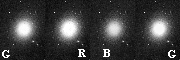
The arrangement of the images, Green-Red-Blue-Green shows positive and negative perspective, that agrees with Hubble's postulation, and the Tired Light Theory.
The purpose of the meeting at Sydney Observatory was to establish, record and document a date for the "technical scientific ownership" of this theory of light. The establishment of P-wave light is purely an extension of Nature's order. It will be the job of others to research the predicted effect. It is time for the astronomer to keep on observing that area of the sky from night to night. All that can be trusted at the moment is the satellite information concerning object GROJ1629-49, which says "watch this space", perhaps for centuries until this prediction comes true, in the S-wave region, for then the speed of the P-wave can be determined.
Mr. Lomb made an important observation, for he said "Most of these gamma ray events just fade away, without any visual component." It could be that this object may exist at the outermost extremity of The Galaxy and may not be seen for twenty life times (400-500 years). If such long lasting events are regularly observed and simply fade away without a visual component, there must be a very good reason in Nature. To contemplate the enormity of the event, in terms of gamma particles alone, a two week period of 100 Mev illustrates that something cataclysmic has eventuated. Where did this quantity of particles originate? It was last observed at location RA 16h 28' 57.7" declination -49°36'25". Mr. Lomb's statement could also mean that the optical components of many other gamma ray events may not be seen, or linked to the original event, since the time lag between the two event arrivals is so great. An interesting research project would be to centralise such fade-out events in a special catalogue, so that an automated telescope could scan these locations each night. Professional astronomers need not worry, for there are many amateur astronomers who are quite prepared, amateurs who have the resources currently available to carry out such research at zero expense to the scientific community. All that is required is a regularly published list of events, their dates, the locations, and intensities. That is not too much to ask for. Each year the list could be updated, and when there is an optical component, the real work begins because the prediction will be realised.
Because this prediction exists, confirmation will not mean that the author's theories of light and relativity are true, rather the researcher must use the scientific method, to eliminate all false reasons, to determine the truth. If the researcher agrees with Nature, then, that is the truth. But to agree with any theory in spite of Nature, in order to agree with the "flavour-of-the-month" will be seen as continuing a delusion. Look for, and accept, only the truth.