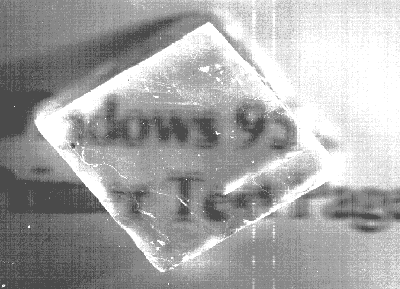
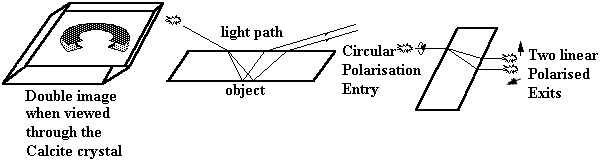
Figure 18-1 Double refraction in the Calcite crystal vertically blurs
an object viewed through a crystal. (Image made with a scanner)
Polarized Thoughts!
The most primitive stage of the scientific method is the notion, a gut-feeling that a certain mechanism is at work. This will become the speculation in the problem definition stage of the research, where similar concepts, ideas and data are gathered together. The researcher must determine whether or not there could be some truth in the speculation. It is the researcher's role to find that truth, by eliminating all observational illusions and experimental deviants. As this analysis continues, the hypothesis takes shape, with the research entering the experimental design stage. Any conclusion drawn before experimental data is obtained, can only be used as a guide, since the probability of error is substantial. Because the hypothesis seems to be logical, seems to make sense and seems to work, it does not follow or mean anything worthwhile, until the actual mechanism is determined beyond all shadow of doubt. Electrovalency is a prime example of how wrong a science can be in accepting a notion as fact. No experiment has proven that electrovalency is the mechanism of chemical bonding, yet, electrovalency is asserted as a fact of Nature, where the reasons for electrochemical bonding are without basis and without proof. Nature is apt to deceive the unwary.
As the name of this stage suggests, the aim is to design a working experiment. Unfortunately, if there are unknown conditions, one invariably makes assumptions, which may, or may not, be true. If an assumption proves to be invalid, one risks a credibility challenge, unless those assumptions are satisfied and proven to be true during the experimental stage. Primary Data is collected during this stage from observational sources. The experimental results, the data, should confirm or deny the validity of the hypothesis and the assumptions, within the framework of the science, to a reasonable degree of accuracy. To draw a conclusion at this moment without correcting the sciences, based on any experimental results is rather dangerous, for there is a probability of error greater than 95%. Once the sciences are corrected, the probability of error will reduce to about 30%. The current high error figure is borne out with Rutherford's fascinating experiment, where thin metal foils were bombarded with massive alpha-particles. The observational results were statistically treated to determine the shape and size of the atom within the then fabric of Chemistry and Physics. Analysis of this type occurs during the empirical stage of research where the primary data is organized in such a way that one or more conclusions can be drawn. It is here that one is treading on really dangerous territory, for what one believes as true, modifies the conclusions reached. Many believe that Rutherford's analysis was perfect, that the atom is empty space, however, at the time, there were no electron microscopes, no concepts pertaining to metal bonds or dealing with the structure of metals (especially thin foils) and there was no knowledge of the neutron, or measurements of atomic radii.
As a consequence of the discoveries made since Rutherford's time, the list of potential challenges goes on-and-on. As education states that Rutherford was correct in his analysis, some believe that no one has the right to challenge that research, for using the knowledge of today to attack Rutherford is dirty politics or heresy. The scientific method demands that such an attack be made, with all new evidence, since the search is for the truth, where the ultimate conclusion to any research, can only be the truth, and the truth is only found during the final research stage, the follow-up causal research stage.
Causal research attempts to confirm that a specific event produces the affect that causes an effect, however the bulk of this research stage begins when the conclusions are drawn and the results published. The follow-up or on-going research is generally not carried out by the original researcher, rather the conclusions and analysis must be challenged and continuously reviewed by the scientific community. During this on-going causal research stage, primary and secondary data sources will confirm or deny the claims and proofs. The aim of this final research stage is to prove the truth or deny the theory. It takes but one exception to deny a theory, and if denied, alternative theory must be proposed to replace the deluded theory. To accept Rutherford's analysis, when so much evidence today challenges his analysis, places science in an error situation. In the eighty years since Rutherford's experiment, there have been many great discoveries, and if Rutherford's analysis happened to be true to Nature, then all theory would be subject to this truth, for there would be no exceptions to the theory, and it would work in all situations. But, there are exceptions; there is great complexity; contradictions exist; simple Astronomy disproves nuclear-centric structures; and there are many things which the vague orbiting electron atomic structure cannot explain. Causal research instantly states that there is something intrinsically wrong. The researcher must find the error, in order to fix the introduced problems.
To struggle around this known failure, the Scientific community breached the scientific method in not pursuing the truth. Many were led astray by Chemistry's infallible electrochemical beliefs, accepting Rutherford as fact, and above Nature, so Quantum mechanics became "THE FIX", when the fix was no more than a septic bandage, jerry-rigged to hold the framework and fabric of Chemistry together. But, this septic bandage proved to be lethal, for it was applied without antiseptic, resulting in a run-away infection, slowly killing the sciences. The only prognosis is amputation. As Chemistry's framework was built on the foundations of electrovalency, the entire science is doomed since the very heart is diseased. Therefore, Chemistry now requires a complete heart transplant as well, where the foundation and theories must be rebuilt from start. The problem became so massive that Chemistry turned a blind eye, rather than accepting the challenge, many opted to state publicly, "We have been using these theories for so long, they must be true."
As Nature is full of illusions, many preconceived notions about electron beams and Nature, although scientifically true are not true, since the accepted theory is based on errors, so the only truth in the science is the experimental data, not the theory or conclusions reached. As researchers based their work on those who came before, treating the observational results in the same way, they established linked-conclusions without truth. What can be detected, what is perceived, what is known and understood is not necessarily what is happening or the truth. Since truth is subjective, it is limited by the understanding of what is understood to be true at the time. Science is as accurate as the perceived truth allows.
The scientific method was designed to stop errors entering the sciences, not to promote errors as the truth. But this is where the Scientific method broke down, because the scientific method looked for the truth, basing all the observational results on many foundation-errors. Because the foundation is the basis from which all measurements were made and standardised too, a massive problem has evolved. Consequently, the scientific method actively promoted errors as truth. Irrespective of humanity's chemical theory, Chemistry still works in the Universe while humanity squabbles over who is right and who is wrong. When the foundations of a Science, upon which most things in the science are built are wrong, are delusions, are illusions, are in-error, then the science is wrong, for everything built on those foundations, no matter how perfectly they seem to work, no matter how perfect the mathematics, no matter how many exceptions there are to the rule, no matter how many times the rules change to agree with the facts; then the science is wrong and invalid. The philosophy of many seems to be, "Don't let the truth get in the way of a good story."
The conclusion that the scientific method now demands, uses the statement "get back to the laboratory and start again from scratch. and re-write from start." That is the only conclusion allowed under the scientific method, as taught and enforced by every Chemist and Professor of Chemistry. If any part of a procedure is missing or is incorrect, the scientific method states "redo from start". This means Chemistry from 1800 and Physics from 1600, redo from start, (from before the blunders of Renè Descartes which Newton adopted). There is a great deal of Scientific knowledge to be reworked into the framework of Nature. In this work, the causal research carried out identifies and aims to correct several major errors in the Sciences. These errors must be corrected! Research is immediately reverted to the experimental design stage, where one must determine the truth. Are the suggested theories true, or do other theories apply?
Because a much larger pool of experimental data is available, from which one can source tremendous knowledge, and since all the sciences have been intimately linked together in Nature, at this moment, experimentally, the probability of error is much lower than that faced by Newton, Davy, Faraday, Rutherford, Bohr, Einstein, Joules, et cetera. This is due to the fact that several major errors have been identified and perhaps, eliminated, reducing the chances of travelling down that path again. Without regard to humanity or Science, Nature will go on, testing and re-testing everything, evolving and recycling everything, duplicating everything from successes to failures, including humanity at some distant time somewhere else.
As so many of Nature's mechanisms are inter-connected, it is no wonder that Science evolved with demarcation barriers and uncertainty. This is before considering the implications and limitations imposed through misguided beliefs in the super-natural or beliefs spawned by religious organizations, as egocentric theology and dogma. One can trace the history of religions, governments, and multi-national companies (such as the media) to show the desires, and the need to control knowledge. This is not just historical trivia, as today, many organizations and individuals still need to control knowledge. Unfortunately, people cannot see that they are subject to intense manipulation through education and subtle advertising. Some people in positions of power, in seeking greater power through their position, are so obsessed with this aim, to keep the populous ignorant, it becomes necessary for them to undermine and destroy the credibility of any thinking person who stands in their way. Thinking people ask questions and refuse to accept being led around by a ring through the nose, or to be treated as cattle or stock.
To many in authority, knowledge is perhaps the most dangerous weapon that any person can possess, so it becomes necessary to introduce weapons like propaganda, distortion, falsehoods, discrimination, vilification, slander, conspiracy and cover-up claims, to encourage the sheep in the community to do the dirty work. Some call this a path of genocide or "ethnic cleansing". Others justify their actions convinced that National Security was jeopardised by the racist socialist elements. Anyone who thinks must be racist. Politicians, religious leaders and media barrens promote this illegal activity, for laws exist that permit them to incite the people, the sheep, to cleanse society of such heretics. Very few people are aware of the scale of the problem, for it pervades all areas of human activity, including the sciences. One must bend with the wind or be silenced, ostracised, denied credit, locked-away, injured or killed.
There are many reasons for bending with the wind, from peace of mind to security. Science has needed patrons ever since when. Science does not pay the bills. One must be alive to make a contribution to Science. In Kepler's day, it was necessary to please the patron, so Kepler introduced the "Music of the Spheres" to please his musical patron. In this work, Kepler claimed that the moving planets created musical tones as they pushed their way through the Æther, leaving a resonant trail. As the Twenty First Century approaches, this claim may sound like a load of hog-wash to the scientific community, however very few have bothered to test Kepler's claim, using a simple radio receiver to discover the truth. As has been said before, "to observe, one must know how to observe, must know what to look for, must know what one is observing" and perhaps the most important of all is to have the ability to decipher the observation. In the "Music of the Spheres" one must look for a disturbance in the solar wind, so where better than in the radio spectrum, for an event occurring after a solar or lunar eclipse. As the trail of the solar particles converges behind the first object to strike the shock front of the second object, radio noises are produced through chemical activity and reverberations. The solar wind travels very slowly, with the result being that there are actually two eclipse events, the optical event followed by the radio disturbance. The effect produces a cacophony of AM radio noises in the low to HF radio bands. The planets do make noises as they move, a random radio noise, as a consequence of the Solar wind. The observed effects and noises are nothing like the scored musical predictions made by Kepler.
One must be very sceptical of science fact, when such facts are based on conventional scientific theory. Only now, can the mysteries and the exceptions of conventional Science be thrown at the new theories. This is a test of the first order, for the scientific method demands that the theory actually works; that there are no exceptions; no uncertainty, no rules made to be broken; and no changing of boats mid-stream. Testing Nature's theories will open up more areas requiring research, for many more questions will be generated. This process can be likened to sitting for the final exams. But this student will never graduate because the student will not recognise the currently accepted theory as the truth, for as this work shows, "there ain't much truth in it." It is even more doubtful whether this student could graduate using Nature's mechanisms, for there is no time to understand all that has come to be, all that is necessary. This student is lost in the complexity of Nature's simplicity. It may seem odd, but when a simple question is put to Nature at the atomic level, and one seeks out a simple answer, Nature supplies the answer and a great deal more, for Nature is simplicity in itself, while being utterly complex due to the number of simple reactions and the way simplicity interferes with other simple things, duplicating the results over-and-over-again.
In pursuit of the aim to test the theories, it is with great regret that the slippery strata of relativity and Quantum Mechanics must be revisited, to understand light and the nature of Nature. Science makes many confused and muddled distinctions between energy, light and the magnetic spectrum as if they were totally different entities yet at the same time science marries them altogether as if they are the same thing. The problems stem from the vague model of the atom and the multinucleated sciences. When energy was considered in the theory of relativity, Einstein proposed energy as the fundamental reason of being, since everything else including time, started in the Universe at that primordial moment. Before this moment only pure energy filled the Universe. Although Einstein does not mention it, that point of time is best known today as the moment of the "Big Bang". The inquisitive must ask "what mechanism transferred pure energy before the Big Bang?" As the contradictory relativity theories became the "flavour-of-the-month", uncertainty became accepted as fact.
Both Einstein and Quantum Mechanics independently introduced "the photon" into the Science vocabulary as the energy transport mechanisms. Einstein's postulations in relativity killed off all the mechanisms for transferring energy, leaving all other forms of energy in the "too hard basket" or in limbo. Quantum Mechanics would place these in the state of total "uncertainty". As pointed out earlier, relativity and Quantum mechanics hold contradictory photon theories, the three of them (ie. General theory, Special theory and Quantum Mechanics) cannot adequately explain basic optical effects or any real energy problems . It will be necessary to recapitulate and further other arguments to determine the nature of light.
Photon theory or "Particle Physics" cannot adequately explain how light is transmitted; why solid materials are transparent, translucent or opaque. The principal traits, predictions and observational evidence displayed when real particles and molecules are physically involved in motion are not observed in the magnetic spectrum, in light, or in energy in Nature. Although light travels in straight lines, particle physics is subject to Coriolis forces in the rotating 3-D Universe. Particle Physics cannot explain spectra, colour and polarization; diffraction, refraction or reflection; interference, SSB and radio communications. Particle Physics loses all credibility when other types of energy are considered because all the equations involve abstractions and two-dimensional-linear-physics. This is in a three-dimensional Universe where everything has rotational energy. Particle Physics cannot explain the transfer of mechanical energy through a lever, shovel or rake, or in a body exhibiting rotation, let alone the magnetic, electric and gravitational fields. Then there are chemical and nuclear energies to consider. When light and magnetic radiation are contemplated verbose discussions and poor analogies treat each separately because the concept of light being a pure photon fails, especially when one considers radio propagation and the properties of the types of transmissions at every frequency. This act of misleading and deceptive advertising is completed when Particle Physics maintains that light is both a particle and a wave, at the same time, yet the important equations used throughout Optics today were conceived by Huygens, Snell, Maxwell, Hertz, and Marconi using the debunked Æther theory; concepts, which are still applicable and have not been replaced by anything better. The electromagnetic vector model of magnetic radiation is also doomed to failure. So, a completely new theory must encompass all, and replace everything.
One of the strangest predictions made in Quantum Mechanics is that when a gas is excited, the change in the orbital height causes an emission of just one photon, a single photon. There are 64,800 square arc degrees in a sphere or 233,280,000 square arc seconds in a sphere. This means that to detect a single photon demands being at exactly the right place at exactly the right moment, with exactly the right measuring equipment. The probability of being right there, right then, is so very low that the single photon concept is laughable. If this single photon concept were the case, an event like an atomic explosion would not be seen at all. Fluorescent lights would not give off any usable light. Other mechanisms must be working. Although this is not a very good example, since the area of the square arc second changes from the equator to the poles, it does indicate the magnitude of the problem. To satisfy the demands of this model, Quantum mechanics must prove that the photon has a diameter that is bigger than a square arc second or larger than the sphere itself. Rather than this, Quantum Mechanics introduced the double slit hypothesis, so that at every point on the sphere, a single photon will be seen at the same time, irrespective of the observer's position or number of observers, since the photon is a massless-dimensionless particle, existing in many parallel universes at the same time. Throw a ball in Sydney. Fly anywhere in the world, and the ball will be there to be caught. Is it raining or was that the last shower?
Science states quite openly that it does not understand light and magnetic radiation, yet it promotes the acceptance of the Relativistic beliefs married to Quantum Mechanics, as fact. This makes any serious discussion of light almost impossible, because of the improper logic and thought processes used by Einstein's devotees in convincing "all" that the photon categorically exists (when it is no more than a brilliant illusion,) has distorted all concepts. Although this discussion was begun much earlier in this work, it was not resolved leaving much to this point to avoid potential confusion. "The postulation of being" introduced the concept that energy is exerted, transferred, transmitted and stored in matter at positions throughout all three dimensions of the ordinate of position in the Universe.
The question is one of transparency, translucency, opaqueness, diffraction and polarization. These "keys" are fundamental to determining the exact nature of the magnetic spectrum, telling a powerful story from the nature of optical effects to the very nature of the atom. Foolish and misguided "parrot fashion" beliefs have prevented a full understanding of how all magnetic radiation propagates in space and through solid matter. Perhaps the most often articulated and yet the most deluded claim for the transparency of glass is stated "glass is transparent because it is a super-cooled liquid". How many transparent materials are there? How many are super-cooled? All super-cooled liquids are solids. Molecular movement occurs in all solids. Ice, Plastic, Mica, Topaz, Quarts, Diamond, Calcite, Glazes, Resins, Epoxy, Varnish and Sugar are solids and are all transparent. Thin leaf foils and surface coatings of Silver, Aluminium and Gold are solids and transparent. Water, Oils, Acids, Bases, gasses are all fluids and are transparent. A vacuum contains solid matter and is transparent. All these materials contain one important ingredient, solid matter. In the interstellar medium, there is matter. Each atom is a solid piece of matter irrespective of its form. At this moment, the arrangement of matter is of no great concern. What process allows magnetic radiation to pass through solid matter? Some substances are opaque to light, yet have transparent "pass bands" elsewhere in the magnetic spectrum. Some substances become transparent with temperature changes. The situation of throwing such difficult problems in the "too-hard-basket" must cease. It is time to seek out logical answers, to look for and examine the "key pieces" of Nature's puzzle in forming a complete picture.
If science is correct, the true concepts will become evident and confirm science. The only approach to test science is to use the Natural Laws to force an explanation of all magnetic wave motion from cause to effect. The only differences between light and radio waves are frequency and velocity, (radio waves travel faster than X-rays). Magnetic radiation is affected by matter and matter is affected by magnetic radiation. Simply put, when magnetic radiation and energy are spoken about, matter matters, however magnetic radiation and energy are not matter, they are affects of matter that produce effects in matter. The "keys" to understanding the transmission of light through anything, including solids is found in several specific areas. The first was discussed in the seismic studies of the Earth. The second key was seen in both the duck pond and the ocean, while the third key is found in those fascinating deposits called crystals. Believe it or not, Crystallography intimately links matter and energy very tightly together. Then other keys will be found, such as in solutions, lightning storms and X-ray production, radio transmission and aerial design, with diffraction and colour throwing a curved ball at Physics.
The chemists of the middle Nineteenth Century were close to the truth, when H. Watts wrote these words in the (1872) Manual of Chemistry, "..hence, if diamagnetism is not regarded as a distinct force, we must suppose that the Æther is also magnetic and occupies in the magnetic scale the place intermediate between magnetic and diamagnetic bodies." It is not the author's attempt to push the Æther theory because it is now as it was when it was dumped "quite incorrect", almost naive. The Æther theory does make many explanations rather simple for it utilizes a convenient hypothetical fluid as the energy transport mechanism. Chemists and scientists have failed to make the necessary connection between the atomic magnetic field and the effects of energy on matter where the total transfer of all energy through any medium can be explained from cause to effect. The Æther theory needs a total re-write to agree with Nature, while photon theories are scrapped..
In seismic studies, the P-waves travel 1.73 times faster through the rock and the Earth's liquid mantle than do the equivalent strength S-waves. When the geological study of wave motions is related to the magnetic spectrum, it indicates that the speed of light is far slower than would be light's P-wave component. This suggests that only part of the magnetic spectrum is seen and it would be for radio engineers and inventors to open the door into the extremely high speed light spectrum. A space telescope has no way of determining the difference between the P and S-waves in the X-ray spectrum, so it is possible for P-wave light to be detected as an ultra bright X-ray source. Suppose the speed difference is one and a half times light speed, then the wavelength of light would be much shorter because of its velocity, so the P-wave form of light could appear as X-rays. At the same time normal X-ray sources will be seen by the satellite. Light has a frequency range of 1014 to 1015 Hz while the slow moving X-rays range from 1016 and up to 1021 Hz. To throw another spanner into Cygnus-X1 consider a close white dwarf binary star system, where both the P and S-waves are being produced. Both stars can be very bright in the white light S-wave region. The P-wave light component could also be very bright, so the P-wave light would be observed as X-rays by the space telescope due to its speed, not its frequency.
Glass is amazing, because impurities like Cobalt can change the transmission and re-transmission qualities of the glass. Only five spectral lines pass through good quality Cobalt glass, and equally, just 5 spectral lines are reflected by the glass. As the glass is heated, it is like the student attacking the violin, where the glass develops discordant overtones. With the glass becoming red hot, the blue colour is less evident as the hot area disrupts the processes involving reflection, re-transmission and absorption, introducing transmission. Transparency is far more complex than a basic re-transmission effect, involving many deeper concepts which must be understood before light and the magnetic spectrum are understood. Some materials allow all S-wave motions to pass through them, while others only allow S-wave motions with certain vibrational directions. This is true in Geology and in optics and it is called polarization. There are those mediums that pass the P-waves, and those which do not allow their transmission. Different transparency and transmission conditions or transmission factors must apply for the various wave types.
The next 'key", is the motion in the waves seen in a liquid, such as those waves seen on a pond, the sea and the ocean. These are forms of the S-wave. The surface wave of a pond, or in the bath has both a vertical and "in-line" (backwards and forwards) component. However, sound waves in water and the tsunami (the tidal wave) are high velocity P-waves with an incredibly powerful in-line backward and forward vector, but not a very high vertical vector (10 to 20 metres high, forty or more kilometres long and travelling at the speed of sound in water 1,450 m/s or 5,220 Km/hour) . The tsunami is a powerful wave that can easily wipe out a population. Many movie producers show the tsunami as a massive beach wave without any notion of the danger this beast is to people living on the coast.
The same effects occur in air, where the sound waves travel at 331.3 metres per second. There are S-waves as well as sound's P-wave, and this becomes a problem with the HI-FI enthusiast, where the differences are noticeable. There is an enormous difference between "close-microphone" recordings and the "live" stereo recording made in the body of the theatre. To the HI FI devotee, nothing is worse to the ears than hearing a full symphony orchestra, being amplified using close microphones on a single channel public address system. The problem occurs when the overall sound level is amplified and the direct sound clashes with it. The orchestra is in real positional stereo, which establishes a direct-sound-set of characteristics which the devotee of music appreciates. Mixing the mono amplified sound with the direct stereo sound, the three sound sources clash. The result is the production of disturbing harmonics and discords. The P and S-waves that assist in stereo hearing, are confused, giving false directions to stereo sounds, but then these signals are cross modulated, so the L-waves produced are cruel.
A trick used by some recording engineers to improve the stereo separation is to add phase shifts and digital delays on certain instruments, where one track is normal perhaps with digital echo added, but the other track is severely processed. When played back, there is an obvious difference in perception between the left and the right tracks so much so that the sound can seemingly be coming from the extreme left of the left speaker, or the extreme right of the right speaker, an apparent sound source emanating from a point in space that is impossible, yet that is where the sound appears to be coming from. The delay line and the phase shift cause a pseudo-S-wave, which confuses the mind rather brilliantly in creating an audio illusion. To further add to the effect, the recording engineer can introduce a tiny amount of reverberation into the trailing sound source, be it in the left or the right track. When each track is crossed mixed, the background reverberation adds a secondary pressure wave set to the sound, thus giving an illusion of tremendous stereo separation, when the speakers may only be a few meters apart, where the person perceives sounds originating from real sources several metres apart or in the next room. To any budding recording engineer, the sheer physics of sound perception and wave re-phasing is worth investigating.
By far the most interesting "key piece of Nature's jig saw" is perhaps the ordinary Calcite crystal. In a pseudo-scientific reference book, dealing with the metaphysical properties of crystals is this interesting quote:-
The Calcite crystal has a specific property which makes it a major "key" in the understanding of Light, the atom and Nature. This simple crystal does something which is exceptional, but not unique. When a beam of ordinary light passes into and through a Calcite crystal, the beam splits into two separate beams, in the process called double refraction. The full explanation of this effect reveals a great deal, especially how little is known about refraction, optics and matter.
In Nature Calcium Carbonate (CaCO3), is dimorphous and so can exist as one of two distinct and different crystal structures, with different densities and optical properties. Calcite can exist as a scalenohedron (a 12 sided crystal, each face exhibiting three unequal sides) or as the rhombohedron (a six sided crystal, where the faces make the shape of a rhombus). The rhombohedron is like a framework box or set of shelves that someone has pressed out of square. Rhombic Calcite shows a cube pushed out of alignment by 11°47'. The chemical composition of both crystals is identical. They are normally colourless and transparent. Any impurities give Calcite distinctive colours depending on the atoms and molecules of the impurity. The coloured crystals should not be used in this experiment. To explore the fascinating optical effects, Calcite in the rhombohedron form, known as Calc-Spar (having a specific gravity of 2.7) is the only choice. Crystal shops sell small pieces for about $30 to $50. It is a rude price to pay for a really common rock that can be made at home in the kitchen for 20 to 50 cents.
Figure 18-1 Double refraction in the Calcite crystal vertically blurs
an object viewed through a crystal. (Image made with a scanner)
To take the Calcite time dilation to the pen-ultimate truth, it should be possible to see events that happened yesterday in real time today, and by turning the crystal around, it would allow one to see the events of tomorrow, but such is not the case. The general relativity explanation shows academic naivety, for it does not reveal an understanding of basic Chemistry, of light, of refraction, of time, or Nature. To understand the Calcite crystal demands examining a Calcite crystal, without blindly accepting relativity as being the ultimate answer to all the mysteries in the Universe. Not only is this moment of time, the present time in the entire Universe, it is the same moment within the Calcite crystal. It is obvious to any thinking person with the slightest knowledge in optics, that the transmission speed of light changes, as it does in every refractive medium, so the polarization effect must be directly related to the chemical structure.
To state that Calcite identifies the structure of the Calcium Carbonate molecule is deluded, for it is a Water - Calcium Carbonate molecular structure, but then that is not true. The optical effects reveal the organization of the atoms and molecules around the Carbon atom. By itself, the Carbon atom does not allow the transmission of light, until the atoms are arranged in a precise molecular structure. Carbon normally exists in three crystal forms. As the mineral diamond Cn , it can exist as a clear octahedron, dodecahedron and the trapezohedron, with a wide range of colours from black to clear. Carbon also exists as graphite, a black crystalline solid Cn , and as soot, as C2. In the old system, Chemistry has given Carbon a valency of plus or minus 4, however this is subject to rule changes where Carbon can exhibit valencies of 2,3 and 4. Oxygen is normally found as a gas, becoming a liquid at low temperatures. It is supposed to have a valency of 2 minus. Calcium is given a valency of plus 2 and exists as a shiny metal which rapidly oxidizes in air.
To form a Calcite crystal in the kitchen, Water (H2O) containing carbonic acid (CH2O3) or H2O:CO2 dissolves the white chalk compound Calcium Carbonate CaO:CO2. When the solution is reasonably concentrated and maintained at a low temperature (in the refrigerator 0-10°C (30-50°F)), the rhombic crystal, the rhombohedron grows. Above this temperature, the scalenohedron crystal appears. Water of crystallization is an integral part of the crystal's formation, its new found transparency and the molecular structure. Any researcher worth their salt would also be asking "what process is involved that causes the structural changes, due to temperature?"
As Calcium Carbonate dissolves in Carbonic Acid, it does so as whole molecules, in mild chemical reactions where molecules align in a temperature dependent magnetic matrix. The formation of the crystal is the next logical state, since the structure of the solution is already aligned. All that is required, is for the concentration to be increased (through evaporation) at which point, whole molecules are deposited layer by layer. This is not Calcium Carbonate. Calcite is, 2H2O : 2 CO2 : CaO a completely different molecular and chemical structure as H2O + H2O:CO2 + CaO:CO2. The molecules deposit in molecular layers forming unique 3-D alignments of Water, Calcium Oxide, and Carbon dioxide. The molecules in solution settle magnetically into a specifically ordered matrix, whose structure is dependent on the concentration and local activity of the atoms at the time of formation in many "local-magneto-molecular-events".
Some crystal growth is affected by external magnetic fields, such as the growth of spiral garnet. The magnetic structure of the three molecules involved in Calcite are unaffected by external magnetic fields, since the local molecular effects are greater. The molecules involved use their magnetic fields as the glue and here, is where the search begins to explain the mechanisms that alter the molecular structure affecting the optical properties. The question for the researcher to determine is the 3-D molecular packing structure of the crystal itself, for this will give the answer in one step. Rather than the simple way, the hard way using observations and deductions will reveal some horrendous mistakes in Physics.
The Normal in all optical devices, according to Snell's law, is a line drawn perpendicular to the optical surface at the point where the light beam strikes the surface. The difference between the two is called the "angle of incidence". The light beam enters the medium and depending on the amount of slow-down, bends towards the normal at a new angle called the "angle of refraction". On exiting, the light beam increases its velocity at the interface and bends away from the normal. Only when the beam of light travels along the optical axis does the light pass directly through both lens surfaces without bending, but it still slows down while it travels through the medium. In a moment of time, inside and outside the medium, the same number of wavefronts pass, even though there is a speed change. This fundamental truth about refraction challenges the Michelson-Morley experiment, because the same number of wavefronts (even though the wavelength is shorter) pass in the same time frame.
When discussing the optics in a crystal, the pioneering physicists, geologists and chemists who began this research really blundered, and confused the issues by accepting defined words, applying reserved words to other non-related events and mechanisms, thus making all descriptions so complex, that the subject is terribly confused. Rather than maintaining the status quo and reserving precise words by defining them, Science is now contaminated with contradictory definitions that exist to describe very similar, but different optical properties. New definitions must be considered to cater for specific effects that are currently mis-defined. Affected are the definitions for both the optical axis and the normal. These are the principal foundations of geometric optics, demanding reserved definitions. The crystal's optical axis defies Snell's Law, because it re-defines the normal. To a physicist learning geology, or vice versa, means that total confusion reigns until one learns to swop boats mid-stream. As an example of this confusion, consider the following.
The nature of the double refraction effect varies with the light beam's angle of incidence, where the light beam enters the crystal along the normal. The normal to the Calcite rhombohedron is off-set. The optical axis is the precise path where double refraction does not occur. At the point where the rhombic surfaces meet at angles of 78°13' and 101°47' on the blunt corner of the rhombus, where the three obtuse angles meet, a line drawn into the crystal making equal angles to the crystal edges is the direction of alignment of Calcite's optical axis.
It is necessary to standardize on one polarized set of definitions. Optics is maintained using Snell's definitions, while the definitions to be used in crystallography must be re-defined, so that the normal remains perpendicular to the mean curvature of the surface at all times. The optical axis must remain as the direct path along the normal, through the medium to the focal point. In Optics, the optical axis is also the shortest line joining the principle focus to the object through the parallel surfaces at the centre of a lens and perpendicular to the plane of the lens (unless the lens is astigmatic). The optical axis is the most direct line along the optical path from the object to the centre of the image. When a light beam enters a block of plane glass on any angle, the beam will bend from its original path, but on exiting the beam returns to a path parallel to the original path. This process of refraction is dependent on the speed of light changing as light enters and passes through a medium at the surface interface. In any isotropic medium (such as glass), the real optical axis is at right angles to the surface, such that the refraction of a light beam obeys Snell's law. This law is the basis of all optical lenses, where the light is focused purely because of the relationship between the lens' curvature and the speed of light changing as the light enters the medium. The angle of incidence with respect to the normal position at that point on the surface of the lens produces a change in the path direction along the angle of refraction, with respect to the normal.
To save confusion with optics, the crystal now has a "concurrent axis", where the light passing through the crystal is unaffected, where double refraction does not occur, where the polarization is concurrent and appears unchanged. (Already in use is the term "crystal axis", and as it is reserved, it is respected for having a different meaning). Light striking the crystal at an incident angle to the concurrent axis will be refracted depending on the molecular structure and the changing speed of light in the medium along the molecular planes, to an angle proportional to the change in the speed of light along those planes. The path of maximum deviation due to differing optical paths through the crystal, forms the planar axis. Both the planar and concurrent axes are off-set to the true optical axis and the normal to the surface, due to the crystal matrix (the molecular structure) and the shape of the magnetic surface cushion at the interface. Each face of the crystal will present a different planar axis with respect to the normal of that face.
To re-write a previous passage; "the crystal lattice of rhombic Calcite ( H2O : CaO : CO2 : H2O) produces a concurrent axis where the rhombic surfaces meet at angles of 78°13' and 101°47'. On the blunt corner of the rhombus, where the three obtuse angles meet, a line drawn into the crystal, making equal angles to the crystal edges is the alignment of Calcite's concurrent axis."
In the Calcite crystal the laws of optics were distorted, as the normal was considered to be the concurrent axis, irrespective of the surface angle relationship. The light striking the surface along the concurrent axis may be well removed from the normal, being steeply inclined to the surface at the point of incidence, yet the light passes through the sloping surface along the concurrent axis and is not refracted, passing through the crystal unaffected. Because this is a real time molecular event, just as is all refraction,where the process changes the actual transmission speed of light in the medium, a very powerful mechanism, capable of changing the polarization is illustrated.
As the light slows down, on entry to a dense optical medium, or speeds up on exiting into a less dense medium, and where dense refers to the optical properties, the light is bent from the original path depending on the angle of incidence to the normal, the density of the medium and the effective speed of light change. The difference in the speed of light can be quite large. The optical density of the medium is not the true density, or even related to the specific gravity, rather it is the refractive density, which gives rise to the refractive index. The refractive index of any medium is the ratio between the different transmission speeds of light, generally measured from air into the medium and from that medium back into the air. In reality, the mathematics refer to the medium and a vacuum, not air, though 99.999% of all optical tests are performed in the air, when air has a large refractive index compared to a vacuum. Each frequency of light presents a different refractive index in air and all transparent matter. This is the principle which causes the chromatic separation of light in all single element lenses and in a prism. But what defines a vacuum?
Foam plastic exhibits low physical density, but with microwaves, it is optically very dense. A block of foam plastic is opaque, however in the microwave region it is transparent having a refractive index of about 6. The solar corona has an index of refraction that changes with depth and the position with respect to the solar corona's density, causing objects behind the Sun to swim about, not exhibiting a stable position. The closer the light passes the Sun, the greater the light from distant stars will be refracted. The same happens in the Earth's atmosphere as the telescope is guided from the Zenith, (the point overhead) to the horizon, where progressively the star light must pass through more atmosphere at a more acute angle. Immediately overhead, there is no refractive deviation, however at 15° from the horizon, the light is deviated by 3'32". At just 1°, the deviation is 0°24'25", while at the horizon the deviation allows one to look over the horizon, to 0°34'54". These atmospheric figures were determined by Bessel and can be confirmed by most astronomers.
When double refraction occurs, as it does in the Calcite crystal, there are two apparent indexes of refraction. In figure 18-1, an ordinary beam of non-polarized light strikes the Calcite crystal at an angle to the surface where the light separates into two polarized beams, to be refracted towards the concurrent axis depending on the relationship to the planar axis. It is the molecular alignment that forms the crystal, as a rhombohedron, and in giving the arrangement of molecules their optical properties. This is interesting from the elpron model of the atom, for it shows that "transparent" and "colour" are actually re-transmission effects, at the interface. Here the molecules work together to create a mechanical engine with a precise orientation. The magnetic fields created in the crystal matrix produces a dysfunctional transmission at the interface itself, converting the beam into two polarized components beams, with separate and distinct diverging paths. The "flat surface" at the atomic level reveals, a not-so-flat surface, as layers of calcium oxide, carbon dioxide and water, produce two transmission planes at right angles and a stepped surface.
The angle of incidence to the concurrent axis is at the normal to the staggered molecular layers, not to the mean surface normal, directly pointing to magnetic refraction effects at the surface cushion where the regular alignment of the magnetic fields form a sloping cushion, but not parallel to the surface. It is this that becomes the interface and the medium of propagation, therefore refraction has nothing to do with the mean surface angle as such. Once the interface separation occurs, the reverberating magnetic fields transfer reverberations along locked paths that only allow one degree of polarization on that path, with different loading, causing the beams to diverge, aping the molecular structure. The seemingly high refractive index of the extraordinary beam to the concurrent axis is due to a mechanical aberration, a loading effect caused by the molecular layers and the magnetic crystal structure, slowing the speed of light in the medium on that plane. From this basic understanding of Calcite, both refraction and reflection are totally transformed, for a mechanism is evident. The speed of light in the medium along each path is different, though the speed differential between the two beams remains constant. The single beam is refracted along two different paths at the interface and continues on those paths without change. On leaving the medium, refraction restores the beam's original path direction, but as two parallel polarized beams.
The point which must be raised here is that both of the refractive indexes are not true in terms of how we perceive Snell's law and so the story tells the very method by which magnetic radiation (light) passes through a solid. The losses in Calcite are minimal compared to what they should be if these were true polarized filters. When light is stripped of all the non-polarized components, less than 1% should pass through the filter. If the filter was exceptional, less than 0.1% of ordinary light would pass because that would be the constituent percentage of the particular angle of linear polarization in ordinary light. A true polarizing filter would have a similar transparency factor to that of the monochromatic H-alpha filter. In Calcite, the transmission is just too high, suggesting that the filtering is actually using a re-transmission and conversion effect. The transparency in Calcite is a function of the crystal lattice structure and the surface interface, the magnetic cushion. The polarization of the wave is absorbed, refined and re-transmitted along two specific bucket brigade paths through the lattice. Due to the tight packed nature of matter in a solid, the reception and re-transmission of magnetic vibration planes is slower than in a gaseous medium, or even a vacuum, because in a solid, more magnetic fields must be reverberated and shaken, but then the actual transfer speed between molecules is increased, though the outcome is slow.
In comparison, the molecular arrangement in glass and other isotropic mediums create many bucket brigades carrying every polarization simultaneously, through solid matter, liquids, gasses and vacuum. As the fluid in the magnetic field expands away from the magnetic pole, it has a physical size and shape, direction, pulsation rate and a rotational speed. Around an inert gas, the toroidal field forms a magnetic cushion with precise dimensions at a certain pressure. The passage of magnetic radiation is modified and facilitated by these factors linking the fields of atoms in solids, fluids and vacuum.
Consequently, even in the most optically perfect medium, there must be transmission losses with distance unless tricks are played with the medium to force propagation. Technology exploits such a trick in the use of optical fibres, where the transmission losses in glass are very high, however, the nature of the optical fibre's thickness and the reflections along the fibre produce a virtual alternating current analogy, so the fibre's chemical construction reduces the direct line resistance to the magnetic vibrations. Because of the alignment and arrangement of the water molecules in the Calcite crystal, the polarized aberration of light in the crystal is very obvious. The elprons in the water molecules effectively allow the transmission of light through the crystal with precise polarizations and dispersion angles. The planar axis is the key to determining the molecular arrangement in the crystal, for the alignment and positions of molecules in the Calcite crystal are responsible for the polarization and refraction effects.
Local magnetic bonding locks the three molecules as layers and these become resonant at optical frequencies on two distinct planes. As the alignment is fixed, the magnetic field reverberation in the system is restricted to resonate across a broad band of frequencies, but in Calcite, only two directions are able to carry the optical signals on specific planes. Each molecule receives and re-transmits the resonances propagating the magnetic energy as vibrations from field to field.along that specific plane. The molecular loading on one plane is low, while the other plane is quite great, producing a unique refractive index for each plane.
When a surface is coated with a metal skin, the exposed towers create many diverse magnetic fields which receive such vibrations and pass only a small amount and reject a great deal, the result being that every atom on the surface is a secondary source of magnetic radiation. In the astronomical telescope, such a mirror can focus the light of a distant star, with very little absorption or change to the spectra or polarization of the starlight. This is not a matter of reflection as such, despite the fact that the mathematics are identical on the final bottom line. Rather at the atomic level, the surface of the metal coating is rough compared to the wave structure. However, the design can make the magnetic surface very smooth, much like a cushion which works as an interface, so that the magnetic fields of each atom absorbs and re-transits the light. Precise polarization is maintained by the random alignment of the metal atoms, where those fields correctly align the polarization and reinforce the signal to maintain the polarization to the focal point.
With transmission through optical glass or plastic, the isotropic medium has no specific plane of transmission and re-transmission. The surface is atomically very rough, but the magnetic field cushion is smooth, so that the magnetic vibrations enter the magnetic fields and bend at the very surface of these magnetic fields, not at the molecular or atomic surface level. The initial contact with the tight magnetic fields passes the vibration through the field and through the next field and so on until the light comes to the rear surface of the glass. Again there is a smooth magnetic boundary to the air coupling, so the beam refracts into the atmosphere, passing the signal from field to field. In the Calcite crystal, the magnetic surface is both stepped and alternatively positioned, even thought the surface looks smooth, hence Snell's law is not applicable in the real sense. Magnetic radiation, in particular, light covers a fine range of frequencies and as these come to the magnetic interface, an aberration effect occurs due to the shape of the magnetic fields. The concept infers a mechanism where points of resonance or a sweet spot transfers a particular vibration frequency or plane of vibration to enter the next magnetic field. The lower the frequency, the more central the resonance occurs around the elpron magnetic field equator, while higher frequencies resonate further from the central region, into the pole positions.
Consequently, the angle of incidence will be "seen" by the magnetic field to be seemingly different only because the sweet spots are different, transferring the polarization and colour frequencies through the medium from a point originating before the real surface of the medium. The problem with such transparency is chromatic aberration. Light is separated into its constituent colours, where a section of a lens could be considered as a section of a prism, (the device used in a spectroscope to separate light into its colours). The shorter wavelength Blue colour is greatly slowed down, so it will be focused well before the long wavelength faster Red colours. This does not mean that the field has to be aligned in a certain direction, rather each atom's magnetic field is responsible for passing the vibration through the matter.
A second type of material, anisotropic materials cause the linear polarization found in sun-glasses and some crystal structures. One of the earliest navigational tools was a transparent crystal, which when looked through indicated the North and South horizons. Even on cloudy days, there is sufficient atmospheric polarization to direct a navigator. The transparent crystal structure made a polarized filter, working on the principle that light when bent by atmospheric scatter and reflection becomes polarized. Today, polarized sun glasses may be a fashion statement, but they work. The reason why they work is an important key to understanding reflection and colour. As light is reflected, all the light is absorbed and then re-transmitted by the matter which light struck. This is quite different to the current understanding of "reflection" .
Opaque matter is that which totally rejects or totally absorbs the band of magnetic radiation (light) which is being observed. The matter may still be stimulated by the magnetic radiation however it returns either no signal or a signal which tells what was absorbed and what was re-transmitted. The energy in the spectral lines that were absorbed, vibrates subsequent atoms through the medium. A fluorescent pigment may look green in colour, but under ultraviolet light may appear bright yellow. When high quality Cobalt blue glass is viewed, the spectral lines reflected are also those being refracted through it. The glass is opaque to the rest of the spectrum. A red filter looks red and is transparent to the Red end of the spectrum. If the current optical theory of light reflection happened to be true, then a red transmission filter should appear a blue white as all the colours with the exception of Red must be reflected and only Red would be transmitted through it. Blue cellophane not only appears blue, it transmits blue light. These facts alone must change our perspective of colour for there is a lot more to colour production and perception than realized.The magnetic fields of matter become the energy path, as the reverberations travel into the medium.
Energy striking the surface of the Earth would subsequently be transferred through the atomic magnetic fields to an atom at the centre of the Earth. The Earth's magnetic field plays an important part in assisting in the alignment of low pressure atmospheric molecules in the ionosphere, creating paths for short wave radio communications around the planet. The magnetic fields of these molecules are modulated by the radio signal travelling through the magnetic fields of the atmospheric molecules and these pass the signal on. Eventually, the signal completes its trip around the planet. This may only take a seventh of a second at speeds just above that of light, for this is a pure refraction-reflection effect due to the atmosphere's differing refractive indexes for all S-wave magnetic communications.
Permanent magnets, the Earth and the Sun and dominant magnetic bodies, do not affect or interfere with the propagation of light, no matter how intense the magnetic field flow. Some magnetic radiation is affected, due to different working mechanisms. At the source, the toroidal magnetic field of the atom is flowing in a closed system, so it presents a structure which allows it to be pushed and deformed (for push-pull P-wave propagation) and one which changes its motion in terms of its position, rotation, reverberation and loading (for side-to-side S-wave propagation). When the magnetic medium is alternately loaded by an external magnetic field, the elprons powering the field respond rapidly to the changes in loading, slowing down or speeding up, adding or removing energy from the atom.
Even though the atom may have many elprons, one that is loaded momentarily by a passing molecule, causes the other elprons to mechanically react through the magnetic field, so the atom transfers the signal through the solid material. If the variations load the rotational velocity of an atom, it immediately is followed by changes in the atom's overall magnetic field. When resonant to the waveform being transferred, the atom absorbs the frequency band and re-transmits this energy in a specific frequency group. Changes in frequency band or frequency composition could occur, where the atom adds its own fingerprint resonance to, or removes a resonance band from, the signal before passing the energy to neighbouring fields at a different frequency. A major change in the elpron activity would alter the loading of the atoms and this would affect the speed of energy transfer and the transmission properties, so an opaque material like butter, becomes optically clear.
The humble Calcite crystal has flung the door to the Universe wide open, for this silly phenomena of going against virtually everything in optical theory, points directly to the mechanism for the propagation of magnetic radiation and energy through matter and the Universe, that mechanism being the magnetic fields of matter. This crystal has changed optical theory so much, it is necessary to rewrite optical theory. Magnetic radiation itself gives further hints to its very nature. It is a wave motion producing surface effects when it strikes matter's interface, showing intrinsic properties like diffraction and polarization. It can travel through solid matter, such as glass and perspex almost unaffected.
There are energy losses as light passes through each surface. In the most excellent quality optical glass, the light losses are typically about 6% per surface. Energy losses can be improved through special transparent coatings on the optical surfaces. If the coating is one eighth of a wavelength thick, a resonance occurs in the coating which passively amplifies a range of wavelengths, at the cost of unwanted frequencies, boosting the transmission figure. Sometimes, passive wave amplifiers like surface coatings are not obvious. This will be further discussed in respect to radio aerials. Conventional theory states that Light and radio waves are not bent by magnetic or electric fields. Astronomically, this appears to be true, however, if the medium is influenced by strong fields, the transmission properties will change, such as the polarization and spectra. Moving atomic particles (alpha particle, electron and proton) are deviated from their paths. The gamma ray is not deflected but this does not mean that it is magnetic radiation. Other processes work that stimulate magnetic radiation effects, when particles strike matter, liberating magnetic radiation.
Although magnetic radiation is supposed to travel in straight lines, optical refraction deviates the light from the direct path because all mediums alter the transmission speed of the respective wavelengths. The atmosphere is opaque to many regions of the magnetic spectrum, while transparent in other regions. Distortions occur because the atmosphere is a turbulent non-homogeneous medium, where different regions exhibit different transmission speeds.
Light leaving the Crab Nebula pulsar, refracts through an enormous nebula and exits into the interstellar medium through the nebula's interface. This is a chromatic interface, causing light to travel at different speeds depending on frequency, so that the radio signal undergoes massive refractive changes compared to the optical signal from the same source. Optical observations show a flashing star, while radio observations reveal a descending whistle across the radio spectrum, rather than the ascending whistle that Tired Light would cause due to the distances involved. The Tired light theory is pure refraction, where longer wavelengths travel faster in a medium than do the shorter wavelengths. The medium is the interstellar vacuum and this must have a refractive index and all associated optical properties. Hubble's red shift observations prove that this is so, because with greater distance, there is a spectral shift to the red end, and is relative to the observation site, not the centre of the Galaxy or the Universe. Extremely distant pulsars in other galaxies will reveal an ascending whistle indicative of the distance and the refractive index of the medium. The Crab nebula's strange behaviour can be shown as a refraction effect from the nebula into the interstellar vacuum.
At the low end of the magnetic spectrum, wave motion is typically detected using a conventional radio aerial. At microwave frequencies and higher, reception becomes exceedingly difficult using conductors as aerials. Microwaves are forced to travel down a wave-guide to excite a metal surface (as in a transponder) where another local microwave signal is injected, causing a mixing process, from which a detectable electrical interference signal can be detected. The difference signal is tuned and amplified through a conventional radio receiver. All magnetic radiation can be detected through such surface excitation effects, including Infrared, Light, Ultra-Violet and X-rays. A magnetic wave with almost no remaining energy, (as in SSB transmissions) can induce an oscillating electric current in an aerial which can be detected and amplified.
Furthermore, gravitational, magnetic and electric fields do not affect or effect the propagation of magnetic waves, but matter does. All magnetic S-waves are polarized and that polarization is parallel to the electric current flow (by definition) unless the radiation is reflected or passes through a medium which changes or converts the polarization angle.
Current knowledge recognises that a rapidly oscillating electric current produces an oscillating magnetic field and this radiates magnetic waves. Therefore the magnetic wave is given three component vectors. The direction of propagation is the primary vector, about which the magnetic and electric vectors work at right angles to each other. It is logical to insist that both external magnetic and electric fields must distort magnetic radiation, but what is observed proves that they do not! To make the magnetic signal impervious to the effects of electric and magnetic fields, it is necessary (for the time being) to abandon these magnetic and electric vectors, since they are confusing and so must be considered as names referring to effects, not affects. (This construct is only being used as a linking model which, it is hoped, will identify the actual mechanism.) Since it is realized that magnetic radiation has certain properties that modify matter, in turn, these properties can be modified by matter. To create a theoretical distinction, the mechanism will not concern magnetic or electric polarizations, for these are the created surface effects which the magnetic radiation produces.
The "dipole" aerial used in radio technology is a basic passive amplifier, much like a resonant chamber that consists of two metal rods, like a flat tuning fork. The dipole needs to be two pieces of wire extending in opposite directions away from the aerial connector. As experiments revealed that electricity travels at 95% light speed, to create a natural resonance, each arm of the dipole is made just 5% shorter than one quarter of the wavelength for the desired reception or transmission frequency. The dipole resonates across a narrow band of frequencies. However, to achieve the best resonance, the incoming signal must strike the aerial at right angles to the direction from the transmission aerial, so that the two aerials are parallel. This proves that the magnetic radiation is polarized. For the simple vertical dipole, the direction of radiation outwards would appear in the form of a donut, passing through every compass point. When the dipole is mounted horizontally, the donut is cut in half by the Earth's surface and if made visible, would appear like a brilliant single colour rainbow. When mounted horizontally, the signal received is horizontally polarized.
Any vertically polarized signal reflecting down a valley, bouncing and reflecting will be received on a dipole, but the polarization shows marked twists and perhaps tilts with each reflection. The new polarization angle will be found by adjusting the dipole's direction for maximum signal strength and resonance, somewhere between the horizontal and vertical, sometimes diagonal to the direction of the signal. The polarization is changed when the signal reflects from matter. This shows a re-transmission effect, and is considered as a consequence of the ground-wave. Light reflecting off a wall is also re-transmitted and becomes polarized. As the angle of reflection increases, a point is reached called the "Brewster" or polarizing angle where the light becomes totally polarized. Much of this light can be filtered out by polarized filters. In the laboratory, polarized light passing through a fluid can accurately determine the density of some soluble substances, like sugar, which rotates the polarization angle. Unfortunately, there is no polarized definition for horizontal or vertical polarization of light, though the expressions are often used.
To increase the resonance or passive amplification, a second simple half wavelength reflector rod can be mounted behind the dipole and fixed to the mounting shaft. Spacing the dipole aerial and reflector rod by a quarter wavelength develops a directionally sensitive resonance effect. The design is best illustrated by the character "H". This is the simple "Yagi" aerial named after the inventor. These aerials can be easily moved to detect the polarization angle for the best signal strength. Rotating the aerial along its mounting shaft between the vertical and horizontal polarization reveals a marked difference in signal strength between the polarizations.
The Yagi aerial has a design which reveals another secret about magnetic radiation, where the dipole (called the active or driven element) is positioned between a reflector element (one quarter wavelength behind the dipole) and a series of director elements in the forward direction (at one eighth wavelength separations). The incoming signal causes a cascading resonance in the directors until the boosted signal resonates the active dipole element. The use of more director elements increases the signal amplification, making the aerial highly directional and extremely sensitive to any change in polarization. The direction of radiation from a 64 element yagi is along the direction of the supporting shaft. As this becomes more highly directional, the frequency band where the aerial works becomes finer and finer. The same design applies to optical filters, where successive one eighth wavelength coatings can be built up on the lens, causing the frequency rejection band to become larger and larger, while the pass band becomes extremely narrow , perhaps reaching just one wavelength wide. A one quarter wavelength coating acts as a reflector for unwanted frequencies, while resonance increases the line's brightness.
To swop between vertical and horizontal polarization for the big aerial arrays, became an engineering nightmare until the combined crossed-yagi was introduced. The amazing thing about this design is its ability to be treated as several unique aerials. This aerial had the advantage of being able to swop between vertical and horizontal polarizations, as well as intermediate polarizations. Not only can it quickly detect vertical and horizontal polarizations, but when a phase related signal shift is introduced between the vertical and horizontal components, the aerial detects "circular" polarization, either clockwise or anti-clockwise at the flip of a switch. Normally, a helical aerial will transmit a signal with circular polarization, but this requires a helical aerial with the same pitch and direction of rotation to receive the signal.
Circular polarization is something really exciting. Circular polarizations exist in Nature. The crossed Yagi can rapidly identify the polarization of a radio galaxy. This is obtained by inserting a 90 degree phase shift between the vertical and horizontal elements of a crossed yagi aerial simply by using a quarter wavelength coaxial cable between the active elements. Here, circular polarization can be switched from left to right hand before the aerial is connected to the tuner. The normal aerial for circular polarization is a helix, a spiral of wire. Circular polarization is typically caused by electrons spiralling in a magnetic field either towards or away from the receiving antenna. It is caused when resonating particles in a plasma spiral along a magnetic field, which immediately states the obvious, the magnetic polarity and field strength of the magnetic source itself, which shows up as circular left or circular right polarization depending on the "polarization" of the magnetic field (i.e. the North and South end of the magnet). If the field is distorted or the entry of particles into the plasma is through a stream, the field may produce elliptically polarized signals. The magnetic polarity of sunspots was first detected using a spectrograph, because certain active spectral lines have moved from their "normal" position. This is known as the "Zeeman effect". Anisotropic materials can produce circular polarization and this effect is often used in dielectric crystals (materials which exhibit a property called "gyrotropic behaviour"). Both radio and optical astronomers confirmed the intense magnetic fields around the sunspots because of the very strong circular polarizations.
The intensity of the effect meant that the strength of the deviation could be simulated on the Earth in a laboratory, and thus told how strong these fields really are. Excited atoms in a transparent tube emit magnetic radiation in every direction, with every possible polarization until a magnet is brought near the discharge. At this point the Zeeman effect starts to twist the polarization of the fluorescing atoms, altering the frequency of light by altering the speed of the molecular current cells in the vacuum. Magnetic radiation is directed away from the source in all directions unless focused into a beam. In one direction the frequency drops, while in the other direction the frequency increases, indicating a certain molecular motion.
The Kerr cell uses a liquid like nitrobenzene to twist the polarization when an electric field is applied to the liquid. The amount of twisting is dependent on the field strength. This effect is often used for high speed switching in optical fibre technology to modulate a light beam, or it is used to display the numbers on the hand held calculator's LCD screen. Typically, the linear polarized light undergoes a phase shift and the polarization switches to elliptical polarization when the Kerr cell is activated.
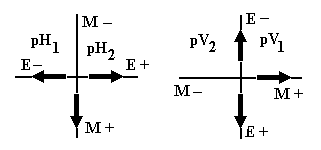
The alternating electric current travelling backward and forwards along the aerial surface produces a rapidly changing magnetic field in creating the polarized radio single. Looking at the situation in terms of a moving magnetic and electric vectors from the front and back at the same time (Figure 18-2), the resultant stress vector produced around the conductor caused by the moving electric/magnetic field along the conductor, should give a single resultant polarized wave.
Although two different polarization vectors are illustrated for both the horizontal and vertical polarizations with respect to the observer's position, front or behind, when the vectors are added, the results give an unscientific conclusion, because one of the resultant vectors is the same, that being pH1 and pV2, but this cannot be true. There is something that is obviously wrong, since the forward horizontal polarization is the same as the reverse vertical polarization, although the similarities and differences can be explained, the picture becomes rather dubious.
When one relates the component vectors of magnetic radiation and the various field types, the predicted effects do not occur, which suggests that the electric and magnetic vectors add together to form a resultant vector movement in the medium. However, when these vectors are put on paper, where models are drawn to explain any phenomena, the two vectors, the magnetic and electric components, do not work together, however they cause the surface effects indicating that they work together. Obviously, there is another process is working , a mechanism that allows propagation of the waveform, so that Horizontal polarization remains as Horizontal polarization in front of, and behind the polarized transmitting aerial.
To understand polarization, the geology of the Earthquake shows the S-wave to have just two components, the direction and the polarization. The signal intensity is carried by the degree of side to side or up and down motion for a given frequency, as a movement or stress reverberation. Thus the polarization is the angle where the greatest deviation or stress takes place.
Logically, the movement and intensity share the same axis, perpendicular to the direction of travel. If something is horizontally polarized, then the original deviation is horizontal, unless the signal is grossly reflected, but the actual moving stress forces are vertical.
There can be only one direction of stress movement, not two. It makes a great deal of sense that only one active vector is required, in simplifying the explanation of every surface effect. If the moving electric field initiates the stress, then the stress must propagate through the magnetic fields. The magnetic fields are affected by the magnetic vector, so it is not pH1, pH2, pV1 or pV2, so, it must be "M", the magnetic vector itself, the medium of propagation. The only medium that fills all space and matter is the magnetic medium.
Using this concept, many things, surface effects and the like, develop mechanisms. The mechanism of propagation seems simple enough, light and radio waves travel in this medium which permeates all space and matter, from atom to atom, reverberating each magnetic field of matter on a plane perpendicular to the direction of travel without being influenced by rotational energy. Equally, the P-wave would push-pull the magnetic fields in the direction of travel. Therefore the use of the term "electromagnetic" in relation to radiation is wrong. It is magnetic radiation.
Magnetic wave motion and magnetic radiation are perhaps far better terms to use since Science has a problem with electromagnetism. The electromagnet is a coil which creates single burst magnetic field events, when electricity flows or ceases to flow through it. This is confusing because one electromagnetic form develops a standing or controlled field in a local region as an electromagnet, while the other electromagnetic form is concerned with the electromagnetic wave motions that travel through the magnetic fields of all matter including those caused by a magnet or an electromagnet.
Christian Huygens (1629-1695) introduced a principle that states "all points on a wavefront can be considered as point sources for the production of secondary wavelets that fan-outward in all directions from that point." Each wavefront is the consequence of many billions of secondary events. At the point of contact where light strikes an edge, a secondary source of light is produced, radiating in all directions from that point into the shadow zone. Similarly, a synthetic shadow may be created through optical tricks, but where the wave-edge is no longer supported, the wavefronts radiate into the shadow zone. As this light is focussed in a telescope, the effect becomes a bright problem, a rather complex optical problem called diffraction, that seemingly is without solution. Explanations are poor , dealing more with the wave motion in the medium and avoiding all real connection to both the mathematics of focussing and atomic mechanisms. Diffraction establishes the limits of resolution for most optical devices, restricting magnification. There is no apparent cure, though there have been many attempts and optical tricks used to marginally improve the quality of the image. Telescopes and optical microscopes struggle to magnify an object greater than 1,500 times, due to the effects of diffraction. No optical trick has succeeded because the mechanisms were not understood.
A shadow is produced when the light strikes a boundary or an edge. Two forms of diffraction are identified in Physics, linear and circular. It may seem trivial but a straight edge produces linear diffraction and a circular aperture establishes circular diffraction. When a star is focussed in a refracting telescope, the circular aperture of the lens's creates circular diffraction appearing as concentric rings around a central disk. Any straight obstruction placed at any point in the optical path, infects the image with linear diffraction, appearing as a bright line radiating from the central star image, (the direction of the line being perpendicular to the direction of the edge). Reflecting telescopes often use a spider support assembly to hold the secondary mirror. If the support arms of the spider are straight edges, the linear diffraction produced is the vectorial resultant of all linear diffraction sources, forming a star image with stellate arms radiating from the central bright star image, between the spider's arms (see insert figure 18-3). In the human eye, tiny blood carrying capillaries are not seen in one's vision, however they do cause the brighter stars and planets to appear "star-like", due to linear diffraction. Everyone's eyes are different and each eye produces different degrees of diffraction, so every person "sees" an object, like the planet Venus, through different diffraction effects. Every person draws Venus differently. The stellate arms are very bright, hiding much fainter detail. Optical theory, particle theory and the Æther theory, all prove to be inadequate when discussing diffraction, for certain observed events remain mysteries. Both the image and vector diffraction image focus together. Lens Theory indicates that they should focus at different positions. The spectral composition of diffraction is the same as the object being focussed. The following illustration, figure 18-3 shows a curious effect noticed when a laser beam strikes an edge.
A linear fan is produced appearing as a fan of light identical in thickness to the beam's width, originating from the point of contact and radiating above, beyond, below and back from the contact point towards the source. Any optical laser or laser pen will illustrate this effect. But Huygens theory predicted that the light striking a surface would radiate in every direction, appearing as concentric spherical wavefronts. Since figure 18-3 is drawn from observations, Huygens concept is proven to be invalid.The point of contact produces an in-line re-transmission effect, as a plane along the direction of travel and perpendicular to the edge, originating at the contact point and radiating on that plane in most directions. Materials of different thicknesses and shapes, from the razor blade, to the edge of a rough piece of wood all produce fans of linear diffraction, when the edge is grazed by the light beam, irrespective of the edge's surface quality or its coating. The same fan structure is observed when the grazed edge, is part of a circular aperture, be it a ring or the edge of a lens. Therefore, there is only one form of diffraction, that being linear diffraction. A circular aperture produces uniform linear diffraction at each contact point around the circumference of the aperture, so that as the wavefronts converge along the optical axis of the
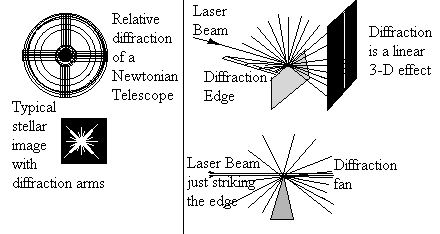
aperture, a vectorial resultant gives rise to an image where a star will be seen as a circular spot surrounded by concentric
rings having alternating directions of magnetic stress. When this is understood, diffractors can be discussed. A diffractor is an optical device that focuses light using diffraction, without lenses or mirrors (such as a pin-hole camera or the grazing incidence camera), although some hybrid designs use optics and diffraction together to form an image. Optical edge effects need to be explained at the atomic level, but this will involve altering optical theory. A few minor corrections need to be made to optical theory before continuing.
Light passing through the magnetic fields of the air molecules, has two component vectors, the direction and the magnetic stress. The intensity of the light is the degree of magnetic stress, and this is responsible for two re-transmission limits where the intensity is too great, negating matter's ability to hold together during the transfer of intense light. The lower-upper limit merely breaks chemical bonds, while the upper limit shatters nuclear bonds. The same mechanisms apply in Geology, where rock strata is so severely shaken during an Earthquake, the rocks shatter and break. The upper limit is noted with a thermonuclear meteorite impact, where the environment surrounding the impact region is vapourised into sub-atomic particles.
No matter how irregular a surface may be, a magnetic cushion or interface develops between the surface and adjoining matter. In a vacuum, free-molecules are attracted to and attach themselves to other solid matter due to a gravitational-feedback effect at the local atomic level. This description will be expanded in the next few chapters. The close field proximity caused by so many atoms and molecules existing over the surface of a solid, reinforces the strength of the magnetic interface. The smoother the interface cushion, the less irregular magnetic coupling occurs, improving the optical coupling to the environment from the surface. A rough piece of granite (a jagged grainy grey rock), shows no apparent structure, and exhibits a high surface area to the air. When the surface is either polished or wet by water or an oil, the contact surface area is reduced, improving the optical coupling at the interface, to reveal unseen colours and structures. Any improved optical coupling increases the absorption and re-transmission of magnetic resonance into the environment and into the medium.
For the environment and the medium to be transparent, demands that both mediums must be resonant and capable of re-transmitting the waveform, direction and the respective polarization. A glass window may be transparent, but when there is a fog outside, the transparency is seen as translucency. Irregular re-transmission causes translucency. Propagation factors can make a medium transparent and opaque at the same time, (transparent to all circular polarization yet opaque to either vertical or horizontal polarization.) As the alignment of the surface fields permit several degrees of field movement and reverberation, the alignment can also restrict certain vibrational planes and resonances; (solidified black bituminous tar is very reflective in sunlight (often called glare), however the tar strongly polarizes reflected light due to its surface interface re-transmission.)
Many other solid materials polarize the light due to reflection. In 1809, Ettienne Louis Malus discovered that light can become completely polarized by reflection. Sir David Brewster (1781-1868) then deduced that the refracted light will be similarly polarized at a specific angle related to the refractive index of the medium, but the refracted polarization is at right angles to the reflected polarization. At this point of time, light was considered as a corpuscular particle or a pressure wave, but Huygens' belief related light to P-waves, just like sound, but sound travels around corners, so several mysteries developed. Around 1816, Augistin Fresnel and Dominique Arago attempted to cancel out light using the interference of two polarized light beams, but these failed to interfere, creating a bigger puzzle. It was not until Thomas Young's experiments in 1800 and 1817 that light was identified as a longitudinal transverse wave (an S-wave) that many of the mysteries were resolved, and the Æther theory became accepted, but mistakes became accepted as fact.
Most Physics and optical books do not use the words, horizontal and vertical, in defining light's polarization, rather the situation is left to one's interpretation of the various texts as assumptions are made concerning the alignment and structure of matter. Common glass is formed when a homogeneous mixture of Soda ash, Lime and Sand, is super-heated and cooled, forming a transparent super-cooled-liquid, but it still remains a solid. Irrespective of Chemical theory, a chemical reaction does take place in the formation process, since glass exhibits all the properties of a material different from its components and does not return to those components. Glass may be heated and cooled very slowly without returning to its components or becoming taking on different crystal shapes. (The giant glass mirror used in the Mt Palomar telescope was cooled over almost two years.) Glass exhibits common polarization effects, indicating a regular molecular structural change. When a non-polarized beam of light strikes the surface of a block of common glass (where the refractive index = 1.5) and where the angle of incidence (with respect to the normal) is the Brewster angle (56.3°), the reflected light (figure 18-4) is polarized and is considered as having a perpendicular polarization (the senkrecht) where the s-component has a magnetic-stress vector parallel to the plane of incidence, (a perpendicular electrical polarization,) while the refracted beam at this point exhibits the p-component (a parallel electrical polarization,) with a perpendicular magnetic-stress component plane.
Covering the surface of the solid is the magnetic cushion, and as a light beam grazes the surface, the cushion will respond like a wheat field responding to wind gusts, where each magnetic field cushion acts as a secondary source of radiation, from the in-line direction to angles above and below the direct path. The diffraction fan produced above and behind the edge is polarized while that on the source side is non-polarized.
This does not mean that a polarized filter will reduce the diffraction, for each molecule in the shadow zone also responds to the vibration plane. At the edges of the edge, the molecular cushion fields have more freedom and are intimately connected with more air molecules allowing a greater bending of the signal around the corner into the shadow zone, however, when these are removed by optical tricks, the edges of the illuminated path is unsupported, whereupon the edges of the beam stimulate resonance in the neighbouring molecules due to magnetic coupling. This situation is far more complex than experiments in a wave tank reveal, for other sources of diffraction are becoming evident.
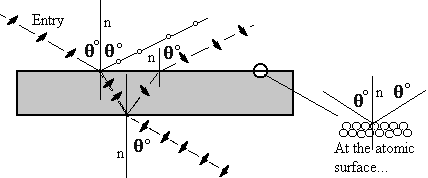
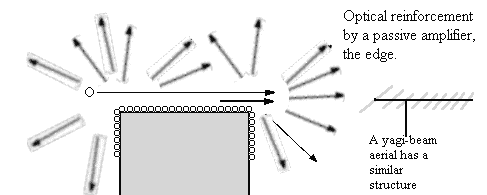
Even when optical tricks are used to strip away the edge effects, the re-transmission of the unsupported edges initiate a direct line resonance parallel to the beam and produce an in-line direct path resonance between the object and the focus that amplify the effect. Optical tricks can be applied to reduce the diffraction, converting linear diffraction to circular diffraction, but this is a no-win situation.
Diffractors at this moment come into their own, for the best way to defeat diffraction is to use diffraction as the focussing method, however, diffraction is chromatic, where each wavelength creates a different focal point. The pin-hole camera produces an image where the chromatic effect is opposite to that of glass. Amazing at it seems, a marriage can be made with optics to produce an achromatic image; a single element lens causes blue light to be focussed neared the lens and red light further away, as the diffraction from an iris mounted behind the lens can cancel out much of the chromatic effects, with red is diffracted more than blue. A poor quality wide angle lens can reveal crisp clean images when a square iris is positioned in the focussing cone of light. This optical trick was used in some aerial cameras made during World War II.
Some strange optical effects are observed when one looks down a long aluminium pipe. Placing a circular slit at the aperture can turn the pipe into a diffractor, as grazing incidence optics transforms the pipe into a lens to focus the light. In acoustics, long thin pipes of differing lengths are placed side by side and directed onto a microphone. The shotgun-microphone is highly directional, being able to resolve a single sound source, like a person talking across a crowded room where many people are holding conversations, because it uses "fly's-eye optics". It is possible to produce a highly magnified image using this technique where individual signals from sensors in the interferometer are combined, but they are not viewed in real time, rather, the image is built up through synthesis, where as the instrument rotates, a region of sky in scanned, so that each scan crosses the sky in a different direction and where they all intercept, the point can be magnified. Another scanning system is the single slit interferometer, where the brightness of a field of view is detected through a long slit as the field passes-by. Equally, the slit can be made to move, building up an image of the object. Although sometimes used in Astronomy, greater use is made of it in the X-ray department of most dental hospitals, to X-ray the complete skull. Scanning slit synthesis techniques work without using lenses, and may reach levels of resolution and magnification better than normal optical devices. The Mills cross uses two scanning slits as a fixed position, fully steerable interferometer. The aerials of the Mills cross do not move, for they are cemented in place. The telescope is steered by changing the phase relationships of the aerials. There is still a great deal to be explored using diffraction as a means of focussing images.
Perhaps the author's favourite aerial system is the micro-pencil-beam coaxial dipole, where the coaxial cable becomes a highly directional slit viewer. The cable can run along the top of a long straight fence, but it is a special cable, cut into 95% half wave length lengths and connected to the next piece of cable, so that the inner core of the first joins to the shielding of the second, and the first's shielding joins with the inner core of the second, along the length of the fence. The more lengths, the narrower the beam and the greater the resonance in the cable. Sounds crazy, but it works. The slit is actually a super narrow disk, absolutely perpendicular to the direction of the cable, however the horizontal mounting of it means that the Earth truncates the disk. As the Earth turns, the slit receives all signals from across the sky. A second parallel cable, mounted atop another distant fence allows the aerial to become steerable through phase shifting the two signals. The primary
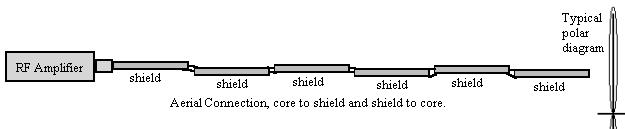
There is a great deal which needs to be explored in this exciting area of Physics, for diffraction has been neglected due to the lack of any reasonable explanations, for both light, and diffraction.
1. "Love is in the Earth A Kaleidoscope of Crystals THE Reference Book Describing the Metaphysical Properties of the Mineral Kingdom" by Melody. Earth Love Publishing House 1991Return to Calcite
2. Physics for Students of Science and Engineering. Part II, Resnick and Halliday, John Wiley & Sons Inc.,pp 975 Return to Resnick