 |
CHAPTER TEN
ENERGY - FORMS |
 |
|
CHAPTER TEN
ENERGY - FORMS |
|
The aim of this chapter is to define the term "energy-form", as distinct from "energy". In pursuit of this aim, the electric field will be examined. Current electrical theory states emphatically that the electric field is a sub-atomic field in origin, even though Science has no idea what causes this field when much experimental evidence is ignored and explained-away, such as the fact that the electric field structure does not form in common water. Observational illusions will be identified. This is a case of not knowing what one is actually observing, so blinkers are used to preserve the theory and the mystery. Later in this work, the electric field will be fully identified as a molecular field where magnetism changes the nature of molecules, the alignment and properties of matter in producing a force.
It is important to realise that the electric field cannot be nuclear in origin, for under normal conditions it has no longevity. Conventional theory states that matter, having gained or lost a quantity of electrons, develops a charge. This is not always true, for un-charged neutral matter develops a relative charge, opposite in polarity to a nearby charged body. At the atomic level, atoms and molecules develop an altered magnetic structure, changing the alignment of molecules in the atmosphere and in specific solids. Unlike the magnetic field, the electric field exists as a monopole. A monopole is said to be a static field that radiates in all directions towards and away from the point of charge. This point of charge is the primary terminal. With no other charge about, the atmosphere acts as the oppositely charged default terminal. Freedom of movement in the atmosphere allows a bidirectional molecular motion to be initiated, where the air molecules physically move towards and away from the apparent monopole.
The charge is relative to the local environment, in that the effective field strength is dependent on the relative potential difference and charge concentration to the surrounding environment. Once the charge on the charged-point has leached away, or the local environment reaches the same potential, the field ceases to be. As the neutral atmosphere surrounds the monopole, it becomes the medium of propagation and the field itself where the air molecules align in certain directions to carry and distribute the charge. Only when an oppositely charged body is introduced into the space of an existing electric field does a dipolar field structure develop.
The nature of this dipolar electric field is different to magnetism for molecular flows can produce a point to point structure, rather than the directed flow-field structure seen in both magnetism and normal fluid dynamics (a flow of molecules between the intake and exhaust). In Nature, point to point fluid motion is often seen when certain conditions prevail. In most fluids, point to point structures are identified in the whirlpool and tornado where a swirling rotating Eddy across the surface reaches a break-out point, throwing the vortex of the tornado in a perpendicular direction to the rotation. In the case of the electric field, the spark breaks-out and jumps between the stress-points of oppositely charged terminals. The spark does not travel in straight lines, rather it shows the path of the vortex and its associated rotational distribution, by linking molecules in straight lines with abrupt directional changes.
The terms permittivity and permeability apply to the environment through which the electric field exists. Matter restricts and limits the motion needed to form the electric field. Observations reveal that electric fields pass rapidly through a vacuum but slowly through solids and liquids. The shape and strength of the electric field is dependent on the relative available charge, the density, surface area and structure of matter. Many observational illusions take place because this field is molecular in origin. One of the classic illusions confused Lorentz, where at extremely high voltages, the electrons pass through a vacuum at speeds near that of light. Owing to the disparity between physical observations and electrical theory, Lorentz could only suggest that as the electrons approached the speed of light, a time dilation effect occurred, where time, not matter, slows down. Since his time-dilation mathematics seemed to fit with the observed events, Einstein in the mid-nineteen-twenties introduced the effect into the Special theory of relativity, placing a finite upper speed, the speed of light on all things in the Universe. Many questions were left un-answered due to misguided scientific theory. Before such a radical notion of altering time can be accepted, all the unanswered questions concerning conductivity and the molecular field must be answered. Science cannot explain the mechanisms or processes that permit the propagation of electrons through matter. To explain electricity means looking elsewhere in Nature for the answer, to examine matter differently.
In the most pure distilled water, the electrical resistance is so impressively high, it is considered as a very good insulator. Every chemist will state with overwhelming conviction and confidence that electrolysis is not possible in pure water, due to this insulator effect. However, water is Nature's Dr. Jekyll and Mr. Hyde molecule. The advertising language preaching the importance of household safety switches states that water is a dangerous conductor of electricity, being the single most important cause of fatal accidents around the home. This form of water is not really water, although it is water. Such a remark may seem very Irish, but in such situations, even distilled water's crystal shape is chemically altered, due to the presence of other matter, changing water's alignment and effectively reducing the electrical resistance. Suddenly, distilled water becomes a most dangerous electrical conductor. It is therefore necessary to attempt to perform electrolysis on pure water, an experiment designed-to-fail. The question must be put, "What will it fail?"
The hurdle that must be overcome is the purity of distilled water. Most distilling procedures use a water jacket to condense the steam into water. The method works well in refining basic distilled water, but this is far from pure-water. Such procedures introduce atmospheric contamination, since the water drips from the end of the distillation tube into the water collection bottle, dissolving air. In this designed-to-fail experiment, the procedure initially demands a reasonably high purity of water and cleanliness. Each experimental phase requires two (2) litres of pure water. To obtain such quantities requires distilling already distilled water. The distilling method could be radically changed to increase the purity. To keep as much air out, the air and condensed water must be chilled to a temperature of less than 2°C. Even when establishing the experiment, the water should be freezing cold.
To refine water to an almost pure state, (figure 10-1) one must bring distilled water to the boil in a semi-sealed glass beaker, so that the steam passes down a freezing cold Pyrex tube through an ICE jacket. A safety pressure valve must be fitted to the first flask to prevent it exploding, if the outlet tube freezes. The steam will solidify and slowly slide down the tube into a second sealed chilled flask (maintained at below 2°C), thereby preventing atmospheric attack.
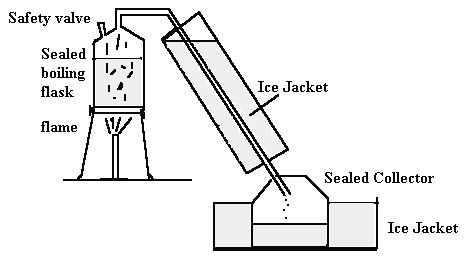
Figure 10-1 Device to purify distilled water
Once 200 mL of icy water is obtained, disconnect the second flask and slosh the water around the flask to remove any contaminates. Dispose of the "used" water. Reconnect the flask and continue to collect the frozen water. Once full, seal with a stopper and keep it refrigerated. To test the purity, place a small quantity of water into a chilled clear container, being careful not to contaminate the sample with air. Freeze the sample till solid. The ice block formed should be as transparent as optical glass without any cloudiness, striae or air streaks. Each phase of the following experiment will require a relatively stable environment for a week or two. The kitchen or garage can become the laboratory, however, if one is going to cook a roast or make chips, be careful to avoid contamination by atmospheric carried oils and greases. The importance of the experimental results and conclusions reached are paramount, for the observed will change chemical and electrical theory.
THE DESIGNED - TO - FAIL WATER EXPERIMENT.
This experiment is the doorway into Nature's Chemistry.
Rather than designing an experiment requiring calibration, measurement and testing, the experiment is chiefly observational, in that one merely needs to observe the physical changes taking place. If so desired, calibrated measurements can be made, to confirm the observational results and conclusions presented in appendix four. As the observations need only to be made once every twelve or twenty four hours, this should not burden one down with un-necessary involvment. One could even film the experiment using time-lapse photography. Once set-up and running, the experiment must not be moved, upset or jarred until the experiment is completed.
Distilled water can be obtained from most super-markets, service stations, and auto-spare-parts stores. This water may not be to the purity required. The experiment will work with normal distilled water, however some profiteers, market and sell, tap and filtered water under product names such as "Pure Water", "Demineralised", "DISTILED" and "DIS-TILLED WATER"(sic), even though there are laws concerning false advertising and product labelling. True distilled water can be produced in any kitchen with the minimum of fuss (unless under threat of divorce). The testing procedure can be used to test the quality of any water product, for each chemical impurity reacts to produce chemical fingerprint deposits that can identify contaminates. Water product testing, demands that the water be tested "as-supplied". Only then can manufacturers be challenged and litigation proceedings begun.
Required in setting-up the experiment (illustrated in figure 10-2) is a source of electricity, 12 Volts DC at 200mA to 750mA (nothing too sophisticated; any 12V DC power-pack or model railway transformer-rectifier can be used); a capacitor (1000mF at 20Volt) is needed to smooth the electrical flow; a good multimeter (ohms, Volts,Amps, frequency) ; a pocket torch; a note book; wire cutters; a cigarette lighter; and a pen/pencil. Each phase of the experiment requires two clean optically transparent small spice-bottles (new, not used, straight sides, not fluted); a clean 2 Litre glass beaker or a glass fruit/salad bowl (15-25 cm diameter) with high clear vertical sides; half a metre of cling-wrap; a fresh pair of rubber gloves; two small adhesive labels and a fresh metre length of common insulated light gauge multi-stand twin core Copper loud speaker cable, (AKA 4 to 8 Amp light duty power cable). So, 5 metres of 14 or 16-strand twin core speaker cable is enough to complete the first ten experimental phases. (Note: to take this experiment to its very limits, use 24-strand twin core 15 Amp power cable, and a large volume (>200 mL) Hydrogen collection bottle.)
Separate the 5 metres of twin core wire into two single 5 metre wires. These must be cut into metre lengths. Hold a single metre length of wire in one hand and with the lighter flaming, at about 2 cm from the end of the wire, warm the plastic insulation material so that the insulator can be softened and stripped away, exposing the bare Copper strands. This method prevents the Copper wire being cut, damaged or nicked. Twist the strands into a single core. Carefully trim any burnt material from the insulator and place the discarded insulator material in one spice bottle for the moment. Tie a knot near the end of the wire, about 3 cm from the bare insulator and attach a label just below the knot. Do the same for the other end of the wire. Write on one label, the positive symbol (+) and on the other the negative symbol (-). In one hand, hold both knots so that the wire forms a "U" shape. At the bottom of the "U" cut the wire forming two equal lengths. Again use the lighter to warm the plastic insulator material about 5 cm from the cut point to expose 5 cm of bare Copper wire. The priority must be to avoid contamination from this point. Do not touch the bare Copper wire with bare fingers. With gloves on, carefully twist and form each of the bare Copper lengths into small flat spirals, small enough so that each will fit neatly inside a spice bottle. Each spiral will become an electrode.
Most commercially available wire is not pure Copper, so this method of turning the central region into the electrodes is to ensure that whatever the material, both electrodes are as close as possible to being almost perfectly matched in terms of composition. If one wants to be really precise, weigh the dry wires to an accuracy of 0.0001 grams for something unexpected will be noted when the wires are dried and weighed at the procedure's conclusion. The standard spice bottle has a 75 mL capacity. Each spice bottle can be calibrated before the experiment by filling the bottle with water, then using an air filled syringe to inject air into the bottle, displacing this water. Most syringes are calibrated by the manufacturer For health reasons, never trust a syringe found in a park or on the side of a road. Please obtain a fresh 35 mL syringe from the pharmacy or a needle exchange. (There is no need to purchase the needle or butterfly attachment.)
With clean rubber gloves on, place the clean spice bottles on their sides with the insulator material in the clean glass container and add 200-300 mL of pure water. Rinse everything in the purified distilled water, including the electrode-ends of the two wires (Please do not wet the labels or the terminal end of the wire). Discard this water and rinse a second time with another 200-300 mL of distilled water, also discarding this water. Do Not Dry! The philosophy here is that if anything at all is contaminated, then all will be equally contaminated. With the exception of the wires, place all the components in the glass tank. Pour the remaining freezing cold litre of water into the container, submerging the spice bottles. Very carefully remove all the air from each spice bottle by holding them under the water level and with the gloved finger, pump and flick the remaining air out.
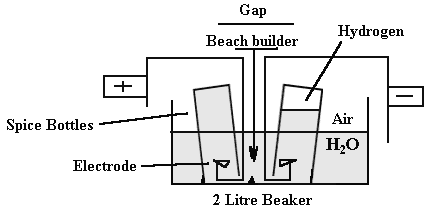 12-16 volts DC
Figure 10-2 The apparatus for the Electrolysis of distilled water.
Phase 1.
Carefully stand each full spice bottle upside-down in the water and insert an electrode under each bottle's lip, so that the water-filled-bottle rests on the wire forming a wedge-shaped gap (figure 10-2). When standing up, half of the spice bottle should be out-of-the-water. Balance and align them like two leaning towers, tilting away from the centre, so that the two gaps are directly facing each-other and separated by 3 cm. If a tiny amount of air, a tiny bubble a few millimetre across remains in the upside-down spice bottle, don't worry too much; just note the shape and size of the bubble. Once the bath reaches 5°C, it will dissolve all the air it can at the surface interface. The water should be returning to room temperature, so care must be taken to avoid dissolving any air.
A 3 cm gap separation will present some good results. It will still take about 110 to 130 hours to complete this phase of the experiment. (Note: The extended version using 15 Amp power cable takes about a month!) One could easily state that this experiment is as exciting as watching paint dry, however, this experiment takes longer and like a good paint job, the results are worth the wait. The greater the distance between the electrodes, the longer the experiment will endure. With a one centimetre gap separation, (a true electrode-electrode distance of about 2.5 - 3 cm) the velocity of the reaction will be so great, the completion time could be less than 60 hours. Since the reactions have so much force behind them, many of the observations will be obscured, for too much is happening in too small a distance in too short a time frame. During subsequent verification experimental phases,other bottle separations of 1, 2, 4 and 5 cm, can be used, to give a total of 5 phases. Although one only needs to perform the experiment once, the scientific method demands that all ten phases of the experiment must be completed (ie. 10 x 250 hours = 2,500 hours or about 5 months).
Place the two small pieces of the insulator material on the bottom perpendicular to and across the direct gap to gap path. The other two can be placed randomly on the same side, closer to the side of each bottle's wedge gap. The insulators side of the direct path will be considered as the precipitate beach-building experiment, while the other side (free of insulators) is the control side. Try to prevent the wires running across the bottom by bending the wires so that the weight of wire is held by the container's sides.
Stage 1. With the multimeter, measure the resistance of the apparatus. Connect the positive meter terminal to the positively marked wire terminal. The resistance should be from 40M to 100 million ohms. If the resistance is below 15 million ohms, the experiment has been severely contaminated and must be re-done from start with purified water. If one wishes to test the quality of a water product (tap, rain, mineral, stream, natural spring, demineralised, etc.) low initial resistances are expected (from 30K to 20 M ohms) due to mineral, air and biological contamination.
Stage 2. Connect the capacitor across the power supply's connections (positive to positive and negative to negative). Turn on the power supply and with the volt meter, confirm that a voltage is present. A ripple 12 Volt supply should provide a smoothed voltage of around 16 Volts. Measure and record this air voltage across the capacitor before connecting it to the apparatus. One could attach the meter in the circuit, to measure the electrical current (a series connection between the capacitor and one electrode) or as a voltmeter (a parallel connection across the capacitor and both electrodes.) Now the fun begins. Connect the positive power source to the positive terminal of the apparatus. Connect the negative source to the negative terminal. The experiment has begun. Write down the time and date.
Again measure the voltage and it will be seen that there is a voltage drop, indicating that something is happening, for electrons are definitely flowing in the bath at a rate greater than would flow through an equivalent resistor. This should not be the case, for the resistance is so high, yet the measurement shows a steadily increasing voltage drop and increasing current. A close examination of the negative and positive bottles shows absolutely no activity. Cover the bowl with cling wrap, being careful not to rock or disturb the wires or the bottles. The cling wrap is there to keep atmospherically carried particles and contaminants out, such as oils, dust and grit that may inadvertently cause some conflict. At this point, walk away and let Nature open up the doorway to her Chemistry.
The bowl will quickly reach normal temperature so atmospheric contamination will occur, but this does not matter since the experiment is operational. Leave the experiment alone and return in 12 hours to make the first observations. Don't be alarmed if everything looks pristine, as if nothing has transpired. Carefully lift the cling-wrap, but do not fully remove it. Although everything looks the same, there is something different. A very tiny bubble will be observed in the negative bottle. One may think that the bubble was in the bottle from the start. With the pocket torch, shine the light into the negative bottle, perpendicular to the direction of sight, whereupon rising very slowly, tiny star-like absolutely micro-minute bubbles may be seen. With any luck, a much larger bubble may be observed racing passed the small bubbles, perhaps one a minute. Peering into the positive bottle will show no bubble activity at all. Shine the torch towards the collision zone between the gaps where a very faint, almost transparent, rich blue precipitate smear may be noticed. The appearance of the bubble confirms that the experiment is working. Carefully replace the cling-wrap and walk away. That is all the first observation requires. Come back in twelve hours.
With just three primary ingredients in this bath, Hydrogen and Oxygen from the breakdown of water, and the Copper from the destruction of the electrodes, then, the molecules formed can only be combinations of these three elements and perhaps any other contaminants contained in the metal, water or from the air, Oxygen and Nitrogen. As the contaminants in the initial bath should be less than 1 in 100,000,000, these should be quickly dumped. If the contaminants exist in the Copper wire, other very pretty colours (greens, violets, oranges etc.) may be seen along with the blues, browns and yellows of the Copper Oxides, Hydrides and Hydroxides. Each Copper molecule has a unique colour. Once the conditions are right, insoluble materials are dumped, soluble molecules will travel throughout the bath as whole molecules in solution.
The other major contaminant are atmospheric, but don't worry too much, for this will prove beneficial later in identifying certain Copper molecules, which when exposed to dissolved Oxygen change colour. Only in the very initial stage is this Oxygen a problem, for it will disguise the events taking place. Oxygen and Nitrogen will be stolen from the air once the water temperature increases above 2°C. The beauty about this experiment is that each Copper molecule has a precise fingerprint colour, making it possible to identify the key molecules without elaborate testing. Some molecules have such an aversion to water they form nodules, beaches, or crystalline tree-like webs. Confusion can still exist due to colour recognition and changes in the density of precipitates. As the experiment progresses, colours may mix together as two or more precipitates are deposited as a mix. A degree of evaporation from the water bath will be noted, increasing the solution's concentration.
BEACHES AND COLOURS
The deposition of precipitates grow as beaches and channels across the bottom, especially against the insulator materials and at the base of each bottle. Each spice bottle must be considered as a pump, drawing in water and pumping out both Copper laden charged molecules and water. Once the reaction establishes itself, dissolved molecules, (not ions,) held by the water will travel from one electrode to the other. Between the two wedge gaps is the collision zone where beach deposits should form. Most good general Geography and Geology books cover beach growth and sedimentation development, so read these and compare the observed with sedimentary beach building theory. The position, shape and size of each beach will show the direction, velocity and quantity of the deposits carried across the bath.
Some of the following coloured precipitates may not eventuate, however it is best to know of them, just in case. With each precipitate, the position, colour and colour changes assists in identifying the molecules involved. Cu2O is either a rich red or a dull-red insoluble material. CuO2 is a deep yellow-brown, however, in solution it is an aqua colour. Its sister oxide CuO is absolutely black. The three blue colour precipitates are the hydroxides (i.e. they contain OH).Cu(OH)2 is a rich blue, CuOH is a light blue,while the extremely pale blue molecule is CuH2O2 (or CuO:H2O). When heated or exposed to water for some time, the CuH2O2 molecules decompose to a heavy dark-brown colour. The Yellow deposits are CuH while the red-brown deposits are Cu2H2. When considerable concentration of CuOH and Cu(OH)2 turns the solution a milky-blue, Cu2O will begin to be deposited. The saturated conditions causes the light blue molecules to be dropped from the solution, however, in the more vigorous phases, (at separations of 1 and 2 cm) the reaction speed is so greatly increased that the milky translucence of the bath hides many observational effects. Some molecules will attach themselves to any vertical surface in the bath. Others will form a scum on the surface. Cupric Nitrite Cu(NO3)2:3H2O is very deep blue in colour.
This experiment is enchanting for it shows a real marriage between the principles and laws of Physics, Geography, Geology and Nature's Chemistry taking place in the apparatus. Where else can one expect to see the natural sciences working together in such accord, in such harmony? The answer to this philosophical question must be everywhere in Nature, since all things in Nature work at the atomic frame of reference, as the cause-and-effect of reactions are intimately related, directed and guided throughout the Universe by the laws of Nature at the atomic level. These laws are unwritten laws, used by mankind to explain all manner of phenomena to do with the interaction of matter. The observational results are continued and discussed fully in Appendix 4. Although the description is factual, there may be subtle observational changes between any two identical experiments due to relative environmental differences.
Each phase of the experiment will take from 60 to 250 hours, perhaps longer to complete and there could be as many as ten phases. The faith of many will be both tested and shaken, if not shattered when they observe just one phase of the experiment. If the reader does not wish to perform the experiment, knowing how the experiment works is important, since the explanation directly challenges the fundamental beliefs and theory of terrestrial Chemistry. In partially working, this experiment fails Chemistry. A great deal of debating and re-writing of Chemistry will result from this experiment, for it plunges the wooden-stake, deep into the heart of the entire electrochemical theory, the very foundation of all humanity's chemical theory. To find out exactly what happens, read Appendix 4. Certain statements and conclusions made in this section are as a consequence of the results. The concept of "ions-in-solution" is herewith abandoned, for whole molecules are observed. Such observations are in total opposition to the accepted beliefs of Chemistry.
This experiment may be used to test natural spring water and other water products. The more contaminated the water, the more milky the solution becomes. If ordinary "distilled water" is used without refining and the reactions cause the bath to become very cloudy in a short time frame, such as in 24 hours, one should challenge the credibility of the manufacturer, for their product is severely contaminated. Similar experiments with tap, filtered, sterile, mineral and demineralised water may reveal the manufacturer's water source. Tap water contains a great deal of Chlorine (giving green Copper precipitates) and traces of Fluorine, so it is possible to identify fraudulent water products, merely by noting the colours of the precipitates and the gasses released in a certain time frame.
In this experiment, Oxygen gas will not be released by the positive electrode, unless the water is contaminated by a salt, Chlorine or Fluorine. Two litres of distilled water may sell for $1.80, while natural spring water can sell for as much as $5.00 a bottle, when the truth be known, that their product is nothing more than tap water costing $ 0.03 per litre. Motor vehicle lead-acid batteries demand distilled water, not demineralised water. The presence of Chlorine (indicates tap water) or Sodium (Sea water) will greatly reduce the life of a lead-acid battery. Many service stations provide a special distilled water bottle for re-filling the battery, however, tests show that 60% of these are filled with chlorinated tap water, thereby voiding the battery manufacturer's warranty. But service stations do have vested interests since they sell expensive replacement batteries. Use only distilled water to re-fill a lead-acid battery. Buyer beware! Be alert! Be aware!
In the Ice experiment (as described in Chapter two,) it is the first experiment to show something is amiss in Chemistry. Even at the extremely low voltage of less than 0.05 Volts, there is an extremely active field between the terminals of the solid ice-Salt-cell. One rarely considers the low voltage electric fields, unless dealing with capacitance effects in an electrical circuit. The ice experiment produces marked corrosion inside the cables, and this is directly related to the very active low voltage electric molecular field. Salt crystals take from one to three months to become noticeable on the ice cell's electrical terminals as the Copper wires inside the cables completely corrode.
Analysis of the Ice experiment supplies reasons for a battery's "shelf-life", the corrosion of battery leads and the designed-obsolescence of computer mother boards (where the batteries used to maintain the BIOS and clock settings, after 18 months corrode and leak causing a serious computer failure. Often the leaking battery acid attacks, and destroys the expensive mother board.) What many fail to realise is that even in a small radio or amplifier, the capacitates transfer signal levels where a change in voltage of just one electron can be detected.
Any discussions involving the processes and mechanisms observed in this experiment requires defining the energy-forms. When one understands what an energy-form is, some would consider such a definition as a difficult task, since there are so many energy-forms that exist. Each energy-form is the means of propagating energy so the definition must be in two parts, where the first part covers the general means of energy propagation from matter, through matter, while the second part deals with the specific mechanism, to influence other matter. Energy is propagated at different speeds through mechanisms involving different processes. Often, one reads comments about the speed of light and the speed of sound, but rarely is the speed of heat mentioned. All such speed measurements are subject to restraints in the medium, the energy applied as a force and then the positional change is relative to other local matter, where in a given time frame, the object or the energy-form has moved from one relative position to another relative position. In some situations, the energy is propagated through a medium, without causing motion in the medium.
People identify heating reactions as slow reactions with diverse origins, just as they do with light and sound. Heat travels through a fog, while light does not. Heat and sound seem to travel around corners, appearing to obey different laws to those involved in the propagation of light. But then heat is transferred or liberated through numerous processes at different speeds using infrared radiation, motion, impact, particle radiation, friction, mechanical means, chemical activity, wave motion, pressure, stress, strain, resonance, electrical flow, resistance, magnetic changes, convection, and conduction to name a few. The mechanism involved introduces specific processes that affect matter, to produce effects in other matter.
The sheer diversity of the energy-forms involved in the Ice and the designed-to-fail experiments, intimately links Physics and Chemistry. Playing an important role in each energy-form is the chemical bond, for it can be formed, stressed, compressed, twisted, altered, broken, aligned, shifted, re-positioned, locked and moved. Magnetic bonds do not necessarily need to be full chemical bonds, as a magnetic spill can hold and align matter in a crystalline form. Even the atmosphere is crystalline in Nature. Without the correct model of the atom, many energy forms cannot be explained. The reactions and processes observed in both the Salt-Ice and designed-to-fail experiments are extremely complex when the total picture is contemplated, however, when a modular approach is taken, the complexity is replaced by Nature's simplicity. All chemical reactions take place in three dimensional space and involve three dimensional structures.
Unfortunately, science gives many names to the same processes, without appreciation of the energy-form's energy source or mechanism, the processes or the mechanism. Objects that liberate light after the source of energy is removed, have fluorescence, while those that remain hot can exhibit low conductivity, while materials that still liberate sound have residual resonance. To complicate matters, some materials naturally fluoresce, whereas heat and sound can be either liberated or absorbed during a reaction. As Heat and Light were considered as different, many understand them as unique and different energies. Demanded here is defining the absolute boundary point, a barrier or energy range that distinguishes exactly the point separating potential and kinetic energy. These are not energy-forms, they are energy types.
Consider, a moving body such as a stationary heavy 150 Kg wooden dining table, sitting firmly on the floor. This motion is not a contradiction. It is real motion. The table has a great deal of kinetic energy, even though it is apparently stationary with respect to the local environment. Effectively, the table is saturated with potential energy. Any stationary object on the Earth's surface is moving with considerable rotational velocity. The 150 Kg table exists inside a uniformly moving environment, which, depending on one's latitude and altitude can be travelling at 1,500 Km per hour (416.6 m/s) around the Earth's axis, some 33,350 Km per hour (9,263 m/s) due to the orbit of the Earth around the Sun and about 80,000 Km per hour (22,222 m/s) around The Galaxy. At the time of writing, the recognised speed measurement for The Galaxy in the Universe has been asserted in the scientific community as being around 600 Km/s, or 2,160,000 Km/h (towards the Great Attractor). This assertion is not a proven measurement, so it can only be used as a means of forming a general approximation. The dining table has more kinetic energy stored as potential energy than initially contemplated.
As KE= ½ mv2 ,then
0.5 x 150 Kg x (600,000 ± 22,222 ± 9,263 ± 416 m/s)2
.
= 0.5 m ( 600,000 ± 31,900 )2 ... 8A.
= 0.5 (360,000,000,000 ± 1,017,610,000)
~ 180,000,000,000 Joules Watts Newton/metres/second
This huge figure is the available energy due to relative motion with respect to what must be considered as the Relative Universal Stationary Position, (as all measurements are not Earth relative.) Such a figure would be a fraction of the energy liberated if the table impacted with a true-stationary object, for the calculation does not consider any other energy-form involved, such as rotational energy, nuclear bonding energy, chemical energy, etc. To bring the table to absolute rest in a straight line without impact, demands some kind of braking or speed reduction mechanism, where energy is applied in the short term to slow the object, compensating for all rotational components,(else the table will spin so rapidly, chemical bonds break.) The equation "8A" does not consider the differences in rotational energy across the table though there are minor difference in 3-D position. Some will say that the rotational forces are minimal, but the mathematics of rotational energy illustrate an awesome bottom line energy figure, many times greater than the calculated Kinetic energy (linear-motion-energy). Any form of linear braking would require at least that much energy to be applied merely to bring the table to the absolute stopped position.
In chemical energy terms, the impact of the table against an absolutely stopped object would be exothermic. Slowing the object could be seen as exothermic, even though it is actually an endothermic process, for energy must be applied and absorbed, or released into the environment from the table in order to bring it to rest. This endothermic process is not adding energy to the table, rather it is cancelling the table's energy, however such energy cannot be retrieved at a later time. As the table is slowed, magnetic throughput introduces a drag, which, even after the table's motion ceases, will cause heating and re-alignment effects where the table rapidly absorbs energy from the local moving environment. Once the table reaches the absolute rest state energy, any mechanism used to accelerate the table is truly endothermic, when this may involve the same exothermic mechanisms that slowed the table in the first place. Even after a great force has been applied, the velocity of the object may be less than the local environment, so the object may seem to be travelling in the opposite direction to the environment. Newton's equation refers to the energy released if the object was brought to rest, but what is "rest" actually relative to? Is it Universal-stopped, local-stopped or object-stopped?
Here, the local environment is moving faster than the object. The velocity between the object and the environment is the relative portion of Newton's equation, so the available energy is relative between the specific objects in a single frame of reference, not an external one. This is what relativity is all about, determining the particular frame of reference where observations and calculations become meaningful. The equation relating everything to the universal stopped position, would involve using the absolute value (ABS) of the difference in the two velocities squared, or ABS (v12- v22 ) , where v1 is the velocity of the environment and v2 is the velocity of the object. Object-relative equations need only use (v12- v22)2. For the non-mathematician, the absolute value is always expressed as a positive value, so the ABS of 2 - 4 equals two, not minus two. Often this is identified in an equation using the pipe symbol as brackets, such as when subtracting four from two, but to always have a positive or real value. i.e. 2 = | 2 - 4 | (consider a car travelling at 40 kph, turns a bend to travel at 40 kph in the reverse direction. Its speed is still 40 kph, even though it went through a change of 80 kph, 40=|40-80|.
At a universal stopped position, the table will be buffeted by the local environment, especially if the table reached that position within the environ of The Galaxy's magnetic field. In this situation, the magnetic alignment of a compass needle would point in the direction of motion, not towards the Galactic magnetic poles. Matter is loaded by the local environment, and changes in that environment due to the motion of the environment external to the environment under test. This is substantiated using the claimed time dilation experiments made in the early 1960's, where three atomic clocks were used to prove the theory of relativity and claimed as proof of the time dilation effect. Actually, differential rotation altered the loading of the clocks. Add to this the fact that satellites in orbit above the Earth (where the environ is markedly different) does not suffer from the observed effects noted when the atomic clocks were flown at low-speed-low-altitude in opposite directions around the Earth. Compared to the stationary clock, one clock gained time while the other lost time. This does not mean that time changed, rather it means that differences in rotational energy from the external environment (the air) altered the loading in that moving environment (inside the aircraft) and it was this that caused the clocks to gain or loose time. Does time change when a clock is running at the wrong speed? If moving clocks distort time through time dilation then if one really wants to stop, bend and distort time, place a clock or chronometer in the middle of a road, then drive a fully laden road compacter or semi-trailer over it. The time will be bent and the clock will stop.This is the same affect, for loading any clock, changes the speed of that clock, not time!
So, when does kinetic energy become potential energy and when does potential energy become kinetic energy? To answer this question demands the amputation of the words Kinetic and Potential, for such terms are incorrect and deluded. Energy is energy, be it total energy or the available energy. Perhaps something could be said for the use of "potential". The problem is that the word "potential" is a confusing term, since it has several dubious meanings. Does the following sentence cover all the potential meanings of potential, its adverbs and adjectives?
Perhaps, the spurious meanings of the term "potential"presents science with a potential disaster, for such a high error potential potentially exerts a high potential as it is subject potentially to and depends on the definition's potential to discern the liberated potential energy-forms acting to raise or lower the potential, when involving higher potential outcomes as the probability potential is established for the potential energy forms, as distinct from the precise potential for each potential energy-form, at which point the potential difference can be measured potentially when not in the potential state, as it requires a state of imminent potential to do work whereupon the available energy is converted from potential to a force potential as kinetic energy, so that the full potential of available energy will be realised, but then is dependent on the relative potential state of the potential matters potential be it as an energy-form or as potential energy .
The trick in understanding this word salad is to substitute other words for each occurrence of the words potential (noun, verb and adjective) and potentially (verb, adverb). Be careful, for the phrases potential energy-forms and potential energy forms have totally different meanings. One refers to the forms of potential energy and the other considers possible energy-forms. Basically translated, the sentence reads
"Perhaps, the spurious meanings of the term "potential"presents science with an impending disaster, for such a high error probability may exert a high reluctance as it is subject sometimes to and depends on the definition's ability to discern the liberated differential energy-forms acting to raise or lower the force, when involving higher energy outcomes as the probability rate is established for the latent energy forms, as distinct from the precise ability for each unique energy-form, at which point the range difference can be measured if required when not in the quiescent state, as it requires a state of imminent probability to do work whereupon the available energy is converted from the latent to a force differential as kinetic energy, so that the full estimation of available energy will be realised, but then is dependent on the relative physical state of the various matter states be it as an energy-form or as available energy .
Each energy-form presents a specific energy availability for that specific energy-form depending on the mechanism, thereby giving rise to a measurable potential difference over a range from the starting-state to the final rest-state, if and when that energy is made available and is released or consumed. When released the energy becomes a measurable quantity. Other energy-forms may be released at the same time depending on the threshold level, but these are also restricted to the available energy range for that energy-form. Effectively, the latent energy of a system is equal to the total energies in the system, but this is only released when all the chemical and nuclear bonds break. The energy availability of a system is different to the system's total latent energy. The quiescent energy is the sum of the total available energies. Energy availability is dependent on and limited by, the compatibility, rate and direction which the energy-forms are released by a system and the energy in the surrounding environment, during compatible reactions. So then, the potential difference of each energy-form plays a role, be it through gravity, pressure, a voltage, chemical bonds or motion (as activity, a change in velocity or the speed of rotation) etc, which is of course subject to the amount of matter involved, and the type of reaction in that energy-form.
Contemplate that 150 Kg stationary but moving dining table again. Unprotected and left in damp conditions, the wooden table may be attacked by borers and termites or simple rot, to become part of the food chain, where its chemical energy is slowly released and biologically distributed. If the table is dropped from a height of 100 metres, many energy-forms are released, from that moment the table is released and begins to fall, to the moment after the impact where all the energy-forms reach equilibrium whereupon all motion and resonance stops. Energy is released into and is absorbed by the local environment, or it escapes into the surrounding environment. As the table drops, displacing the air produces an M-wave sound as it pushes air out of the way (drag) imparting energy into the environment while gaining energy from the environment as the gravitational-feedback energy increases. At impact, energy is released through numerous energy-forms, from the chemical energy released as chemical bonds are ripped apart, to heat, sound and possibly light. Subtle rotational energy changes across the table rotate and spin the fragments as they are flung outward from the impact site. The vertical motion is reflected by the impact site, opposing the trajectory. So much energy is liberated as chemical bonds are wrenched apart that other chemical bonds establish between the material of the impact site and the object.
After the impact has subsided, other energy-forms can be released from the fragments of the table. Suppose the fragments are gathered and burnt. The fragments now liberate more energy as heat, light, sound and a great deal of pollution. In the surrounding environment much of the energy is lost and rejected by matter. The flame could be made to pass through a thermocouple in directly producing electrical energy, or it could be used to boil water contained in a pressure vessel, producing steam to power a turbine generator or a pump. Sound, mechanical and electrical energy are released. Equally, one may burn the wood to boil the water in making a pot of tea or a cup of coffee. The wooden table, its fragments, ash and pollutants may be dissolved chemically giving off more energy. Perhaps the fragments or residue could be buried in the ground as fill, or spread as a fertiliser, allowing further chemical reactions to occur. With time, the table may even be petrified forming coal, oil, or diamond. So many energy-forms are released due to the processes involved and the rate of energy transfer. Even though the same processes may be involved, the different energy-forms produced, release the available energy for that energy-form at a rate dependent on the environment. The 457-Magnum is a mean hand gun, which when fired in the atmosphere releases a bullet that travels with great speed for a considerable distance. When fired under water, the range of a 457 Magnum is greatly reduced, to perhaps about 4 metres because of the resistance in the water.
Matter may or may not be receptive to accepting energy-forms. When receptive, matter on-passes energy to other matter. When non-receptive, the matter forms an energy rejection boundary, where the interface between matter rejects the absorption, conversion and transmission of the energy-form (such as an insulator or shock absorber). A massive ocean wave can crash into a tourist resort causing destruction, for the energy released through numerous energy-forms in a short time frame is substantial. Mankind's need for the resort's stability and longevity means investing in a sea wall to absorb, or waste the ocean's energy. Unfortunately, this strains the local marine environment. Through careful design, Nature can be used to solve mankind's problem. When the sea wall is replaced by an off-shore reef, the force behind the ocean wave can be absorbed, by both the reef and the volume of water held behind the reef, effectively increasing the resistance to transfer that energy-form any substantial distance. As the waves break over the reef, they put more water into the lagoon, causing it to flood because the water is pumped in but cannot escape. The spacing and shape of several parallel reef structures can reflect the wave back onto itself, causing an apparent rejection of the energy-forms over a range of frequencies. Reef structures are filters, and as such they have an electronic equivalent. By design, filters have pass-bands, rejection bands, and absorption bands. An inappropriate reef design can cause a filter circuit to become resonant, amplifying certain unwanted frequencies in the rejection band, leading to catastrophic results in the resort.
By far the most mis-understood energy-form is rotational
energy. The scientific banner name of this energy is "Angular"
and is used by physicists to describe such motion. It is a woeful
term, for it is confusing to many as it does not relate to the
real world. Angular motion is the academic way of describing
rotational motion. In the real world, people speak in terms of
revolutions per second (rps), while the academics rotate an
object through an angular distance (measured in radians) in a
second. The radian is an obscure angle having no real solution.
It is approximately equal to an angle of 57.3°. The angle is
called a natural angle since there are 2 radians in a circle. In general,
rotational energy equations are two dimensional in a three
dimensional Universe. Now, as has no real solution being approximately
3.14159... etc. In many ways, working in revolutions per second
is more user friendly in that certain functions have immediate
solutions allowing direct mathematics, rather than awkward double
conversions to achieve the same end. No matter which system is
used, the bottom line remains the same.
radians in a circle. In general,
rotational energy equations are two dimensional in a three
dimensional Universe. Now, as has no real solution being approximately
3.14159... etc. In many ways, working in revolutions per second
is more user friendly in that certain functions have immediate
solutions allowing direct mathematics, rather than awkward double
conversions to achieve the same end. No matter which system is
used, the bottom line remains the same.
For instance, what is the tip-speed of a CD measuring 12cm in diameter. A normal CD spins at 300 rpm (about 5 rps. The answer is the speed of the circumference. Many people do not realise the forces that are involved or the danger that exists in ten and twenty four speed CD drives. The distance a point on the tip would travel in one revolution is the circumference, so the tip-speed is the circumference times the number of rotations in a second.
Therefore 2 x 6cm x 5rps = 188.49 cm / s = 6.7858 Km/h
A ten speed drive spins the disk at ten times this speed, while a twenty four speed drive is really moving presenting a tip-speed of 162.8 Km/h. The disk may only weigh eleven grams, but it has sufficient energy to cut a person in half. Such speeds demand great respect for such is the speed of a low velocity bullet. A 32 speed drive (160 rps or 9,600 rpm) has a tip-speed of over 217 Km/hour. These drives take a great deal of time to spin up in speed and equally, to slow down. The physical forces involved would place most matter in the about-to-be-ripped-apart situation, where the centrifugal force away from the axis is just below the molecular bond strength holding matter together. As bullets can kill, so can the fragments of spinning objects. In the game of cricket, the centrifugal forces involved in bowling the heavy cricket ball over-arm, can dislocate a man's shoulder.
Although rotational forces will be treated in depth shortly, it is necessary to introduce some of the concepts at this stage to explain the relativity of different energy-forms. This will lead to a point where the infamous Michelson-Morley experiment can be put to rest, and the Foucault Pendulum explained with certainty. The problem in relativity is knowing which frame of reference is moving. On a bleak windy night, the storm raging outside is powered by the Coriolis forces, where the motion of the wind from the weather cells across the ground accelerates the wind to perhaps 170 Km/h. All wind speed measurements are referenced to ground-based observation platforms at the weather bureau. But is the wind actually moving, or is it the Earth?
Coriolis suggested that winds form as part of a convection cell above a rotating body. As the air moves from high pressure regions to low pressure regions they are deviated by the rotation of the Earth. As the wind is dragged around the Earth, it is hotter in the afternoon causing a pseudo low pressure region forcing all the Earth's weather systems to rotate faster than the Earth (from West to East). As the difference between the High and Low pressure cells increase, less and less rotation is picked up by the wind, so, depending on the direction to or from the equator, the wind will either travel faster than the rotation or travel slower, due to the relative speed of the Earth at each unique point of latitude. This makes for a classic case of relativity, where the observer blames the wind for all destruction caused, when it is the Earth's rotation that is the power behind the wind. It is not the air, it is the Earth!
The Earth's equatorial diameter is about 12,740
Km,
so the circumference is near to 40,023.86 Km.
As the Sidereal Day is approximately 23h 56m 04.1 or 86,164.1
seconds,
the equatorial tip-speed is 464.507 4 metres per second (1,672.226
Km/h).
At latitude 15°, the tip-speed is given by (Cos(15) x 464.507 4)
= 448.68 ms (1,615 Km/h),
while latitude 30, it is (Cos(30) x 464.507 4) = 402.277 ms (1,448
Km/h).
There is a 62 m/s difference between the equator and latitude 30, amounting to a speed of 224 Km/hour !
The wind may be travelling from the equator towards the pole, however, it leaves the Equator with a velocity of 1,672 Km/h, so as it moves into lower latitudes, it progressively travels faster and faster than the planetary latitude which is effectively slowing. Eventually, it reaches a point where the air is moving so fast that it is travelling parallel to the equator. The same applies in reverse to the poles, where the wind is spun from the polar mass, but here the wind rapidly falls behind the rotational speed. Eventually, it reaches a limit where the winds travel parallel to the Equator. This establishes two distinct bands per hemisphere, the tropics and the polar regions. Coriolis argued that these become self-contained systems, promoting the development of the temperate zones, as a sympathetic system between the tropics and the poles travelling in the opposite direction. With this, Coriolis described the World's weather systems.
The same Coriolis weather structure applies to all planetary and stellar bodies where the parent body is rotating. Inside the Earth, the parent body is the core. Surrounding the core is the liquid mantle. At the centre of the Sun is a core, and as the Sun is rotating, rotational energy is seen as sunspots and various latitude related rotational speeds. Every total Solar eclipse shows the Coriolis magnetic field produced by these moving cells. This will be further discussed in Chapter 14. These cells also occur with depth, and so, with depth, layers form. As there are substantial pressure differences, these layers initiate the magnetic reversals and changes in polarity of the Sunspots. This also explains magnetic reversals. On Jupiter, the rotation is so rapid ( 9 hours 50 minutes) that wind speeds of perhaps 350 Km/h are possible, for its atmosphere has separated into about 10 cells per hemisphere, and is possibly several layers deep. Saturn, Uranus, Neptune, Venus all have thick atmospheres showing various Coriolis structures. This motion categorically proves that the Universal Stopped Position is a real frame of reference, for the motion of all matter relative to the stopped position is identifying the relative universal rotational parameters.
It would be rare to discover any object in the Universe undergoing linear motion, unless that matter was travelling between two stationary positions. The Universal stopped position is identified in the explanations of Foucault Pendulum; the Gyroscope; the inertial guidance system and by way of the fact that all masses have rotational inertia with respect to a stationary position. All of these devices involve rotational energy. Any discussion of rotational energy reveals so many scientific mysteries that one must challenge the credibility of the sciences for not looking at the obvious. There are just so many energy-forms where rotational energy plays an important role, that it is difficult to think of one that does not.
This world is not flat. The planet Earth is a ball that spins about its axis as it orbits the Sun, while travelling around The Galaxy, and probably around The Universe. Yet, Newton's equations of motion involve pure linear physics,that is motion in a straight line. There can be no such thing as linear physics on the rotating Earth, or within this part of The Galaxy, for all motion is subject to the Coriolis effect due to differential rotational energy. Surely, linear physics must be identified as a knowledge virus of the first order, because most of Modern Physics is built on this linear foundation. A foundation built on the observational illusion promoted at the time by The Church where the teachings in 1700 still maintained that man's environment, the Earth is stationary and that man's world exists at the centre of the Universe, a Universe that revolves about the Earth. Galileo's work did not enjoy popular support in 1700 as people were still being burnt at the stake for heresy. Such an ego-centric mind-set is typical in the breeds of this intelligent predatory primate animal species.
The Earth does not exist at the centre of anything. The Sun exists at the centre of the Solar System, and is nowhere near the centre of The Galaxy and is definitely far removed from the centre of the Universe. And now to make matters worse, further observational illusions and poor diagnostics have contaminated the understanding of rotational energy, to such a point that rotational physics needs to be corrected before Physics can be rebuilt on a strong foundation.
Rotational energy is the most powerful and important form of energy in the Universe. From the atom to the most massive galaxy, the Universe itself, rotational energy controls matter. This does not mean or infer that rotation could be an ordinant or some hitherto strange dimension. Rotation is a three dimensional property, an attribute of matter. Energy is stored in the atom by way of movement and rotation. Using rotation, the universal stationary frame of reference can be determined. The Foucault Pendulum is claimed by science as the "only-proof" that experimentally shows the motion of the Earth, despite the fact that all gunners and archers must take into account, the Coriolis forces caused by the Earth's rotation, in order to strike their target; despite the fact that almost every aircraft has an inertial guidance system; despite the fact that Coriolis forces are taught in Geography, and meteorology, for rarely is the effect mentioned in Physics or Geology, where all things including the continental plates and the currents in the mantle are related to the rotation of the Earth. Just as rare is the notification of Foucault's discovery of the gyroscope and the principles that underlay the inertial guidance system. Coriolis corrected Newton's laws of motion to introduce the half into the equation KE=½mv2. Is it because of this attack that Coriolis, now seems to be ignored by Physics?
Every ten or twenty years, some scientist has attempted to seek recognition in the scientific publications claiming proof of anti-gravity machines based on gyroscopic motion, when gravity has nothing to do with gyroscopic motion. Confusion abounds here because of observational illusions and the invalid use of mathematics in a terrestrial environment. Gravity is a very weak force. Science shows over and over again that it not have any understanding or appreciation of the tremendous forces involved when two or more frames of reference react to initiate rotation.
The basic gyroscope consists of a disk, centrally mounted to a perpendicular axial shaft. As the disk is spun- up in speed around this axis, it takes on a rigidity that seems to defy gravity. The spinning disk will not fall over. To explain this away, science at this moment, introduces the force of gravity ( F = mg ) into the equations of rotation, whereupon gravity is wrongfully taken into the answer in-order to explain the gyroscope, so gravity becomes part of rotation. Gravity is a unique matter-feedback effect, while rotational energy locks the axis direction onto a stationary position. By convention, the vectorial solution of the gyroscope is said to be along and in the direction of the axis according to the right hand screw rule (the thumb shows the direction of the vector and the fingers represent the direction of rotation).
The term "by-convention" is another way of stating "we accept the results if they are explained this way, though we don't know why." The right hand rule works for determining the magnetic field around a current carrying wire (the electrical current flow is marked by the direction of the thumb and the fingers represent the direction of the magnetic field), but this is also a mystery. Still, there is no justification in its use in the spinning of a disk as this is a pseudo-vector, an illusion. When the physics of the spinning disk is examined, the energy-forms associated with rotation can be explained. In the next chapter the rotational forces will be explored in greater depth. The resultant vector experience on the axial shaft is a consequence of the centrifugal force locking that axis to a particular direction, giving the pseudo-force experienced on the shaft a magnitude and a dual direction. Precession will be seen as a gyroscopic wave effect, a G-wave, caused by rotation.
The spinning elprons in the atom experience centrifugal forces. As matter forms in three-dimensional space as a magnetically coupled crystal structure, the mass experiences inertia. The rotating objects will be seen to lock onto a fixed axial direction until the axis is made to precess (wobble) or slip, whereupon the wobble or slippage will continue until the force that caused this is equally distributed through the matter or compensated for by way of the application of an external force to change the wobble or to alter the direction of slippage. With this, Newton's first and third laws are explained. The first law is popularly taken as " a body remains at rest or continues to move with constant speed in a straight line unless acted upon by a net external force." The third law then states that "whenever a force acts on an object there must simultaneously be exerted an equal and opposite force in the direction of the applied force." Nature does not work simultaneously. When the action is applied, the reaction is experienced during a second time frame owing to the response of matter. The energy of an impact must travel through the object and be converted to other energy-forms.
In the classic description of Newton's third law, a projectile is fired from cannon mounted on a railway carriage (Railways were invented in 1820-1825). This particular demonstration illustrates so many energy-forms that it could easily fill a three hundred page treatise. The chemical energy in the cannon's barrel involves about 100 mechanisms. The pressure contained in the barrel causing the loose fitting piston to move and slide up the barrel about another 100. The gun barrel itself is projected backwards and outwards by the explosion. Matter has elasticity due to the metallic magnetic bonds, meaning that the chemical explosion increases the pressure within the barrel causing the barrel to increase in diameter as the pressure is applied from the explosion chamber and along the barrel behind the piston. The shock wave travels through the sides of the barrel and liberates a sound. The barrel is specially grooved, so that as the piston moves, it develops a rotation. The friction of the projectile drags the barrel in that direction causing the barrel to twist. As the piston exits the barrel, it has two degrees of motion as the shell, its impetus and its rotation. Impetus is the correct term, for the force has been applied to move the shell, and send it on its way, but at the moment of leaving the barrel, it has an initial impetus which it loses due to resistance in the environment, altering the shell's elliptical path. Moving through the atmosphere, the shell creates an M-wave in the air, whereupon its motion is affected by gravity as the projectile with mass, and by drag through fiction and aerofoil effects.
The barrel now untwists, creating a seemingly opposite force to the rotation of the projectile. The excess chemical energy is released as light, heat and sound at the mouth of the barrel owing to the pressure differences and air coupling. This moment involves another few thousand energy-forms. The gun's recoil is equal to the cumulative energy required to push the piston through the period of time that the piston is contained in the barrel, then as the excess exhaust gasses blow as a jet into the atmosphere until pressure equilibrium is obtained, and the restoration of the twist forces. The recoil carries through the gun's mounting as a rotational force, since the gun is mounted on at least one axle causing a lever effect. The energy is now propagated through magnetic bonds as several forms of shock waves. The direction of the force causes a displacement in position. As the railway carriage is mounted on wheels, the displacement of the deck pulls on the carriage wheels, causing them to roll, converting the displacement into rotational energy. The entire carriage mass is held on the tracks by gravity, so the force of the displacement pulls savagely on the axles. As the displacement occurs for the period of time that the cumulative actions take, more energy is released in the recoil than in projecting the shell to the target!
As the shell was fired in the Earth's southern hemisphere in a southward direction, the relative velocity of the shell with reference to the ground is physically increasing due to the rotation of the Earth causing the projectile, to travel faster than the rotation (thanks to Coriolis). With a slight wind blowing to the South East, the relative wind speed and direction reduces the air pressure experienced by the projectile. This is seen by some as a tail wind, when it is not pushing the projectile at all. The result is that the projectile travels a great deal further than it would have when shot in the opposite direction. On impact with the ground, the explosion will show an increase in the energy liberated as additional energy seemingly came from nowhere. The distinct velocity increase is due to the rotating Earth. Again, there are literally hundreds of energy-forms involved in each explosion. As the number of energy-forms involved in this simple example are so numerous, the empirical definition of an energy-form must be "... the means of propagating energy from an event in matter to affect changes in other matter."
-------End Chapter Ten ------
size = 10,750 Words