In the work De Magnet (1600), Dr. Gilbert outlined the first artificial method to alter Iron's magnetic state, hammering Iron sheets in the Earth's magnetic field. Since then, numerous other methods have been identified to change the directed magnetic state of matter. Around 1800, Faraday attempted to categorise known matter into magnetic and non-magnetic chemicals. But Faraday's accuracy was limited by his method, his procedures and the number of known chemicals and elements. It was not until the recent research into recording mediums did the properties of matter become a great deal clearer. Materials considered as non-magnetic less than 30 years ago are now used throughout the recording industry to permanently record not just voice, but data and video images.
The difference between Iron and Steel are obvious to the trained eye. Iron is a relatively soft metallic element that quickly begins to corrode, while molecular steel is much tougher owing to Iron's bonding to Carbon, Oxygen, and Calcium, with Chromium or Nickel. When Iron is magnetised, the initial magnetic properties are very good, but soon the external field is removed, the Iron mass returns to a non-magnetic state. Once steel is magnetized, the molecules permanently lock the magnetic direction in place. The use of the term permanent to describe magnetism is false and misleading, for the magnetic properties of matter can be changed. A permanent magnet can lose its magnetic properties. Permanent magnetism can be destroyed through one or more of the following mechanisms;
Apparently, these facts are not appreciated nor are they understood by many cosmologists, for cosmology pushes deluded scientific beliefs, presenting as fact, gross contradictions to Nature and the sciences with total conviction based in uncertainty. Quantum Theory emphatically relates specific orbiting electrons in an atom to the production of directed magnetism, but the theory and the mathematics used are unscientific and unfounded. Irrespective of this deluded view of magnetism, the alignment of atoms in molecules is critical to the production of a permanent and directed magnetic field structure. Most matter will form a magnet when the situation forces matter to align with a common magnetic direction. Any examination of astronomical magnetism demands correcting much wild speculation, delinquent theory and mis-information. The primary theories promoted to explain the Earth's magnetism are completely without basis and lack proof. Cosmologist states that the Earth has a solid Iron core, while geologists claim it has an extremely hot liquid Iron core.
Nature's permanent magnets are Lodestone and Magnetite, (Fe3 O4 and Fe O2 : Fe3 O2). Both are igneous rocks, chiefly composed of very heavy, very dense Iron oxides. While cooling, the Iron oxides aligned to the Earth's magnetic field, recording the Earth's local magnetic image at that time, at that location. During the 1960's, it was found that many sedimentary non-ferrous rock deposits also managed to record the Earth's magnetic field image when deposited. Together these records identified the Earth's changing magnetic field and the proof of continental drift. Something more profound was identified in this research, a mysterious sequence of total magnetic reversals throughout geological history. As the continents aimlessly drifted about, and as the Earth's magnetic generator rotates at a different speed to the crust, the story of the Earth's magnetic field generating mechanism was encrypted and recorded.
The Uniformitarian Law must be rigidly applied here for the active processes within the Earth's interior responsible for the field generation, do not reverse with the flip of a switch, nor do the theories suggest a method that could the explain a flip in the permanent magnetism of an Iron core. The known facts concerning permanent magnetism and the Earth itself, challenge all notions of an Iron core. Since the magnetic mechanism must be on-going, and as the field direction fails and re-establishes itself in the opposite direction within a short time frame, a mechanism must exist, and that can only involve an on-going fluid mechanism. This does not mean that the Earth's core is liquid or responsible.
Classic speculations used to explain astronomical magnetism include neutron star theory and the Babcock Model of Planetary Magnetism. The neutron star theory states that when a star explodes as a supernova, it does so with such force, the star's magnetic field is fossilized within the neutrons that came from the star's once Iron core, to form a cosmological power-house with an infinite energy outpouring, generating an enormous spinning magnetic field. It is a scientific fact that neutrons cannot be deflected by magnetic or electric fields and that they will not generate, produce or influence any magnetic or electric field. As will be shown, the neutron star theory is grossly unscientific, naive and deluded. Why are neutrons in Iron different to neutrons from Helium?
For some inexplicable reason, many cosmologists believe that a solid Iron core is necessary to explain stellar and planetary magnetism. Strange, but the Babcock dynamo Model does not use an Iron core in its description of magnetic field production. The "Babcock Dynamo Effect" is most interesting, for one's objections to it will give one a better appreciation of magnetism. This model is claimed to generate Nature's very powerful stellar and planetary magnetic fields. Just mentioning this theory gives it some degree of credibility or credence, (when it has none). Unfortunately, it is scientifically necessary to describe this model in detail. After reading through the following description, question and analyse its logic and scientific merits.
The model "takes a line of force from an external magnetic field and passes the line if force vertically into the rapidly rotating astronomical body (such as the Sun and the Earth) and parallel to the axis of rotation. The body's rapid rotation pulls the line of force around and around with the rotation until the line travels parallel to the equator producing a self-sustaining magnetic field. This unstable line of force starts to oscillate. On the Sun, every so often these oscillating lines of force develop standing waves and break through the surface to form sunspot pairs. This theory is the best theory as it explains solar magnetism because the Zeeman effect, the physical shift of a spectral line produced by ionised matter in an intense magnetic field, is so great, that the only field generator capable of such strength is the Dynamo effect." (extract courtesy of "Astronomy; The Infinite Universe" an educational video)
So, why is the Babcock model so unpalatable, so unscientific, so wrong ?
First Point: a line of force is not a real line or physical thing. As a description, the line is used for calculation purposes. It is a visualization representing the cross-section of a 3-D field structure. The observational illusion of unique lines is seen when Iron filings are sprinkled onto a sheet of paper above a magnet, where each Iron filing becomes a sympathetic tiny magnetic particle aligning and linking into a magnetic circuit with other Iron filings, bridging across the most direct route between the magnet's pole pieces, seen as an apparent line. The spill fields between connected circuits repel other similar parallel magnetic structures. Hence the illusion of unique and individual lines is observed. A line of force cannot be captured, stretched or pulled around a rotating body as it is not a unique entity. The entity is the magnetic field itself, and this will influence a rotating body differentially.
Second Point: A flow of electrons is required to increase the magnetic field strength. The interstellar magnetic field strength is only a few Gauss. That is about 200 times weaker than the strength of a fridge magnet. However, the solar magnetic field in the region around a sunspot generally exceeds 3,000 Gauss. Such magnetic amplification is excessive and cannot be recreated by any material spinning in a weak magnetic field.
Third Point: There is no mechanism for a line of force to generate a magnetic field stronger than the magnetic field that created it. An external field will induce a flow of electrons as an electrical Eddy current in a conductive material dependent on rotational speed and field strength, but this current produces a magnetic field that opposes the field generating the electron flow, thus presenting a force, as a high resistance to the rotation, serving to rapidly slow all rotation.
Forth Point: The Sun's rotation is far too slow. It would not have sufficient speed to produce a noticeable effect. The solar atmosphere has a mean rotation of about 28 days for one complete revolution. As the speed of a magnet's magnetic flux in a magnetic circuit has never been determined, though it is said to be near the speed of light, what mechanism allows the line of force to be dragged around and around the Sun?
Fifth Point: The sunspot is a physical object, having physical and optical parameters which identify it as a floating solid raft of Calcium rich slag, one that has accumulated and is being pulled into a vortex of rotating plasma, capping a solar tornado or whirlpool.
Sixth Point: During sunspot maxima, there may be as many as 100 massive sunspots on the solar surface. In periods of sunspot minima, there may be no visible sunspots. No matter what period of the cycle, there can be an odd number of sunspots. Solitary massive sunspots are common. The Babcock model only allows for even numbers of sunspots.
Seventh Point: There is no known correlation between the sunspot numbers and the total Solar magnetic field strength. Even during sunspot minima, total solar eclipse photographs reveal a powerful solar magnetic field structure in the corona.
Eighth Point: Where does the original line of force originate and what generated it? Is there a big Iron bar magnet at the centre of The Galaxy or the Universe? How does a galaxy develop a magnetic field? What is the shape of the galactic magnetic field? What is the alignment of the Sun to The Galaxy's magnetic field?
Ninth point: Using the Babcock model, explain the mechanism that allows the 11-year magnetic sunspot cycle where the magnetic polarity of the leading sunspot during one cycle exhibits a North polarity, while in the following cycle, the leading spot exhibits a South polarity. As the Babcock model works with the direction of rotation, it can only explain a perpetual magnetic direction, and will not explain such a reversal.
Tenth point: What external means would cause the total magnetic field reversal of the Sun? The only mechanism capable of alternating polarities demands that either the Sun's rotation ceases and reverses, or that the external magnetic field of the Galaxy reverses its field direction. Such simple harmonic motion would be much like the agitator action in an automatic washing machine. But there is no apparent agitator mechanism attached to the Sun or The Galaxy. Both bodies have continued in the same direction of rotation since the formation of the Solar System.
Eleventh Point: What is so special about a solid Iron core? Iron only forms a magnet at low temperatures. Steel is more resilient holding residual magnetism at moderately high temperatures, but looses all directed magnetic qualities with heating, impact and chemical activity. Once steel is magnetised, it normally takes a great deal of energy from an external source to reverse the magnetic direction, yet the Earth's magnetic field flips automatically without energy being applied from any external object. This flip occurs within a short geological time frame. The magnetic field generator of the Earth, the Sun, and the Galaxy must work at temperatures exceeding 10,000°C, perhaps in excess of 1,000,000°C in the Sun. Steel is magnetic only to temperatures of about 500°C. Geologist contradict the solid Iron core belief claiming that the Earth has a "liquid Iron core" citing unscientific beliefs about the properties of S-waves because these waves do not travel through the core. Oddly, geological evidence proves the core's density is far too low and the speed of sound far too slow for Iron , Iron minerals and liquid Iron, but then in total contradiction, the geologists claim the core as being the magnetic field generator, when they have not determined a suitable mechanism to power the magnetic field or to explain magnetic reversals. As the speed of sound and the density of the core are lower than the crust and half that of Iron compounds, one must be very dubious of both composition claims for the core. This belief in "Iron" is a scientific artifact that should have been dropped many years ago.
Twelfth Point: Examination of all total solar eclipse records show that the Sun is producing a stand alone magnetic field with a unique structure. This field does not enter the Sun parallel to the axis, rather the field appears to rise from and swivel about the solar axis. Photographic evidence does not show a magnetic blanket structure which the Babcock model demands, where the field enters and exits the Sun, rather the Sun produces a radiant self-generated directed magnetic field. To spin a metal disk between the pole pieces of a powerful magnet produces a magnetic blanket structure where the external field generates Eddying electrical currents in the disk, in accordance with the laws of induction, an opposed magnetic field that presents a great deal of resistance to the rotation, rapidly slowing the disk. Energy must be continually applied to the disk to maintain rotation and the field strength produced.
Thirteenth Point: The Solar wind creates such a flow around the Earth and other planets that shock fronts form and these exert such an effect, the solar magnetic field is prevented from impinging on any planetary magnetic field.
Fourteenth Point: One must be very sceptical of Science when the Babcock model is presented as fact especially when the arguments are completed with a statement demanding proof through inferred agreement, "the only field generator capable of such strength is the Dynamo effect". One should take exception to this logic style, for it is pure salesmanship, not science, presenting unproven speculation as fact. Science demands proof.
What value are credentials, when one must accept Babcock, in order to gain accreditation, since salesmanship is used to deny the student considering any other magnetic generation method? The Babcock model at this point should be put down and removed from Science for it is bad science. Amputation is not the most pleasant way to remove any cancerous infection, especially one caused by a knowledge virus spawned by delinquent and incorrect theory, models based on unproven notions. The Babcock model lacks all credibility and proof. As for it to be even remotely considered as a possible mechanism for solar and planetary magnetism, it is an embarrassment to one's mentality. Yet it is accepted more than any other theory without question or proof, because of academic inertia, "that's the way it is and that is the way it will stay until something better comes along". Although there is great academic pressure to conform, one must actively challenge the Babcock model because the mechanisms that produce the magnetic effects seen on the Sun, the other planets and that originating in the Earth remain hidden. But no matter what proof is shown, some will point the finger of scorn at the messenger, defending the sciences, rigidly adhering to such historically accepted beliefs, no matter how baseless, how inane, some will demand an apology from the messenger for the loss-of-face personally suffered from constructive criticism. As so many have accepted and taught this dogma as the truth, the virus spread. Is this a case of not letting the truth get in the way of a good story ?
Another interesting theory developed in the 1960's, the Parker Magnetic Dynamo. Basically, this theory requires a conductive spinning convecting region, be it the interface between the solar convective and radiative zones of the Sun, about 200,000 km below the visible surface. Begin with the assumption that in the normal state, the solar magnetic field runs North-South and that North is at the top. It is observed that the solar equator rotates faster than its poles, in terms of angular rotation, (solar differential rotation). That is, the polar region axially turns about the North-South axis in 33 days while the equator can turn in 24 days.
It is further necessary to assume that the solar plasma has a high electric conductivity, to generate magnetic field lines that follow the plasma flows. As the plasma moves, the electrical and flow currents gradually become twisted into spirals by the differential rotation. The theory goes on to state that the lines of magnetic force are also twisted by Coriolis force and convective flows, so that the magnetic field is ultimately organised by this twisting into long flux tubes. The theory now gets into the weird science category, because the lines of magnetic flux become wrapped around the rotating core and become buoyant! Swimming in the convective flows, they float along the convecting layer and become cyclonically twisted, popping through the surface as 'sunspots'. The magnetic field is so twisted, even the magnetic lines of force break, with solar activity relieving the eneromous stresses on the magnetic field. These Parker sunspot have magnetic fields with polarities such that the leading spot has the opposite polarity to the hemisphere it is in for that 11 year sunspot cycle. At this point, the Parker theory has just made a series of massive blunders, selectively using observational data without viewing the entire picture. There are problems sunspot generation is closely associated to the production of Solar flare activity. The exact coupling is poorly inderstood by science, yet such theory is made to sound convincing by making far too many assumptions.
The Parker theory goes on to suggest that if the large-scale field is dipolar, any migration of these sunspot fields across the solar surface will neutralize some of the original Solar dipolar field. With the sunspot cycle reaching its maximum, sunspot fields near the equatorial region supposidly produce a strong toroidal solar magnetic field which then begins the process of weakening the cycle. As the toroidal field strength diminishes, the magnetic field of the Sun reverses, so that the South Pole is now at the top. After two sunspot cycles, that is about 22 years, the original direction is reestablished.
The important realization which must be stated is that a line of force is not a physical thing, it is a descriptive construction, the cross section of a 3-D flow pattern. Faraday was wrong in considering each line as an unbroken physical line. For the line to oscillate and appear as a sunspot pair may sound feasible, however, one can only suspect that cosmologists have not bothered to view the Sun or to look at the total solar eclipse photographs found in most Astronomy books. Observational evidence is selectively used without just prudence or reason. Sunspots can exist by themselves, in pairs and in groups. A sunspot field can exist in the tropical region one leading polarity (say North) and at the same time in the same hemisphere a temperate latitude sunspot field can exist with the opposite leading polarity (South).
Together the solar magnetic field and sunspot form the solar "Rosetta Stone" which tells exactly how solar magnetism works. It reads like a book when the facts are put together. The mechanisms and processes are replicated throughout Nature, if one cares to look. The Earth is not like a bar magnet. The core is known to turn at a different rate to the planet and on a different axis, and the magnetic field generator turns at a different rate to the crust and the core! This one fact points to the convective region called the mantle. The same can be applied to the Sun. The terrestrial facts have been known, virtually since the first magnetic maps were made of this planet.
There are many fine reference books on terrestrial magnetism, of which perhaps the most concise was written in 1936 by S. Chapman, titled "The Earth's Magnetism" (published by Methuen & Co. London). It is obvious that many cosmologists have not looked at the world's isogonic, isoclinic and isodynamic maps (found in such reference books) before making what appears to be unscientific claims, based on invalid assumptions, assertions and regurgitated ignorance, sometimes treated as major beliefs. One should not preach false truths as scientific knowledge, for such action only serves to degrade and pervert Physics, Chemistry, Astronomy and Geology. Many cosmological theories will not stand up to scientific scrutiny, yet their ownership of poor logic puts cosmology on what the cosmologist believe to be the cutting edge of Science, when it should be on the chopping block.
Ever since Galileo pointed his telescope towards the Sun, astronomers have studied the movements and histories of sunspots. There is so much known, so much statistically relevant information available, that it is amazing a workable model of the Sun has evaded the perception of astronomers and cosmologists. Rather than furthering this attack on parasitic cosmological theories, those that have no basis in Science, it is necessary to describe active magnetic field generators where the working temperature can be over a million degrees. There is a powerful model that does explain the magnetic field generation of The Galaxy, The Sun and planets according to the laws of Nature. Where better to start looking for an explanation of Solar magnetism than, (perhaps where cosmology didn't look) the Sun itself.
The Solar magnetic field is not a passive induced magnetic field. It does not come from the Galaxy. It is a locally produced dynamic magnetic field actively generated by a very active slowly rotating star. The same mechanism works for planetary and galactic objects. This type of magnetic field generator produces a unique magnetic field shape which is seen in the Corona during a total solar eclipse and again it is seen in the world's isogonic, isoclinic and isodynamic maps. The current knowledge of the Sun, sunspots, and the Corona can be looked at from many perspectives and all come up with the same model for the Sun, Jupiter and the Earth. This model is predictive, for given a time and date, the shape of the quiet Corona can be predicted with certainty, as can be when a magnetic reversal should take place.
Magnetic fields are caused by the movement of electrons and the alignment of matter. The core could be made of any material, for it does not need to be the magnetic field generator. Historically, astronomer's identified an approximate eleven year sunspot cycle. Sunspots always progressively move from higher latitudes (the poles) towards the equator. Occasionally, some are observed at the poles. More often, the sunspots appear in the mid-latitudes, as pairs along lines on latitude. Generally major sunspot groups are connected. Some groups collide and merge. Sunspots have intense magnetic field strengths. Alternate sunspot cycles reverse the magnetic polarity. As the sunspot pair share the same latitude, the leading sunspot with the rotation exists with one magnetic polarity (be it North or South) during that cycle in both hemispheres, however in the next sunspot cycle, the reverse magnetic polarity leads. At higher latitudes in a particular cycle, the leading sunspot is magnetically reversed.
Over the 11 years, the sunspot region moves from high latitudes towards the solar equator. As the sunspot groups move from the poles to the equator, the rotational rate changes. From sunspot observations, the solar rotation can be fast, 23 days, slowing to 33 days, so the average rotation of the Sun is accepted, when sunspot timings give different results for different latitudes, and different results for the same latitude from one sunspot cycle to the next. Other regions of the Sun at the same time travel at different rates. The correct solar model demands that all these observed properties are expectations, not exceptions. Believe it or not, the same features are found in the Earth's atmosphere.
Every few hundred years, the sunspot cycle turns off. This indicates an interference process responsible for producing the sunspot cycles. Between successive 11 year cycles, there is a major difference in sunspot activity, which varies from cycle to cycle with an almost predictable regularity. The prevailing common poles of the leading sunspots in both hemispheres during a cycle, and the magnetic reversals from cycle to cycle, leads to two possible conclusions, that the real cycle must be closer to 21 YEARS and that a dual depth-dependent mechanism is driving both hemispheres. When the magnetic cycle is viewed as a 21 year cycle, a regular pattern between strong and weak sunspot cycles becomes apparent, depending on the leading sunspot's magnetic polarity. There are perturbations in sunspot number counts which identifies separate and distinct cyclic events taking place. This tells absolutely of a common mechanism and an interference effect in the Sun's internal structure.
The Sun is in the main, a plasma body undergoing fission and fusion processes with highly charged materials being acted upon in an extremely turbulent rotating atmosphere. Where hot plasma rises, cools, and settles, slag deposits form on the colder walls giving rise to an effect called granulations. The average size granulation is larger than the diameter of the planet Jupiter. Each granulation shows magnetic properties. When statistically viewed in latitude bands, from the Equator to the poles, the magnetograph analysis reveals typically 6 (but sometimes 8) definable bands, depending on the point of time during the 21 year cycle. This research is assisted by the Earth's orbital view of the rotating Sun.
The view of the Corona during a solar eclipse shows the solar magnetic field at the poles, with strange "horns" existing in the magnetic field around the mid-latitudes, reverting back to a highly compressed field extending outward from the equator along the ecliptic as the Zodiacal light. Total Solar Eclipses are beautiful and rare enough to maintain a steady and popular interest. So it is that many photographs exist of almost every total solar eclipse since the late Nineteenth century. Eclipse photographs made 21 years apart, show amazingly similar coronal activity, while the 11 year cycle changes show different horn structures. The coronal activity from year to year shows marked changes as the horns move towards the Equator. Solar activity can change from second to second as the Sun is very active, which means that an eruption on the Sun could inject a huge quantity of matter into the Corona and may for a short time upset the predicted view of the Sun. Predictions can only contemplate a quiet Sun. The Sun is not as quiet as many astronomers believe it to be. Although the Sun is a very active X-ray source, it is not a neutron star. Radio telescope shows the coronal activity having a temperature of some 3 million degrees.
Sunspots progressively move from the poles to the Equator, so one could assume with some certainty that the actual slippage from the poles to the equator is around 31-32 years (or one and a half 21 year cycles). The process responsible for solar magnetism is becoming so obvious, it is a wonder that no one has looked for the obvious. Having found the 21 year cycle, it is possible to show the solar magnetic field generator and the mechanism of the star.
To discuss the solar atmosphere, it is important to understand a few fundamentals about the Earth's atmosphere and oceans. Sailing ships, the industrial traffic between Australia and England before the age of steam were totally dependent on the winds. As time is money, then the more trips, the more money. Navigators attempted to avoid the doldrums, where the air does not move, preferring the roaring forties to sail with great speed. Merchants and navigators soon became aware of the Earth's wind zones and used them to their financial advantage. The Earth has three distinct zones per hemisphere; the polar region; the temperate zone and the tropics. It was not until the Nineteenth century mathematician Gaspard de Coriolis, explained a rotational effect in Nature that the reason for the roaring forties and doldrums became obvious; where a strange force prevailed in Nature, in the ocean and in the Earth's atmosphere. The question then was "why is it so?" Coriolis looked for the process and discussed a mechanism whereby the rotation of the Earth influences the movement of objects across the spherical crust. Coriolis described extremely slow speed events on a rotating planet, the weather, a projectile, the oceans. Each climatic zone is like a cell, a ring around the Earth with boundaries at precise latitudes. An effect, he related directly to "the conservation of angular momentum, to the motion on a spherical rotating body."
In archery, gunnery, and flight, the Coriolis effect must be taken into consideration, because as the Earth is rotating, the projectile follows a Coriolis trajectory. In archery, the target is in line of sight. The trajectory of an arrow shot East or West in zero wind, does not change and will strike the bull's eye (if one is a good archer). However, shooting the arrow in a North or South direction, gives rise to unexpected problems as the arrow veers dramatically, curving away from the target. When such objects travel without any guidance system from a region of high planetary rotational motion (such as on the Equator) to a region of low rotational motion (at a higher latitude),the relative direction of the object will seem to follow a curved path, racing ahead of the planet's rotation at that latitude. With greater distance from the Equator, the arrow will be travelling at a greater ground speed than it had when it was launched. Progressively the arrow seems to be gaining speed and curving in its path racing ahead of the planet's rotational direction until it is travelling parallel to the Equator, having lost its original apparent linear momentum and direction away from the Equator. In actuality, the arrow did not gain momentum. Linear motion gave way to rotational momentum. This is a rotating planet and as such when the arrow was launched, the elprons in the atoms the arrow's tip travel with a different rotational energy to those in the arrow's tail. As the flight progressed, the relative difference in rotational energy caused the arrow to turn, so that if the target was mounted a thousand kilometres away and along the meridian (North-South), the high velocity arrow could strike the bull's-eye in the perpendicular direction at a greater velocity than it started with. A complete 90° change in direction. This effect (although not so dramatic as this hypothetical), is a proof of the Earth's axial rotation. The Coriolis effect is a fact-of-life.
On the golf course, a ball hit on the East-West fairway travels East-west, however. where the fairway faces North or South, the Coriolis force can cause an apparent "slice" to be seen, even though the ball is hit correctly. In the Southern hemisphere, a golf ball hit southward is travelling from a region of high rotational speed towards the green which has a lower rotational speed, so the ball's path will race ahead of the Earth's eastward rotation over the green and will be seen as a slice to the left. In the Northern hemisphere, a fairway travelling North will also show a force towards the East as the ball's trajectory slices to the right. When the fairway is reversed, the ball travels Westward because it is moving from a region of low rotational speed to a region of high rotational speed, so the ball fall's behind the Earth's rotation. The Coriolis force is not really a force in its own right, rather it is purely an effect above the surface of a rotating body, where at the moment of energy transfer to the projectile, the rotational inertia is fixed, and throughout the trajectory remains constant unless external forces influence the object's path.
An experiment used to demonstrate the Earth's rotation and the minute differences in rotational momentum is the Foucault pendulum. A very heavy mass swings on the end of a long pendulum (about 20 metres long). The direction of swing and the pendulum's path, changes over the course of a day. The pendulum travels in what could be best described as an attenuated or stretched-out figure eight shape. And as the day progresses, the long axis of the figure eight passes through every compass point. Again, the elprons in the atoms of the pendulum's leading edge are travelling at a different rate to those in the pendulum's trailing edge, so they respond to small changes in rotational inertia, from moment to moment causing the Pendulum to maintain its rotation. Therefore, the rotation of the Earth is shown through the minute Coriolis forces involved. But these forces are not minute. When one does the mathematics, one will be horrified at the amazing difference and power exerted in rotational inertia across a 10 cm object. Believe it or not, Science considered the pendulum's motion as a scientific mystery.
When any ball spins on its axis, the axis barely turns while the "equator" spins rapidly even though the angular change is the same. Take a large beach ball, one metre in diameter. The circumference of the ball is 3.2 metres. As the ball rotates five times a second, the effective speed at the ball's equator is 16 metres per second. However, at the base only one centimetre from the axis the speed is a hundred times slower than at the equator. When a gram mass is attached to this point on the base and another to the equator, there is a tremendous difference in the forces exerted on the ball and on the two masses as the ball rotates. This is seen as a difference in rotational momentum. The tip speed of each is dependent on the axial radial distance, not to the Earth's gravitational centre or to its centre of mass.
As there is no such thing as linear momentum on the Earth and perhaps not in the visible Universe, since the Universe is not a flat plane, unless an object is despatched from a point where all rotation ceases, from a Universal Stationary Position. Although the equations of linear motion seem to work on the Earth, all experimental observations are measuring relative rotational motion across a rotating surface. In the real world, necessary corrections must be used to compensate for the rotational forces in Nature. Such corrections are automatically made to all guidance systems and on-board navigational computer programs, hence the truth is kept "invisible".
The Coriolis effect seems to exert powerful forces as the sum of many little forces. Such forces are dramatically illustrated when the crystalline air matrix moves with such force it destroys objects. As rotational momentum is conserved, energy is released, through winds, (tornadoes, hurricanes, cyclones) and in generating the huge electrostatic charges seen in thunderstorm activity. The sheer power of the difference in rotational momentum illustrates the effective power of the cumulative total of many little forces moving together in the same direction. But the object is not causing the force, for it is maintaining its direction. The power is derived from the planet's motion beneath the object and the relative forces are due to speed differences and molecular interconnections in the atmosphere.
The mathematics are worth repeating since they present reasons why the Coriolis forces are so powerful. The Earth's mean diameter is 12,740 Km, then the circumference at the equator is some 40,040 Km. Assuming this figure as close, then the equatorial tip speed is about 1,670 Km/hour. The rotational speed at latitude 30°, is given by:-
Cos ( 30° ) x 1,670 = 1,446 Km/h
since the Cosine of 30° = 0.8660
a difference of 224 Km/h is calculated
The motion away from the Equator is directed parallel to the equator. The object at this point has an effective velocity about 230 Km/h faster than the rotation of the Earth at latitude 30° in a rotational direction parallel to the Equator. So, by the time the projectile reaches latitude 30°, it has apparently turned 90° , travelling faster than the planet at this latitude position, parallel to the Equator, faster than the original impetus that it had. Other effects such as surface drag and viscosity slow and alter the speed and direction. The effect becomes greater with increasing latitude and height.
Question:- A slight wind moving away from the Equator should have what velocity at latitude 45°? Determine the speed differences at latitudes 47.9° and 70.7° (respectively, Cosines 0.666 and 0.333)
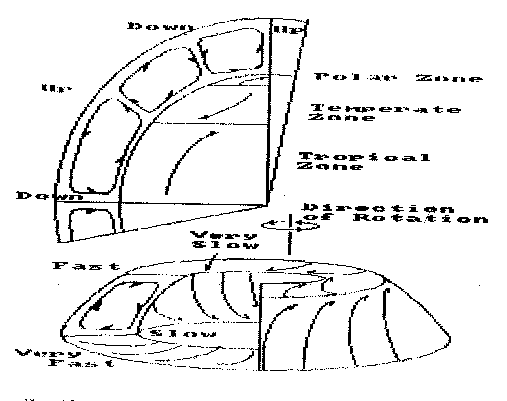
The weather systems of the Earth are beautiful to study, because so much can be learnt from them. Not only does the Coriolis force apply across the surface, the forces apply with the changing radius within a rotating liquid body and with depth or altitude. Coriolis was able to explain the world's weather in three separate cells per hemisphere, (6 bands) as illustrated in Figure 11-1. The planet Jupiter has a more complex Coriolis horizontal banding system. Jupiter's rotation is so great, its diameter (138,880 Km) so large, that extremely high wind speeds could arise from the ten hour period of rotation. The wind speeds could reach as high as 900 Km/h. Many atmospheric parameters can be determined from the banding structure. This banding should occur with depth forming levels, since the Jovian atmosphere is believed to be 12,800 Km deep. Care must be taken as the "visible surface" winds are going to be much higher than the "actual surface" winds due to viscosity and pressure. Each level will have different wind speeds, perhaps a mean speed around 200 - 250 Km/hour.
Figure 11-1 The Basic Coriolis structure of a rotating
atmosphere and a temperate zone cell.
Note: This figure shows Cold air falling at the Equator and
Hot air rising at the poles. Every coordinate position on the
star, on the Sun has angular momentum based on the axial rotation
irrespective of the thermal activity. Needless to say,
temperature differentials produce "hot spots" and
neighbouring regions "cool zones", resulting in a
convection cell. Rotation, density, viscosity and pressure
differentials in the solar atmosphere initiate Coriolis plasma
flows in each hemisphere. Not only do these currents flow across
the surface of the Sun, they occur with depth as the flow ascends
or descends.
The Coriolis forces maintain and distribute thermal energy; cause specific convection cells and will be seen to be responsible for producing the planetary/stellar magnetic fields. Even in the mantle of the Earth, the conservation of rotational momentum applies in the moving magma, explaining the Earth's magnetism, continental drift and the reasons why certain planets like the Moon and Venus are dead. Failure to recognise this force on the Sun, the Earth and Jupiter means that astronomers have not been able to accurately determine the nature of solar and planetary magnetism. This discussion is necessary because it is about to reveal the most intimate secrets of a star, solving many unexplained solar observations as the model of the Sun is changed. This story will show researchers how to look, where to look and what to look for, because researchers have overlooked Nature's simplicity and more importantly, the obvious, the very structure of a rotating star.
Where better to look for Coriolis currents than on the Sun. Even though the apparent surface features show tremendous thermal activity, Coriolis effects apply because the Sun is a rotating astronomical body encased in a plasma, on which surface magnetism and sunspot activity are observable. The photosphere's Solar diameter, (the visible diameter) is about 1,394,260 Km. The mean solar rotation is about 28 days, giving it a slow equatorial speed of 6,520 Km/h, while at latitude 30°, a speed of 5,645 Km/h. Above the solar surface is the corona, a solar atmosphere or activity zone measuring five solar diameters across. In this region extremely high radio temperatures can be observed resulting from chemical activity, atomic bombardment and motion, where ejected matter from the Sun moving along the magnetic field collides with matter falling back to the Sun, making the magnetic field visible. Just like the atmosphere near a bush fire, the corona presents a refractive index that causes light passing through it to refract, so it is that stars and planets seen through the corona, appear to swim as light is deviated, dependent on solar activity, altitude and latitude. These observations tell a totally different story about the nature of a star.
The granulations that appear as a surface cover on the visible Sun are slag borders that mark the limits of localized convection cells, where plasma rises and falls through thermal mechanisms. As the currents move vertically, they are subject to the solar rotation. Any statistical analysis of the magnetic polarity of these granulations, using polarized light research (magnetographs), reveals three, sometimes four latitude bands per hemisphere, adds weight to the argument that the Coriolis plasma flows produce the Sun's Magnetism. The law of least resistance applies through the conservation of rotational momentum in major convection current mechanisms that distribute energy, thus obtaining thermal equilibrium. As cooling occurs, the Coriolis cells slip across the core's surface, effectively cooling down each latitude region. The 31 year journey of such cells from the poles to the equator is the transport cycle.
To trace the history of the transport cycle means examining an off-cycle. As the core's pole is hot, rising plasma reaches the surface at the pole, fans outward across the surface, flowing away from the axial pole. Travelling from a region of low rotational velocity to a region of high rotational velocity, the flow moves behind the rotation, progressively over faster regions of the rotating core. On reaching a point where the winds travel parallel to the equator at great velocity, the back pressure causes the plasma wind to return down to the core's surface, but this drags other material down forming a pseudo current temperate zone current over the surface travelling towards the pole. As both flows descend from a region of high rotation to a lower one at the core, the plasma wind travels faster than the core and parallel to the equator, as enormous back pressure causes the wind to separate, one flow travelling towards the tropics while the other part returns to the pole, but the poleward flow travels from a region of high rotation to one of almost no rotation, rapidly spiralling to the pole, faster than the core's rotation. The high plasma winds around the polar hot spot quickly establish equilibrium in the cell. An intense magnetic field is produced by each of the four major plasma current flows of this cell due to the alignment of matter.
In the temperate zone, plasma pulled down by the downdraft onto the core causes a flow across the solar surface from a region of high rotational velocity to a lower one, causing the currents to travel faster than the core, but when these two high speed currents converge at the downdraft, massive spiralling vortexes form as velocity cancellations produce rotational effects. Matter in the Temperate-Polar convergent downdraft travels downward from a region of high differential convergence dragging the funnelling tornado structures deep to the core, structures that fill with nuclear by-products and floating deposits. The temperate current rams the core, turning toward the equator, travelling from low relative rotation to a region of rapid surface rotation, falling behind the core, but again the current reaches a latitude where the back-pressure forces another direction change, so the current rises to deviate once again only to return to the temperate-polar boundary. The previous updraft drags material from the tropical region creating a third tropical cell. As the speed of each current builds, the magnetic field caused by each flow grows. The converging polar current produces an immensely strong field. Each cell (like that illustrated in figure 11-1) has at least four major magnetic moments, around each back-pressure direction change, each with specific polarity and direction. The next key to this mechanism is the 11 year sunspot cycle.
The term 11 year sunspot cycle is a historical name. It is not an accurate figure. Although a full cycle is close to 20.6 years and each half cycle should be 10.3 years, half cycles are observed to take from 7 to 16 years. This interference effect is similar to that observed when two slightly different musical notes are played together, a beating effect is heard. Over the history of the sunspot cycles (figure 11-2), every hundred and eighty years, the sunspot numbers peak then disappear completely for several cycles. This beating effect and the timing problems strongly indicate a dual layered Coriolis system, where the upper layer slips over the lower layer presenting different heating and resistance effects.
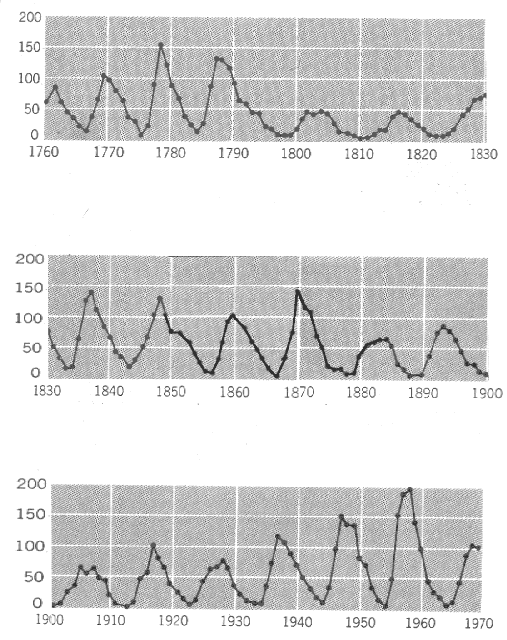
Figure 11-2 The Sunspot Cycle
The scenario under test suggests that the solar magnetic field arises from moving matter in a two layer onion skin arrangement of Coriolis cells without directly involving the star's core. The geometry of Coriolis slippage predicts a non-sinusoidal beating, where owing to the formation of partial sympathetic cells at the tropics and at the poles, the slippage could be considered as forming either two saw-tooth or saddle-back wave forms that drift in and out of phase. Effectively, two equatorial cells meet at the equator, either as a surface downdraft, or as an updraft from the lower layer. Four cells converge and/or diverge in the middle zone between the two layers. There are four possible contingency structures for this zone. All currents converging; all diverging; top layer diverging with bottom converging; or top layer converging with bottom diverging.
As the surface layer travels over the lower layer, the distance travelled is a great deal further. Although the lower layer should be slower due to increased pressure and viscosity caused by depth, one could argue that the lower layer cells travel faster as the distance is shorter to the equator over the core. Equally, with the extremes of temperature the lower cells could have such a low viscosity they may slip more rapidly. But when the upper and lower currents are travelling in the same direction, the slippage may be swift completed in 7 years as compared to opposed currents with increased resistance could extend the slippage to over 15 years. Even without this knowledge, it is still possible to predict the year of a solar magnetic reversal. The different impurities formed during changed heating conditions identify the beating signal as changes in the size and number of the sunspots. The slippage of the lower layer Coriolis cell's can be calculated from astronomical solar surface observations dating back to Galileo.
As this section involves explorative research, the aim is to identify a working scenario that answers the question of fast or slow deep currents. The beating predictions must be tested against observations. The curve of best fit must account for all hiccups, peaks and dips in the sunspot cycle (figure 11-2) and its exact shape. Very interesting are the periods 1945-1950, and 1930-1935 during maxima, as well as the periods 1920-1925 and 1950-1955 during the decline to sunspot minima. To solve this can be done through approximations, starting around the average searching for cycles that fit. The problem being the small sample size caused by limited records. To start with, if the surface cells experienced a full cycle rate of 20.3 years, two conditions are possible.
One could satisfy the Fourier transforms needed here but the mathematics behind this model are quite horrendous, only because each attribute is treated separately. A computer model can be used to simulate the conditions to derive similar curves. To explain the mathematics would be well outside the scope of this book, though one can use harmonic variations (78 and 90 years) to predict major field reversals.
To determine the overall magnetic direction, one could save much undue mathematics by simply defining each fast current as having a "+1" or "-1" direction. A positive and a negative together would form a dipolar structure while two positives or two negatives would either form a cumulative field when running together or a repulsive field when across a cell. This method is illustrated in figure 11-3 to approximate the overall field shape, direction and intensity resulting from a two layer Coriolis model. With three cells per layer per hemisphere, a total of 24 currents, form 20 magnetic field coils, comprising of 12 single current flows and 8 double strength common direction currents. The Equatorial convergent currents regulates the flows from both hemispheres such that both hemispheres are mirrored with opposite magnetic polarity in forming the directed magnetic field. Even though this description is for the Sun, with only two vertical layers, it applies to Jupiter with perhaps 5 to 10 vertical layers.
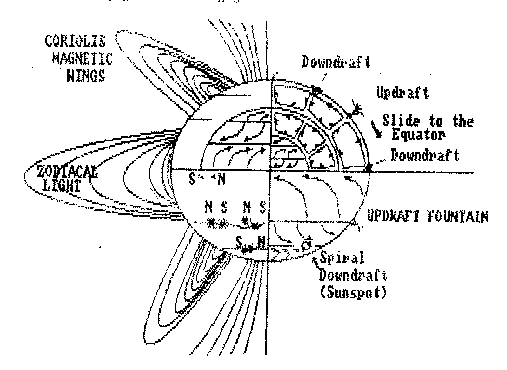
Figure 11-3 The Coriolis Magnetic Sun
This illustration is not the final artwork. To be replaced
This model predicts that the temperate zone field opposes the direction of the polar and tropical fields, causing its field to be squashed, thus the classic horn structures are seen in total eclipse photographs, but in so doing repulsive effects compress the equatorial field outward along the Sun's equatorial plane to establish the Zodiacal light. Although deformed by the planetary shock front, this same structure appears in the Earth's Van Allen belts and the magnetic field of Jupiter whose Coriolis magnetic field structure is far more complex than the Sun. Due to the simplicity of these mechanisms, accurate predictions about the appearance of the expected quiet solar corona during any total solar eclipse are possible.
At certain points in the transport cycle, the Sun's cooling system fails, producing very "hot" conditions burning away the heavier atoms, those by-products caused when the cooling system runs efficiently. The amount of slag floating on the surface decreases as high level fission reactions destroy the larger atoms. This is a heating process. Once the cooling mechanism starts to work again, the temperature decreases but the amount of slag produced increases as the overall solar energy output decreases. Some of this heavy material will end up in the slag, creating a maximum sunspot period, with many large sunspots. Immediately after this phase, the cooling system fails, so radiant global warming occurs on the Earth.
To explain the strange nature of the sunspots and their reversals along latitude bands, slag deposits accumulate in the vortexes where super up-drafts or downdrafts meet. The lower layers transfer slag deposits to the surface layers where it is seen floating and tumbling as rafts in the updraft fountains or downdraft whirlpools as rafts of heavy by-products. These huge cyclones tumble and stretch the rafts, rolling them about so vigorously they form long thin spirals of matter travelling deep into the downdraft or from the base of an updraft. The vortex may impinge on the granulations returning to the surface. Since the barrel like vortex has both ends exposed, the alignment of matter produces a magnetic field along its length. The magnetic field direction is dependent on the Coriolis conditions and prevailing nuclear wind speed. The massive downdraft compacts debris in tumbling Eddy currents of floating matter. Heavy floating rafts form above the conical and tubular whirlpools. Updrafts also cause whirlpools between the fountains, and downdrafts cause a higher convergent ridge around the Sun. Effectively in both regions, the height of the plasma is greater than the normal plasma level height. Due to the same convergence effect occurring in the Earth's oceans, the height of the Sargasso Sea is much higher than the surrounding ocean's sea level. As the whirlpool spins, it promotes the formation of trailing sympathetic cells that physically and magnetically couple as an Eddying sunspot group, as parasitic whirlpools, as sunspot groups. The rotation of the leading whirlpool (racing ahead or falling behind) must be one way for an uplift, and the reverse for a downdraft. It is also very obvious why sunspot velocities around the Sun give different rotational periods between consecutive 11 year cycles.
Slag rafts are not normally engaged in the thermonuclear processes until there is a sufficient nuclear temperature rise. Generally, the heavy waste material is slowly pulled apart and blown off the surface by plasma winds, blown into space, but local nuclear temperature rises in a region may cause a portion of the slag to explosively react, throwing planetary sized masses of heavy material into the Corona as a solar flare. This theory predicts both the Red Giant and Brown star for once the rotation ceases and the star dies, where the temperature decreases, massive slag deposits build up and are initially explosively blown from the surface to increase the physical diameter as a Red Giant. But then as even these reactions fail, the star collapses in on itself, to cool as a massive dark object. Even the corona would collapse, liquefying and solidifying on the cold ice giant's crust. A dead star made of normal matter and a danger to all future space travellers, presenting a greater danger than the unmarked reef to the ancient mariners.
Solar eclipse, chronograph and SKYLAB X-ray photographs of the Sun reveal the structure illustrated in figure 11-3. From the late 1960's and through the 1970's, NASA operated "SKYLAB". From this platform the Sun was studied in depth using X-ray film. The problem was the known rotation of the Sun. There is a difference between the real speed and the believed speed of rotation. The Sun's core has a different rate of rotation to its nuclear atmosphere, just as does the Earth to the Earth's atmosphere. The NASA footage revealed not only the solar core, it showed evidence of two distinct vertical layers and the actual workings of the amazing Coriolis mechanism deep within the Sun. These films need to be revisited in the light of this model since many questions will be answered by a review of this data.
The whirlpool's rotation aligns matter generating a magnetic field that loads the atoms effectively shifting the position of the spectrum. As will be discussed shortly, this is directly related to the Tired Light theory, where the medium producing the light changes the dispersion of light, its polarization and propagation speed. Analysis of the spectrum and the circular polarization of light from a sunspot, the Zeeman effect, identifies the different magnetic directions, strengths and polarities. Even though considerable rotation is detected, sunspots seem to be almost stationary on the solar surface. As the processes are concealed by the relative darkness of the crust forming the sunspot, much remains unseen until there is a massive explosion when the raft reaches critical mass, unmasking the cavity below, liberating cavity radiation.
Something really odd happens here which must change the perception of the spectrum. Between the bright emission lines of the spectrum, there are dark bands called the absorption lines. There is another dark line which must be considered, the void lines. The explosion of a sunspot produces a solar flare, seen in the spectrograph as cavity radiation (which is best understood as the complete and even illumination of the spectrum, devoid of all lines, a full spectrum of equal intensity). Absorption and emission lines are unchanged, however in the voids the solar flare becomes visible. This event immediately identifies the absorption lines of the Solar Corona as distinct from the voids, non-allocated regions of the spectrum. This also suggests that the Sun has a tenuous crust, because the full spectrum cavity radiation comes from the cavity formed when the skin is ruptured. The view is looking into the rupture. All chemical and nuclear reactions that produce light emit spectral lines. The only other mechanism which could produce such an emission is through an incandescent or heating effect. 3-D views of the sunspots at the initial phase of a solar flare show the solid raft or the surface cracking apart as the flare climbs and the brilliant interior is exposed, discrediting basic thermal effects.
Quite noticeable in most high resolution total Solar eclipse photographs (those which clearly show the lunar disk) are the updraft and downdraft latitudes if one knows what to look for and where to look. Clearly visible in many are the uplift fountains and the convergent ridges, seen as tiny parts of the photosphere rising above the silhouette of the Moon, occurring at predictable Solar latitudes. There are two types of Bailey's Beads; those caused by the Sun appearing through the lunar valleys and those directly caused by the Coriolis cell's boundary zones having a greater apparent radius than the Moon. From these observations, it is a simple matter to marry the Sun's Corona to the fountain and ridge zones. The Sun will have the following Bead markers; the equatorial boundary; the tropic-temperate boundary; the temperate-polar boundary, and (if visible) the pole. Due to the Earth's orbital parameters, the Earth's 7° orbital inclination of the Sun, each boundary zone appears on the same Solar latitudes.
Sunspots and granulation borders only appear dark because the Sun is so bright. When the sunspot is greatly magnified and viewed by itself, the sunspot is still intensely bright. During periods of sunspot minima, amateur astronomers (the primary solar observers) have infrequently reported the total disappearance of all granulations over massive regions of the solar surface, indicating massive heating. From day to day, the sunspot appear almost unchanging , having a dark umbra (the central region) and a veined iris-like penumbra which borders the umbra. The sunspot's penumbra appears like a web with light and dark streaks pointing away from the umbra.
One would assume that if the sunspot was in fact rotating, the striped penumbra should show that effect, but it does not, rather the striped penumbra seems almost unchanging. The sunspot is an example of the "Ekman" spiral, (figure 11-4) where the heavy slag covers the end of the rolling sunspot whirlpool. The sunspot's visible mass presents such a high resistance to rotation that it seems stationary. Matter accumulates with it as web structures due to eddy cells in the granulations around the very dark Umbra, as many rafts and smaller rolling cylinders form the Penumbra. On the Earth, the Sargasso Sea is another typical Ekman Spiral, situated in the North Atlantic Ocean. It presents a high resistance to rotation as it is composed of floating weed and kelp. Perhaps, the Pacific Basin's geological hot-spot, the Hawaiian volcanic chain, could be produced from such an Eddy current in the mantle. As the Ekman spiral is a combination of both Coriolis and frictional forces, the motion of a sunspot's penumbra indicates a high drag factor, also suggesting a thin tenuous crust.
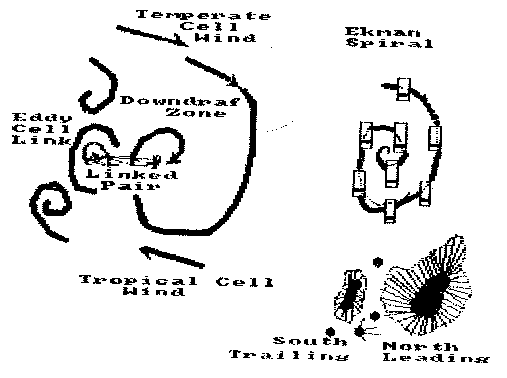
Figure 11-4 The Sunspot: an Ekman Spiral
This illustration is not the final artwork. To be replaced
Although Meteorological records have only been maintained for a short while, there is evidence to support the cyclic sunspot cycle causing major climate changes on the Earth. Such evidence is found in archeological, geological and biological records and is wrongfully attributed to el Nino effects. Of note is that the long range weather forecasters use a 90 years cycle to give their predictions. The growth rings of trees are very revealing showing climatic anomalies every few centuries further suggesting a lowering of the reaction temperature and the shutting-down of the waste production for a time. This would mean that the energy output of the Sun as light and heat are suddenly changed, resulting in dramatic weather changes on the Earth with mini-ice ages and long droughts, perhaps lasting 30 or more years. The Earth should have an almost identical Coriolis current structure to the Sun owing to the Earth's increased density, viscosity and speed of rotation. The Earth's geological history shows similar effects of heating and cooling, but with a much longer periodicity. The great ice ages and extended periods of global warming have resulted in excessive droughts, famines and the decline of many civilizations. When both the Earth's cycle and the Sun's cycle are viewed together, such periods can be forecast. The growth rings of trees and those of fossilized trees tell the story of the past only too well.
The alignment of moving matter in the Coriolis currents of the Earth's mantle is responsible for the formation of the Earth's magnetic field. The Earth's solid crust and liquid mantle produce a barrier to hide the "horn" structure, since this reversed field is quite weak. Large pieces of crustal material floating on the mantle are tossed about like rafts in the continental drift system, sometimes pulling the continent beneath sea level, beneath the crust itself. There is conclusive evidence to prove geological epoch changes, where the continents have been shattered, bent and broken, even submerged for long periods by the Mantle's downdrafts. The magnetic field of the Earth is not as simple as one would like, so geologists will experience a great deal of difficulty attempting to equate the Earth's magnetic recording to the path of the continents.
If the crust was impacted by a meteor or an underground thermonuclear device at the wrong point, all regional continental plates in the area will move resulting in many earthquakes around the boundaries of the affected plates until a point is reached where plate equilibrium or stabilization is realized, but such an event may alter the Earth's cooling and magnetic generating systems with devastating consequences. Current belief is that a super continent once existed on the primitive planet, but this broke into two large continents, "Gondwana land" and "Laurentia". These massive floating rafts have since been broken and bent into today's continents. The forces involved could have come from a major event or many events, from the impacts of massive asteroids, perhaps several hundred kilometres in diameter, to some massive stress break. The energy needed to break a continent is awesome. Even though the forces involved in such a catastrophe are staggering to contemplate, the energy transferred throughout the event and throughout the medium is at the atomic and molecular level where many directed little forces in a certain time frame create an effective force with a specific magnitude that results in a series of reactions until equilibrium is reached. The alignment of molecules gives rise to the directed open permanent and semi-permanent directed magnetic field as well as the formation of heavier atoms. In the Solar environment, the Earth's mantle, in Jupiter, and in other rotating planets, the alignment of matter caused by the prevailing winds is enough to produce and direct the molecular magnetic field. The mass spectrograph illustrates this effect when charged and moving diamagnetic matter responds as normal magnetic matter in the directed magnetic field.
In 1978, R.H.Dicke linked the properties of the Solar cycle to the motion of currents in the Sun, (Nature 276,676) but could not suggest a magnetic mechanism. Doctors Robert Howard and Barry J. LaBonte identified further evidence of the Solar Coriolis currents (Astrophysical Journal July 1980) using the 150 foot high Solar tower Observatory at the Mt. Wilson Observatory. During a twenty year observation period they measured the velocities of numerous latitude zones to conclude the presence of velocity bands around the Sun, a structure which provided evidence that the Sun has a strong internal resonant large-scale mass motion dynamo that was actively producing the magnetic field and the sunspots. Their results, viewed in figure 11-5 identifies the 21year cycle. The major sunspot groups are always found at the boundary between the fast and slow currents. Howard stated "The velocity bands must be associated in some fundamental way with the sub-surface magnetic fields responsible for the solar cycle".
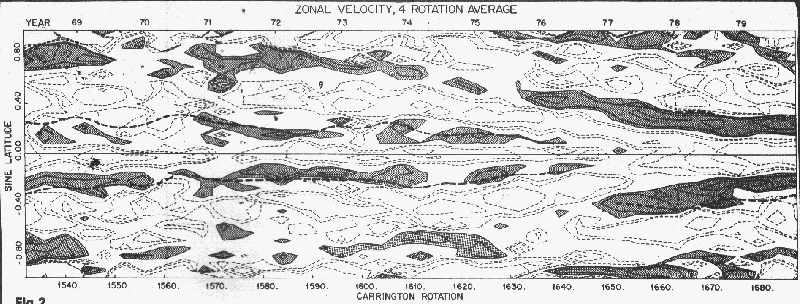
Figure 11 -5 Solar cell slippage to the equator.
1980 AD
Research by Robert Howard and Barry J. LaBronte
Geological evidence of the Earth's internal structure comes by way of seismic observations of both massive earthquakes and nuclear explosions. Sound travels rapidly through the rocks, however different strata have differing speeds of sound and each wave form has a specific refractive index in that strata. The S and P waves are the most important wave forms because they have the ability to pass through the Earth. Fortunately, the S-wave is absorbed or rejected by the core and in so doing leads to an amazing effect called the shadow zone (figure 11-6). Suppose a meteor impact at the centre of the Pacific Ocean produced a massive earthquake. All around the globe, seismic stations monitor the progress of the sound waves travelling through the Earth on the refracted direct path to each site. Figure 11-6 identifies the path of such refracted signals to several populated sites. One will note that with increasing density, the signal travels in a curved path. The presence of the core creates a boundary zone at the 103° mark, where all S-wave signals abruptly cease, indicating that at a depth of 2,900 Km, the signal struck a solid opaque ball. The S-wave component fails to travel through the ball, due to opacity, a transmission problem at the interface. The P-wave continues to refract through the low density ball at crustal velocities. On leaving the ball, the velocity of the P-wave increases across the interface but then begins to slow as it refracts back to the surface, slowing down with decreasing pressure. This P-wave component is monitored at all the sites in the 143°-180° zone. The shadow is noted in the 103° to 143° zone, where only very weak L-wave signals are sometimes experienced, (these travel through the crust to reach the particular seismic stations). The timing of the P-wave and S-wave events can be predicted with reasonable accuracy. A more complex breakdown of the Earth's interior can be found in many post graduate University Geology and Geography texts, showing interim reflective layers in the mantle at the appropriate Coriolis depths.
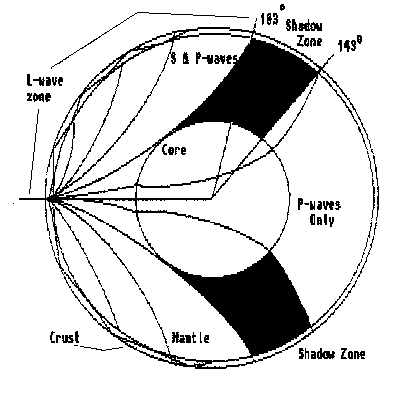
Figure 11-6 The Earth's shadow zone
To discredit all Iron core theories, Iron and Iron ores are very dense and have a very high sound transmission speeds.)
The Facts:
Origins 1: Using the solar magnetic field, the origin of the Solar System becomes more obvious. Coriolis forces also affect the galaxy, but in a slightly different way, restricting the size and shape of the spiral arms and the galaxy and the mass thrown into the spiral arms from the galactic core. With the decrease in the gravitational pull of the galactic core and with increasing distance, the galaxy's core loses its mass to the arms as stars form from the nuclear soup and move from a region of decreasing rotational momentum into a region of higher rotational momentum. The motion outward from the centre slows, wrapping the outer stars into a faster rotating circular disc and galactic arcs. This will causes problems as the stars existing along the galactic plane are likely to collide with the older red stars orbiting the galactic core on highly inclined orbits. The majority of exploding stars seen in our galaxy is, in the direction towards the core, however when observing distant galaxies, the majority of supernovae are generally observed in the outer limits of the galactic disc due to such collisions.
Energy is supplied by the local environment and transferred from atom to atom, through and by, each atom's magnetic field. The Milky Way's magnetic field travels outward along the spiral arms. Any gaseous matter or nuclear soup moving down the spiral arms, will align to this magnetic field to form rotating proto-stellar clouds. Some on these clouds will condense to form a proto-star which due to rotation gives rise to a Coriolis magnetic field. As this star begins to warm, other matter in the cloud aligns around the star's magnetic axis, whereupon it is gravitationally sorted and magnetically compressed. Coriolis divisions form in the proto-planetary nebula as it begins to condense, but only those cells with the correct orbital velocities will survive on flat circular orbits along the magnetic equatorial plane of the star. As each forming planet develops Coriolis magnetic fields, their fields shape and structures the surrounding matter as a proto-lunar nebula, giving rise to moon systems that orbit on the planet's magnetic plane at Coriolis locations. The mechanisms and processes of Bodes' law will be discussed shortly.
Magnetism is so grossly misunderstood by many, simply because educators actively promote the we-will-never-know-attitude, filing this subject in the too-hard-basket. Indoctrination of the accepted truths has led many students to dispute Nature in favour of invalid learned beliefs, handicapped by scientific dogma, thus preventing people looking at Nature to identify Nature's truths. Believe it or not, the Babcock model will still be taught by many educators as being the only mechanism for solar magnetism, when so much evidence and proof exists that confirms the Coriolis model.
---------- END CHAPTER NINE --------
size 11,750 Words
Please do not rush off to email the author just
yet.
It is too early. Never assume that Science is right, test
everything!
Read on as your questions may be answered in subsequent text.