CHAPTER TWELVE
ASTRONOMICAL BLUNDERS
ASTRONOMICAL BLUNDERS
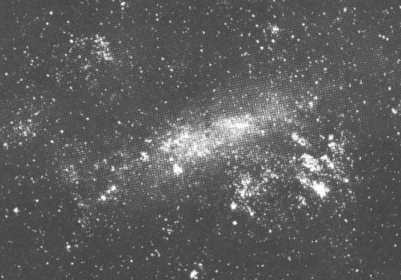
One does not need to believe in God to become involved in a theological discussion. Unfortunately, mankind's irresponsible egocentric beliefs have run wild. No human can attempt to think as a God, nor should one aspire to be a God, since every human is mortal. The best one can do is to marvel at the creations of God, to marvel at the Universe (such as the SMC above). In the Judeo-Christian religions, God gave Moses The Ten Commandments, a basic sexist set of rules for all people (not just men) to live good and wholesome lives. To control God's biggest creation, the Universe, God apparently conceived The Laws of Nature. But God did not hand out copies of these Laws, rather God gave certain intelligent life forms in the Universe the advantage, a desire and the need, to find and use these powerful laws wisely. Failure to respect God or the Laws of Nature has always resulted in dire consequences.
Religious beliefs have moulded mankind's preoccupation with the origins of everything, with the consequence that many astronomers found problems accepting "infinity" and voiced their objections, "There must be a start! There must be an end!" a statement which conventional science could not overcome, even to putting an age on God and the Universe. Any attempt to put an age on God amounts to heresy in every religion. Most dogma states that God is infinitely old, for God is, always was and always will be. The Big Bang theory is more in keeping with man's religious beliefs. On page one of the Jewish Bible, Genesis wrote, "God made the World". Many who blindly accept this Genesis seven day creation theory have apparently not bothered to read further into the Bible, for on page two, a totally different theory is presented.
"Theoretical Astronomy" otherwise known as "Cosmology" is a branch of Physics needing intense scrutiny. In order to explain the astronomer's observations, cosmologists process these observations using current scientific knowledge and mathematical theory to propose explanations and develop models on the origins of things astronomical. In this, the problem definition stage of research, the possibility of error is extremely high, especially when the conclusions are drawn far too early without adequate proof. Well hidden and deep rooted within modern cosmology's very foundations are several powerful errors, upon which so much current theory has been built. Correcting these errors will force astronomers and cosmologists to abandon much baseless and idle speculation.
In 1917 Albert Einstein published his first work titled "the General Theory of Relativity". Part of this theory sets out the hypothesis expressing the relationship between mass, time, energy and space in the Universe. Despite the fact that this theory of gravity is widely used, few people understand its innermost workings, blindly accepting it as true, without question. His first theory of Relativity, the General Theory, depends on the presence of matter in the Universe. Only energy existed before this. Once this postulation was made, gravity, time and matter began in the Universe. Gravity is an affect of matter which causes all objects to be pulled together, an affect which Einstein needed to overcome, to prevent the Universe from collapsing in on itself. Einstein introduced without proof or basis, a curious repulsive force opposite to gravity, called the cosmological constant. It was pointed out to Einstein that his general theory of relativity predicted an expanding Universe, yet Einstein did not realize that this prediction was contained in the theory. His theory demanded a dynamic Universe, (either expanding or contracting), but astronomers could not find any evidence of expansion or contraction, so he altered his equation to make the Universe stand still, supporting the accepted uniformitarian view, the Steady State Theory.
At the turn of the Twentieth Century, the Universe was considered as being the Milky Way. Although galaxies were seen, they were believed to be other nearby solar systems (in the formation stage) or nebula (glowing fuzzy clouds) in the Milky Way. At the Lowell Observatory in the USA, Vesta Melvin Slipher discovered that the spectral lines of these nebulosities were different to the stars. Slipher determined that some were local dust clouds resulting from exploding stars and the like, however he found the majority of these objects existed along a broad band across the sky, cutting through the Milky Way. Slipher noted that these objects displayed a unique spectral shift towards the red end, so they could not be related to the Milky Way or the Solar System. It was a band of hitherto unknown new objects. Some astronomers speculated on these being other Universes.
In 1924, the American astronomer Edwin Powell Hubble realized that these objects were "other" Milky Ways, external galaxies outside the Milky Way Galaxy. Astronomers could not prove and did not realize the spiral shape of the Milky Way until the mid 1970's. In 1929 Hubble proposed a link, a relationship between red shift observations and distance. He asserted "the greater the red shift, the greater the distance", despite much contradictory evidence where the closer galaxies (coming towards us) have a "Blue shift". Hubble forced his observations to fit into Einstein's theory of relativity, changing his discovery to promote the expansion theory. This modified speculation, would become known as Hubble's Law where it is stated:-
"The further the galaxy, the faster it moves away and the greater its red shift"
This is neither a law or a proof, yet was destined to become an intrinsic proof of the theory of relativity and the foundation stone of the Expanding Universe Theory. During a BBC radio interview in 1950, the British astronomer Fred Hoyle, coined the term "Big Bang" to make fun of the expanding universe theory. At that time there were two distinct cosmological theories. The Steady State theory maintained the Uniformitarian view of the Universe "as it was in the past, it will be in the future, since the processes that occurred then, continue to occur today and will continue to occur." The Big Bang theory places all the matter in the Universe at time zero inside a central ball which happened to explode, blasting matter in all directions, filling up the void with glowing stars, galaxies and nebulosities.
Hubble needed to know the rate of expansion; just how fast were galaxies moving apart? Incredibly, Hubble's observations of galactic spectra revealed a linear (straight line) relationship. One can deduce the velocity of an object from a spectral line sequence that has physically changed position. Hubble's relationship is shown in figure 12-1. Mathematically stated, the rate of change or the slope of the line (called the Hubble constant "H") is given by the formula v = H x where "v" the velocity of recession of a galaxy is directly related to the distance "x". For every million light years, astronomers currently accept that "H" has a value of 17 Km/sec or 25 Km/sec. Two values ?
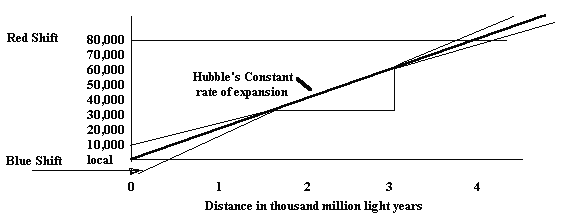
Figure 12-1 One of the two current Hubble relationships
To avoid the problem of the Blue shift in local galaxies, cosmologists introduced the concept of "The Great Attractor". This huge unseen gravitational body is claimed to be pulling all the local galaxies (including the Milky Way) together. As the great attractor conveniently lies more or less on the plane of the Milky Way, it will never be seen. The argument for its apparent invisibility and presence is that as the Milky Way obscures the view of the Universe, it will never be seen, so it must exist. This postulation is pure speculation without basis, without any real proof, yet is treated as fact.
With Hubble's "evidence" of an apparent expansion, Einstein revised his cosmological constant considering his previous concept and his alterations to the theory (in making the Universe stand still) as the biggest single scientific mistake of his life. The relativistic universe was now one of expansion. With the tools of relativity and optics, Hubble could now determine the age of the Universe, which he found to be younger than the age of the Earth! Hubble's initial estimation began the expansion only 1.8 billion years ago. This is contrary to Geological evidence which suggested that life began on the Earth at this point of time, and then the same geological evidence indicates that the Earth is around 6 billion years old. This introduced the problem, "Why is the Earth and the Milky Way Galaxy older than the date of the hypothetical Big Bang, the origin of all matter in the Universe?" This problem recurs as the Universe is progressively increased in size.
Hubble's constant strikes several other major problems. Following the introduction of Radio Astronomy, new objects were observed at the very limits of the Universe using orbiting space telescopes and large instruments on the Earth's surface,. As larger telescopes and better techniques revealed more distant galaxies, the constant had to be revised. Around 1965, the Earth's position in The Galaxy changed as the age of the Universe was pushed to seven billion years. By 1972, the Big Bang was again pushed to ten billion years through Quasar discoveries. In 1995 two different values of the constant were accepted, presenting ages of either ten or fifteen billion years, making the Milky Way a very young galaxy.
The Steady State theory maintained a forever unchanging Universe. The original Big Bang theory placed all matter in the Universe in a small ball which exploded. There are problems with this Big Bang theory as all matter in the Universe, in a small ball would result in a true black hole, so the Universe could never have formed. To get around this knot, cosmologists bent time, warped matter and curved space to make the theory work in MANY revised Big Bang theories. By far the worst part is that the Big Bang theories are all contradictory, so, when one talks about the Big Bang, the question must always be asked "which Big Bang theory?" Some Big Bang theories are cyclical, exploding and imploding for ever. Others are terminal, where after a single Big Bang the Universe speeds away from the origin burning itself out, leaving a void devoid of all matter, not even ash.
Another Big Bang theory starts with a buckling in the space-time continuum forming matter spreading outward by creating Eddies in warped space to become the galaxies. Since this happened at time zero, it spread instantly throughout the void creating matter at a speed greater than the speed of light filling the void with spinning islands of matter. Before relativity existed, there was nothing and suddenly, as the bubble in the fabric of time warped, in the moment of time, that being (according to cosmologists) at precisely time 1 x 10-47 seconds of creation, at time
0 . 000000 000000 000000 000000 000000 000000
000000 00001 seconds,
(Note: This is stated without an error statement, not even
± 0.5 %)
the Big Bang, the Universe, time and gravity all came into existence. With this event, relativity began to work. To some this may sound plausible. If so, then it must be possible to replicate this moment in a laboratory, to create a mini-Big Bang. Some cosmologists argue that before this moment in time, not even God existed. But what caused the warp? The visible Universe is a very big object and it did not just appear in one by ten to the power minus forty seven seconds, because the rate of change would need to be at least 1090 times greater than the speed of light. It is much easier to argue that the Universe evolved.
In yet another Big Bang theory is the concept of multiple quantum events involving matter creating several Big Bangs at various times and locations in the Universe. Then another states that these Big Bangs occurred simultaneously. In an exceptional theory, Isaac Asimov considered a "four-leaf-clover" structure around the parameters of positive and negative time, positive and negative matter. In this theory, Asimov argues that the Universe oscillates through successive Big Bangs (as + +, + - , - - , - +), expansions and collapses forming a classic four-leaf clover diagram. Far worse is to come, for the next several theories border on the ridiculous involving simultaneous explosions and implosions of parallel universes using up to 40 unknown dimensions, with good universes and mirrored bad universes, where matter and antimatter, light and anti-light exist.
Hubble's results are used by cosmologists to prove an expanding Universe. But these observations can be challenged and shown to be no more that a distance related illusion. The ramifications of this illusion to the General theory of Relativity create inherent problems in the linking of gravity to the curvature of space in the Universe. It suggests a Universe that is either open or closed. No other choice is allowed, moulding the belief that the Universe contains matter related to the central-most point in the Universe, that position where the observations are made, the planet Earth! So, space in the Universe is proposed by General Relativity as being curved and distorted by gravity. Obviously, a Universe with more gravity will be in the process of collapsing in on itself heading towards the "big crunch". In such a situation, the Universe would have a decreasing radius and therefore a higher rate of curvature each day.
Credit was bestowed on Hubble as he was first to research the distances with galactic red shifts. As Hubble was there when it came to see these "new" objects, his research became the foundation stone of galactic knowledge, but when he explained his observations, there were no other models to consider. Hubble's evolutionary model (Figure 12-2) was taken as the only evolutionary model, as his theory linked into Einstein's corrected General theory of relativity. Together these corrected theories become mutually self proving. Astronomers soon discovered that galaxies have two stellar populations, the "new" stars in the arms and core, while there are much "older" red stars in orbit about the galaxy.
Since the Steady State theory predicted "old" galaxies, cosmologists, using Hubble's classification system and the theory of relativity, predictions were made as to the properties of "old" galaxies. But what defines the age of a galaxy ? Position ? Composition ? Red shift ? Distance ? Shape ? Size ? Stellar populations ? Not even Hubble could explain this. As astronomers could not find any "old" galaxies, no matter where they looked, their conclusion stated "since all galaxies appear to be the same age, then the Steady State theory must be considered as invalid for this is proof of the Big Bang." Since Hubble's observations are taken as a proof of relativity and as Einstein changed his General theory of Relativity to accept Hubble's observations, setting universal expansion in the framework of general relativity, Hubble was treated with sycophancy (absolute adulation, almost worship). Hubble's models, the processes and evidence seems correct, it became virtually impossible to challenge his interpretations of galactic evolution. So why should anyone be prepared to risk scientific scrutiny in toppling the father of galaxies and perhaps relativity in the same process ?
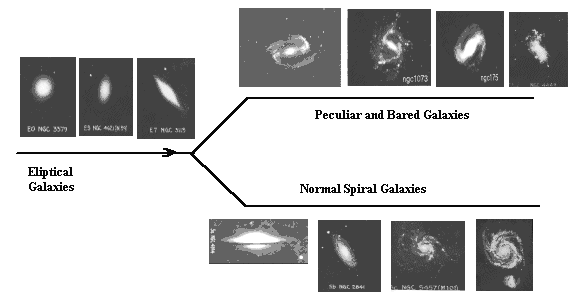
Figure 12-2 Hubble's Evolution of Galaxies
It will be shown that because Hubble failed to link the beginning and the end of the evolutionary model, his galactic object classification system is invalid, and this has directly led to gross scientific confusion. When cosmology took on the expansion theory and ran with it, they did so because the observations seemed to fit the accepted theory. Hubble's initial speculation is a brilliant discovery, a great accomplishment. His interpretation and Einstein's correction can be seen as equally brilliant errors at the same time. This argument will take some time to develop as the situation produced by this partnership is very involved. The marriage of Hubble's classification of galaxies (see appendix 6), his evolutionary path (Figure 12-2) with the expanding universe theory and the general theory of relativity, sent Astronomy on a tangent. Cosmologists used the new tools of relativity ignoring the most basic observations, only because they were educated to accept false beliefs as the truth.
Hubble considered the older galaxies, like the Milky Way and Andromeda, to have evolved from the elliptical galaxy. If this is the case, then all elliptical galaxies must be older than the spiral galaxies. One must experience problems accepting this because the elliptical galaxies are classified into two unique stellar groups; those that contain all new-stars, and then there are those containing very old stars. There are no homogeneous middle age elliptical galaxies. The only way this could be true would be if the middle aged spiral galaxy collapses in on itself to form an old elliptical galaxy, before consolidating and re-forming as a new-star galaxy. This links the beginning of galactic evolution with the end. Oddly, the Milky Way Galaxy is today claimed to be just 7 billion years old, yet astronomers look to the Universe to see galaxies some 14 billion light years away, with older stars. But the mathematics do not work out. As the star populations are the same for all galaxies, how can the age of the older orbiting red stars of distant galaxies be older than the age of the Universe? These distant galaxies are almost three times older than the Milky Way Galaxy, so then, why is the Milky Way younger when all other galaxies are now claimed to be of the same age? Such arguments identify fundamental contradictions that challenge the premises of modern cosmological theory. When one is limited by the blind acceptance of relativity and Hubble's conclusions, the truth and facts are ignored, unless the observations happen to, or can be made to fit through a specific sized window to suit the accepted view of the Universe. Further, to use relativity to prove the Big Bang and then to predict what the opposition theory, the Steady State already predicts, is this not twisting science with a logic form that borders on deception?
Perhaps the definition of the "old galaxy" demands some thought. The search for "old galaxies" is the ultimate example of not knowing how to look; not knowing what to look for; not knowing where to look; not knowing what one is actually looking at; and worse, not using the scientific method or research methodology to reach a valid conclusion! When beliefs are limited, how can the observations be scientific and useful in determining the age of any galaxy? Many observations have be incorrectly attributed to fit something that is just not true. The Earth is not at the centre of the Universe, in fact it would be egotistical and unwise to put the Milky Way Galaxy anywhere near the centre of the Universe. From the Earth, in every direction, the view fades to black.
The Milky Way is not on the edge, for at that point one would see a black abyss in one direction, a wall of galaxies extending around and below with the brilliance of the Universe fading to the centre. As the Milky Way is within the confines of the Universe, it is necessary to contemplate the real world situation, for no matter which direction, distant galaxies are seen at the limits of the Universe, so, were these objects already there when the Big Bang occurred? As the light from these objects left there some 14 billion years ago, each distant galaxy must have aged, evolved and grown large enough to be observed, well before that point of time. Logic decrees and astronomy accepts the fact that "with greater distance, the younger the objects observed." Yet the astronomer observes large galaxies, which the cosmologists claim to be of the same age, so again there must be a big problem in determining the age of each galaxy and the Universe. Cosmologists cannot agree on the age of the Milky Way. A galaxy is not like a tree, where growth rings tell its age. It is not like a horse, where the number of teeth tell an age. A galaxy must evolve, but from what? For the Milky Way to be relatively young, where all other galaxies show the same apparent old age, means that the Big Bang must have been an implosion from the outside surface to the centre. The almost uniform distribution of distant Quasars supports this challenge. Where is there a local Quasar ?
Using Hubble's linear relationship, the diameter of the visible Universe must be 28 billion light years with the Earth at the centre. For these objects to be there 14 billion years ago, defeats the age of the Universe. For an expansion rate of one quarter light speed, 56 billion years are needed for these objects to reach the current radius from our egocentric-geocentric-position. To fit the desired time frame, these objects would need to be travelling at speeds greater than light. Irrespective of one's belief in the speed of light, the Doppler shift would be so great, these objects could never be seen in the optical or radio spectra. Since the galaxies and guasars are seen, the speed from "a centre" as claimed red-shift observations of 2 to 4 must be caused by a distance related illusion, a natural effect, not an expansion or Doppler effect.
There are intrinsic difficulties with Hubble's postulation and the interpretation of three dimensional geometry in Hubble's evolution of galaxies. If the Universe was in fact expanding (as seen from the Earth) where the relationship is found to be a linear relationship, then Hubble and cosmologists have returned Astronomy to an Earth-Centred pre-Columbus, Universe. Only when viewed from the centre of the Universe would the trigonometric relationship between distance and the rate of expansion appear to be a constant. Only at that position would the expansion be seen as a linear relationship in all directions. The geometry of any observations made elsewhere in an expanding Universe would show variations with direction indicating where the detonation occurred. With any explosion, each moving object must have a trigonometric relationship to the source and to the motion of every other object. All red shift observations must change for every direction.
The budding cosmologist needs to try this exercise. This is a two part problem as basic geometry must reveal both a direction and a centre. It is not necessary to struggle through the entire mathematics, rather one should be aware of the mathematics. The aim is to determine a constant of expansion, to prove Hubble's linear relationship obeys the simple Laws of Geometry throughout the Universe. Figure 12-3 features a hypothetical recent (1870) cosmological explosion. For the sake of explanation, the unit of distant measurement will be a "blok" having a precise length. In 1930, the position of the observation point was at 10,000 bloks from the centre at location "A". The distances to objects numbered 1 through to 11 were determined. In 1990, at location "B" the observation point was 10,000 bloks further out, where the distances to the same eleven object were measured.
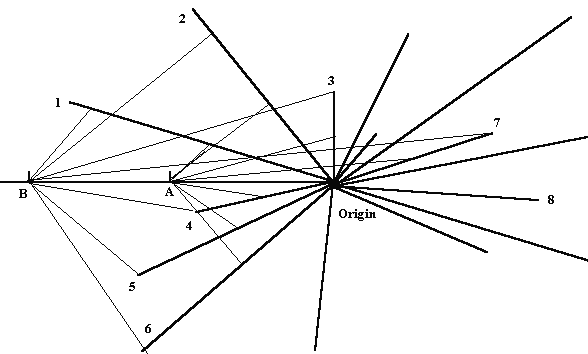
Figure 12-3 Part 2: Given the answers obtained as the question, determine the centre.
Now for the problem. From the geometry determine the rate of expansion. To play here, one needs a scientific calculator or a set of mathematics tables. The basic equations used in trigonometry are Sin Ø°= O/H , Cos Ø° = A/H and Tan Ø° = O/A . (As a quick revision, "A" is the length of adjacent side to the angle, "O" is the opposite side's length and "H" is the hypotenuse or longest side.) The value of the angle's Sine, Cosine or Tangent are found in standard mathematics tables. The distance to be measured is the hypotenuse. This is a really interesting exercise in Geometry, identifying the trivial cosmological problem. Each measurement and position bears a trigonometric relationship. From the perspective of the observer's position (A to B), the eleven reference points have moved away from the centre. If all objects had the same rate of expansion, they would exist on a shell. In the Universe, the rate of expansion is not constant, so figure 12-3 is close to the real situation. Relativity demands that the Universe is open or it is closed. Four expansion possibilities are probable. However, there are actually five distinct likelihoods to be considered. The first moves each object with constant speed outwards. The second assumes a constant acceleration for each object as they move outwards. The third maintains that each object is slowing down with distance from the centre. The fourth considers that each object has a different acceleration outwards typical of an explosion and as gravity becomes less. In this exercise, this is the most likely event. It must also be noted that the fifth choice none of the above is true. Only one result will fit the observations.
To prove that the apparent motion of all eleven objects away from the Earth is constant and that it agrees with Hubble's relationship, prove that Cos Ø° is a linear relationship no matter the distance, the angular direction, the number of samples, the speeds, even the time frame. Whatever the answer, any fixed expansion rate would mean that all the objects would be placed at the same distance from the centre. If the rate is proportional, the centre can be determined. If the Earth exists on an arc with respect to a centre, as the arc expands, every point on that arc moves away with a different trigonometric expansion rate to every other object on that arc, but in the explosion, many different arcs must be considered, with respect to the relative distances from the centre. Before reading on, complete the exercise and determine the relationship of the Earth to these objects and the mathematics of the entire system. As trigonometry is working in the Universe, there can be no linear relationships in regards to expansion or motion! Any mathematician will quickly point out that plotting the differences at several moments in time, requires using the Cosine table, which is definitely not a linear relationship.
Although some will try to solve this problem, every mathematician will laugh at such futile attempts. This exercise is pure Causal research. The results defeat a scenario based in the ridiculous. Simply stated, if Hubble's expansion rate is proven to be true, then one has conclusively disproven the Cosine Law by proving that for all angles the Cosine curve would be a straight line, having one value. The above exercise identifies a mathematical and scientific joke. Blind acceptance of Hubble's expansion only proves blind gullibility. The observed expansion of the Universe is one of Nature's deceptions!
Hubble could only obtain a linear relationship if everything had constant acceleration and measured from the very centre of the Universe; but the Earth is not at the centre of the Universe. Hubble's expansion constant must be a trigonometric variable related to the angle of observation Ø°. To illustrate the point, the simple geometric exercise (figure 12-4), starts with an arc, and several objects on that arc. Each object forms a triangle to the centre, so as the observer's viewing angle Ø° changes, then the Cosine of the line of sight angle must reveal different expansions and a common direction to the centre.
Note: Only some construction lines are shown. 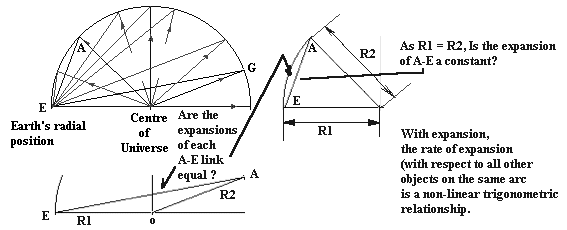
Figure 12-4 The Geometric relationships of an arc with radius "R"
From this simple trigonometry, the Cosine rule effectively voids all 15 Big Bang theories, simply because none explain the simple geometry of the Universe. On paper, the theories look beautifully simple, an Earth-centred Universe, but the events, distances and the evolution of the Universe in the calculated time frame prove it as the Big Blunder. All fail. Although many proofs exist that disqualify the Big Bang theories, cosmologists choose to ignore them. The Big Bang is challenged, by the simplicity of the Universe. Other questions must now be asked of their theories to seek the truth. Before this event, what was in the void? Where did this ball of matter come from? Cosmology has contradictory answers to these questions depending on which school of Big Bang beliefs one accepts, Relativity, Quantum Mechanics, or Uniformitarian. To discount the geometrical challenges to the Big Bang, relativistic physicists have attempted to claim that the Big Bang did not come from matter, rather matter is now solidified energy that developed from buckling the curvature of space time foam, giving rise to many Big Bangs at that moment of the time warp and spread instantly throughout the entire Universe.
The Geometry of multiple Big Bangs must be put in the correct perspective, (figure 12-5). Obviously, if many Big Bangs occurred across the Universe at the same time, or over a period of time, since each has a different origin, explosions must intersect. Contemplate for a moment, making red-shift observations from the central position. Hubble should have found a total mess of Blue and Red shifts without order. But Hubble found an almost smooth linear relationship with distance. He did not find any evidence of multiple Big Bangs. The only red-shift predictions possible from the central position in figure 12-5 is an almost homogeneous mixture of red and blue shift in every direction. As this is not observed, so the concept of multiple Big Bangs must be scrapped. The Uniformitarians argue that if multiple Big Bangs occurred, then other Big Bangs should be observed today at the edge of the Universe. The gauntlet of truth is thrown at the feet of the cosmologist to show proof? Where are such Big Bangs for the processes that did occur must continue to occur and will be seen throughout the past and into the future? Despite cosmology's claimed proofs of The Big Bang, none of the proofs can be proven and then which Big Bang is proven? The Big Bang remains as an irrelevant unproven speculation without scientific basis.
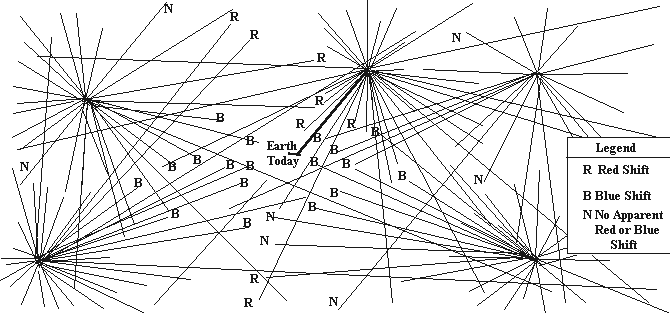
Figure 12-5 The problem of Multiple Big Bangs
To the Universe and Nature, everything (including light) ages and goes on. To look to the sky towards distant objects 12,000,000,000 light years away, means that those object were there then, formed and bright enough to be seen. Since the problem of the spherical Universe was posed in figure 12-3, there must be different ranges of velocities observed in every direction. For any expansion theory, the direction one looks must change the statistical range in velocity variations thereby indicating a centre and all the directions of motion. But this is not observed.
One of the principle methods used by cosmologists to explain the expansion of the Universe is to paint a series of dots on a balloon. The balloon is then inflated slowly to represent how the galaxies spread apart with the expansion, (a function of Cos Ø°). This visualization is relatively simple. In a darkened room, where only the balloon is illuminated, describe the view a flea would have from the balloon's outer surface looking all about. As illustrated earlier, looking upwards would be a black abyss. Looking across the balloon's surface would appear a horizon. Looking through the surface towards the centre, the known Universe. From a position just under the surface, the black abyss would appear as a disc. The view from under the surface would reveal a bright wall of galaxies extending as far as the eye could see but fading with higher angles from the centre of the disc of the abyss, showing the curvature of the Universe's skin. Looking back towards the centre would be the illumination from the Universe fading with increasing depth. To move the observing position closer to the centre of the Universe, the diameter of the black disc would close up. Placing the observer's position anywhere deep inside the sphere would reveal a homogeneous Universe where all objects would have different rates of expansion. If these objects have different rates of expansion, then the observations would not even resemble Hubble's linear relationship. All observations are contrary to the Big Bang predictions and models. There is absolutely no reason to accept The Great Attractor or any explanation for Blue shifted galaxies unless the galaxies are flowing in the arms of a super galaxy, as rivers of galaxies. None of the balloon speculations match the structure of the known Visible Universe.
The actual structure of the Visible Universe appears to reveal only a tiny part of the picture of an immense Universe. From the Milky Way Galaxy, a vertical wall of galaxies is seen across the sky. There does appear to be great voids and parallel walls or webs of galaxies that vanish into the distance, suggesting an immense structure, perhaps a massive super galaxy, for no matter which direction one observes, at distances claimed to be 15 billion light years, the Universe appears much the same and simply fades out. It will not be until the next generation of telescopes comes-on-line that the limit of The Visible Universe is pushed to the next magnitude of fainter deep sky objects.
Before that happens, the Visible Universe will now increase in size. Many cosmological theories, concepts and ideas fail because of simple Geometry. A circle can be divided into 360°. Each degree of arc is divided into 60 minutes and each minute is divided into 60 seconds which astronomers call arc seconds. In Astronomy, the arc second is a very big angle. In a circle, there are 1,296,000 arc seconds. To draw a circle with a radius of 15 billion light years means that the span of an arc second on the circumference amounts to a distance of 72,750 light years. Such a distance is astronomically, very short. The length of the Andromeda Galaxy was estimated by Baade at 120,000 light years. To view the Andromeda galaxy from the edge of the Visible Universe, or to re-position it to the edge of the visible Universe, Andromeda would measure 1.65 arc seconds across. As many similar giant middle-age galaxies are visible in the largest telescopes where the arc angle is far smaller than one tenth of one arc seconds, the visible Universe must be at least 70 to 200 times larger than that determined through calculations using Hubble's constant. There are fainter, larger distant galaxies observed with the Hubble Space Telescope whose angular diameters are far smaller.
Looking outward, galaxies exist at the extreme limits of resolution of the super telescopes. The Yerkes 40 inch refractor and the Hubble Space Telescope have similar resolutions around 0.1 arc seconds, while the 200 inch Palomar reflector has a resolution of 0.023 arc seconds. A galaxy, the size of Andromeda, seen at the limit of the resolution for Mt. Palomar's telescope pushes the visible Universe to a radius greater than 1,100 billion light years! So trivial are the mathematics, the answers can only throw astronomical estimations about the size and age of the Universe out the door and onto the scrap heap.
No matter how one juggles red shifts, relativity, time, and space-time, the Geometry and mathematics in the Universe do not fit any of these cosmological predictions, theories and conclusions. There is far too much evidence against Hubble's expansion being a constant. Although Hubble's constant has been used to provide a proof for the theory of relativity, the expansion theory cannot be used as a proof of relativity for the expanding universe theory is obviously pure speculation without basis. Hubble's linear relationship strongly supports an observer-centric process caused by natural mechanisms. It is important to attribute the discovery of the linear relationship to Mr. Hubble, however it is necessary to determine the correct mechanism for this relationship. Since astronomers are observing red shifts in the spectrum, it would be quite valid to advance a natural effect as the cause, such that the linear relationship discovered by Mr. Hubble is a direct consequence of the propagation of light over vast distances in the Universe; that is to say, a conservation of energy where :
"the greater the distance, the greater
the Red Shift,
owing to the rate of dispersion in the transparent medium
permeating the Universe".
Hubble's principle is merely an illusion caused by the Laws of Nature identifying the conservation of energy in light. This will be referred to and explained as "The Tired Light Theory". A little historical background is required to introduce the explanation of this theory. In passing, Olbers' paradox, another important relativistic proof will be negated.
The Herschels were an English father and son team. Sir William Herschel (1738-1822) and Sir John Herschel (1792-1871) mapped the celestial heavens because a band of stars crossed the sky. Often they argued that if the stars were scattered uniformly through infinite space, then no matter what direction the telescope points, stars should be seen and the sky should appear as a uniform blaze of light. The Herschels postulated that after travelling great distances, if each star emits the same amount of light, nearer stars would appear bright while distant stars would appear fainter. Eventually, the light would grow tired, run out of puff and simply fade out.
But things turned-out to be a little more complex than the Herschels imagined. As telescopes grew larger, fainter objects were seen. Nature's inverse square law states that the apparent brightness decreases with the square of the distance. Using the observed brightnesses, the Herschels attempted to determine the distances to the stars. They identified the local broad band of stars to be a Galaxy, the Milky Way, but the Herschels wrongfully positioned the Solar System in The Galaxy. The method and assumptions made were scientifically valid for the time, though flawed. The results illustrated that the Herschels were on the right track in determining the shape of the Galaxy, but the errors conceived in their assumptions made for massive blunders, locating some stars (like Sirius) well within the bounds of the Solar System. The Sun was not believed to be a star at that time.
Today, with a better background knowledge of light, better instrumentation and new procedures identify the reasons why the Herschels made such observational errors. As solar parallax, (now used to measure stellar distances) was yet to be observed, the Herschels wrongfully assumed that all stars had the same brightness. The mechanism of absolute magnitude was not understood at the time. Just as the stellar spectrum identifies different compositions, then each star must have a different mass and brightness. Finally, in 1838, solar parallax revealed an enormous distance to a close star. The solar parallax technique used is so difficult without photographic means, a few stars had known distances in 1890. The spectroscope and parallax created the link between composition and brightness to distance. The determination of absolute magnitude takes many factors into consideration so that the inverse square law can be used with a degree of certainty. From this starting point, the measured brightness and spectra will predict (with a reasonable accuracy) the distances to the stars.
In 1826, the astronomer Heinrich Olbers, published an outstanding paper where he continued the Herschel brightness argument into a paradox based around an exceedingly simple calculation. The argument is extremely important to the understanding of the behaviour of light. Olbers simply estimated the total amount of light energy which should reach the Earth, asking the question "Why is the night sky dark?" This question demanded an answer. If there are an infinite number of stars in the Universe and each star emits the same amount of light, then the night sky should be infinitely bright. Why is it dark?
Within 100 years, astronomers wishing to expound the virtues of the expanding Universe theory, the primordial Big Bang, began to proclaim that Olbers' paradox is proof positive that the Universe "is expanding", without logical thought or proof. This may be seen as a deliberate distortion of the truth through deceptive salesmanship, because at any instant in time, Olbers' paradox applies to both the Big Bang and the Steady State theories, for it will be seen that optical mechanisms are at work, not galactic mechanisms. The Herschels were partly right in suggesting that light ran out of energy, as light tired due to absorption and conservation of energy. The evidence of energy conservation is unequivocal.
No matter where, conservation of energy applies to everything, including light and all forms of energy propagation. Despite the fact that light and sound are different, the principal laws of wave motion, (refraction, reflection, dispersion and transmission) are the same. The laws of optics apply to sound, as sound is a wave motion moving in a medium. The sound of a lightning strike changes with distance. Near the spark, an extremely loud crack-bang is heard. Within several hundred meters, the high frequency crack and the lower frequency bang sounds are stretched into an Earth shaking roar. A few thousand metres further on, the roar of thunder is heard. This effect is not a consequence of reflection or echoes because isolated lightning in high clouds creates thunder where the only path is the direct path, free of reflective surfaces. The sound of thunder is the same at sea, in the city and floating in a hot air balloon 3 miles high. However, sound has a rate of dispersion and undergoes a red shift, a spectral separation with distance in the atmospheric medium. The initial transient high frequency "crack" travels slower than the fundamental tone, the roar, in the air medium. To modify Olbers' paradox for sound, "If the six billion people on the Earth all spoke at once, everyone should be deafened".
It is a fact that individual frequencies of light travel at different speeds and each frequency range must undergo a spectral separation with distance. Optical experiments show that red light travels faster than blue light and radio waves travel faster than red light. As light traverses such enormous distances, the energy losses are compensated for by a lengthening in the wave length, (a resultant shift to the red end of the spectrum), or an apparent acceleration or stretching of the wave fronts. At extreme distances, X-rays become blue light, then red and as distance increases, enters the radio spectrum. The wave length of light is measured in Angstroms (abbr. Å) or 10-10 metres. This is where it may become confusing. A wavelength of Green Light 5300Å will eventually pass at the same speed through the interstellar medium as green light. With distance, a wavelength of 5000Å (Blue-Green) shifts to the red end through the 5300Å band. When the light reaches the increased wave length of 6000Å it is travelling as Orange at the faster speed of Orange light. Unless absorbed, the wavefronts accelerate to be seen in the radio spectrum. This fact will be proven.
When a star explodes, the nova should be first detected in the radio spectrum. Some hours, days, weeks or years later, an event may be seen in the visible spectrum, followed by an observation by satellites viewing the X-ray and Gamma ray spectrum. This dispersion of light is explained by the theory of "Tired Light" as a conservation of energy where the velocity of the wave fronts increases with distance. It is not necessary to consider the Steady State, Big Bang, Quantum Mechanics or the contradictory theories of relativity. With Tired Light, other considerations must be discussed in relation to the medium through which light and magnetic radiation travels, be it plastic, mica, glass, the atmosphere, the solar corona, or the vacuum of inter-stellar and inter-galactic space. Further to this, the full mechanism of light propagation will be discussed shortly.
The radio observations of pulsars, (stars that tick like a
clock), reveal some amazing dispersion effects. The Crab Nebula
pulsar flashes 30 times a second, but in the radio spectrum a
descending whistle is detected, not the click-click normally
received with most pulsars in the radio spectrum. Tired Light
presents Astronomy with an almost fixed constant rate of
dispersion dependent on distance, however the radio spectrum of
the relatively close Crab Nebula indicates a local change
in the dispersion effect in the region around the Crab, where
radio signals experience very unusual refraction effects caused
as the signal from the pulsar travels through The Crab nebula and
crosses the nebula-space vacuum interface; a specific finite
boundary. Consequently, local variations alter the transmission
factor of The Crab nebula. Refraction around and through the Crab
nebula will be seen as a normal dispersion effect in a medium.
The Tired Light theory simply concludes with Hubble's original
statement:-
"due to the conservation of energy in light,
the greater the distance, the greater the red shift."
Note Well:- Stripped out are all references to acceleration and expansion.
The Red Shift change can be expressed as a proportion; a fraction of light's speed. Knowing the change in wavelength and the speed of light, it is possible to determine both an apparent velocity and the rate of dispersion. The mathematics involved in this exercise are quite exciting and simple, however many of the astronomical books on the subject are totally inferior, for they show the affected spectra, but the proofs seem fabricated, simply because all the important scientific information needed to confirm the truth is not shown. Most of the published illustrations show what appears to be a complete spectrum for each object, with the Calcium lines moving from the extreme left to the extreme right of the illustrations. If this were the case, then the spectral change shown would amount to velocity increases in the order of 55% light speed. What is not obvious is the region of the spectrum (the spectral window) used to show the effect. Back calculating from the claimed distances, reveals that only a very narrow optical window is portrayed. A hint to solving the poor calibration of the astronomer's displayed results is the velocity 61,181 Km/sec being 20.408% light speed. In general Astronomy books, the mathematics to convert a wave length change to a distance estimation is rarely shown, rather statements of "fact" are presented. It is very interesting to note how the facts change. In the 1959 publication "Astronomy" by Robert H. Baker Phd (Publisher D.Van Nostrand Company Inc. New York) reference was only made to the "H+K" absorption lines of Calcium, without stating wavelengths. Baker quotes this as the work of Mt. Wilson and Palomar Observatories (page 527). In the 1959 figures, the value of Hubble's constant is considered as 56.35 Km/sec/million light years (l.y.), while the 1975 value for the same object is changed to 25 Km/sec/million l.y. (found in Malcolm Thompson and Robert Jastrow's work "Astronomy: Fundamentals and Frontiers" (John Wiley & Sons, Inc. New York page 267)). Even the Andromeda Galaxy moved from 800,000 l.y. to 1,500,000 l.y. Any good researcher must challenge these changes especially when two distinct values are accepted today as the linear Cosine function?
Fixing the velocity of light in this exercise to 2.997924 x 10⁸ m/sec, that is, 299,792.4 Km/sec in free space, the Tired Light theory states a linear relationship between the spectral shift and distance unless affected by a dense medium. In Figure 12-6-A and B, the "A" version is Hubble's relationship. Figure 12-6-B shows something far more interesting. Note the two Horizontal axis scales. For the same 5 objects, the 1959 and 1975 distance determinations are from commonly published material. The frequency of light didn't change,nor did the speed of light, the light year, the galaxies, and time didn't change. The considerations made for any Doppler shift (change in wave length due to velocity,) didn't change. However Hubble's Constant DID change in 1972.
In 1959 an elliptical galaxy in Virgo was claimed as being 20 million light years distant, then just 16 years later, Astronomy moved it to a new distance of 63 million l.y. Another elliptical galaxy in Hydra measured at 1,000 million l.y. became 2,900 million l.y. in 1975. So, what is the true situation? This is amazing science. The wavelength of light is directly related to its frequency, while the speed of light remains constant as per the demands made by accepting the Special Theory of Relativity. So, something is wrong.
velocity in Km/sec
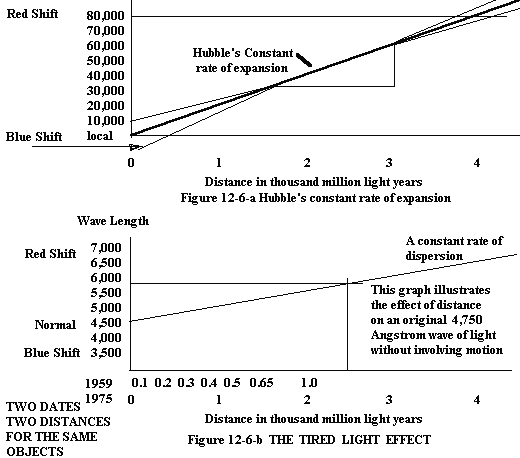
Really strange is the comparison between the velocity determinations (which are very close) to the distances that vary by a factor of 3 as illustrated in Table 12-1. Due to the limited optical window of the portrayed spectra, it is necessary to assume an original wavelength of 5500Å (green light) to reveal similar answers to those presented. One could assume that green light is near the mid range sensitivity of most photographic emulsions. Although the distance (x) is stated at the time by the authorities, as fact, it is necessary to recalculate these from the given velocity (v) to determine more correctly the astronomer's spectral band size. Assumptions are dangerous however in this situation, the aim is merely to test the claims made, so assuming a starting wave length of 5500Å, a great deal can be achieved. To determine the truth, one must work backwards to find out what mischief some cosmologists have been up to in displaying the observations, according to the Doppler equation given in expression 1 (Table 12-1).
Velocity = change in wavelength x velocity
of light (Original wavelength.) 1.
So, change in wavelength = Velocity x original wavelength (velocity
of light)
distance (x) in 1959 |
-- |
20 |
300 |
300 |
650 |
1000 |
million l.y |
velocity (v) |
0 |
1,200 |
15,000 |
21,500 |
39,300 |
60,900 |
Km/sec |
x=v/H (in 1959) |
0 |
21.3 |
262 |
381 |
697 |
1,080 |
million l.y. |
v/c |
0 |
0.004 |
0.05 |
0.0717 |
0.131 |
0.203 |
Km/sec |
wavelength |
5500 |
5,522 |
5,775 |
5,894 |
6,220 |
6,616 |
Å |
distance (x) in 1975 |
-- |
63 |
820 |
1,070 |
1,900 |
2,900 |
million l.y. |
velocity (v) |
0 |
1,207 |
14,973 |
21,575 |
39,284 |
61,181 |
Km/sec |
x = v / H (in1975) |
0 |
48.3 |
599 |
863 |
1,571 |
2,447 |
million l.y. |
v / c |
0 |
0.004 |
0.499 |
0.719 |
0.131 |
0.204 |
Km/sec |
wavelength |
5500 |
5,522 |
5,774 |
5,895 |
6,220 |
6,622 |
Å |
Table 12-1 Background needed to determine the rate of dispersion
In 1959 the rate of dispersion would have been 1.116 Å per million l.y. Due to the change in Hubble's constant, the 1975 figures reveal a dispersion change of 0.387 Å / m.l.y. As 1 Å = 10-10 m, the wave front speed increase would be about 0.007036 c / m.l.y. At 15,000 m.l.y., light speed has risen 105 times placing what was green light in the long infrared.
Olbers' paradox, a claimed proof of the Big Bang theory can be explained away by the "Tired Light Theory". Unfortunately, this Tired Light Theory also presets the size of the visual Universe as dependent on the size and sensitivity of the equipment. Perhaps one could see about 5,000 stars with the naked eye on a clear night away from the bright light pollution of the city. In the pocket telescope the number of stars virtually doubles. With a much larger telescope, so many stars are seen that the star numbers border in the hundreds of millions. Such a great deal more of the Universe is seen, perhaps to the current visual limit of the known Universe. Further object may be seen from space using longer satellite exposures (perhaps as long as a month) revealing far more distant galaxies. It will not be until the next generation of space telescopes comes on line, that the size of the Universe will be next increased to a radius greater than 1,100 b.l.y. (not 15 b.l.y.).
Hubble actually found something quite important, a diverging relationship in red shifts as illustrated in figure 12-7, but he used statistics to determine the mean range where several "stationary" elliptical galaxies fitted precisely. But then the great attractor concept must be used to explain away all the local perturbations. With distance, Blue shifted galaxies (those heading towards the Milky Way) develop a Red shift (as if they are moving away) purely because of distance. Figure 12-7 shows the diverging relationship predicted by the Tired Light theory, which matches Hubble's observations, identifying an observer-centric illusion, and illustrating a range from Red to Blue. It is necessary that the Blue shifted Galaxies must be considered, but since Hubble ignored them, Science is now corrupted!
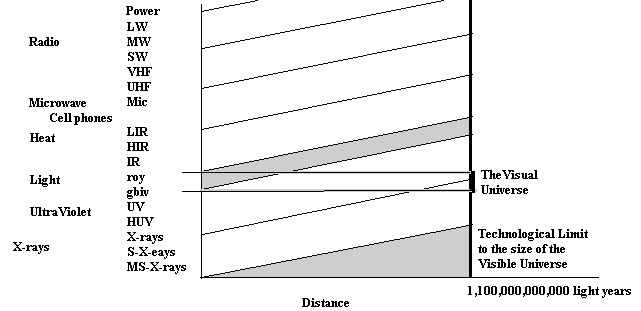
Figure 12-7 Hubble's expansion concept is wrong. This is what
Hubble actually observed.
A "Blue" Doppler shift obviously is affected by the Red Shift caused by the dispersion of light over a distance. Simply put, the expected shift would be given as:-
Effective Shift = Dispersion Shift ± Doppler Shift
So, it appears that these objects are rapidly heading towards our Galaxy.
To measure the brightness or darkness of the sky between the stars is limited by natural and technological limits, the seeing conditions and an instrument with suitable light gathering power. The larger the physical diameter of the telescope the better it will capture and measure the strength of the magnetic radiation, thereby setting its technological limit on the visual limit of the Universe. This fact is necessary to understand the next prediction.
With the advent of electronic and space technology, some brilliant insights added to the wealth of knowledge about the Universe. Today, the most wonderful tools are at the disposal of astronomers, allowing measurements to orders of magnitude which just forty years ago, would have been considered impossible. No matter what band of frequencies is chosen, there should be stars and galaxies visible, but there are changes between the optical and radio spectra. The dark bands in the spectra become very interesting because the theory of relativity predicts that it is possible to determine the background temperature of the Universe. As light and IR slips into the radio spectrum, the theory of Tired Light must put some objects in these bands where there should be nothing observed. The mechanical atom theory states that matter's dark bands are caused by absorption, rejection spectra and voids. Before going further at this point, it is necessary to note a few facts.
The Steady State theory fell into disrepute because of four main reasons. It claims that galaxies are of different ages. This claim was investigated by Hubble and many astronomers, however no evidence could be found to support different aged galaxies based on Hubble's model of galactic evolution, so all galaxies must be the same age, but at different stages of development. As Hubble's model is incomplete, this claim is false. The second proof was that as human technology improved, measurements with greater precision could be made, but this introduced a time problem, where red shifts and distances showed an even greater apparent expansion. This is denied by the Tired Light theory where a conservation of energy over a distance occurs. The third proof is the remnant background radiation from the Big Bang predicted as less than 1°K. The discovery of microwave background radiation killed off the Steady State theory. A major error here will be illustrated shortly. The fourth and most dominant reason is simply that no one is willing or prepared to put their reputation on the line, to challenge the contradictory theories of relativity or the cosmological Big Bang lobby in explaining away the previous three reasons according too conventional Physics. This is not a defence of the Steady State theory, rather it is a blatant attack on fabrication, misguided thought, tunnel vision, false beliefs and blind faith, which turned relativity into a fundamentalist religion where many have the attitude that 'Relativity is God and no one has the right to challenge God '. To challenge relativity is not heresy and to win against the force of relativity is a matter of logic.
As stated, the principal attack made on the Steady State theory was completed by the discovery of the microwave background radiation. To state categorically that the mottled background temperature of the Universe in the microwave region is less than one degree Kelvin without referring to the foreground and the background temperature measured in other regions of the magnetic spectrum and the resolution of the equipment, is unscientific. This remark directly challenges the credibility of the claimants, their postulations and their proof. Observations of stars and galaxies can be made throughout the entire magnetic spectrum, from gamma rays to X-rays, UV, light, Infrared, microwave, VHF, Short Waves, Medium waves and to long wave radio waves. Radio maps of the Universe at 1.4 GHz, 500 MHz and 144 MHz show similar but less detailed structures to the optical star charts, with the major structures appearing across the entire charts in all but a few regions.
Radio maps of the Universe at many different frequencies show stars, nebula, the Milky Way, and other galaxies. In the spectrum above the microwave region, the Infrared, Light, and X-ray spectra, all show these important structures, yet in the Microwave map, there is nothing. This is extremely odd because the magnetic spectrum is continuous and as the microwave region shows a mottled map where all structure vanishes, and is then claimed to be within one quarter of one degree Kelvin, existing over the entire sky, then categorically something is wrong. It could be that the results are fabricated, or there is a totally different cause; some entirely different mechanism. If the data and results are true, then it shows an opaque zone, a spectral absorption or rejection band. Apart from a deliberate scientific fraud, the only explanation possible is an absorption-rejection band effect.
The observations state categorically that magnetic radiation cannot pass through that region of the magnetic spectrum over vast distances, so there must be an absorption line or two in the microwave region preventing seeing the Universe or this galaxy. This effect creates a barrier to the Tired Light theory where the continuing slide from the X-ray spectrum, through light and into the radio spectrum is abruptly stopped. The unbalanced view of the Great Orion Nebula hints strongly at molecular absorption. Suddenly a new limit is placed on the dispersion of magnetic radiation passing through the Universe. That is, the red shift slide starts at the source of radiation and with distance reaches a band in the microwave region where the Universe is opaque. Just as the atmosphere is opaque to certain magnetic frequencies, it is feasible that the interstellar medium has opaque regions. A bright Mercury vapour lamp when viewed through Mercury vapour at room temperature is seen with greatly diminished intensity due to the absorption lines of cold Mercury. Microwave radio frequencies just below this speculated opaque barrier originating from the same source would naturally slide down the spectrum into the extremely long wave regions unless other absorption lines stop the signal's slide. So what molecule would absorb everything?
When radio maps were initially made of the Milky Way Galaxy using the 1,420 MHz Hydrogen Line, slight changes in frequency with distance and velocity gave radio astronomers a 3-D map of the Milky Way Galaxy. The slide means that to research the progression of radio signals at low frequencies becomes extremely handicapped by the physical size of the aerial. The longer the received wave lengths, the greater the aerial size. Terrestrial broadcasts interfere with following the progression. There is a big difference between a terrestrial broadcast signal and one emanating from space. Intelligence is carried on the sidebands of the carrier signal, so if one or more absorption lines appeared in the region of the signal, then there is every likelihood the intelligence will pass (for a time) through the barrier. There may be a slight signal loss, however radio engineers compensate for this by "twigging-up" the signal.
Another method of determining background radiation is to take a large telescope and measure the optical background temperature between the stars and the galaxies using a photosensitive collector. On the Earth, a region of sky was photographed with a super cooled charged coupled device, revealing absolutely nothing, a very low temperature. The Hubble Space Telescope examined the same region using an incredibly long time exposure, discovering thousands of new unseen galaxies many smaller than half an arc second, previously obscured by the Earth's atmosphere.
The microwave background radiation can easily be related to specific processes that also prove the Steady State theory. This radiation is not proof of the Big Bang because this is an expected result that is not "exclusive". It is proof of extreme gullibility and self delusion. Astronomers and cosmologists were looking so hard for proof, they found proof where there was none to be found. What the results do show is an attempt to prove a fallacy, with a fallacy. Such research is not causal, so to use the explorative research results as a proof, is simply, a deception, for it is promoting a falsehood as the truth. To use nonsense science as proof of the Big Bang is a travesty.
Due to molecular Hydrogen and free Helium, there will be absorption bands, where natural absorption forms a barrier that prevents the background temperature from being measured. If nothing is seen, then the background is black and will appear near absolute zero. This microwave background results can therefore be replicated many times, so it cannot be used as a proof of the Big Bang for the observations state in two words, "totally opaque".
Returning to the expanding balloon experiment used by the cosmologists. The mottled results obtained from the satellites do not show the structures which one must find if the Big Bang were true. To further defeat the background radiation theory is the inverse square law which now works really well. Place a small glowing pea globe light source near the surface of the balloon in the darkened room and describe the intensity of the light on the surface. This description should be much the same as being inside the Universe. In one direction the observing position should be much closer to the source of illumination while the other direction is so far away, that any map of the Universe at one degree Kelvin, should appear as a sphere with a bright patch on this side of the sphere, fading to black. The mottled microwave map is challenged scientifically because the results obtained show the predictions of an absorption spectral view of a weak poorly focused map of the Universe, with little or no structure, devoid of all galactic identification reference points. The mottled microwave map and the filtering of light from certain astronomical objects conclusively proves the presence of absorption lines in the magnetic spectrum of the interstellar-intergalactic medium. There is a great deal more to this argument.
Even though there is incredible order in the Solar System and in the planetary satellite systems, in the Universe, there seems to be no real order. Red shift mapping of the Universe reveals but a part of a structure, a partial view that only makes the overall view just that little more difficult to understand. At the extreme limits of computer imaging technology and powerful telescopes on the Earth and in orbit, the view of the visible Universe just fades out. With the next generation of bigger more sensitive telescopes, the limit will be that little bit further away. The Earth is not the centre of the Universe. The astrophysicist has no way of determining the centre of the Universe due to the conservation of energy giving most galactic objects the illusion of motion away from the Earth. Any expansion of the Universe will not be observable owing to a natural illusion, Tired Light.
Contemplate attempting to map the Earth where the entire view is and always will be that of a country town in the fog where the visibility is 100 metres. In this situation it was discovered that Infrared (IR) could be used to "see" through the fog revealing greater distances. As the IR detectors were made larger the technological limit was extended to discover a strange unknown phenomena called the horizon. Then it was discovered that the distance to the horizon altered with height as did the air pressure. To explain away the phenomena, a false belief grew in the town where it was stated that the IR was bent in the fog causing the illusion that the flat Earth is dome like. People accept the beliefs of their teachers.To some, the view of the Universe ends at their front door while others look past galaxies.
The size of the Universe is a personal thing. The actual size of the Universe is impossible to determine at this point of time, because the measurements of distances have been determined with limited equipment and limited beliefs. Astronomers will have difficulty in determining the size of the Universe because there are no standard "signposts" in the Universe currently known. Such signposts will reveal the physical three dimensional parameters of each galaxy. The view of distant galaxies from this part of the Universe is subject to the amount of light captured in the telescope. There is currently no way of determining where the centre of the Universe actually is, or the actual physical dimensions of a distant galaxy. Red shift observations cannot express a direction to the centre of the Universe because cosmology has got it wrong. Everything observed is limited by the technological limits. Cosmology preaches a Universe with a radius of 14 billion light years (1 b.l.y.=109 l.y. in this case,) from the Earth. Simple geometry indicates a Universe with a visually limited radius closer to 1,100 b.l.y.
One can extrapolate Tired Light's predictions (Figure 12-8)
setting technological limits for various sized telescopes
operating in different regions of the magnetic spectrum. Science
must not be built on contradiction or blatant speculation. It is
unscientific to change evidence to fit; to make false claims of
proof; in forcing and teaching limiting beliefs; to avoid any
challenge. Everyone must recognize the ethical and moral issues
concerned. Inadvertently cosmology has promoted falsehoods in
preaching contradictory doctrine without scientific basis,
without forethought, without truth, without logic and in
disregarding both the observations and the scientific method. 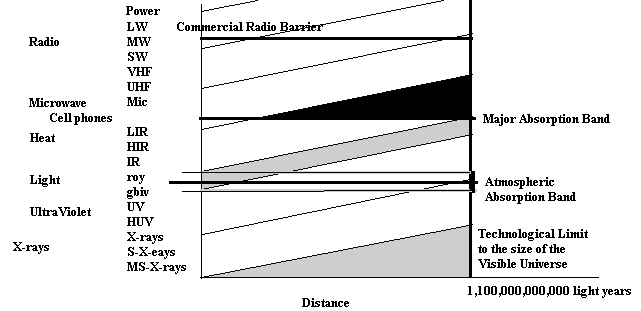
Figure 12-8 The visible Universe's present limited size
Obviously the visible IR Universe is larger than the X-ray visible Universe. Due to the apparent absorption band in the microwave Universe, the IR to microwave Universe will be truncated before the X-ray to microwave slide, but as the technological limit is pushed further into deep space, only the more active objects, X-ray sources will be visible in the IR spectrum. As the radio spectrum is so polluted on the Earth, the only way to increase the technological limit would be to build huge radio telescopes on the other side of the Moon, or on another planet, perhaps Mars.
Consequently, to use the microwave region to look for other intelligent life in the Universe, seems rather deluded . Intelligent signals would slip down the spectrum. It is important to note that Marconi's first transatlantic transmission made last century, by the year 2000, would be just about to reach stars only a hundred light years away. The Tired Light theory pushes the ET search into the normal AM radio bands. Any intelligent life would need to have discovered the technology capable of sending and receiving high band microwave radio signals. The Ancient Greeks were very intelligent. The Ancient Babylonians had galvanic cells (batteries) over 2,000 years ago, but did not have any radio stations.
Without common communications systems, how can intelligence be detected from so far away? If mankind cannot detect hyper-light communications, then what chance is there of detecting hyper-light communications. But what are hyper-light communications? They are unknown on Earth, but they may be used "out-there". Before radio, there was no intelligence on the Earth? So, does this mean that Marconi's broadcasts began mankind's intelligence? Marconi began transmitting signals in the very low frequency bands, because he initially believed that short wave radio communications would not travel across the Atlantic or span the world. The early trans-Atlantic long-wave Marconi transmitter could be heard for miles, echoing across the country side, because of the power requirements and the methods used to push this power into the aerial. The coronal discharge from the aerial would light up the sky with each press of the Morse key. To anyone who could read Morse code, no message was secret. Later, short-wave radio communications disclosed the presence of the ionosphere and this in turn reduced the power requirements by a million.
There are several other problems in the search for extra-terrestrial intelligent life forms. Consider the fact that the solar radiation striking the Earth has energy equal to 1,000W per square metre. From another planet orbiting a nearby star, the Earth would appear over a million times fainter than the Sun, perhaps lost in the telescope's diffraction effects. To detect radio signals from a 1,000 MW transmitter (1,000,000,000 Watts) would be like looking for a block of land 1,000 metres square, orbiting the star. The effective signal from such a transmitter would be so weak compared to the star's noise reflected by the planet, it could make detection almost impossible at stellar distances. To increase the effective transmitting power, the culture would need to have developed SSB (Single Side Band) capabilities and beam aerials. For those cultures with technological levels capable of travelling between the stars further demands a communication system that is both much faster than light and free of stellar interference, else there would be the need to have outpost satellites far removed from any star acting as signal repeaters. Such "faster than light" communications could be possible as only a small part of the phenomena of magnetic radiation is used and understood. This option will be explored shortly. It could be that there is another form of communications, waiting discovery. Astronomy is a region of discovery.
This section has illustrated that far fetched theories do not explain the simplicity of Nature in the Universe. It merely takes simple questions and solid logic to challenge falsehoods. As Nature is Simple, all events can be traced to emanate from simple interactions between the numerous Laws of Nature, step by step, process by process in various mechanisms, one process working at a time. Everything seems to follow both the laws of least resistance and conservation. To trace the mess caused by the Big Bang knowledge virus (its false proofs, the theory of relativity and much misguided thought,) is quite simple.
The Tired Light theory presents astronomers with several real problems, because everything has a red shift caused by distance, not necessarily because of the object's velocity with respect to the Earth. Doppler shifts are observable between the arms of most galaxies, when the major shift is directly related to the object's distance from the Earth. Hubble inadvertently introduced a massive error, the ramifications of which affect all the sciences. As a consequence, many relativistic objects must be discussed and either accepted or disproven. If there is any truth in the existence of such objects, the evidence will be found.
The predictions made by any theory that is based on pure unfounded speculation does not prove that such objects exist, unless one is extremely gullible, or one treats science as a religion where faith is needed before proof. All astronomical objects that exist in three dimensional space in the Universe, must be explainable.
One cannot seek an understanding of any
astronomical object
with the mind and eyes closed, or with just one eye.
To observe the Universe demands opening both the eyes and the
mind.
=================== END CHAPTER 12 ====================
size 11,730 Words
Please do not rush off to email the author just
yet.
It is far too early. Do not make the mistake of wearing two or
more hats at once! If one must argue, base your arguements on a
strong unified foundation.
Read on as more questions are answered in subsequent chapters.
