GALACTIC CLASSIFICATIONS.
Star Catalogues and classifications.
Astronomical objects referred to for the purposes of further investigation are referenced in conventional star catalogues. To many non-astronomers, references like M51 or NGC 5128, will be absolutely meaningless. Astronomers use various systems, often alphanumeric codes to replace the traditional method of naming astronomical objects,such as the first thing that comes to mind.
The "Whirlpool Galaxy" looks like a whirlpool, whereas the number M51 is the same object described in a specific astronomical star catalogue. The letter "M" refers to the very first catalogue or list of nebulosities which the comet hunter Charlse Messier produced. His aim was to tell other comet hunters "don't look here, it is not a comet!" He listed 103 amazing astronomical objects.
Some catalogues are not available to the general public and so the cross references to another object classification may be lost. Then other catalogues use astronomical positions rather than an item number. The pulsar CP1919.04 is found in the Catalogue of Pulsars where 1919 is the right ascension angle RA=19h19m and the .04 is the (North or South) declination , 4°N. Cygnus X-1 is an X-ray source in the constellation of Cygnus found in both the radio astronomer's catalogue and the catalogue of X-ray objects.
Unfortunately, there are no astronomical standards for published works (including video publications) allowing any author to alternate between one or more star and galactic catalogues. In one chapter, the author may use M51, while in another chapter, the reference NGC 5194 may be used, when the two are the same object. Then, there are those astronomers who use obscure in-house catalogues and relate to objects such as V404.
Consequently, since this work has dealt with stereoscopic analysis, only commonly published astronomical objects have been used with commonly available catalogue information. These objects are frequently found in very old and new Astronomy books and may be referenced under different names. This does not mean that one must add to the confusion by creating a new 3-D catalogue ! Existing galactic and star catalogues really need to be standardised so that one name relates to that object.
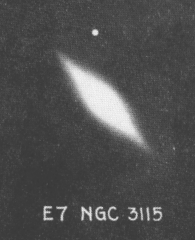
As in the New Galactic Catalogue (NGC), many astronomers followed in Hubble's footsteps using his 5 major classifications which are meaningless when one applies 3-D observations and logical thought to each class of objects and their sub-groups. The following examples will assist in visually defining the classifications envisaged by Hubble using his awkward definitions.
Since the classifications seemed logical at the time,many assumed that they must be right. Not so! As Hubble placed many different objects in the wrong pigeon holes he set Astronomy on the road to error. This will become quite evident when Table A-5-1,(a summary of Hubble's complex morphological (i.e. related to structure) classification system,) is compared to the 3-D evolutionary model.
| Class | Families | Varieties | Stages | Type |
| Ellipticals | Compact | cE | ||
| Elliptical (0-6) | EO | |||
| Intermediate | EO-1 | |||
| "cD" | E + | |||
| Lenticulars | SO | |||
| Non-barred | SAO | |||
| Barred | SBO | |||
| Mixed | SABO | |||
| Inner ring | S(r) | |||
| S - shaped | S(s)O | |||
| Mixed | S(rs)O | |||
| Early | SO- | |||
| Intermediate | SO0 | |||
| Late | SO+ | |||
| Spirals | Non Barred | SA | ||
| Barred | SB | |||
| Mixed | SAB | |||
| Inner Ring | S(r) | |||
| S-shaped | S(s) | |||
| Mixed | S(rs) | |||
| O/a | SO/a | |||
| a | Sa | |||
| ab | Sab | |||
| b | Sb | |||
| bc | Sbc | |||
| c | Sc | |||
| cd | Scd | |||
| d | Sd | |||
| dm | Sdm | |||
| Irregulars | Non-barred | IA | ||
| Barred | IB | |||
| Mixed | IAB | |||
| S-shaped | I(s) | |||
| Non-Magellanic | IO | |||
| Magellanic | Im | |||
| Compact | cI | |||
| . | ||||
| Peculiars | Pec | |||
| Peculiarities | Peculiarity | pec | ||
| (All types) | Uncertain | : | ||
| Doubtful | ? | |||
| Spindle | sp | |||
| Outer ring | (R) | |||
| Pseudo outer ring | (R') |
Table A-5-1 de Vaucouleurs' Revised Hubble Morphological Galaxy Classification System
Hubble claimed that Lenticular galaxies have characteristics between a completely smooth elliptical galaxy and the spiral galaxy. To confuse analysis, the Lenticular, Spiral and irregular galaxies can exist with barred shapes. This means that an active galaxy can exist in all the classifications, thus the nature of a galaxy's core will never be known, simply because the classification system is inept, deluded and wrong. Active and star-burst galaxies defy physics because they can have a mass so great the escape velocity can exceed a million times that of light. These objects exist and can be seen, as the photograph above confirms, despite Einstein's general theory of relativity and Opprenheimer's ill-conceived ittl-thought-out, preternatural black hole concept (ie. science fiction trash based on scientific incompetence), As these visible galaxies are observed, they are "black holes" nor are they " white holes". They are massive objects! Currently promoted cosmological theories have not and cannot begin to provide any mathematical description as to how these objects can be seen, let alone explain the Physics of the active-star-burst galaxy. All the science's non-consistent-contradictory theories fail. Why not examine the mechanisms of the PacMan Galaxy? It fits the description.
For the purposes of explanation, relating stereoscopic
astronomy to the evolutionary cycle of galaxies, the errors in the
"Revised Hubble Morphological System of Galactic Classifications",
means that in proposing an arbitrary replacement classification system,
Hubble's classification system must be scrapped. A workable replacement is subject to the
approvable of the International Astronomical Union. However, it is doubtful
whether they would change the system, to re-formulate, develop, and evaluate an
alternate system. Due to peer pressure, they probably would modify Hubble's system to
save-face.
The following is a quickly thought out guide that is superior in every respect.
Only the major classifications are used here.
Within each galaxy exists:
The magnetic field of a galaxy is responsible for many attributes of the galaxy. A PacMan galaxy has a dipolar structure and an ion engine. As its rotation changes, so does the magnetic field produced. The stable spiral galaxy will be found to have a common axial magnetic polarity, opposite to that extending outward around the diskforming a diamagnetic structure. The axis will either be North in both directions or South in both directions until such time as the field becomes axially dipolar, whereupon a jet may form, tearing the centre from the galaxy. This disaster could also be caused by a large PacMan galaxy passing through the galactic heart. In both situations, the remnants form a diffuse ring of similar stars. Once the ion engine is operating, the PacMan will leave a characteristic trail of rogue stars in its wake. This could be seen as stars immediately above the galaxy's axial pole, or as a trail of stars passing through the centre of the star ring.
A Open cluster in a galaxy's spiral arm gives rise to a local gravitational collapse, forming a gobular cluster. As this collapses, there is every likelihood that it will become cancerous, attracting matter from the local region while growing in rotational speed. This can produce an active baby PacMan capable of reaking havoc as it travells down the magnetic field of the spiral arms. The PacMan's mechanism produces one direction of polarity with respect to the position of its ion engine's direction. The direction of the diamagnetic component of the parent galaxy's field along the spiral arm will serve to either repell or attract the PacMan with respect to the parent's central core. Lucky is a galaxy that ejects the PacMan. Unlucky is the galaxy that the liberated PacMan flies into.
Galactic cannibalism and merging takes place. In both situations, there will be an attack, a victor and debris. It is this debris that makes up the next classification of galactic objects.
Perhaps the worst attribute of many star and galactic catalogues is the lack of information about specific objects. In "The Deep Sky Field Guide to Uranometria 2000.0", (Uranometria 2000.0 is the catalogue), a rather comprehensive work, the description given of NGC 5128 is only "Centaurus A". The Crab nebula is similarly treated. Other objects are given glowing descriptions showing all the parameters involved. Lack of basic information degrades the value of such works.
---------end appendix 6 --------
