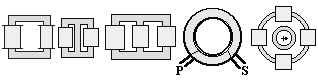
Figure 9-1 Various Toroids
Behind the Facade.
J.J.Thomson was openly criticised when he proposed the concept of a solid atomic model, a particle having an equal distribution of positive and negative components. Despite unequivocal evidence, his theory was emotively discounted and trivialised by those who did not appreciate the atomic frame of reference. Well before applying available knowledge, misguided zealots soon began to actively promote acceptance of Rutherford's orbiting atomic model, despite the fact that the electron cloud model failed to work when animated. They argued that when charges neutralise, Thomson's atom would explode, whereas Rutherford's atom was prevented from exploding because his electrons orbit high above the nucleus. This exploding argument deplicts the reaction of a fully charged electro-chemical battery when its terminals are shorted-out. It is a terrestrial effect that substantiates the claim, observational illusions are produced by not knowing what one is actually observing. Nature's mindless simplicity had to be explained-away by zealots using unproven speculation, dogmatic beliefs, mis-information, peer pressure and sophistication-powered by faith to market a deluded theory to the public.
Sophistication has since allowed self-proclaimed specialists to develop and elevate invalid theory above Nature. It appears that before Nature is accepted, Nature must be exposed to a method of questioning that refuses to acknowledge or accept Nature's Laws. Since a theory is considered as true, Nature must be wrong. Over $40 billion US dollars has been spent fruitlessly searching for Black holes because theory says they exist, so they must exist. Blind. acceptance, sycophantic adulation, unswerving loyalty, tradition and fear or one's peers, does not make good science.
A comparison of 'The table of the element's electron shell configurations' to data tables and graphs in the previous chapter have opened the window to view a deception. A compelling story unfolds of scientific betrayal by those who once controlled scientific knowledge, because science has come too far along this path. Correction could be seen as a loss-of-face. Science is locked into a Catch-22 situation. Educators do not know any better. To save face, the status quo must be maintained, preserved and protected. Many today are forced into the situation of protecting inept theory. Few would risk scientific scrutiny, especially when observations and new theories challenge the accepted truth, one's credibility or position. Such theory must be rebuked or ignored.
The electron cloud atomic model and relevant theories are seen framed on the gallery's walls for all to honour. It is more like an impressionistic painting than a picture of Nature. The accepted theory portrays each period forming a complete shell. This shell can be composed of unique sub-shells. As the period number increases, so does the number of sub-shells in that period. Each shell is denoted as either an alphabetical identifier or a layer number, while the sub-shells are identified by an alpha-numeric code. From Hydrogen, each period uses the shell's alphabetical identifier, (K,L,M,N,O,P and Q). When referring to a sub-shell, a numeral prefix describes the particular shell followed by an alphabetical character to refer to the relevant sub-shell. The first and smallest shell is the lowest layer near the core, the 'K' shell. This first shell does not have a sub-shell, yet it is denoted as the ' 1 s ' shell. All 's' sub-shells begin each shell and are filled with just two electrons. The next period, spanning from Lithium to Neon, is the 'L' shell, composed of the '2s' and '2p' sub-shells. Rather than stating 'L-s', the sub-shell is denoted as '2s', being the first sub-shell of the second period. This double redundancy used confuses many people. The 's' sub-shell is an exclusive and unique orbital sub-shell that must fill with two electrons before any other sub-shells in that particular shell begins to fill. As the next sub-shell in the period fills, for no explicable reason, it can reach a capacity where other sub-shells take priority and fill, perhaps robbing electrons from previously filled shells including the 's' sub-shell above. Once an outer sub-shell ceases filling, incomplete previously filled deeper sub-shells may restart their filling and fill to greater capacity before the outer shell continues to fill. The 'M' shell is the period, Sodium to Argon, having 3s, 3p and 3d sub-shells. Although the system seems logical when displayed on paper, with each new period, things become illogical when the atom is animated. If this theory is true, then there must be proof.
There is more to this convoluted system. It will be seen that for each period, the number of sub-shells progressively increases, so that the order and filling sequence become unduly complex. After the K layer builds, the L with two sub-shells (2s & 2d). Then forms the M shell with 3 sub-shells (3s, 3p & 3d). The N has 4 sub-shells (4s, 4p, 4d & 4f), and progressively, each layer increases the number of sub-shells, so that O has 5 ( 5s, 5p, 5d, 5f & 5g), P has 6 ( 6s, 6p, 6d, 6f, 6g & 6h) only to be finally capped by the Q shell which should have 7, but only has 2 sub-shells ( 7s & 7p). Since the electron cloud atom lacks the necessary mechanisms, to maintain, distribute and sequence electron orbitals, this classification system is naive. Not only does it lack proof, it lacks corroborative detail, integrity and logic.
Every chemist and physicist is taught to accept the electron shell configurations because they are no more than best fit guesses. However, rigid acceptance produces an unswerving loyalty to this deluded theory, creating more questions and problems than can be resolved by the theory. The guesses are not very good because many redundancies are built into the system, such as the superfluous sub-shells 5g, 6f, 6g, 6h and 7p. These shells are not used. The following mess illustrates the crude attempt to force deluded theory to agree with observations. Examine the logic to this strange filling sequence.
The mechanics The logic
2 electrons in 1s of K Complete
2 in 2s of L 2. This sub shell is full.
6 in 2p of L add 6, =8. So, completed
2 in 3s of M New shell. @ 2 This shell is full.
6 in 3p of M add 6, =8. So, it is completed
2 in 4s of N New shell @ 2 This shell is full
8 in 3d of M Return to level 3 and fill with 8 more = 16
remove one from 4s and hold 3d at 10 Steal one to add 2 to level
3 = 18
restart 4s and hold at 2 2 again
6 in 4p of N Add 6,=8 So, it is completed
2 in 5s of O New shell @ 2 This shell is full. 2
2 in 4d of N Return to level 4 and start a deeper layer.
remove one from 5s and restart 4d to 8 Steal one to add 6 to 4d,
=8
remove one from 5s and hold 4d at 10 Steal another and add to 4d,
=10
2 in 5s of O due to restart 2 again
6 in 5p of O Add 6, =8. So, is it completed?
2 in 6s of P New Shell @ 2 This shell is full.
1 in 5d of O and hold Return to level 5 and begin 5d with 1
insert 11 into 4f of N Return to level 4 and create another layer
remove one from 5d in O and move to 4f in N Steal one and add to
4N,=13
increase 4f in N to 14 then add one to 5d in P Add to 4N, =14
restart 5d in O to 9 9
remove one from 6s in P and add to 5d in O 9+2=11
complete 6s at 2 in P New Shell @ 2 This shell is full.
6 in 6p of P Add 6, =8 So, it is complete.
2 in 7s of Q New Shell @ 2 This shell is full.
1 in 6d of P Return to level 6 and hold
9 in 5f of O Add 9 to a sub-shell 3 layers down
In a strange way, these answers are simultaneously correct and terribly wrong. This filling sequence attempts to satisfy observational answers without understanding the questions that Nature has posed or the unchanging answers that Nature continues to supply. Deluded theory and a gauche perspective has generated this series of observational illusions. Unfortunately, these misguided theoretical answers relate to invalid mechanisms that are legally enforced through the National Standards authorities and the scientific community. History is seen to be repeating.
Contemplate for a moment the problems that many early thinkers had with The Church. Problems caused by the law makers in The Church accepting Aristotles' view of the Universe, setting those philosophies into the foundations of theology, dogma, and Church Laws. The Earth does not move. The Earth is flat. The Earth is the centre of the Universe. Heaven is above and the eternal fires of Hell are below. etc. Although Columbus had discovered the Americas proving the Earth as round, when Copernicus proposed a theory that said the Earth and planets orbit around the Sun, the all-powerful Church attempted to suppress his theory and persecute those who spread this knowledge. His theory did not centre the Earth at the centre of the Universe. Copernicus mysteriously died on the very day his work was published. Some years later, Tycho Brache, for his own safety, had to use an observational deception when he confirmed the Copernican theory. He centred the planetary orbits around the Sun, so that the Moon and the Sun's system of planets orbit the Earth. Although Galileo's first telescopic observations proved the Copernican system, Galileo also found himself in mortal danger from The Church. Under house arrest, he maintained till his last words that the Earth moved. The parallel here is to the attitude of the scientific community in not accepting change and the denial of the fredom of speech.
It is necessary to apply the correct and most logical atomic mechanisms to recreate and prove this table of theoretical guesses as a series of observational illusions. This means attributing the electronic configuration table of vague electron clouds to the geometry of a mechanical atom. The following explanation of the mechanical atom investigates the truly fascinating working mechanisms of Thomson's atomic model, modified by the addition of neutrons and the use of various working mechanisms in the structures, forming a malleable solid atom. Chemical bonding will become a logical extension to the following mechanisms.
The concept of an atom made from rotating spheres (a core devoid of electron clouds) could be described using geometric constructs, starting with flat tight structures, building into lumpy sphere-like structures. It must be realised that chemical bonding variations will alter atomic structures through local environmental conditions. Four primary sub-atomic particles must be carefully scrutinised in the most basic examination of the atom and its properties. These are the proton, neutron, electron, and elpron. Fundamental to this examination are the atom's magnetic properties.
The neutron's role and properties are fascinating for a neutron gives the impression of being totally inert, non-magnetic, almost useless, yet its role in giving an atom longevity and stability cannot be questioned. Acting as a bearing and separator, it is intrinsic to the successful energy transfer within the atomic structure. Mechanical obsolescence may eject a neutron from unstable atoms before the atom reaches stability. The neutron's mass is slightly greater than the proton. When shattered, the neutron liberates a ßeta-particle and a single proton. In the alpha-particle, two neutrons hang in the atomic structure, even when a magnetic connection seems impossible. Believed responsible for atomic magnetism are the proton, electron and elpron. This belief does not cancel the neutron from the scheme of things. The neutron may present a specific field structure that is not deflected by magnetic and molecular fields.
The path of sub-atomic particles can be recorded using thick photographic emulsions or observed in real-time with devices such as the frozen cloud chamber or an expansion bubble chamber. In each, high speed sub-atomic particles break the crystalline structure's chemical interconnection bonds, thus making the path visible. Thick photographic emulsions need to be chilled during exposure owing to the effect of photo-reciprocity (faint exposures on warm emulsions rapidly return to the unexposed state and disappear). To expose the emulsion, sub-atomic particles must travel along and in the emulsion layer, not at right angles to it. The exposed emulsion must be chemically processed (developed) to fix the image before examination with a microscope. The path of sub-atomic particles may be observed in real-time. The bubble chamber uses a rapidly decompressed liquid to force an expansion of the broken bond trail. Each path appears as a trail of bubbles. The frozen cloud chamber uses an electrical potential to stress a chilled vapour (air and methylated spirits vapour, chilled by solid CO2). When side-lit, extremely fine sub-atomic vapour trails (that should be too fine to be observed) become visible. Although the observations of metal foils placed in the cloud chamber seem to agree with Rutherford's findings, doubt will cloud Rutherford's observations and conclusions because reflected sub-atomic particles fail to be observed. Interesting is the fact that different foil materials when bombarded with one type of sub-atomic particle will liberate completely different sub-atomic particles, often maintaining the original impact trajectory. Such observational results strongly point towards other mechanisms as being responsible. The problems identified here concerns particle transmission in a medium. Some materials maintain the trajectory, however the particle beam may change, after entering a medium the beam may exit as a beam of neutrons or some other particle.
When a sub-atomic particle tracking device is placed in a perpendicular directed magnetic field, a neutron's path is seen to pass directly through without being deflected. The ßeta-particle is assumed to be magnetic because it is deflected along a curved path. Similarly, as both the proton and alpha-particle follow curved paths, opposite in direction to the ßeta-particle, they are also claimed to be magnetic. The alpha-particle exists with a double positive charge, compared to the ßeta-particle's single negative charge. Although the alpha-particle does not readily break apart, it may barely hold together after a conflict event ejects the particle with minimal rotation. The deflection of the three particles gives a mass to charge relationship that agrees with the theory, because the charge to mass theory and the means of calibration are based on this observation. To argue on these particles being magnetically altered by charge, the following would be true to the theory: As alpha-particles and electrons are magnetic, at the pole pieces of a strong magnet in a radioactive environment, Alpha and ßeta particles would adhere to the magnetic poles and be reconstituted liberating Helium atoms. Electrons would flow through the magnet and neutralise the alpha-particle.
To equate magnetism and matter, in terrestrial observations, the open magnetic circuit of a bar magnet is inefficient, being subject to losses. Over time, the magnetic properties of a permanent bar magnet fade away due to environmental resistance. When two similar open magnetic fields are brought into close proximity, the magnetic circuit will naturally close, linking pole to pole. Physically capping the connected opposite pole pieces with a magnetic link allows the magnetic flux to flow with greater strength in a tighter circuit, reducing the environmental resistance and spill fields. This procedure maintains the magnetic effects until required. Although the exposed loop field possesses direction and intensity, the field becomes more invisible as the loop takes-on the properties of a toroidal field.
In the atom, the shape, size and rotation of elprons produce magnetic flux currents that actively prevent side by side close proximity couplings. In forming a partially closed diamagnetic loop field, magnetic flux currents push and hold the magnetic components of molecular Hydrogen (H2) apart. The position, gap structures and the magnetic direction of the open or closed magnetic rings give an element its chemical and physical properties. As chemical reactivity is dependent on mass, rotational inertia, molecular bond strength and spill field structures, Hydrogen would have a low order of chemical reactivity. To initiate any chemical reaction, the Hydrogen molecule must become magnetic. This involves opening the molecule to form a magnetic dart, in breaking one or both pole-to-pole connections. With the formation of heavy Hydrogen or Deuterium, the addition of a neutron increases the mass, but this alone does not account for the reduction in chemical reactivity. It appears that neutrons close the tiny magnetic circuit by capping the elprons to form loop structures. There are two Deuterium molecules to consider, atomic masses of three and four, that is, (1H1:1H2 ) and (1H2)2 ie. a molecule of Hydrogen and Deuterium, one of Deuterium.
Although Deuterium (1H2)2, the alpha-particle (2He4-2)and the Helium atom (2He4) all share the same number of components and basic structure, where different chemical properties are exhibited due to spill fields produced by particle separations and magnetic field strengths. The magnetic structure of Helium is tight, encased by a toroidal magnetic envelope. As the structure of the alpha-particle is virtually identical to the Helium atom, irrespective of charge, it must be diamagnetic. The alpha-particle would be greatly influenced by the environment as it is a large slow particle compared to other sub-atomic particles. For this reason, it could be argued that as these large particles lose speed as they race away from an event site, chemical interconnection bonds break, causing an on-going trajectory change in response to the environment's liberated rotational forces.
ATOMIC MECHANISMS: To begin to describe the atomic structure requires overcoming a few three dimensional hurdles. The starting place is to examine the toroid that forms the closed magnetic field. Consider the closed magnetic circuit as a coterie, a group or circle of individual units brought together for a specific or mutual purpose. The coterie binds the atom like bands of steel around a wooden barrel. The physical size of a coterie is limited by the structure's rotational integrity and mechanical efficiency. Each coterie is like a string of pearls around the neck, wrapping around a hypothetical axis, perpendicular to the plane of the ring. The complete coterie's magnetic axis is like the string passing through the pearl necklace, endlessly travelling along the ring (the Amperian axis). The smallest coterie is that of the Helium atom.
The toroidal magnetic cell is scientifically rather weird. Iron filings sprinkled onto a sheet of paper above a magnet or a magnetic compass indicate the presence and direction of a magnetic field. However, when the magnetic circuit is formed into a circle, the magnetic field being forced to travel around the loop, it seemingly traps the magnetic field inside the ring while the external field is dispossessed without a measurable direction. This external field remains invisible to Iron filings, but does not remain invisible to simple technology. Variations in the invisible magnetic field gives the researcher some information about its apparent direction and field strength.
The circular electromagnetic toroid, (a coil wound closely along the length of an unbroken ferromagnetic ring) has been known to the electronics industry for many years. The magnetic field produced when a current flows in the coil is said to be endless, having no defined pole positions. The magnetic circuit travels around the toroid's Amperian path. A change in the current passing through this coil changes the toroid's field strength. When a secondary coil is wound above the primary coil, a change in field strength will induce a voltage in the coil indicating the presence and direction of the toroidal magnetic field. Induction around a direct current powered toroid is rather strange. A small alternating electric current will be generated in a single vibrating wire passing diagonally through or parallel to the toroid's polar axis.
Two devices in common use are based on the toroidal magnetic field; the transformer and the induction motor. Conventional rectangular transformers are square toroids. In any transformer, the primary or secondary coil voltage can be floated with a DC bias voltage, so that the induced output signal, instead of swinging from positive to negative, will vary about the bias voltage. Only when there is a change to the magnetic field strength of the primary coil will there be a change in the voltage of the primary coil. Long term DC voltages will not pass through a transformer, unless the DC voltage is made to vary, but then the output signal voltage will not indicate the original DC voltage. The field variations are noted as an alternating current. In environments where rapid temperature changes occur, thermal changes to the transformer will allow the moment and rate of change to be detected, but not the temperature. Some transformer applications involve sending complex DC and AC switching signals along the signal lines without influencing the other signals passing on those lines. This is illustrated by the world's telephone systems where balanced switching signals do not alter the transformer's output signal.
Figure 9-1 illustrates some interesting transformer variations. The conventional transformer (not shown) is wound on a series of interleaved "E" and "I" ferromagnetic laminations to form the figure "8" shaped magnetic core. The primary and secondary coils are typically wound on the central cross member of the "E". Rectangular magnetic circuits introduce many losses. Some electronic pianos and radio applications used two isolated primary mixing coils and a central secondary coil, effectively making an intersecting double toroid. The total isolation transformer mounts the primary and secondary coils on opposite sides of a cost-effective square toroid.
For the same voltage and electrical current requirements, the design advantages of toroidal ring transformers (being more efficient, smaller, flatter, having lower cross-talk and being easier to mount) were outweighed by the disadvantage of being extremely difficult to manufacture. It was not until the transistor and computer revolution that its use spread, owing to improvements in the technology needed to manufacture these devices.
The induction motor uses a controlled moving toroidal field to produce rotation. The right hand illustration in Figure 9-1 is that of a simple induction motor. Some of these motors work on a three phase system, where a three 90º phase signal is applied to three coils, not four. The same can be applied using a delaying capacitor to shift the phase of the alternating current. Progressively each stationary coil is powered around the ferromagnetic ring or armature. The central magnetic rotor chases, or is chased by the toroid's moving magnetic field. When driven with a 50 Hz AC Voltage, the induction motor will produce a rotation of 1500 rpm, while 60 Hz achieves a speed of 1800 rpm. A variable frequency power oscillator can slowly accelerate the rotor to a point where the centrifugal forces exceed the rotor's chemical bond strength resulting in a structural failure. At the atomic level, this motor configuration could propagate and alter the direction of rotational energy throughout the structure and influence nearby structures.
It is important to note that it is possible to magnetise a toroid with a directed magnetic field. Examples include the loud speaker magnet and early designs of computer RAM. Environmental resistance reduces the longevity of the magnetic effects. In early memory circuits, the design used a matrix of ferrite toroids, arranged in a grid structure. Three wires pass through the centre of each toroid. The two grid wires gave the toroid its grid position with an X and Y grid coordinate. These are used to write the digital information magnetically. If the electrical current needed to magnetise the toroid is reached by applying a 6 Volt signal to the circuit, then each of the grid wires could be independently driven with a voltage of 3.5 Volts without magnetising any other toroid. Only where two grid wires intersect, each carrying 3.5 Volts, would the voltage exceed the 6 Volts threshold, so that toroid alone became magnetised. The third wire traverses backward and forward diagonally through the entire matrix. This is used to read the written digital information, however, in reading this memory, a 6 Volt signal must be passed along this diagonal wire. Effectively this action erases the entire memory, bit by bit. As each magnetic toroid is erased, a different electrical resistance is noted between magnetised and non-magnetised toroids. Sequentially, the complex output signal is read as off-or-on states and used to refresh and re-magnetise the next core memory block. The reason for this diversion will become apparent.
In Particle Physics, atomic magnetic field effects are best described through both aerodynamics and fluid-dynamics. When the electron connects with a proton, the magnetic direction is intensified. The aerodynamic principles of a sloop (a sail boat) illustrate how this effect could amplify the available energy, creating a more directed force and powerful pump. The jib or foresail increases the mainsail's pulling power and tacking angle into the wind by directing the prevailing wind over the mainsail. In responding to changes in environmental magnetic throughput, elprons absorb and transfer energy within the atom as rotation. Flux pressure surges and throughput transfer this rotation to neighbouring atoms by way of magnetic links, stress, resonance and flux winds. As compressing shortens the magnetic circuit, the magnetic flux travels faster, increasing both the elpron speed and the magnetic force of repulsion to nearby atoms. The effect is much like that of a vacuum cleaner's turbine when the inlet hose becomes blocked and the engine races due to the shorter by-pass path.
The rooves of most industrial sites are dotted with simple impellor exhaust vents. These passive air-conditioners take energy from the prevailing winds to pump air from the building. From the simple "S" shaped dual vane impellor to the massive domed 64 vane turbine, the aerodynamic design of the vanes convert environmental throughput energy, the prevailing wind direction, into rotational energy. In a gentle breeze, these turbines rotate quite rapidly. Vanes not involved with producing rotation drag air from the building. As moving air passes over the toroid, a circulation is created inside the toroid that reinforces the rotation, effectively serving to pump massive quantities of air from the building through the device. When a propeller is made to turn in the atmosphere, it pumps air in a spiralling surge.
In much the same way, a change in magnetic throughput will alter the elpron speed and magnetic flux pressure inside the coterie rings. Each rotating elpron creates a magnetic surge that alters the rotation of other elprons in the ring. As the environmental throughput energy increases the more energy is absorbed and passed into the atom. The surge frequency increases within each coterie ring, pumping the coterie. This transfer the rotation to nearby atomic structures through magnetic means. The higher the surge frequency, the greater the magnetic repulsion to other nearby fields causing materials to expand, or realign in the changed magnetic conditions. Compatibility of atomic surge frequencies would cause chemical bonds to establish, while incompatibility may break these same bonds. The surge frequency is quite different to spectral resonance. Although these devices are rotating and have resonant flows, each device will have a separate internal resonance caused by shape, size, energy distribution rates and external loading. When stimulated, the atom can physically display this resonance as a spectral transmission, or molecular loading may absorb this spectral resonance.
In the atom, each rotating sphere is a gyroscope that presents an inertial force due to position and direction. Each sphere will continue to move or slip in a certain direction unless acted upon by an external force. Inertia is the cumulative rotational inertia of the atomic structures in a mass. As an atom's inertia bears a direct relationship to total mass, both neutrons and elprons are rotating. Arising from this is the prediction that that low inertial structures could be developed through the alignment of matter. Equally, as gravity bears a direct relationship to mass, neutrons play a part in the gravity-feedback effect.
With respect to the larger atoms, all environmental changes take time to filter through the structure. The more components or greater mass, the greater the response time needed for the atom's internals to meet the changing conditions. Because energy is not instantly distributed, a limit to the size of atomic structures is established. At the sub-atomic level, friction is replaced by mechanical conflict when sub-atomic particles with high rotational speed make contact. Giant atoms would statistically reach a point of critical mechanical conflict shearing the compromised structures from the mechanism, as either alpha-particles with two Beta-particles, or as complete atoms. Mechanical obsolescence will eject excess neutrons from the stack. The velocity of each ejected particle indicates a sudden conversion of rotational energy into projectile motion. Only in super-cooled, low energy environments would the giant atom exhibit longevity.
Another affect to be considered at this level is that of magnetic loading, where magnetic throughput loads the atomic mechanism. Energy transferred magnetically is stored through rotation to give directed and non-directed forces, such as pressure, stress, temperature, activity, inertia, motion, magnetic radiation, gravity and bonding. A force is exerted through relative differences in magnetic energy. As previously illustrated, friction is not a sub-atomic event, rather it is an inter-atomic-molecular effect produced by the close proximity of moving atoms and molecules. The frictional force exerted by moving magnetic fields can be so great, magnetic links and chemical bonds may destabilise and break. In response to energy throughput changes, the elpron's rotational speed alters the magnetic flux flow rate and energy storage conditions. The change may be so great that the surge frequency in the atom and its molecules promotes a structural failure, breaking molecular or atomic bonds. It may introduce compatibility and stability in the establishment of new chemical bonds. An increase in a chemical's purity will create a situation where common surge frequencies load nearby atoms, increasing the failure rate. A million tons of Uranium ore may contain more than enough unstable Uranium-235 to detonate, however, the chain reaction will not begin. With greater purity, the probability of a thermonuclear event with smaller masses exponentially increases.
To label the atomic axis with the terms top and bottom, (Figure 9-2) there are two possible directions of coterie rotation. Depending on one's point of view, because the atomic axis can be inverted, the outer coterie surface will be seen to roll toward the bottom or towards the top. When it comes to add more particles to such a structure, they clump together in the most efficient position or be thrown from the structure due to mechanical obsolescence. In part this roll direction will be responsible for some atomic and molecular compatibility effects. The definition of top and bottom rotation will only become important when chemical bonds are discussed.
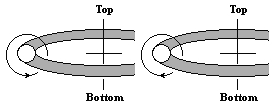
The Helium atom has one mechanical region where matter could clump, that being on the inward travelling vortex where the coterie rotation is towards the top, (figure 9-2, right hand image, situated at the top point). As the atom is made larger, the atomic bonding points would be along the Amperian axis, forming flat atoms. Chemical and throughput pressure must distort these structures when chemical bonds are involved. Mindless mechanical rotation will centre each axis so that the atom's coteries all share a common central axis. Coteries that link together would probably require separators and bearings to maintain rotation. Both structures will have an atomic axis from which predictions and measurements of bond angles can be made.
Geographers use the terms latitude and longitude to describe a sphere's surface. As the atom would form a layered structure, it would be very confusing to refer to the latitude of a coterie or the latitude and longitude of a bond point, however, spill gap fields would have logical origins, directions and intensities. The term latitude slice is convenient, representing the plane passing through the Amperian axis and parallel to the atomic equator, with an axial height above or below the atomic equator. If larger atoms have spheroidal shapes, the atomic coterie latitude slices would appear much like the banded planet Jupiter.
An equatorial latitude slice could sit on the equatorial plane, or above and below the equatorial plane with a maximum axial height of one neutron diameter (Figure 9-3). The top most point of a tropical plane (above or below the equator) would be at a height of a neutron diameter dnd. The third contingency occurs when the equator passes between two snugly fitting tropical layers, giving a capping height at 0.88 dnd, above and below the equatorial plane.

As more elprons and neutrons adhere to the structure, the initial equatorial latitude slice fills until it is completed by mechanical problems. Progressively as the atom grows larger, mechanical efficiency forces the structure to restructure and cap. This structure forms the foundation to the next latitude slice at a higher axial height. As the next layers fill, mechanical advantage permits the tropical coteries to continue their growth until the structure fails and caps. This geometric exercise clearly illustrates the formation of the intermediate layers noted in the periodic table (table 8-1) and will identify reasons for the regular nature of chemical properties, trends and compatibility.
Before fully examining any specific atomic structure or design, environmental factors need to be considered. Fascinating are the atoms because chemical bonding and local magnetic pressure will rapidly produce atomic structural changes. Given the right conditions, almost every atomic structure will transform and be deformed, presenting different but precise bonding locations, altered chemical properties and crystalline shapes that reflect the change. This is evidenced by the use of catalysts and the many structures of Carbon-12, 6C12. In the Carbon atom, there are only twelve particles to consider, six elprons and six neutrons. From this base, each atomic structure will have unique geometrically related properties.
To begin this investigation, suppose that the twelve particles exist on a flat plane, forming a somewhat triangular shape, six elprons surround six neutrons. When pancaked, two Carbon atoms, the soot (C2) molecule would mount together face to face, magnetically connected at each corner. Here the spill fields link North to South and South to North. As there are three apex magnetic spill fields, each atom has six linked magnetic pole locations. When compressed, molecular bonds are stretched to breaking as the Carbon atoms slip or roll across each other. With a bulk quantity of Carbon, compression will align the flat atoms along flat planes, so that nearby atoms establish side-by-side links on that same plane. The crystal structure formed is that of a flat molecular rings, the graphite structure (nC3). At each apex, North to South and South to North spill field connections are made, alternately connecting Carbon atoms, one up, one down. There are weak links between neighbouring layers due to rotation and toroidal field compatibility. This structure is magnetically satisfied without using electro-chemical or Van Der Waals bonds. The same description can be extrapolated to explain graphite's lubricating qualities.
As greater pressure is applied, Carbon's atomic structure will be compressed into smaller and smaller volumes, reducing the length of the magnetic circuit and changing the bonding points. The tetrahedral structure of diamond (nC4) is produced. This involves popping the Carbon structure to form a fourth bonding position. Carbon may exhibit other structures under extreme pressure. It could take on a 3+6+3 structure, or as a robust 4+4+4 stacked slanted layered Helium structure forming a hard, resilient and almost chemically inert atom. At tectonic pressure, the next step would be cold fusion where atoms are pressed together into heavier elements, so that graphite or diamond could form Magnesium (6C12 + 6C12 = 12Mg24) or heavier atoms.
The soot molecule, when reacted with Hydrogen produces CH-CH (acetylene), across one bonding position. The Hydrogen atom is like a bar magnet, that will act as a magnetic shorting link, replacing the direct spill field's path. To bond at two bonding positions forms CH2-CH2 (ethylene) while all three bonding positions produces CH3-CH3 (ethane). Once the three bonds are established, a catalyst can produce enough magnetic stress on the components to produce chemical deformation that will expose the fourth bonding position, causing the Carbon structure to pop and pyramid.
Chemically, between the soot and diamond structures, at least four other structures can be attributed to local molecular effects. Contrary to popular belief, diamonds do not last forever. Diamonds can be burnt, shattered, chemically dissolved and abraded. When graphite or diamond are burnt in Oxygen, chemical loading and reaction pressure alters the structures of both Carbon and Oxygen, forming Carbon monoxide (CO) and Carbon dioxide (CO2).
When Chlorine reacts with ethane, the Carbon-Carbon bond breaks, producing two CCl3 molecules. The central region of the Carbon atom's structure is distorted and popped by molecular magnetic throughput pressure. This will reconfigure the atom into a tetrahedral pyramid structure with equidistant bonding points. The popped central region become accessible to other magneto-chemical combinations, such as Carbon tetrachloride (CCl4) and methane (CH4). Repulsion effects hold the tetrahedral structure apart at precise angles of 109.5º. Further chemical reactions will restore or modify Carbon's atomic shape without drastically changing the magnetic field structure of Carbon. This may help explain many of the strange thermodynamic problems and the myriad of chemical exceptions found when researching Carbon's molecular properties.
When a compressed spring is dissolved in acid, the stored energy is liberated as an increase in heat, yet, as the formation of a diamond requires adding a great deal of energy through pressure, one would expect that this stored energy be liberated when diamond is burnt in liquid Oxygen. However, the energy liberated when burning a diamond is similar to other forms of Carbon. If diamond took so much pressure to make, where did this stored energy go? Chemistry explains this away by assuming the disparity as caused by double and single bonds. It is argued that compression into diamond breaks graphite's double bonds, so diamond is formed with low energy single bonds. As single bonds break, a much lower energy is returned. The bond lengths seem to confirm this, but one is still in the dark because the stored energy is lost forever. The widely accepted inferior definition of energy states in part that energy cannot be created, nor destroyed, yet this is a case where energy seems to be lost. Stranger is the fact that soot and graphite with their double bonds are very soft, while diamond with its weak single bonds is one of the hardest materials known. A hint here is that Boron Nitride (BN) with its 25 sub-atomic particles has both a graphite structure and an equally hard diamond structure.
Since Carbon's solid forms have defined crystal structures with specific cleavage planes, the structure of the atom can be determined. At the start of the Periodic Table, the odds and evens rule does not apply, because there is no such rule. Nature is one of simplicity, for whatever works will maintain longevity until the mechanism fails. To examine the atomic structures requires building atoms from simple magnetic balls. Starting with the Helium structure with only two elprons, this structure holds together as Hydrogen, not Helium. The addition of one neutron allows compaction but forms a relatively unstable Helium structure. The balanced structure of two elprons and two neutrons works, for Helium-4 is a survivor. Adding one or two neutrons to Helium-4 produces some very unstable variations. The two elprons will only accept a maximum of four neutrons.
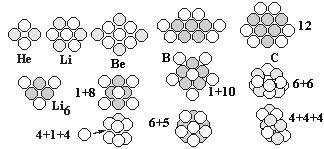
To be fully appreciated, these structures must be animated.
Adding another elpron to Helium forms Lithium, the lightest solid known. This atom has three possible spill fields. There is a degree of mechanical conflict between three elprons and two neutrons. The first successful Lithium isotope exists with three neutrons, (3Li6) (A%= 7.52%). The six particles would form as a ring or a triangle (illustrated in figure 9-4). This structure works, but is nowhere near as effectively as the Lithium-7 atom (A%= 92.5%) (3Li7). The simplest hexagonal closest packed structure of (3Li7) could be described as an alternating toroidal ring of three elprons and three neutrons surrounding a central motor neutron.
Many reference texts cite that (3Li6)(in figure 9-5) exhibits slightly different properties to (3Li7) due to its higher electrode potential. Lithium becomes increasingly more unstable with additional neutrons. It will accept one more neutron, before becoming totally unstable. It should be noted that molecular Lithium (Li2) is the key to chemical bonding because of its high reactivity and chemical exceptions. As a metal vapour molecule, it could exist as a pair of stacked toroids, so that the three alternately linked magnetic spill fields hold the structure together. In a pure form, the individual metal molecules would bind loosely together, forming a relatively soft metal.
Although Beryllium (4Be9) is an even numbered metallic element, it has only one successful mechanical structure, that with 5 neutrons. It can also exist in unstable forms with 3, 4 and six neutrons. As a flat square ring, under extreme pressure its structure could flip a neutron to the top or centre, taking on a double Helium structure, around a central motor neutron, but in so doing would become an almost inert atom having a low reactivity.
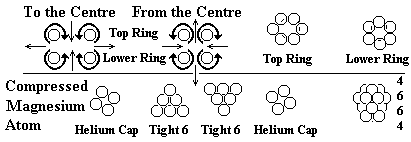
Each layer can be viewed by itself or as a model of the structure.
Boron is an odd numbered element with an odd number of neutrons. As Boron (5B11)forms on the atom's equatorial plane, it has several viable structures. Beginning with three or four neutrons, the four elpron structures are not that stable. The first successful isotope has five neutrons, (A%=18.98%) however it becomes more mechanically stable with six neutrons (A%=81.02%). With pressure, the Boron structure could pancake into a 6+5 structure, deforming the inner pentagonal shaped toroid, or it may take on a 3+5+3 structure. Boron becomes so highly unstable with 7 or more neutrons that it confirms rotation and mechanical conflicts in the atom.
Although Boron's five elprons and seven neutrons are terribly unstable, the figure of 12 particles becomes extremely stable when the elprons and neutrons are equally distributed, as six elprons and six neutrons. Carbon with a mass of 12 is a very fascinating element because its molecules seem to defy much Chemical theory. It has two naturally occurring isotopes, Carbon-12 and Carbon-13. It can exist with 4 through to 9 neutrons, a substantial range.
Carbon-14 is an interesting isotope, believed to be formed at high altitudes through cosmic irradiation of Nitrogen and Carbon dioxide. Although considered as below detection, sufficient Carbon-14 enters into the life-process, only to become trapped in the bones, hair, ivory, teeth, and cellulose during the living process. A tiny amount of Carbon-14 is absorbed with normal Carbon from the food chain. Its presence becomes a means to date once living artefacts. and fossils. The half life is approximately 5,730 years. The living specimens and well preserved remnants of bristle pine cones of California have given science a means to calibrate and confirm the Carbon dating technique. A study of tree rings from living and deceased specimens has given a full chronology, recording each year's climate, in a continuous sequence, dating back well before 3,200 BC. Although sedimentary deposits (peat bogs and fossilised trees) confirm many geological age estimations, they predate the creationist's biblical origin of the Earth (4004 BC).
When tree ring samples are compared to the Carbon-14 dating system, a growing error is detected. At 5,000 BC, the calculated date is about 800 years too early. There are four possible explanations of this error. It is highly doubtful that some 7,000 years ago, more Carbon-14 existed in the air. During the destructive radio Carbon testing procedure, the original material is burnt until pure Carbon remains. Chemical bonds are known to maintain the longevity of some isotopes. Perhaps, as an inflated radiation count appears younger, one or more of the following may explain the error.
The first six elements illustrate that mechanical conflict and mechanical efficiency establish a survival order in the formation of atomic structures. Whatever the atomic shape, Nature's answer will be the simplest, most obvious. The atomic number does not give the atom its structure, nor its properties, rather each atomic structure is a function of rotating elprons and neutrons working together. Environmental factors alter atomic structures and chemical properties. However, certain mechanical configurations (the bad number list) could never survive due to absolute conflict instability. This evolutionary image is a fingerprint of the rotational magnetic mechanisms. As the coteries are a convenient description, it would be that the atomic shapes are geometric, perhaps based on hexagonal architecture. As the first several elements are basic flat structures, chemical bonding will cause these structures to warp. It could be that Nitrogen, Oxygen and Fluorine are also flat structures. This will be expanded in another section.
It is expected that with Neon, there would be a collapse, where the atom restructures to form a more lumpy spheroidal structure, perhaps with two equatorial coteries, or as a foundation for the next coterie to develop. When twenty balls are arranged on a flat surface, Neon's structure does not appear, rather a core of seven balls is surrounded by 13 balls. One suggested structure for twenty balls is to make a balanced 3+7+7+3 sphere. However, to magnetically balance this structure as an inert body is extremely difficult, for each seven-structure requires three elprons in the ring, leaving a remainder of four elprons to be distributed in the atom. Placing one elpron in the centre of each ring of seven, or to cap the atom, top and bottom, the structures would be magnetic and fail. To become inert, the structure must isolate all magnetic spill field effects, requiring a complete ring of ten balls, or two rings of five balls. This is geometrically possible, as the ring of ten can run around the equator between top and bottom temperate zone stacked rings of five. This would be seen as capping a ten ball structure with rings of five. The question is to ascertain which coterie is driving the structure. It could be the ring of ten, or two rings of five. As Neon isotopes can exist with a range of neutrons, from 9 to 13, it is possible for the elprons to run around the structure on the equatorial plane, encasing the central neutron stack. This is obvious from the distribution of naturally occurring Neon isotopes (below). The caps would work best when balanced, requiring either five or six neutrons, however the six neutron stacks would present mechanical problems.
The next two elprons added to the structure, form the next group 1 and 2 elements, making top, then bottom, more magnetic. Although capping completes the structure, at the same time, the structure is already two elprons into the next period. In simple terms, the period has two starting points and two ending points. In the Bohr model, the starting point is group 1 and finishing with the inert gasses. In this structure, group 3 becomes a continuing starting point to the new layer, finishing at the next group 2 element when both caps are in place. Once the initial flat equatorial layer is established, the next coterie grows as a temperate band above this structure as a latitude slice. It has a certain stable capacity, so it will be that the opposite hemisphere temperate zone will take priority and fill. As each period fills, this mindless-mechanical solution produces sub-periods that have other starting and finishing points because individual latitude slices fill. Predictions about bond positions and structures can be made with a degree of certainty because each sub-period is geometrically related to the coterie radius and structural position.
As an example of sub-layers, without much thought or logical analysis, in figure 8-1, a Gold atom was compared to the alpha-particle. Represented as (7+14+23+34+47+34+23+14) with 8 latitude slices, this answer may not be Nature's answer, even though the element Mercury would complete the sub-layer, advancing the structure through another cap (7+14+23+34+47+34+23+14 + 6). To run with these figures only because they seem to fit, would be scientifically reprehensible. As pointed out, the obvious structure of Neon, as 3+7+7+3 is not feasible, though both 5+10+5, or 6+10+6 work with an equatorial elpron ring. When animated, reasons becomes obvious as to why and how Neon's longevity is achieved with the 5+10+5 structure.
Driven by throughput flow, rotation is transferred from the equatorial coteries to polar caps, statistically, the last part of the atom to respond to environmental changes. If there is going to be mechanical conflict, the probability is that the first complete structure to shear-off would be the weakest part of the atom, the polar cap. In the larger atoms, rotation and surge frequencies could eventually drift out of synchronisation to the point of mechanical conflict and cataclysm. When struck by another sub-atomic particle, the polar caps would seize and be thrown from the structure.
Working as a differential engine, elpron motors and neutron bearings transfer rotational energy throughout the structure. Magnetic winds and the motor effect reduce the chances of physical contact and mechanical conflict by holding the coteries apart. The development of a fresh latitude slice should reverse the bonding compatibility of the neighbouring elements. Indications of the coterie development should appear with definable voltage swings, depending on the position of the latitude slice. As the atom grows larger in size, although each latitude slice will have a decreasing effect, the equatorial band will have a greatly reduced effect, while higher temperate and polar bands present a greater effect.
The atom's filling sequence is quite simple. Consider once again the first ionisation energy, using a floating mean, the voltage swing for each period appears in graph 9-1. When compiled with the activity series and the tables of melting and boiling points, a sequence is identified that expands and explains the electron configuration table. The story told is analogous to connecting pumps, in-series and in-parallel, depending on latitude, to increase or reduce flow rates and affinity to other atoms. Also, because the atom's structure may be deformed by the chemical activity, voltage and magnetism, the method used to determine an element's first ionisation energy could produce different measurements and reaction energies.
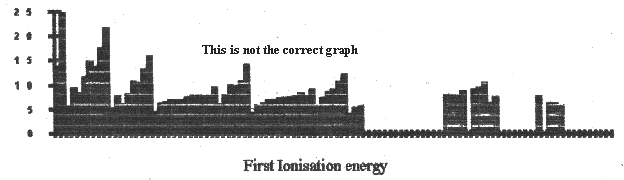
Graph 9-1 The First Ionisation energies:- Floating mean for each extended period.
The trends identified across the graph reveal period pairs. The highest peaks are the inert gasses. The first layer above Helium starts at Lithium and Boron being capped at Calcium. The next period that started at Potassium, begins at Scandium, passes through Krypton and caps at Barium. The greatest period pair that starts at Caesium, starts the equatorial filling sequence at Lanthanum, passing through Radon, but is incomplete as element numbers 118 and 120 are unknown.
To equate the relative forces that 'ionised' the element presented in Graph 9-1, required that measurable events were observed. Matter's lowest threshold ionisation reaction is not the most immediate response and it may not be an ionisation. For the element to react, the most suitable reaction requires a threshold energy that is dependent on many factors including, the atomic structure, the coterie's binding strength, the gap field bonding position, coterie rotational directions, and magnetic resonance, giving rise to the molecular interconnection strength. Because the claimed first process has a measurable value, the poor definitions of 1st ionisation energy and the element's activity form an observational illusion that hides the mechanism producing the effect. When electrons are forced to travel through a discharge tube, atoms and molecules becomes more disposed to move and transport electrons in the evacuated tube, vibrating the molecular crystal structure. This is not necessarily an ionisation. When chemical reactions take place, the simplest reaction occurs in a string of reactions. The spontaneous reaction of Sodium with Chlorine initially involves breaking, then establishing molecular bonds.
As coteries form above, below, or on the atom's equatorial plane, different levels of force or primary voltage distinctions will be experienced depending on the position and strength of the spill field that connect the atoms in the molecules. The equatorial-tropical conditions illustrated in Figure 9-2, need to be considered; where elprons gather as either
The tighter a coterie structure that binds the atom, the greater the force needed to alter the atomic shape, flip its structure, chemically react, transport an electron, etc. An increasing voltage is required to break the tightening coterie bind. The uniform and tight coterie structures of the inert atoms present a high resistance to change. In comparison, due to their loosely capped weak structure, group 1 atoms readily succumb to small forces, being active in the electron transport or structural change. So it should be that with the formation of a coterie in the opposite hemisphere or in an equatorial band, a voltage decrease will occur.
Buried equatorial coterie or tropical bands fill and link in such a way that common external coterie bands are attacked, giving the appearance of small but regular voltage shifts. During the formation of the layer's inner level, the atom restructures itself with an equatorial band that form a pair of remote tropical bands. Double tropical bands form without an equatorial slice when the layer's outer level begins to satisfy the structure. During the interim, other minor structures form that mimic layers and levels as coteries expand and fill.
The illusion of the configuration order becomes apparent when the sequence of lowest energy reaction order is used to position the coteries. To build the periodic table, the order illustrated below is not necessarily the atomic filling or positional order, rather it describes the observational illusion of the periodic table's structure based on elprons. Later, this will be expanded because of mindless matter's need for specific neutron numbers.
The Action The illusion Completion
Helium Inert 1st Layer Filled 2 electrons in 1s of K
Layer 2 Inner Sub-layer
Cap Helium as Beryllium 2 in 2s of L
Fill equator, three top )
and three lower ) 6 in 2p of L
Collapse 5+10+5 Neon Inert 1st Sub-layer of layer 2 filled
Layer 2 Outer Sub-layer
Cap Neon at Magnesium 2 in 3s of M
Fill equator three top )
and three in lower ) 6 in 3p of M
Collapse as Argon Inert 2nd Layer Filled, start layer 3
Layer 3 Inner Sub-layer
Cap Argon to form Calcium 2 in 4s of N
fill four above on the equator }
fill four below on the equator } 8 in 3d of M
cap the structure with 2 } remove one from 4s and hold 3d at 10}
restart 4s and hold at 2
fill the upper temperate zone with 3 }
fill the lower temperate zone with 3 } 6 in 4p of N
Collapse as Krypton Inert Layer 3, 1st Sub-layer of layer 3
filled
Layer 3 Outer Sub-layer
Cap Krypton to form Strontium 2 in 5s of O
2 in 4d of N illogical
fill four above on the equator }
fill four below on the equator } remove one from 5s and restart 4d
to 8
remove one from 5s and hold 4d at 10
cap the structure with 2 2 in 5s of O due to restart
fill the upper temperate zone with 3 }
fill the lower temperate zone with 3 } 6 in 5p of O
Collapse as Xenon Inert 3rd Layer Filled, start layer 4
Layer 4 Inner Sub-layer
Cap Xenon to form Barium 2 in 6s of P
illogical 1 in 5d of O and hold
fill seven below on the equator )
fill seven above on the equator ) insert 11 into 4f of N
remove one from 5d in O and move to 4f in N
increase 4f in N to 14 then add one to 5d in P
cap the structure with 2 )
fill the upper temperate zone with 4 )
fill the upper temperate zone with 4 ) restart 5d in O to 9
remove one from 6s in P and add to 5d in O
cap the structure with 2 ) complete 6s at 2 in P
fill the upper-upper temperate zone with 2 )
fill the lower-upper temperate zone with 2 ) 6 in 6p of P
Collapse as Radon Inert 1st Sub-layer of layer 4 filled.
Layer 4 Outer Sub-layer
Cap Radon to form Radium 2 in 7s of Q
fill seven below on the equator )
fill seven above on the equator ) 1 in 6d of P
cap the structure with 2 ) 9 in 5f of O # Current limit to
periodic table
fill the upper temperate zone with 4 )
fill the lower temperate zone with 4 )
cap the structure with 2 )
fill the upper-upper temperate zone with 2 }
fill the lower-upper temperate zone with 2 }
Pred1 Zx. Inert At.# =118 At.Wt=308 Layer 4 filled
Cap Pred1 Zx to form Zz #120 @ 327 ±10
The position where the elprons fill is subject to interpretation owing to the structural requirements of the mechanical device.
With this structural approach, the Auf bau principles, Hund's rules and Landé g-factor, can be related to the mechanical atom, but only when the neutrons are considered. The evidence conclusively shows that coterie filling does not obey the linear logic used in the electron configuration table. When it comes to rotating magnetic sub-atomic particles, Nature uses lateral and differential logic. This view of the atom is supported by the standing state magnetic radiation characteristics of matter.
The larger the atom, the greater time required to accomplish any structural integrity change. Unless locked in place by local environmental situations, atomic structures rapidly compensate to altered environmental conditions. Although conventional theory demands acceptance of the electron cloud atomic model, the classic description of the Caesium atomic clock is purely mechanical. The atom re-structures in the prevailing magnetic conditions and physically flips.
In a similar fashion, when Chemistry requires the use of a bare Copper catalyst to promote a reaction, the cause is local to the atom and magnetic. The Copper atoms on the pristine surface physically attract one type of reacting atoms or molecules by local magnetic means causing a temporary bonding and structural change. This produces certain stresses in the attacking atom, opening up spill fields that are then attacked from behind. Once the new magnetic circuit is established between the reacting chemicals, the molecule restructures and develops such an incompatibility to Copper, the formed molecule rejects the Copper hold and leaves the Copper surface pristine.
Introduced in Table 8-1 is the mechanical version of the Periodic Table illusion, one that builds in levels and layers. The mechanical packing sequence forms intermediate layers as the coteries bind the hcp structure. As the intermediate layer form and fill, each coterie develops a specific mechanical directions relative to the atom's perpendicular axis at unique latitude positions, so the fill sequence seems to follow the pattern (2+2, 4+4, 5+5, 7+7). Due to atom's need for efficient neutron numbers, the filling sequence will satisfy both elpron and neutron coteries over the surface of the growing geometric spheroid. With the completion of the lower polar coteries, an incompatible magnetic envelope establishes the gaseous inert atom.
As a toroid can either roll into or away from the atomic axis, the atom's relative chemical reactive compatibility changes with atomic restructuring. The structural changes that occur to Nitrogen and Oxygen are dramatic, not just in the bonding patterns, but with compatibility. Nitrogen will not directly bond with Oxygen in a flame, yet under certain conditions, such as a spark, the two elements unite. Compatibility problems are also noted with the reaction of Fluorine with Chlorine.
The problem facing the mechanic is that of differential effects and mechanical conflict. This identifies magneto-mechanical problems fundamental to explaining Avogadro's number and the element's specific gravities where Coterie rotation causes both attraction and repulsion effects that draw atoms and molecules together and yet forces them apart. This situation forms the basis of molecular compatibility where a threshold energy may or may not be needed to promote a reaction. It is in part responsible for some of the claimed Van Der Waals forces.
Mechanical logic decrees that each latitude slice enjoys the opposite rotation to the latitude slices above and below it. When bearings with the same rotational direction are in contact, mechanical limitations exist. As bearings can seize, so can the atomic structure. The structure of the atom makes it inevitable that elpron pairs, rotating in opposite directions, may collide at full rotational speed with such force that the entire latitude slice seizes and shears-off. The atom may cleave into two atoms or as an individual alpha-particle and two ßeta-particles. Due to the rapid elpron rotation, mechanical conflict will eject the offending structure at high speed.
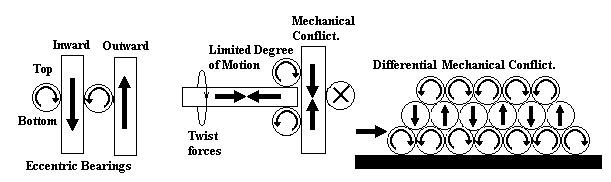
Figure 9-6 illustrates various forms of mechanical conflict where the structure actively resists or absorbs motion. The cross-section of the eccentric bearing should be imagined as an entire three dimensional structure, where six ball bearings surround and contact the shaft at top and bottom, held in place by six equatorial Eddy bearings. As the shaft moves in and out, the bearings in contact with the shaft are free to roll in the same direction with respect to the circular axis of the toroidal bearing. Mechanical conflict prevents the shaft from twisting.
Nature's solution to mechanical conflict, demands that gaps exist so that rotation can be transferred through the structure facilitated by the magnetic flux moving in the structure, keeping the coteries apart. However stressing the atom could promote mechanical conflict effects. These effects are easily demonstrated when tightly packed lubricated ball bearings resist rotation. Packing the bearings in a face centred cubic configuration offers some mobility as differential effects transfer the rotation by altering the direction of rotation, twisting it through 90 degrees.
At this point there are many ways of describing the neutron's role in keeping coterie rings apart and in linking the structure together. The neutron could be considered as a semi-neutral magnetic particle that tightly links itself to the elpron or proton. In a directed magnetic field, the neutron will remain unaffected, and may hitchhike on other atoms. The neutron reduces the space requirements of the magnetic field by channelling it.
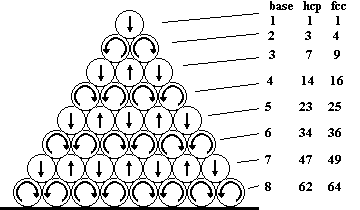
In forming a differential engine, Figure 9-6 indicates the number of particles needed for each horizontal slice. The structure begins with the equatorial belt and successively fills the polar regions, as a regular 4+4 pair of coteries concludes the level presenting a regular polar magnetic structure from period to period. This can be best illustrated as the layer above Calcium packs around the equatorial region as a pair of five-elpron coteries, before completing each polar cap, having a four-elpron coterie.
The atomic structure is subject to change with chemical bonding, giving rise to the chemical bonding pattern. Since mindless magnetic-rotational logic rules the atom's structure, the inert gas structure must have the most simple solution, that being, the sum of each complete latitude slice, without any capping sequences. Figure 9-6 shows that the atom would not be spherical, rather, it would be geometric, forming related structures. The hcp structure, of Neon, (10Ne20), as a 5+10+5, is capped at Magnesium (12Mg24). The structure would collapse become a hybrid hcp and fcc, as 1+4+7+7+4+1 = 24. Alternatively, the four ball diameter base should become a 5 ball base, having a semi-completion at a circumference of 14, (14Si28). If this were the case, Magnesium would become a rounded rhombus with a base measuring 5 balls by 4 balls, having a structure 6+18. If so, the base becomes a five base at this point, examining the flat or 14+10. Above Neon, this is an increase of 4 balls. At the end of the next period is inert Argon (18Ar40). The hexagon with a diameter of 6 balls has a circumference of 18 balls. Although the mathematics seem to work, it should be obvious
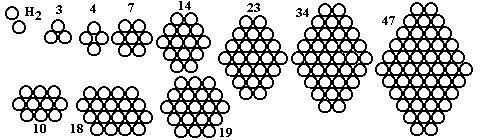
Hidden in the illustrated structure are basic geometric atomic shapes. To pick the forth layer, the thinnest axis is four balls, so to look vertically down on the atom, the shape will be that of a rhomboid with four equal sides measuring four balls, while the height and long axis both measure 6.2 units. This figure can be used to indicate the number of particles required for each complete latitude slice (figure 9-7), because Nature's answer is always the simplest, an answer that no one expects.
Each atom has a bonding pattern series dependent on the atom's ability to change its atomic structure. If one cares to look and act, Nature involves certainty, and certainty comes from simplicity. However, the atom's shape is dependent on environmental factors. Almost every atom may be distorted, compressed and stressed by external effects, changing the atomic structure and bonding patterns. This means that each atom, including the inert gasses, can be pressed out-of-shape or stressed by a catalyst to undergo chemical reactions that otherwise would never occur. Stressing may promote or retard specific chemical reactions. Stressing Chlorine will allow ClF7 to form.
The toroidal magnetic fields of each atom acts as a force field, pushing other atoms and molecules apart. Given sufficient volume, when an element forms a gas, the same number of molecules will occupy that volume at the same conditions of temperature and pressure, irrespective of the physical size of the atomic and molecular structure. This scientific belief seems quite extraordinary when one considers extremely long gaseous chain molecules.
It takes a great deal to break into or to break-open a closed magnetic circuit. Elprons, protons and neutrons enter and leave the toroid when mechanical conditions permit such an event. Cold fusion involves pressing atoms together. This is a low energy activity that deforms atomic structures through local environmental pressure. Hot fusion involves impact that can either fuse the particle into the structure or cleave the atom. During this process, as the atom exists in a state of confusion, the magnet shield collapses. With rotation, the sorting mechanism re-starts, absorbing energy from the environment to re-establish the magnetic structure. As will be revealed, this is one of the mechanisms that gives the atomic bomb its apparent energy outpouring.
If the toroid is broken or incomplete, the magnetic field must jump across a gap to complete the magnetic circuit, whereupon an amazing situation presents itself. At this point, one must discuss a tool, followed by the history and evolution of the recording industry, and finally some electronic musical instruments. The metal detector uses two simple oscillators that beat together producing an audible signal. As one oscillator is connected to the finder or field coil, any material that alters the loading of the coil will be detected. The electric guitar and the motorised electronic organ both use a stationary coil wound around a magnet. As the string or tone wheel moves near the magnet, the magnetic field responds, inducing an electrical current in the coil, but only when the circuit is complete. The magnetic recording head evolved from a simple mistake with the early wire recorder, but this forced the evolution from stainless steel wire recording to tape and disk. Some of these magnetic recording materials will be discussed, for each holds a key to a wealth of knowledge.
The first recording heads were like horseshoe magnets, where the stainless steel wire had to pass directly between the magnetic pole pieces. A molecular change in the magnetic field across the gap induces a current in the coil. To record a sound meant amplifying the sound and mixing it so that the bias frequency would permanently magnetise the wire since the rapidly changing magnetic field shocked the recording medium.
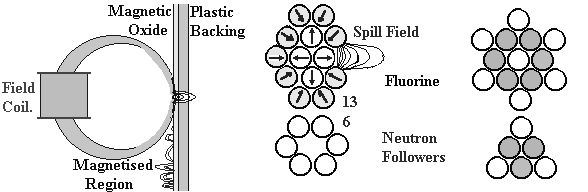
By serendipity, the wire was incorrectly positioned and the steel wire ran over the gap, not through it, but in so doing produced a greater output and better quality signal. It was then realised that the broken toroid creates a perpendicular spill field that bulgs into the environment (figure 9-8). As the broken toroid's gap is decreased, a more perpendicular spill field jumps the gap, to be concentrated as an intense environmental field. The tiny gap becomes a super-sensitive receiver detecting all molecular activity in the region.
The next step was to replace the dangerous wire and steel bands with a roll of paper, coated on one side with Iron Oxide. The paper backing tape was soon replaced with a plastic material. Magnetic tape recording was born. However, many problems surfaced. The belief of the time was that the plastic material would survive for a million years. Soon it was identified that the glue holding the oxide and the editing tape to the plastic backing tape had a limited life. Then it was noted that the plastic material itself had a very limited shelf life! It became necessary to save the history of the industry as many early tape recordings crumbled to dust. The Iron oxide proved to be terribly abrasive wearing away the recording heads, so other materials had to be found. Chemicals considered as non-magnetic a few months earlier proved to be superior. Slowly as technology improved, the recording head gap size decreased as the surface quality of the tapes improved, making it possible to reproduce the full audio spectrum at very slow tape speeds. To many disbelievers, non-ferrous materials like Aluminium, Uranium and Chromium dioxide, were found to work as recording mediums.
The Magnetic play-back/ recording head An incomplete coterie ring's gap field.
When the BBC first attempted to record a video signal, it required very high tape speeds and extremely low orders of wow and flutter. They succeeded with a steel tape. Rather than increasing the tape speed, engineers at the AMPEX corporation used a high fidelity German system. This spun a pair of razor-sharp heads vertically across a curved tape, traversing the tape at high speeds, in creating a sectional recording. The original AMPEX system proved to be far too destructive to the tape and heads owing to the vacuum system needed to bend the tape away from the spinning heads. The system tolerances were too fine and although the recording quality was excellent, the system did not work well enough. This problem was resolved when the head assemblies were encased in a rotating drum, so that the tape could freely slide around the spinning drum with little or no wear on the heads or the tape. The size and shape of the recording head became smaller as the tape speed decreased. With improved technology, the head gap became minuscule.
The home computer revolution that began around 1980, heralded great advances in recording techniques. Today's computer hard disk drive has recording heads so small that several heads easily fit on the head of a pin. In a sixty power microscope, the micro-thin wire of the signal coil is just visible. In terms of engineering precision, the hard disk drive would be considered as the most precise mechanism found in the modern home.
A strong background hiss is heard almost continually when a magnetic recording head is connected to an audio amplifier. Much of this hiss is environmental in origin, where the head responds to air molecules in contact that change with temperature, pressure, wind, motion, magnetism and even illumination. With static micro-heads, the hiss becomes so great that to improve the reproduction quality demands increasing the air flow over the head to supersonic levels. As the air speed increases, the spurious analogue signal climbs above the audible range.
An almost complete coterie ring causes a gap situation in Group 6 and 7, placing the smaller elements like Oxygen and Fluorine at the top of the Activity series. Topping the list is Fluorine, a nasty little fluid with a lethal vapour. This element is perhaps the most vicious chemical of all, reacting with almost everything. As there are several simple reactions that release Fluorine gas, the following warning is given.
WARNING: Fluorine demands a great deal of respect. Always handle with extreme caution; always use maximum protection in a well vented environment. Avoid handling Fluorine or coming into contact with the liquid or its fumes. Avoid breathing the vapour. If Fluorine is inhaled or spilt on the skin, the ulceration (both internal and external) can prove FATAL! If one is exposed to Fluorine, purge the exposed area with high pressure water and remove all affected clothing, seeking immediate medical advice. One cannot be too careful.
The small mass of Fluorine and the toroid's gap so tiny, individual molecules have great mobility. This gap field is both a receiver and transmitter. Although Fluorine exists uncomfortably as F2 in a gaseous form, the magnetic spill is so great that Fluorine's trap mechanism is quickly activated to chemical attack most other molecules as a magnetic dart. Molecular incompatibility is identified when substances like Platinum, fail to react until a sufficiently high temperature is reached.
Chlorine's rotational incompatibility is observed when the reaction forms Cl F5, not ClF7. Any attack by Fluorine or Chlorine occurs one step at a time, one process at a time, slowly loading and changing the Chlorine atom each time, forcing the atom into the hcp structure producing dual magnetic couplings with Fluorine's gap field, but only where the atomic rotation is compatible. The immediate attack of a single Fluorine molecule does not fix the chemical needs of the product formed Cl2 F2. Even greater spill fields are created so the Chlorine is attacked again with larger packing gaps of the growing molecule. A packing gap is one caused by the chemical reaction where the closure of a gap on one side of the atom causes an opening of the coterie ring on the other side of the atom. Although not a good analogy, it could be illustrated by pulling on a string of pearls, for one produces an obvious gap along the string. As more Fluorine is added, more points around Chlorine's coterie ring open, where other Fluorine molecules attack and break apart to form Cl2 F4 , creating a greater loading problem in the Chlorine molecule, stressing the magnetic bonds. Now Cl2 F6 is formed. Then Cl2 F8 is forced under extreme molecular pressure to break the very weakened Cl2 bond, leaving just one compatible point where the final Fluorine attack is possible, linking across this bonding position producing two similar molecules of Cl F5. No further reactions are possible at this stage.
Conductivity and Semiconductivity: Electrical theory states that electrical conductivity is a function of electrons flowing over the surface of the conductor. Despite much hard evidence this belief is maintained because of Franklin's interpretation of atmospheric events where like charges are seen to repel. The description given by electrical engineers to describe the mechanism of semiconductor materials with P and N-holes contradict electrical theory. In the description and as illustrated by all semiconductor devices, electrons pass through the semiconductor in one direction only. It will be noted that when electrons travel through a conductor, a metal, a liquid, a resistor, or across a vacuum, rather interesting events take place that do not agree with electrical theory. When discussing semiconductors, the observational illusion of P and N holes is used to describe the events. It is an observer relative description, much like Tycho's description of the Solar System. The semiconductor is a mechanical pump. The concept of P and N holes is hog-wash. The P-material simply aligns the pumps to align in one direction, while the N-material aligns the pump in the opposite direction, so that electrons are pumped through the material in one direction.
To examine the electrical theory's claim that electrons flow over the conductor's surface, as a resistor is a conductor, then it is possible to measure with accuracy, the path length. In a simple experiment, where the bare metal end of an insulated electrode (figure 9-9) is buried deep inside an electrically conductive medium, (such as a large block of graphite). This being connected to an Ohm meter. The other electrode of the Ohm metre is brought into contact with a distant surface, forming a circuit with the Ohm meter. The electrical resistance measured will categorically prove that electricity passes through the material structure.
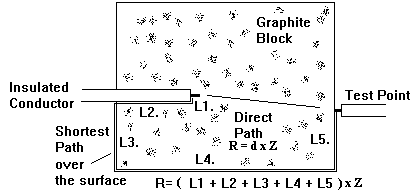
The surface resistance of the conductor is
measured in Ohms per centimetre and deemed as being the value Z.
The path length that electrons must travel is D, between the
buried electrode and test probe. This is calculated by the
measured resistance per centimetre multiplied by the distance.
According to electrical theory, the total resistance should be
the sum of the distances D = (L1 + L2 + L3
+ L4 + L5) multiplied by the surface
resistance. Experimentally, the resistance path when measured.
Conductivity occurs when electrons migrate from atom to atom, in, on and through matter in any direction. The hint to conductivity is noted in Bohr's Periodic Table which places conductive metals on the left and the non-conductive non-metals on the right, concluding each Period with a closed field diamagnetic monatomic gas. Between the conductors and non-conductors exists a band of metalloids, that is, semi-conductor materials. Semiconductive materials are normally conductive until that time when the molecules are aligned and electrons migrate through the medium in one direction only. Conductivity and semiconductivity are best described in terms of molecular alignment and atomic rotation. Many materials, previously not considered to be semiconductors will be placed in this category.
With the new Periodic Table, the magnetic field's binding tightens across the period, producing atoms with different packing conditions and coterie structures, from loose to closest packed before the structure fails and opens again. The tighter coterie fields of the non-metal elements and non-conductors resists external magnetic effects and electron flows because the molecular structure actively protects and holds the electrons more firmly. The conductor's metal atoms have greater separations to neighbouring atoms than do the non-conductors. The metal atom's open coterie magnetic field allows them to rapidly restructure and re-sort. The alignment of the metal atom's exposed magnetic field makes the metal reflective, gives the structure malleability and promotes electrical movements. The strong magnetic field twists atoms with partial coterie rings, and the rotation of these coteries pumps electrons through the conductor. Dislodged electrons in the metal's structure flow more freely due to the loosely packed alignment. An additional electron increases the magnetic field of the metal atom, causing it to attract the next atom. This forms a conductive bridge across which electrons travels nut this breaks the bridge. To test this scenario, requires examining semiconductor materials, for they present the key to conductivity due to the alignment of the atoms and molecules in a semiconductor material to establish a one-way-electrical path that only allows the passage of electrons through the material in one direction. These materials are typically found in groups IV, V and VI, however, the alignment of certain molecules will produce semiconductor properties.
The key to the semiconductor, as being different to metals and non-metals is found in the Periodic Table, Group IV elements are Carbon(C), Silicon (Si), Germanium(Ge), Tin (Sn) and Lead (Pb). Group V elements include Nitrogen (N), Phosphorous (P), Arsenic (As), Antimony (Sb) and Bismuth (Bi). Group VI elements are Oxygen (O), Sulphur (S), Selenium (Se), Tellurium (Te) and Polonium (Po). Some of these elements are called metalloids. Non-elemental natural semiconductors include Galena (PbS), Indium Arsenide (InAs), Indium Antimonide (InSb), Gallium Arsenide (GaAs) and some of the pyrites family. The metal crystal structure of some Mercury amalgams can form a semiconductor material.
To force the effect, a semiconductor material like Galena held by a clamp and connected in circuit is tickled by a single wire probe, called the cat's whisker (also connected in circuit). As the probe is made to touch the crystal surface on crystal's sweet-spot, the crystal acts as a rectifier, allowing a flow of electrons in one direction. When light falls on this contact connection, electrons are pumped across the connection in one direction, creating a primitive photo-cell.
In the Silicon diode, the cat's whisker is held by one electrode and attaches to the centre of the semiconductor material. By design, an impurity has attacked the Silicon at this central position where contact is made. Depending on the nature of the chemical products formed by the impurity, electrons can flow into, or away from, the Silicon semiconductor. Similarly, when light strikes the joint, a greater photo-diode effect is observed as electrons are pumped by the semiconductor. When light strikes a semiconductor material with the correct crystal alignment, an electrical pumping action moves electrons from one side of the material to the other, producing a potential difference between the surfaces.
The image screens of early television cameras, (Vidicon, Orthicon, Plumbicon) and the photomultiplier work because the materials in the image screen are semiconductors. Photocopiers and laser printers use a semiconductor coated image-master to capture the optical image, forming an electrical image on the drum's surface. Although these devices are claimed as examples of the photo-electric effect, other semiconductor materials like Cadmium Sulphide (CdS) present photo-resistive effect, where the material's electrical resistance increases with illumination. The photon concept of light fails to describe the full extent of light's affect on matter. The photo-electric effect fails to describe other materials that are photo-sensitive, photo-chromatic, photo-emissive, and photo-chemical. The magneto-mechanical atom explains all these effects as a function of aligned elpron rotation and the magnetic structure of matter.
At the atomic level, molecular design and alignment are critical to the semiconductor material functioning as a semiconductor, or transparent medium. The image screen is not just a coating of a semiconductor material. A transparent metal is coated onto a transparent optical window to supply electrons to the material. Light entering this window, passes through the metal. A semiconductor material is aligned and coated onto the metal surface, and again coated with a thin layer of metal. This sandwich allows electrons to be supplied to and removed from the semiconductor material. The semiconductor's alignment is critical, and electrons must be supplied to the top transparent metal coating, else the photomultiplier will not work correctly. The intensity of light striking that region of the target screen's area pumps electrons through the material to the opposite metal surface at a rate proportional to the intensity. The photomultiplier is a cold cathode device, where the image screen is the cathode. Excess electrons supplied to the semiconductor must be pumped through the surface to the cathode side before gas molecules carry the electrons from the cathode to the first anode. The surface electrons are replaced by the circuitry. The photo-electric effect fails when the photomultiplier's photo-sensitive screen is disconnected from the ladder circuit.
The television camera's semiconductor image screen is generally configured as an anode. In much the same way as the video monitor, a molecular electron carrying beam is produced by an electron gun and made to sweep the under-surface of the semiconductor sandwich. The focussing and deflection of the molecular beam are similar to the television picture tube, however, to obtain an extremely fine beam, electron carrying molecules must pass from pole to pole along the centre of the magnetic focus field. The video signal is taken from the image screen's transparent metal coating. As the beam scans the rear side metal coating, the beam current reveals no apparent change in the molecular charge cloud until light passes through the optical surface transparent metal coating and stimulates increased elpron rotation in the semiconductor that pumps electrons from the beam through the semiconductor to the transparent metal surface in producing a noticeable variation in the beam current. This signal is detected and amplified. To increase the low light level sensitivity below 7 lux, the beam current must be increased.
The problems of image retention, image lag, and image flare are produced when the semiconductor coating responds to a bright light and over-pumps. It becomes exhausted and fails for a time. Early photo-sensitive screens, such as in the photomultiplier, Plumbicon, Vidicon and Image Orthicon, suffered badly when bright lights struck the semiconductor surface. Image smear occurs when the pinpoint of focussed starlight is streaked like a comet along each scan line from the focal point to the right side of the monitor screen. Image flare causes a bright object to bloom into a poorly focussed bright blob. A bright light moving across the field of view may take on a comet-like shape with image flare around the image, followed by a dark region recording the path of the light as it crossed the screen. This is image retention.
Effectively the semiconductor's pumping is reduced as the molecular cloud migrates with the beam. The target surface becomes exhausted and retain a negative image well after the electron beam has stopped scanning the image. Extreme image retention results from a physical burning of the semiconductor. The excessive illumination may increase the beam current to a point where the semiconductor passes too much current physically burning or vaporising the semiconductor. The monitor screen reveals the burn as a dark region. The damage may be permanent as the exposed optical glass window is not photo-sensitive. It was necessary to keep these devices in a dark, chilled environment when not in use. Although image tubes do not have phosphor coatings, this problem is called a phosphor burn.
In the early astronomical video tracking systems, light from brighter stars exposed another problem, that of diminishing returns with brightness. The first magnitude star, Sirius, is interesting because it shows the nasty video effect. A standard vidicon observed the star, but the star's centre went negative in relation to the surrounding bright image flare and diffraction image. The sensitivity of image tubes was not very good, preferring to work in reasonably well lit environments. With the introduction of Charged Coupled Devices, (CCD technology) and digital circuitry, many of these problems have been conquered.
However, as the CCD uses a semiconductor surface it is still possible to drive the semiconductor into saturation by starlight, making a star or galaxy appear as a blackhole, having a dark centre surrounded by an event horizon. ( Example M61 where black spots appear at points of greatest illumination. These spots are digital errors.) As the spectral sensitivity of the CCD is greater than the previously used Vidicon tubes and photomultipliers, the CCD can introduce other problems. One problem is not knowing the region of the spectrum causing an apparent brightness. The CCD is colour blind. Filters must be used to determine the colour to colour the image. Found in most home video cameras, the colour CCD has individual filters mounted over each CCD cell, so that one device will detect Blue, Cyan, Magenta, and Infrared. Other problems noted include the pixelisation of circular stellar image into small squares and the production of false colours.
The Plasma Ball, semiconductors, the graphite block and the Ice experiment, all indicate that electrons travel through matter by altering the magnetic properties of matter, forming electrical pathways. That is, as the electrical current flows, the magnetic circumstances change, so atoms and molecules physically move so that molecular contacts open and close the chemical bridges that link atoms and molecules. When the electron passes to an atom it closes one bridge to open another that then closes as the electron progresses through the structure. Each atom must pass the electron through the next open bridge to the next atom before the first bridge re-opens. The rate at which chemical bonds break and restore gives rise to the electrical resistance of the medium, and the point where repetitive coincidence make-and-break failure occurs.
At low levels of collision, certain emissions will not occur, but this does not prevent magnetic emissions or the electrical current flow from being detected. Long distance analysis is not in the realms of science fiction for the effects of affected matter are detectable. Just as Iron filings will reveal the magnetic field around a current carrying wire, so it is that air molecules align to the conductor in much the same way. This gas need not be ionised or fluorescing to transfer magnetic radiation. The changing states of matter can be detected and observed with the correct technology.
Consider Hydrogen gas in an evacuated discharge tube. How many times can Hydrogen be ionised? For molecular Hydrogen, the answer must be twice, but then Hydrogen is no longer present. To form an absolute vacuum would expect that a Hydrogen rich vacuum in a discharge tube, would create it. That is, if the ionisation theory is completely true. Any discharge voltage causing the gas to glow would add then strip excess electrons from the Hydrogen, or it would evacuate and deepen the vacuum in the tube, releasing high speed protons that must escape through the vessel's walls. Since protons are ejected in this scenario, far too many electrons are being returned, so, the additional electrons removed from Hydrogen would polarise the voltage source. In the real world, this mechanism fails to increase the vacuum or to polarise the voltage source, though the excited gas does liberate a great deal of light, with a precise spectrum of resonant sideband frequencies.
The use of the term ionisation is incorrect in regards to any discharge tube since electrons are supplied and transported through the gas in the tube, to be returned to the electrical pump on a one-for-one basis. Conductivity in the rarefied gas requires the formation of molecular convection cells, whereby electrons are added to the gas molecules and these whole molecules or atoms travel along the discharge tube to the other electrode. The gas molecules only lose hitchhiker electrons at the positive anode. As the voltage is increased, the gas molecules reach velocities causing a light boom. This is likened to a sonic boom. The precise physical dimensions of the atom and molecule allow a resonance started within the structure and its magnetic field to reverberate through the surrounding magnetic fields with specific harmonics and sidebands.
To win the argument, many scientific zealots treat matter differently by changing the name of the effect when the same chemical processes and mechanisms occur in different situations. The movement of molecules caused by the addition of electrons (the electric field,) will be seen to occur in water, if one knows what to look for and how to look. This will be illustrated shortly. Even the process of dissolving some material is a chemical reaction that can be detected, because it changes the alignment of matter and emits characteristic magnetic fingerprints every time a chemical reaction occurs. The electric field involves many temporary chemical reactions that force atoms and molecules to move and alter their configuration. When pure water (99.99999999999%) is exposed to different air conditions, or a single grain of common salt is added to pure water, the electrical resistance of the water drops as the water molecules align to the presence of salt and air molecules. Some devices can detect the presence of certain salts to one part in a trillion, that is;
This postulation that every molecule affects and causes effects in other matter can be simulated with bar and horseshoe magnets. 100 steel magnets in a box may weigh roughly 10 Kg. The question, "How much force is needed to overcome the system's total inertia?" is interesting. There is a great deal of inertia in this mass. Each magnet needs to be balanced and supported on a string, making 100 primitive magnetic compasses. All the magnets are hung at the same height from the ceiling, but the magnets must not touch, yet close enough to allow their fields to react. The hanging magnet will not point North and South, rather they form a complex magnetic circuit. Having hung all 100 magnets, merely turn one magnet slowly around and all the magnets respond proportionally in differing ways. This identifies that a little energy can turn a great mass.
As a polarised beam of light passes through water and sugar is added to the water, one will observe a definite angular twist in the direction of polarisation, that becomes more pronounced as the concentration of dissolved sugar increases. When measuring the resistance of water, as common salt is progressively added to a litre of distilled water, the electrical resistance changes. Both of these effects are similar to the ceiling mounted magnets, where a small deviation of one molecule causes a change throughout the structure. This change is not uniform, as the inverse square law applies.
The act of attempting to measure the electrical resistance will also cause water molecules to align towards the electrodes because electrons are being pumped through the water by the Ohm meter's electrical circuit. Each time an electron enters the bath, it will upset the alignment of the water molecules. A provable fact is that each time any chemical enters the water bath, whether the chemical is dissolved or not, the water molecules will alter their alignment around that chemical. The molecular structure of water will respond to a glass rod or a metal spoon placed in the liquid, causing the molecules to align to the foreign material.
At this moment, many science zealots will jump up and try to explain the truth away. They will categorically state that Air is an insulator, while water is a conductor. But pure water is considered as an almost perfect insulator. Just as electricity passes through the air, an insulator as a spark or lightning, electricity passes through water. No matter how pure, water has an electrical resistance. What makes water so different? It is a liquid! Yet, electric fields occur in oils and oils are liquids. Electrolysis occurs only in water based solutions. That is not true! If one looks in the refrigerator, an active experiment was mentioned that conclusively shows electrolysis in the dry air solution. Some will call it corrosion; others will claim it as rusting, but the distilled water's electrodes do not corrode in the same environment. Only the salt water electrodes undergo electrolysis because the meter used to measure the resistance, charged the chemical cell. The colour of old car battery leads will further show that electrolysis occurs in air where one Copper conductor turned blue-green and the other turns an oily black. Water has yet to reveal her secrets. It is necessary to challenge the chemist's model of electrolysis, because the mechanism and processes are quite different to accepted theory.
It was said earlier that when a fire-storm passes near the storm cellar, every molecule of Oxygen, from the cellar and the soil will be extracted to feed the fire. It is now possible to show why these little forces are so powerful, since the fire causes the atmospheric molecules to align allowing Oxygen to be transported to the fire. Contrary to popular belief, the entire atmosphere is crystalline in its very being resulting from the magnetic coupling between all molecules, not just with other gas molecules, but to liquids and solids, on all surface interfaces. Depending on the materials and the quality of the interface, the reflection, refraction, integrity and polarisation of ambient magnetic radiation is altered.
The fire-storm is important because it draws Oxygen from where-ever free Oxygen is found, be it in the air or under the ground. The composition of the atmosphere is approximately 78% Nitrogen and 21% Oxygen. Certain reactions do involve the burning of atmospheric Nitrogen. A smouldering taper when thrust into almost pure Oxygen will explosively burst into flames. However, when a chemical involves burning of atmospheric Nitrogen, as the availability of atmospheric Nitrogen is so extremely high, the reaction is far more explosive than any Oxygen reaction owing to the energy released when the Nitrogen bonds break and new molecules are formed. Exposed to air, Magnesium will rust due to the trap mechanism, forming nitrites and some oxides. The ignition of fine Magnesium wire liberates the captured Oxygen atoms as the Nitrogen is attack by the more compatible Magnesium atoms.
The temperatures reached during the common fires-storm are so great, one must wonder why atmospheric Nitrogen is not involved in most burning reactions. Some of the factors making it so include mechanical compatibility, magnetic alignment, throughput, resonance and the air's crystalline structure. The Oxygen reactions (including movement to the fire) aligns the atmospheric gases including Nitrogen, to permit the rapid transportation of Oxygen over vast distances to the heart of the fire without becoming involved in the actual reactions. Nitrogen and Oxygen although neighbours in the Periodic Table, have very different mechanical magnetic structures and it is here where one finds incompatibility. When Nitrogen is severely stressed by a catalyst, the sorting mechanism of Nitrogen allows it to change its structure, allowing bonds to form with Oxygen. Burning Nitrogen near an Oxygen fire, will extinguish the Oxygen fire as the air crystal takes on a different molecular alignment that isolates the Oxygen.
Perhaps Phosphorous is the most interesting of the elements, holding a valuable key to Nitrogen chameleon properties, because it is compatible to both Nitrogen and Oxygen. Although detergents have used Phosphorous for years, there is a growing awareness to ban its use in most countries. Its dual compatibility allows the element to act as the go-between, linking water molecules to oils. Other elements and many molecules exhibit this trait, where the valency school of thought would consider the element Phosphorous as being capable of having either a positive or a negative valency depending on the reaction, when in fact it should have been considered as having both positive and negative capabilities at the same time, for this element is a mechanical hermaphrodite. Here, two exposed mechanically opposite sub-layers vie for either a clockwise or anti-clockwise solution. Phosphorous has two active coterie rings with specific gap-field directions so each ring has opposite rotational directions. This explanation of the Group V elements will be expanded in the section on magnetic chemical bonding.
All chemical reactions and similar molecular events are atomic events, involving atom to atom magnetic influences, perhaps contact, while all sub-atomic events are nuclear events. Be it that an event originates in the interstellar medium, or in the region about a fire-storm, many contributing factors are involved. The best way of resolving each of these factors is through a modular approach, viewing each factor in isolation and then united in an over-all picture of things.
Energy-forms: As the atmosphere thins with height, the crystalline structure of the molecules becomes more apparent, similar to, but not the same as that observed in the discharge tube at very low vapour pressures. The interface between the Earth's atmosphere and the Solar Zodiacal environment is a very exciting place. Above this region the matter is separated by great distances coupled magnetically to other matter in the solar wind and beyond. This is not the void which science fiction writers and astronomers describe. In this vacuum, as there is matter, all the laws of Physics and Chemistry still apply, so magnetic radiation propagates at different speeds across the Universe depending on the energy-form.
Packing gaps give rise to other spill fields that lend themselves to compatible chemical reactions and crystal growth. Common salt NaCl, has a strong affinity with water and to other salt molecules when the molecule is "complete", yet further chemical reactions occur. Without water's presence, the spontaneous reaction of Sodium and Chlorine forms the dimer Na2Cl2 through the trap mechanism. When this chemical is exposed to the air, the magnetic affinity of water vapour to the dimer robs moisture from the air in another series of chemical reactions, rapidly growing the common salt crystal structure H2O:NaCl:H2O. As each added water molecule does not satisfy the magnetic spill fields, this reaction will continue to absorb water from the atmosphere until the salt becomes saturated.
To prove this dissolving reaction is in fact a chemical reaction, energy must be added to release the water molecules. A great deal of heat energy must be applied in a short period of time to remove the water contaminant. One must consider the laws of thermodynamics and the theories of relativity. Placing a gram of saturated common salt in a sealed container capped with a one way exhaust valve, the same amount of energy can be applied to the salt over twenty days, as it can over twenty hours, twenty minutes or twenty seconds. After 20 days the saturated common salt will still contain all its moisture. However, when the same total energy is applied in less than a twenty minute period, some of the moisture will be removed. If that same amount of energy is applied in a twentieth of a second, the salt may remain wet.
The following party trick is not recommended. Molten tin or lead that splatter can cause severe burning or result in the ignition of one's clothing. If one is quick enough, when the molten metal is being poured as a fine stream, the entire naked hand can be swept rapidly through the molten stream without any harmful effects. Therefore, the effectiveness of the application of a specific energy-form is dependent on both compatibility, atomic inertia and the duration of a compatible energy-form.
To remove the water of crystallisation, a certain standing state energy must be reached and this is only possible when energy is applied during a specific time frame by the correct energy-form. To be effective, the threshold energy must be reached and maintained for a sufficient period, else the energy applied can be lost, wasted, or diverted into some other response. Equally, the same total energy may be applied in such a short time frame that the inertia of the molecules prevents any disassociation, or reaction. If the energy-form is incompatible, the salt will not dry out, even though all the other required parameters are met.
The frozen roast dinner will not cook if placed in front of a 2,000 Watt loud speaker system and blasted with the sound energy at full power for twelve hours. More likely the meat will putrefy as the rotting processes begin. If anything, the roast dinner needs to be cooked in a 1,200 Watt electric oven at 350°C for 10 minutes, then at 250°C. for another 45 minutes, so that it is cooked evenly to perfection. Cooking a similar roast at 500°C for just 10 minutes will burn the outsides leaving the centre raw. A 650 Watt microwave oven will defrost and cook the roast in 10 minutes. To hit the roast with the same total energy in a blast of protons, neutrons and electrons in just a second could vaporise the meal, releasing all its chemical energy as an explosion. So, the question of energy must be rationalised into something that is meaningful.
Temperature and pressure alter the compatibility of molecules. Although Water is said to evaporate in air, it is water's attack on atmospheric Oxygen that causes the depletion of liquid water. Evaporation is a dissolving process where the more active molecule dissolves the least active. Water is far from the innocent bystander, as four major spill-fields and a back-gap-field make it a rather vicious chemical.
As the temperature of the air is lowered, water's affinity to water increases, causing the water to dump any dissolved Oxygen, forming the water macro-molecule, a crystal of atmospheric water as ice or the water droplet. As a liquid, water exists as a crystal structure having a specific molecular arrangement. This compatibility is a result of the disparity in elpron resonance between the Oxygen coteries and that of the coterie of the water molecule's Oxygen component. At low temperatures, the coterie field length through water's Hydrogen elprons experience a high resistance, decreasing the resonant frequency and throughput, well below that of the Oxygen molecule's coteries, effectively decreasing mutual attraction.
This situation is like the "beating effect" heard between two similar frequency sound sources, where the two can be in harmony or in discord. Harmony gives attractive conditions while the discord makes things repulsive. This effect occurs at a precise frequency for the available energy and is dependent on the frequency of each sound source. The degree of rotational speed is an energy effect, so it is dependent on pressure and temperature, so it is possible to alter this freezing point merely by adjusting the pressure. The higher the pressure, the faster the elprons rotate, so water's freezing point must be much lower, but its boiling point becomes higher. Reducing the pressure raises the freezing point and lowers the boiling point, thereby allowing water ice to ablate. This will be noticed in the fan-forced refrigerator after three months when the salt-ice experiment introduced in Chapter 4 (figure 4-1) is viewed.
Something more important comes from understanding water, for as the temperature of the liquid drops, the water at a specific point begins to expand. Some will speculate that if the elpron speed slows, the magnetic effects must decrease, reducing the size of the molecule's magnetic envelope, thereby causing the crystal structure to collapse. The slow-down is true, however, Nature is full of surprises, for the magnetic break-out point and gap-fields change, water's molecular alignment is altered, so the crystal structure occupies more room. Water has over 15 known crystal structures, depending on temperature, pressure, gravity and due to the affects of dissolved impurities, like air.
The sceptic may challenge this by making the magnetic effects clump all matter together like a pile of bar magnets. Such a view, although deluded, is close to the mark, for the Hydrogen components in the water molecule complete the toroid, meaning that the field is circular with four gap field and break-out points, forming an envelope of influence around the molecule, holding it with, but away from other molecules. In the liquid state, water is almost at its maximum compaction density, being like a pile of interlocking bar magnets, however with freezing, the structure alters. It is necessary to note here that water, in all its forms (solid, liquid and gas,) is a transparent molecule when atoms are not transparent. Many chemical crystals that have a water matrix are transparent. There is a key here which links atomic and molecular activity to the propagation of magnetic radiation. It will be necessary to return to this point later.
The burning reactions of some chemical involving oxidation, like petrol in Oxygen, can be enhanced by a specific quantity of water vapour in the air, promoting a better Oxygen coupling with the petrol molecules. In this situation, the water vapour acts as a catalyst. However, as the water vapour passes a specific saturation point, the burn rate decreases, increasing the quantity of pollutants since the excessive water vapour traps Oxygen molecules in clumps, preventing complete ignition. This will be examined further in the section involving Chemical bonding.
Each water-air structure couples solids together in such a way that the atoms at the interface align, modified by the general environmental field, resulting in a specific field direction shift. As light and radio waves are propagated as magnetic disturbances, a fully aligned interface will cause the incident light to be absorbed and re-transmitted with a specific polarisation and colour. Molecular alignment is a characteristic of the interface.
Matter does not reflect light. Matter has a mechanism that allows magnetic radiation to pass through it and to be seemingly reflected by it. Refraction, reflection, colour and polarisation show that matter absorbs the magnetic radiation and then re-transmits the magnetic disturbance, along with information typical of the matter that re-transmitted the signal. Over the next several chapters the propagation of magnetic energy (light, position, etc.) will be examined and in so doing will change optical theory.
Spill-fields and molecular gap-fields are very receptive to changes in the environmental magnetic throughput flux, (just as is the play-back head) where a small change in the local environmental field strength alters the loading (the elpron rotational speed) and the spatial position of matter, where the zones of attraction and repulsion to surrounding matter are repositioned, as the coterie form different cushion fields that modify molecular alignment. This is augmented by the reverberating magnetic field, shaking the atoms ever-so-slightly. This alteration is transmitted by the magnetic cushion field of atoms to other atoms and to the region depending on the reaction and energy-forms causing the change.
As the coterie is loaded, local forces are applied at the atomic level to twist and move the atom. Any increased loading increases the elpron rotation because it increases the energy, therefore it allows greater magnetic throughput, increasing the atom's envelope strength to compensate for the pressure increase. A decreased loading slows the elpron rotation. Although this seems to be the reverse to normal terrestrial events, where the pressure applied to the brakes will stop a motor vehicle, one must look to the atomic events taking place in the mechanism of the atom to understand the reasons for the magnetic field and elpron reactions. In a vacuum, the environment presents very little loading on the coterie, so the magnetic field will be enormous, but its strength will be depleted. The larger the field, the greater the time involved in moving the field, leading to a lower resonance frequency in the ring. As each elpron pushes the magnetic flux around the ring, the increased field size reduces the overall energy needs of the atom. In a discharge tube, the sheer presence of the containment vessel's walls alter the magnetic structure of the gas under test owing to the coupling to this structure at the interface and the local gravity effects of free molecules to the containment vessel's surfaces. It would be interesting to observe the ionisation of the solar wind in space without any containment vessel.
---------- END CHAPTER NINE ----------
Size 18,400 Words