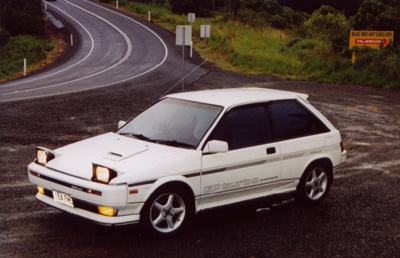
1987
Toyota Corolla II GP Turbo EL31
The Toyota Corolla II EL31
shares a chassis and many body panels with a Tercel, but
that's where all the similarities finish. Powered by a
1.5ltr 12v SOHC 4cyl intercooled turbo the EL31 Toyota
Corolla II Turbo came out to the world with a number of
variants of its name. GP Turbo and Corsa are the most
common, though there is a SRI model that uses the same
body but is powered by the 3E-E non turbo motor.
The EL31 Corolla II could be mistaken to have more in
common with a Corolla but actually shares more parts with
a EP70 / 71 Starlet. Using parts from the starlet like a
engine which has been revised with a larger capacity and
also internals the 2E-TE from the starlet is near
identical to the 3E-TE from the GP Turbo / Corsa. The
GP/Corsa rides on McPherson Strut Coil Spring suspension
with a factory fitted front sway bar and a twist beam
rear axel. Weighing in at 900kg's and producing
110ps/5600rpm makes a enjoyable ride but not exactly mind
boggling.
Four wheel disk brakes will keep the driver off the
guardrails with vented front disks and solid rear disks.
from high speed the brakes work well but running around
town they get to feel a bit loose and spongy, a good set
of brakes pads with better brake fluid should fix this
problem. The standard wheels are only 14inch items and
not one of Toyota's best efforts in design.
When jumping into the cabin the first item to grab your
attention are the adjustable bucket seats that have
excellent comfort. The driver can adjust his seat around
his waist and legs to keep from sliding about on mountain
roads, though the passenger has to make do by holding on
tight, only the driver gets the adjustments. Next to grab
the attention of the driver is the instrument cluster,
with all the normal dials besides one, a Digital boost
gauge which measures the amount of boost the engine is
using and also when in the rev range the boost is coming
on. Unfortunately there are no numbers to indicate the
amount of boost the engine is running.
Driving the GP/Corsa for the first time the pedals
seem to be very close and takes some time to get use to,
but to make up for this Toyota threw a double din tape
deck stereo in with 6 speakers to keep you entertained on
those long drives. The speakers are located as follows:
two in the dash, two in the rear parcel shelf and 2 built
into the back of the seats which can be controlled by
their own volume adjustment, turn it right up for a
massage!
The cabin hosts the run of the mill luxuries
such as air conditioning, climate control, power windows,
power mirrors, power steering, central locking, roof
mounted filtered fan and adjustable 3 way suspension.
which isn't to shabby for a car made in the 1980's.
Toyota Tercel Product History
*All chronology dates are model year, unless noted otherwise. CY refers to "Calendar Year".*
Series Chronology
1980 - Introduced as Corolla Tercel with 4-cylinder 1.5L engine.
1981 - Minor exterior restyle.
1981 - 2nd generation engine.
1983 - 2nd generation introduced.
1983 - Name changed to Tercel.
1983 - 4-wheel drive introduced.
1984 - CY 1984 - Named "Best Buy" by Consumer's Digest.
1986 - Minor interior refinements.
1987 - 3rd generation introduced.
1987 - Redesigned engine introduced.
1988 - Minor exterior restyle.
1990 - Safety upgrades introduced.
1991 - 4th generation introduced.
1991 - Named "Best Buy" by Consumer's Digest.
1992 - Named "Best Buy" by Consumer's Digest.
1993 - Named "Best Buy" by Consumer's Digest.
1993 - Minor exterior restyle.
1993 - Safety upgrades introduced.
1994 - Named "Best Buy" by Consumer's Digest.
1995 - 5th generation introduced.
1995 - Redesigned engine introduced.
1995 - Named "Best in Class in Initial Quality" by J.D. Power & Associates
1995 - Among "Top Ten Models in Initial Quality" by J.D. Power & Associates
1997 - Introduction of CE grade.
1997 - Named "Most Fuel-Efficient Car" by Consumer Reports.
1997 - Among "Most Reliable Used Vehicles, MY's '89 to '95 - Consumer Reports
1997 - Named "Best in Class in Initial Quality" by J.D. Power & Associates.
1998 - Minor exterior restyle
1999 - Tercel ceases production for the U.S.
When the Tercel was introduced to the United States in 1980, it was the first front-wheel drive vehicle ever produced by the automaker. Named the Corolla Tercel, it was intended that the Corolla image - long known for quality and durability - would bring buyers to this new product. Tercel's front-wheel drive design ensured that the vehicle delivered maximum interior space in a small package. It was originally sold as either a two-door coupe or three-door hatchback, with each model powered by a 1.5L single overhead cam four-cylinder engine producing 60-horsepower. Transmission choices were either a four- or five-speed manual or three-speed automatic.
For 1981, Corolla Tercel received a new 62-horsepower engine for improved drivability and lower emissions. Choice of body styles increased as well with the addition of a four-door sedan.
No major changes were recorded for 1982, but in 1983, a full redesign took place. As well as significant body, styling and interior changes, the vehicle also received a new name. Sales successes no longer necessitated the Corolla name association, and the vehicle was officially called Tercel from that point onward. The second generation Tercel was available in three- or five-door hatchback models or a five-door station wagon. The station wagon was also available with either front- or four-wheel drive. In four-wheel drive trim, the vehicle was equipped with a six-speed manual transmission and could be shifted from two- to four-wheel drive without coming to a stop. The sixth gear it carried was an "Extra Low" first gear suited only for very low speed off-road use. Standard front-wheel drive vehicles came with either a three-speed automatic or a five-speed manual transmission. The least expensive model, the base-grade three-door, was available with a four-speed manual only.
1985 saw minor changes to gear ratios and the interior was updated in 1986. In 1987, Tercel's third generation was introduced. The new Tercel was larger and more luxurious than ever before, but it was still designed and built with ease of use and economy in mind. Tercel's new three- and five-door hatchbacks and five-door wagons were powered by an updated 78-horsepower engine. Other improvements included revised rack-and-pinion steering and a newly-designed fully-independent suspension. Regardless, Tercel continued in its role as Toyota's least expensive vehicle.
In 1988, Toyota brought out an even lower priced vehicle, the Tercel EZ. It had a lower level of standard equipment than other Tercels, but was an even better bargain than other Tercels.
For the 1990 model year, Tercel was available as either a three-door hatchback or a two-door coupe, the five-door and wagon having been discontinued. Also discontinued for 1990 was the four-wheel drive system, Tercels now being available in only front-wheel drive. Another major innovation for 1990 was the introduction of the non-motorized two-point passive seatbelt for both front-seat passengers.
For 1991, Tercel's fourth generation sported an all-new aerodynamic shape. Now available as either a two-door coupe or four-door sedan, the Tercel was powered by a further improved version of its 1.5L engine producing 82-horsepower.
1993 saw a minor exterior redesign - bumpers, grille, head- and tail-lights - and a major boost toward a safer vehicle with the addition of a standard equipment driver's-side airbag. Also contributing to the vehicle's safety was the availability of option four-wheel anti-lock brakes. It was carried over to 1994 with no major changes save for the addition of HFC 134-a, a non-CFC refrigerant, in the air-conditioning.
For 1995, Toyota introduced an all-new Tercel. Retaining its compact packaging and high quality, the new Tercel sported a completely redesigned exterior and an all new engine. Also new for 1995, Tercel offered, as standard, driver- and passenger-side airbags, three-point seatbelts for front and outboard rear passengers and adjustable shoulder-belt anchor points for front seat passengers on four door models. All models meet Federal standards for 1997 side-impact protection and offer a four-wheel Anti-Lock Brake System (ABS). Exterior styling was intended toward the youthful buyer.
The interior emphasized a user-friendly environment, pushing the dash further away, but bringing the switches closer, giving passengers a feeling of spaciousness and comfort. The all-new 1.5-liter twin-cam engine provided 93 horsepower and 100 lb/ft of torque - and also greater fuel economy than the previous model. In fact, the 1995 Tercel offered a 13 percent power increase over the previous generation as well as a 15 percent increase in fuel economy. When paired with the new transmission choices, it made for exciting performance and moved Tercel solidly into the realm of "vehicles one buys out of choice, rather than because it is the only one in the price range." Even with its upgrades, Tercel remained Toyota's lowest price car.
For 1997, Tercel value became even greater with the introduction of the one-grade strategy. All 1997 Tercels were available only in Classic Edition (CE) trim level and incorporated many of the standard and optional items from previous Standard and DX level models for one low price. All Tercels came standard with a new 14-inch wheel and tire combination.
Inside, Tercel received a freshening with the addition of a revised dash panel with rotary ventilation controls. Also, all models received revised seat fabric and door panels.
For 1998, Tercel receives updated styling, highlighted by new jeweled multi-reflector headlights, a revised grille and front fascia design and clear lens turn signal lights.
Tercel's rear styling is also enhanced with expressive, redesigned combination tail lamps and updated bumper molding. The new molding extends across the entire length of the rear bumper for added protection and a seamless look.
Production of the Tercel for the U.S. market ceased in 1999 to make way for new and future projects in the entry sub-compact segment.
What does it mean?
Tercel: The Latin word for one-third. Also a fast-flying member of the falcon family whose males are one-third the size of the females.
Where was it built?
All Tercels were built at the Takaoka Plant in Toyota City, Japan.
Contributed by the Pressroom @ Toyota.Com
|
|