|
|
 Life in the West Bank

West Bank Q & A |
|
This page is my attempt to answer some of the questions I
have been asked since coming the West Bank. I am by no means
a scholar or expert on these issues, but hopefully I can offer a unique
perspective because of my closeness to "the situation" (as it is called
here).
You can navigate through this page by clicking the links, or just by scrolling down. If you have any questions (or questions about the questions!), please let me know. I plan to add more questions to this page regularly.
Q: How would you describe the current situation? The situation now is really the worst it has ever been for Palestinian people. That sounds sensational, but it really makes sense when you see what is happening here. The West Bank has been under a state of martial law in varying degrees for the past two years of the Intifada. Between the curfews, checkpoints, and the continuing destruction of the Palestinian infrastructure, the people are squeezed in a vice grip that is destroying their economy and ability to get basic things like medical treatment, education, and even food at times. A unique blend of political events has brought the Palestinians to this point. Before the current Int 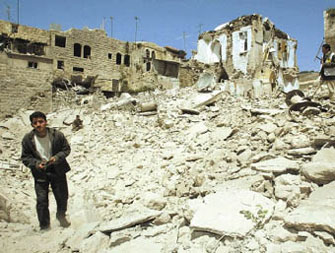 ifada, the next most difficult time was the first Intifada
in the late 1980s, when many Palestinians were rounded up and put in
prison. But in that time, the West Bank was still considered a
part of Israel, so to a great extent life went on as usual for most of
the people, including regular trade with Israel and less restricted movement
around the country. Contrast that with the situation now, where
Palestinians have difficulty sometimes to make a trip of 6 miles between
villages, schoolchildren in Jenin and Nablus are frequently unable to
attend school because of military curfews, and unemployment has soared
well above 60 percent in the West Bank. For most Palestinians in
the West Bank, life is on hold right now. They are isolated from
the rest of the world, watching as their hopes and future crumbles around
them. It should not be surprising that the voices of extremists are
gaining strength and support under these conditions.
ifada, the next most difficult time was the first Intifada
in the late 1980s, when many Palestinians were rounded up and put in
prison. But in that time, the West Bank was still considered a
part of Israel, so to a great extent life went on as usual for most of
the people, including regular trade with Israel and less restricted movement
around the country. Contrast that with the situation now, where
Palestinians have difficulty sometimes to make a trip of 6 miles between
villages, schoolchildren in Jenin and Nablus are frequently unable to
attend school because of military curfews, and unemployment has soared
well above 60 percent in the West Bank. For most Palestinians in
the West Bank, life is on hold right now. They are isolated from
the rest of the world, watching as their hopes and future crumbles around
them. It should not be surprising that the voices of extremists are
gaining strength and support under these conditions. 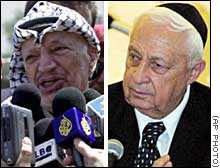 This situation is further complicated by the political wranglings
of the governments involved. Palestinian Authority Chairman Yasser
Arafat appears to be primarly focused on holding on to power in his
own crumbling government, when he is not dealing with regular attacks
by the IDF (Israeli Defense Forces) on the government he has left.
Ariel Sharon, the current Israeli Prime Minister, was elected in the
midst of the Intifada under a platform of “providing security” to Israelis.
He has pursued this agenda by imposing martial law in much of the West
Bank, by controlling Palestinians' movements through curfews in cities
and checkpoints throughout the region, and by aggresively attacking suspected
Palestinian terrorists (resulting in almost daily Palestinian civilian
casualities). These hardline policies have crippled the Palestinian
economy and destroyed much of the infrastructure without "providing security"
or addressing the underlying issues. While the leaders play political
games, it is the people who suffer the most, both Palestinians and Israelis.
The Israeli economy itself has been seriously damaged by the Intifada,
especially in the areas of tourism and trade. Israelis now live in more
fear than ever. Obviously, the current course of action is not going
to bring a solution. Both sides say that peace is the ultimate goal,
but right now neither of them is making a serious step in that direction.
This situation is further complicated by the political wranglings
of the governments involved. Palestinian Authority Chairman Yasser
Arafat appears to be primarly focused on holding on to power in his
own crumbling government, when he is not dealing with regular attacks
by the IDF (Israeli Defense Forces) on the government he has left.
Ariel Sharon, the current Israeli Prime Minister, was elected in the
midst of the Intifada under a platform of “providing security” to Israelis.
He has pursued this agenda by imposing martial law in much of the West
Bank, by controlling Palestinians' movements through curfews in cities
and checkpoints throughout the region, and by aggresively attacking suspected
Palestinian terrorists (resulting in almost daily Palestinian civilian
casualities). These hardline policies have crippled the Palestinian
economy and destroyed much of the infrastructure without "providing security"
or addressing the underlying issues. While the leaders play political
games, it is the people who suffer the most, both Palestinians and Israelis.
The Israeli economy itself has been seriously damaged by the Intifada,
especially in the areas of tourism and trade. Israelis now live in more
fear than ever. Obviously, the current course of action is not going
to bring a solution. Both sides say that peace is the ultimate goal,
but right now neither of them is making a serious step in that direction.
Top of page Q: What is daily life like for Palestinians right now? The average Palestinian is living in a nightmare. Most people know someone who has been killed or injured by military action. On my second day here, I was speaking with a student in the cafeteria about life in his village. I was shocked when he told me that on that same morning he had walked by the body of a young neighbor who had been killed in an Israeli military strike on the car of a suspected terrorist. Sadly, this is not an isolated incident for Palestinians. Every day they watch on the news or in the streets of their neighborhoods as the body count rises. Beyond the threat of being killed by the army, what is equallly damaging is the isolation imposed by military curfews and checkpoints. The best way I can illustrate this life of isolation is to compare it to my own. If I decide tomorrow that I want to travel to Italy for a 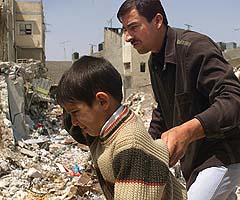 vacation, or if I want to go to Jerusalem for a visit, I
just do it. If I were a Palestinian, these simple things would
be impossible. I would not be allowed to travel into Israel under
any circumstances, and even my movement in the West Bank would be severely
restricted. Any plans for the future would be on hold.
If I owned a business, I would never know from day to day if I could
open my store or get supplies that I needed. On top of these
difficult circumstances, I would have no voice or influence in my "government"
or the Israeli government that could change the situation. There
is no place I could go to voice my complaint that I would be heard.
If my best friend was shot or my house was destroyed, I would have
no recourse to address my grievance. In short, I would have little
control over my life or my future. As an American who has basically
felt unrestricted in my life, it is hard to imagine what it would be like
to live this way.
vacation, or if I want to go to Jerusalem for a visit, I
just do it. If I were a Palestinian, these simple things would
be impossible. I would not be allowed to travel into Israel under
any circumstances, and even my movement in the West Bank would be severely
restricted. Any plans for the future would be on hold.
If I owned a business, I would never know from day to day if I could
open my store or get supplies that I needed. On top of these
difficult circumstances, I would have no voice or influence in my "government"
or the Israeli government that could change the situation. There
is no place I could go to voice my complaint that I would be heard.
If my best friend was shot or my house was destroyed, I would have
no recourse to address my grievance. In short, I would have little
control over my life or my future. As an American who has basically
felt unrestricted in my life, it is hard to imagine what it would be like
to live this way. Fear, uncertainty, isolation, and hopelessness are the defining characteristics of what it means to be Palestinian right now. As many people have told me, "This is the life." After two years of this, they have actually begun to grow accustomed to living in this insanity. They do the best they can to keep living normally, dodging tanks in Jenin on the commute to work in the university, but their lives are nowhere close to what I would call "normal". Top of page Q: Do you feel safe living in the West Bank? I have been asked this question a lot, as you can imagine. The truth is that I really do feel relatively safe here. The university where I live is only 12 kilometers from Jenin, but it is light years away in the way of life. Because there is no military operation in this area, it is quite calm here. And crime is virtually nonexistent. In contrast to nearby Jenin, the economy around the university is actually growing because of the university's rapid expansion. As might be expected, this growth is itself a result of “the situation”. Many of the other respected Palestinian universities are frequently closed because they are located in major 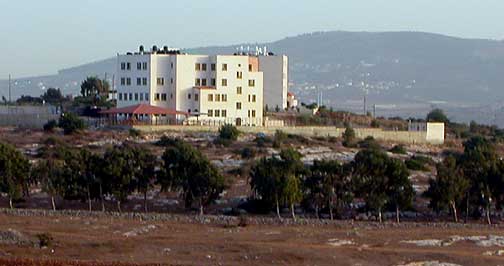 cities like Ramallah and Nablus. But this university
is far enough away that it stays open most of the time, drawing students
who would normally attend other universities. The difficulty
of travel, even between villages, has resulted in many of the students
(more than half) moving to the area surrounding the university, causing
a surge in building of housing at the university and in Zababdeh, the
closest town to the university where around 900 students live. It
is so strange to turn on the news and see Palestinian buildings being destroyed,
then walk outside and see new buildings being built around me. To
me, it is an amazing testimony to the ability of the people here to overcome
obstacles and continue to pursue their education against great odds.
cities like Ramallah and Nablus. But this university
is far enough away that it stays open most of the time, drawing students
who would normally attend other universities. The difficulty
of travel, even between villages, has resulted in many of the students
(more than half) moving to the area surrounding the university, causing
a surge in building of housing at the university and in Zababdeh, the
closest town to the university where around 900 students live. It
is so strange to turn on the news and see Palestinian buildings being destroyed,
then walk outside and see new buildings being built around me. To
me, it is an amazing testimony to the ability of the people here to overcome
obstacles and continue to pursue their education against great odds.
Top of page Q: What are Palestinian people like? Of course it is difficult to make a blanket statement about a people group, but I can speak about my experiences with people here. First, I can confidently say that Palestinians are hospitable people. As a visitor here, I have felt very welcomed. People want to get to know me, to learn about my life, and to invite me to their homes. In fact, I 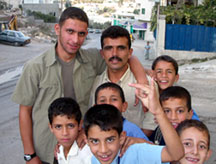 have received so many invitations to people’s homes that my
schedule is already booked up for the next 3 months! This was
strange to me at first, because I thought that Palestinians might be suspicious
of me because I am American. But just the opposite is true.
I have found that they are acutely aware of their bad reputation among
Americans, and they want to change our impression of them. I can
say that so far it's working for me!
have received so many invitations to people’s homes that my
schedule is already booked up for the next 3 months! This was
strange to me at first, because I thought that Palestinians might be suspicious
of me because I am American. But just the opposite is true.
I have found that they are acutely aware of their bad reputation among
Americans, and they want to change our impression of them. I can
say that so far it's working for me! Second, they have strong family ties. When I talk to students about what they want to do for the weekend, most reply that they want to travel home to visit their families. The university students here highly value their families and 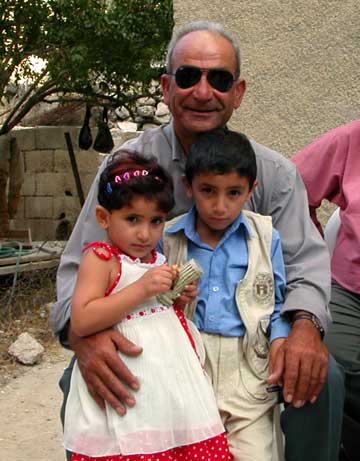 actually want to spend time with them. In smaller villages,
extended families live on the same neighborhood or even the same house.
There is a respect for the elderly and parents that is quite a contrast
from what I am used to in Western culture.
actually want to spend time with them. In smaller villages,
extended families live on the same neighborhood or even the same house.
There is a respect for the elderly and parents that is quite a contrast
from what I am used to in Western culture. Third, they are human. This may sound strange, but what I mean by this is that they are similar to people everywhere. It is amazing how much my perceptions about Palestinians were dehumanized because I only knew them through media coverage, and not through personal contact. It is easy to forget that people everywhere are basically the same: they want to live a peaceful life where they can reach some sense of financial security and provide for their families. They want to have a good life. It is true that some are filled with hate and vengeance (you can learn about them on the news), but most are just hoping against hope that they can have some amount of peace and security in their lives. It is this hope which keeps them going. Top of page Q: How do Palestinians feel about suicide bombings? 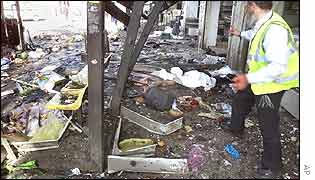 There has been a characterization of
Palestinians in the media that they all support sui
cide bombi
ngs
as their weapon of choice against the Israelis. I don't
doubt that some people feel this way, but I h
ave yet
to meet them. The people I talk to here see suicide bombings as
compounding the problems that they already have. One person told
me, “We are sad when we hear that Israeli civilians are killed.
We know what it is like to lose friends and family members to violence,
and we don’t want others to have this pain.”
There has been a characterization of
Palestinians in the media that they all support sui
cide bombi
ngs
as their weapon of choice against the Israelis. I don't
doubt that some people feel this way, but I h
ave yet
to meet them. The people I talk to here see suicide bombings as
compounding the problems that they already have. One person told
me, “We are sad when we hear that Israeli civilians are killed.
We know what it is like to lose friends and family members to violence,
and we don’t want others to have this pain.” What I find fascinating is the large number of people here who still choose not to be involved politically in any way, even considering how the political situation is drastically affecting their lives. Recently, some students at my university planned a demonstration during lunch hour in support of the Palestinian govenment. A small group of students (100 out of more than 1,000 present) led a vocal demonstration with chanting and flag waving (the kind of stuff you see on TV). But the lar 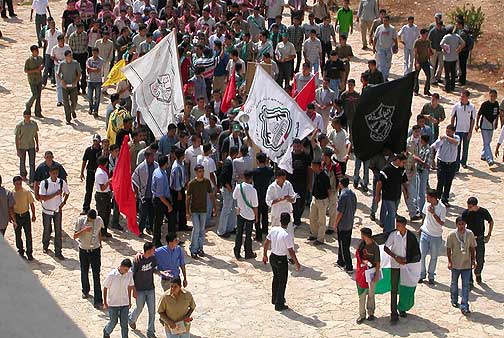 ge majority of the students just went to the cafeteria to hang out. Some
students even got into a fight because the demonstators wanted to make
them join in. As one student explained it to me, "Most of the students
are not political."
ge majority of the students just went to the cafeteria to hang out. Some
students even got into a fight because the demonstators wanted to make
them join in. As one student explained it to me, "Most of the students
are not political." I think it is important to remember that for every vocal demonstrator in the street, there are thousands who just want to live their lives and make it to the next day. Certainly for every suicide bomber, there are tens of thousands of Palestinians who hate how suicide bombings are damaging their reputation as a people and making it more difficult for them to live their lives and make it to the next day. No o ne is happy with the current situation. The problem is how to get out of it. Unfortunately, the vocal political groups here are generally the ones advocating violence, though mostly it takes the form of resisting the occupation by Israeli troops, not suicide bombings on civilians. There is clearly a need for a non-violent resistance movement to come to forefront now, something along the lines of the U.S. civil rights movement. It is the only positive thing that I believe that Palestinians can do to change their current situation. The rest is up to the Israeli govenment and the influence of international community. Top of page Q: What it is like to teach in the current situation? I have to admit that I am surprised at how well teaching in these conditions has worked out so far. I assumed that the students would be so distracted by the situation that it would be difficult to get them to focus on studying. Instead, I have found the opposite to be true. Attendance so far has been excellent (except when roads are closed and some cannot get through), and students are interested in their classes. It seems that they are happy to focus on something besides a political situation that enhances their feeling of powerlessness. As least they are able to do something positive in the midst of this situation. I find that the students are intelligent, funny, and their English level is much higher than I expected considering that their exposure to English is limited to study in high school and some television or movies. Top of page Q: I hear often on the news that "Jenin is under curfew", or "curfew was lifted today." What does a curfew mean in the West Bank? A curfew is the West Bank is not the same thing as, “Now make sure you are in by 11 p.m., young lady, if you want to continue to drive that car I bought you.” Curfews here are the enforcement of martial law among the residents of a city or village. It’s equivalent to a lockdown in a prison. All people are supposed to stay in their homes or risk 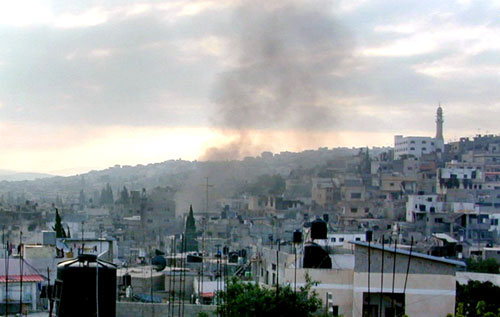 being shot at by the Israeli army (and it does happen). The
reality is that curfews take different forms in different places.
Take for instance Jenin and Nablus, two major cities in the northern
West Bank. Both have been under a continuous curfew for many months.
In Jenin, curfew means that whenever Israeli tanks are in the streets,
people stay in their homes. Every morning the people wake up and
call around to see if it is “quiet” enough to venture out. Whenever
it seems quiet enough, the stores open up and people begin to go out.
But as soon as shooting starts up, the people go back home and the stores
close. The understanding is that people are not supposed to be out,
but many times they are anyway. Many people who w
being shot at by the Israeli army (and it does happen). The
reality is that curfews take different forms in different places.
Take for instance Jenin and Nablus, two major cities in the northern
West Bank. Both have been under a continuous curfew for many months.
In Jenin, curfew means that whenever Israeli tanks are in the streets,
people stay in their homes. Every morning the people wake up and
call around to see if it is “quiet” enough to venture out. Whenever
it seems quiet enough, the stores open up and people begin to go out.
But as soon as shooting starts up, the people go back home and the stores
close. The understanding is that people are not supposed to be out,
but many times they are anyway. Many people who w ork at the university live in Jenin, and they find ways of getting
around the curfew to get to work (most of the time, at least).
ork at the university live in Jenin, and they find ways of getting
around the curfew to get to work (most of the time, at least).In contrast to Jenin, Nablus has been under a continual curfew for four months as of October 1, 2002. In that city, the residents are strictly forbidden to leave their homes except for a few hours on Friday to buy food and supplies. No one is allowed to leave or enter the city. In fact, the only way that people are able to enter or leave is by ambulance. You can imagine what four months of this type of life does to people. International aid organizations are now bringing in food and medicine to people's homes -- the situation is that desperate. In all cases (but in varying degrees), curfews mean serious restriction of a normal life enforced on a large population over an extended period of time in order for the Israeli government to claim that it is providing security for Israelis. It is this type of collective punishment that is punishing all Palestinians for the actions of a few extremists. For more information about curfews in the West Bank, see this eyewitness account. Top of page Q: Palestinian supporters on the news are always talking about "Israeli occupation". What do they mean? "Occupation" refers to the current state of much of the West Bank, where the Israeli army is in 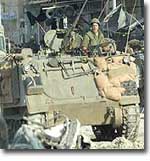 control of the area, not the Palestinian Authority (the provisional
government of the West Bank that was established by the Oslo Accords
in the early 1990s). This means that people living in this area
have no functioning government, but an army that controls their ability
to live and travel. Before the Oslo Accords the Palestinians in
the West Bank had a semblance of a government in Israel, but in the current
situation, with the forced isolation of the Palestinian Authority and
the martial law set up by the Israeli army, the law of the land primarily
now is the Israeli army policy, which controls Palestinians' movements.
control of the area, not the Palestinian Authority (the provisional
government of the West Bank that was established by the Oslo Accords
in the early 1990s). This means that people living in this area
have no functioning government, but an army that controls their ability
to live and travel. Before the Oslo Accords the Palestinians in
the West Bank had a semblance of a government in Israel, but in the current
situation, with the forced isolation of the Palestinian Authority and
the martial law set up by the Israeli army, the law of the land primarily
now is the Israeli army policy, which controls Palestinians' movements.
Top of page Q: Is it difficult for you to travel around the area? Travel around the West Bank is difficult right now due to the many Israeli army checkpoints. Checkpoints have been established by the Israeli army throughout the West Bank to 1) control travel among Palestinians and 2) protect the Israeli settlements that are scattered throughout the West Bank. For example, when I went with a colleague at the university to his village in the southern West Bank for his sister’s wedding, we had to go through numerous checkpoints along the way. We would take a taxi to one checkpoint, walk through the 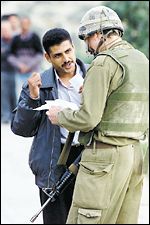 checkpoint, have our IDs checked by Israeli soldiers, and then
get another taxi on the other side of the checkpoint to continue the
journey. On a relatively good day, this means you can make a
trip that should take 2 hours in about 5 hours. On the way back,
though, that same trip took us 9 hours because the Israeli army had
closed all main roads to Palestinians, so we had to travel on dirt roads
through the mountains to go around checkpoints. What this means
for Palestinians is that travel is always difficult and frequently impossible,
even between short distances. Recently a checkpoint was established
between the university and a small town only 6 miles away, where the
IDF was conducting a military operation. 70 students from the university
who lived in that town were not allowed to return to their homes, so they
spent 2 nights rooming with other students in Zababdeh (the town closest
to the university) until they could return home. As you can imagine,
this situation seriously affects business and
checkpoint, have our IDs checked by Israeli soldiers, and then
get another taxi on the other side of the checkpoint to continue the
journey. On a relatively good day, this means you can make a
trip that should take 2 hours in about 5 hours. On the way back,
though, that same trip took us 9 hours because the Israeli army had
closed all main roads to Palestinians, so we had to travel on dirt roads
through the mountains to go around checkpoints. What this means
for Palestinians is that travel is always difficult and frequently impossible,
even between short distances. Recently a checkpoint was established
between the university and a small town only 6 miles away, where the
IDF was conducting a military operation. 70 students from the university
who lived in that town were not allowed to return to their homes, so they
spent 2 nights rooming with other students in Zababdeh (the town closest
to the university) until they could return home. As you can imagine,
this situation seriously affects business and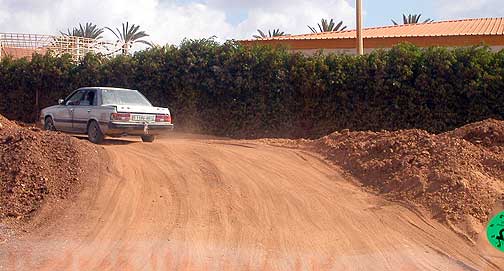 education all around. Checkpoints are another example
of the collective punishment meted out to Palestinians. If a
wanted terrorist wants to go from Jenin to Nablus, he can always find
a way around the checkpoints. Even when the roads are totally
locked down and no Palestinians are supposed to be able to travel, many
still manage to get from Point A to Point B by taking back roads. I
found that out firsthand in my
trip from Hebron to Jenin
in early September. Instead of providing security, checkpoints
punish all Palestinians by making their travel difficult and at times
impossible. For more information about checkpoints, see this excellent
news article.
education all around. Checkpoints are another example
of the collective punishment meted out to Palestinians. If a
wanted terrorist wants to go from Jenin to Nablus, he can always find
a way around the checkpoints. Even when the roads are totally
locked down and no Palestinians are supposed to be able to travel, many
still manage to get from Point A to Point B by taking back roads. I
found that out firsthand in my
trip from Hebron to Jenin
in early September. Instead of providing security, checkpoints
punish all Palestinians by making their travel difficult and at times
impossible. For more information about checkpoints, see this excellent
news article.
Top of page |