 |
| Two capitals in Russia |
| History of St. Petersburg |
|
 |
 |
 |
| The city of St. Petersburg is relatively young if judged by the European or Russian standarts. Founded in 1703 St. Petersburg will in 2003 celebrate its 300th anniversary. But despite being a young city it has a rich and exiting history. On May 27 the St. Petersburg fortress was founded by Tsar Peter the Great and that day became the offitial birthday of the city. Several days later a wooden Cabin of Peter the Great was built, becoming the first living quarters of the new city. For its first few years the St. Petersburg was a small town around the fortress, but by 1712 it was big enough to become the new Russian capital. |
| St. Petersburg |
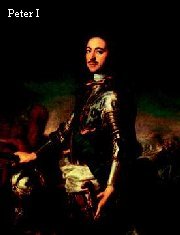 |
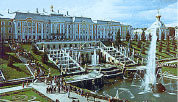
| Soon a Summer Palace was built for him (1714) and a Winter Palace just a bit down the river. There where no briges across the mighty Neva River and people had to be ferried across by boat ( this is why they call St. petersburg "the Venice of the North"). When Peter the Great died in 1725, his wife Catherine assumed power and then the rulers started changing every few years, overthrowing one another. The Imperial splendor of St. Petersburg was best refleced in the suburban royal residences. Peter the Great estate Petergof was remodeled by Bartolomeo Rastrelly, the arhitect of the Winter Palace and the Smolny Cathedral. |
 |
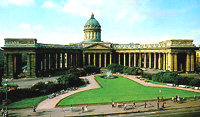
| St. Petersburg turned into a "Grand City" under the rule of Catherine the Great. Catherina's court was extremely luxorious. She was the first to move into the newly built Winter Palace. Catherine started a royal art collection, which later became the world-famous Hermitage. When Catherine the Great died in 1796 a whole new period in Russian history started. During the reign of Alexander I the Russian army successfully stopped Napoleon's invasion of Russia and drove the french army back to Paris (1812-1814). The captured French banners were put in the newly built Kazan Cathedral, where the army commander, Field-Marshal Kutusov, was burried in 1813. |
 |
| In December 1825, a political crisis again erupted. A group of liberal young army officers (later called the"Decabrists") started a revolt, hoping that Nicolas I would have to sign a Constitution for the country. But uprising was cruelly crushed. Due to the Decembrist Uprising the new Emperor, Nicolas I, adopted the most conservative policies. Russia was left to be an economicalyy backward bureaucratic state. Military order was everywhere. Even the civil educational institutions were treated as military schools. Paradoxically, culture flourished under such an oppressive regime. Alexander Pushkin wrote some of his best poetry; Mikhail Glinka, one of the first Great Russian composers, wrote his best operas and chamber music. Fiodor Dostoyevsky lived in St. Petersburg from 1837 and in 1844 started his career as a writer. |
 |
| At the end of 18th century St. Petersburg was becoming a capitalist city. The number of factories and plants grew quickly, while Nevsky Prospect and downtown streets were filled with banks and company offices. The trouble came in 1905. First revolution started. When the WWI broke out in August 1914 it was decided to change the name of the Russian capital from St. Petersburg to Petrograd. The old name sounded too German for conterporary Russians. The war did not go too well for Russia. The Tsar's government discredited itself and political tensions started rising. |
| The political and economic crisis continued all through 1917 and in the fall the Bolshevik party led by Vladimir Lenin had captured political power. By the begining of 1918 the German troops were so close to Petrograd that the Bolshevik government decided to move capital to Moscow. Hence Petrograd was left to be just a regional center. In 1924 the name of the city was changed to Leningrad, and that was a symbol of its transition to a Socialist city. |
| St. Peterburg was turned into "communal" - shared - appartments, housing several families. Life was not a piece of cake, but ahead laif the events that were to change this life completely: WWII and the dramatic 900-day Siege of Leningrad. This was certainly the most tragic period in the history of this city/ Less thantwo and a half months after June 22, 1941, when the Soviet Union was attacked by Nazi Germany, German troops were already approaching Leningrad. On September8, 1941 the Germans had fully encircled Leningrad and the siege began. It lasted for about 900 days till January 27, 1944. At least 641,000 people had died during the Siege ( estimates put this figure at 800,000). After war Leningrad Leningrad was not modernized, but restored to the highest pre-war standarts. The palaces of Petergof and Pushkin had to be almost fully rebuilt. The carefull restoration took some time and big amounts of money. The 70s and the early 80s were a period of stability for the Soviet Union and for Leningrad. But when the government initiated the reformsknown worldwide as Perestroika all stability disappeared. The population began expressing economic hardship, while the reforms went on. In 1991, after a citywide referendum, the city Leningrad was renamed and got back its old name - St. Petersburg. |
 |
| If you have any questions or comments, please, click here. |