 |
|
|
|
|
|
|
|
|
|
|
|
|
|
|
|
|
|
|
|
|
|
|
|
|
|
|
|
|
|
|
|
|
|
|
|
|
|
|
|
|
|
|
|
|
|
|
|
|
|
|
|
|
|
|
|
|
 |
|
|
|
Two capitals in Russia |
|
|
|
|
 |
|
|
|
 |
|
|
|
Why two capitals? |
|
Cities today |
|
Pictures |
|
Links |
|
|
|
|
|
History of Moscow |
|
History of St. Petersburg |
|
|
|
|
|
|
|
|
|
|
|
|
 |
|
|
|
Moscow |
|
|
|
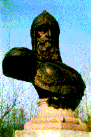
��� The reference to a Moscow, as to a town, is registered in the old manuscript of 1147. In 1156, prince Yury Dolgoruky erected timber walls around Moscow with a moat. He is frequently regarded as a founder of Moscow, and his monument is among the most honored in Moscow. |
|
|
 |
|
|
|
|
|
|
��� First tribes appeared on the territory of the future Moscow in the Neolithic era. The oldest settlements, dated as three thousands years before our era, were discovered within the area of the present-day city.
���� In the second half of the first millennia of our era Slavic tribes occupied areas near Moscow, these were "vjatichi", who are regarded as a kernel of the future Moscow population. |
|
|
|
��� Tatar-Mongolian invasion in 1237-38 produced a great destruction of Moscow. However, Moscow recovered rather rapidly (in the second half of 13 century), and became capital of the independent Moscow principality. |
|
|
|
|
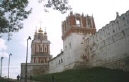
��� In the end of 15th century, during Ivan III management, Moscow becomes a capital of Russia. Moscow Kremlin that was built in the beginning of the 15-century is a benchmark of that epoch. For the purpose of improving the defense of Moscow and of its inhabitants, a number of defence buildings and big cloisters, like Novodevichy - from southwest, Donskoy and Danilovsky - from south, Simonov and Novospassky - from southeast and Andronnikov - from the east, were constructed. |
|
|
|
 |
|
|
��� Development of commerce and trade served impetus for new advance in the science and arts. So, a number of fundamental manuscripts (like "Domostroy", "Stoglav"), great architectural buildings (like "Kremlin" and "Pokrovsky chirch") and the first Russian printed book - "Apostol" by Ivan Feodorov were created. |
|
|
|
|
|
|
��� Moscow has been attacked by Polish-Lithunian army in 17th century and was conquered by them. Then salesman Minin and prince Pozharsky organized people's militia, and Moscow was liberated in 1612.
���� During the reign of Peter the First, arts and science in Moscow, and in Russia in whole, progressed strongly. In 1755 Moscow University was opened, in 1703 the first printed newspaper ("Vedomosti") appeared. |
|
|
 |
|
|
|
|
|
|
��� Moscow architecture reached its peak level of perfection in the second half of 18th century due to advanced Russian architects V.I.Bazhenov (Pashkov's house), M.F.Kazakov (Senat bilding).
���� In 18th century Moscow remains an importantly political, governmental and economical center. |
|
|
|
|
|
During French invasion Napoleon said: "If I'll capture Kiev, I'll take Russia by it's feet, if I'll capture Petersburg, I'll take it by it's head and if I'll capture Moscow, I'll destroy it's heart".Folk army has been organized in 1812 to withstand the French invasion, and a famous Borodino battle took place in August not far from Moscow. |
|
|
|
|
� This battle is thought to be a prerequisite for the victory in the War, although the battle itself was more a failure than a victory. Moscow was left to Napoleon's troops, but before that it was burnt by moscovites almost entirely. Fires and hunger compelled the French army to leave Moscow, where the Russian army entered very soon - in October. After the liberation of the city a commission was authoritized for Moscow reconstruction after the fire, and talented architects were its members (Beauve, Grigoriev). |
|
|
|
 |
|
|
|
|
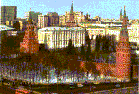
The present-day appearance of Moscow center was founded in those times. Thus, Alexandrov Garden, Theatre Square appeared with Bolshoi and Maly theatres, as well as the buildings of Manezh and the First gradskaya hospital. |
|
|
|
|
|
 |
|
|
|
��� The XIX century is known to be a "golden age" for arts and science, and Moscow was a birthplace for many famous artists, writers, painters and scientists; a number of outstanding politicians were also moscovites. You are, of course, familiar with the following names, whose talent and ideas made the glory of Russia: Pushkin, Gogol', Tolstoi, Chekhov, Herzen, Pirogov, Sklifosofsky, Vasnetsov, Serov, Levitan and many others. |
|
|
|
Communistic ideas of Karl Marx became popular in Moscow, workers and intelligentsia, who became very enthusiastic about them and organized revolutionary groups, studied them in secret meetings. |
|
|
|
|
|
��� Their activities resulted in a series of rebellions, one of them was mentioned frequently as a most successful - Krasnaya Presnya rebellion of 1905. July strikes of 1914 were the next conspicuous stage in the revolutionary process, which was finalized by the February and the "Great October" Revolution of 1917. V. Lenin headed the new government and the capital was again transferred from Petersburg-Petrograd to Moscow. |
|
|
��� The Soviet Union was announced December 30, 1922 by the All-Russia Communist Party of Bolsheviks and Moscow became it's capital. The social structure of Moscow inhabitants started to change in the 20-ies on the account of peasants leaving their villages in search of job and "new life"; later on the poorest part of population came to Moscow as non-qualified workers on factories and in house building. Hence, Moscow architecture changed: the proportion of blocks inhabited by workers increased drastically, the city sprawled outside, many churches were destroyed or transformed into "Palaces of Culture", clubs, stores for vegetables or for building materials.
��� Niklita Khruschev initiated the most active construction of living blocks in the 60-ies, and many families moved from extremely overcrowded multi-family apartments, where more than 5 persons were living in one small room to individual, although small apartments. They were constructed quickly to meet the urgent demands, and, therefore, they are far from being beautiful and diverse.
���� The "opening" of Russia to the West and changes in political situation caused many changes in the attitude of people to their town, its ecology and nature, national and cultural traditions. Therefore, looking forward it is possible to feel optimistic about the future of our city. |
|
|
|
 |
|
|
|
If you have any questions or comments, please, click here. |
|