 |
|
|
|
|
|
|
|
|
|
|
|
|
|
|
|
|
|
|
|
|
|
|
|
|
|
|
|
|
|
|
|
|
|
|
Profiles |
|
|
|
Martin Luther King |
|
Sam Walton |
|
Eleanor Roosevelt |
|
|
|
Home |
|
|
|
Martin Luther King Sr was also a civil rights activist and a member of the National Association for the Advancement of Colored People (NAACP) He would not bow down to the whites and refused to ride on the buses where he would be reminded that the whites saw him as inferior. In fact many times he would openly challenge them to treat him as an equal.[3] King was with his father in some of these instances. It is not surprising that he became involved in civil rights due to the influence of his father. However King had also endured the scars of segregation many times in his own life.[1]
Through his studies at Morehouse College and Crozer Seminary King�s way of thinking and his leadership skills were greatly impacted. Writers such has Henry Thoreau who held the idea that people should act according to their own sense of what is right or wrong rather than what the law said to be right or wrong,[1] influenced him greatly. Also, Walter Rauschenbusch argued that it was the duty of Christians to tackle the social and economic problems of the poor.[2] His greatest inspiration, however, came from the teachings of Ghandi, who advocated the path of non-violent resistance which included demonstration, boycotts and other techniques.[1] |
|
|
|
|
What is
Leadership? |
|
|
|
|
|
Leadership
Theories |
|
|
|
|
|
Types of
Leadership |
|
|
|
|
|
Profiles |
|
|
|
|
|
Interviews |
|
|
|
|
|
Site Map |
|
|
|
|
|
|
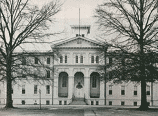
While at Crozer, (photographed right) King often visited the home of J. Pius Barbour, a friend of his father, and refined his preaching skills. He learned how to combine the intellectual Crozer approach with the emotion and raw power of traditional black sermons. While he watched Barbour he also learned how to include economics and politics in his religious speeches. It was this training that polished his oratorical skills enabling him to captivate his audiences.[2] |
|
|
|
 |
|
|
|
|
|
It is of interest to note that King was almost persuaded to take up an academic career and although he made the choice to pursue ministry and become involved in civil rights, he always intended to return to academia. As has been previously noted, King endured the realities of negro oppression and segregation and had made a decision early on to �hate every white person�.[3] This shows the anger, even though tempered by maturity, that fuelled his passion for segregation to be abandoned. If negro oppression had not been an issue it would remain to be seen if King would have found another cause to lead. He may have remained as a leader in a pastoral capacity like his father or become hidden in academia. |
|
|
|
HOME |
|
1 |
|
2 |
|
3 |
|
4 |
|
|
References: |
|
|
|
|
|
|
|
|
|
|
|
|
|
[1] Ganeri, A. (2003). Martin Luther King Jr; from minister to civil rights leader.
London: Franklin Watts.
[2] Hatt, C. (2002). Judge for yourself: Martin Luther King. London: Evans Brothers
Ltd.
[3] Oates, S.B. (1998). Let the trumpet sound: A life of Martin Luther King.
Edinburgh: Canongate Books.
Image
Sourced from Google image search: Martin Luther King |
|