Back to Makassar in 1946
The paragraphs below are from page 50 and 51 of the book "From the formation of the State of East Indonesia towards the Establishment of the United States of Indonesia" by Ide Anak Agung Gde Agung, Yayasan Obor Indonesia, Jakarta 1996.
"...... The consequence of this decision (Editor: not to cooperate withe the CONICA) was that the Makassar CONICA , who held the opinion that Dr. Ratulangi's and the People's Security Center's stance meant that the formation of a new "government" structure in South Sulawesi and the effort to "restore security and civil government" would be hampered, decided to arrest Dr. Ratulangi and several members of the People's Security Center to be sent into exile.
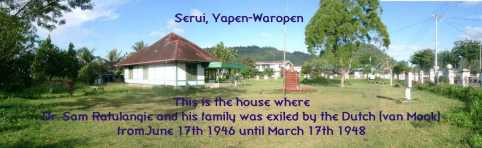
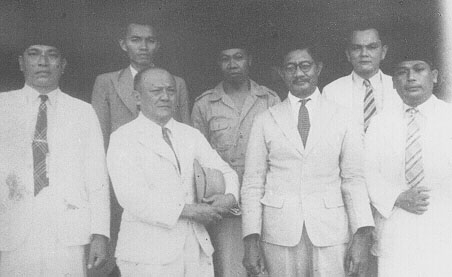
On April 5 1946 Dr. Ratulangi was arrested by the CONICA, along with other members of the People's Security Center, including Lanto Daeng Pasewang, Pondaag, Latumahina, Inchi Mohammad Saleh Daeng Tompo and Tobing.
At first Dr. Ratulangi and his colleagues the Hoge Pad prison in Makassar, in Mid June they were flown in the plane Catalina to exile in Serui, Irian Jaya. The following month Dr. Ratulangi's wife, the wives of the other prisoners and Major(Editor: ????) Soewarno were transported to Serui to be joined with the prisoners. Dr. Ratulangi and his colleagues were freed from their incarceration on March 23 1948, and were brought by the Dutch to Yogyakarta.
After the arrest of Dr. Ratulangie and his colleagues CONICA continued his endeavour to assemble a new "government structure" by working with Nadjamoeddin Daeng Malewa and his colleagues. A number of rajas displayed a non-cooperative attitudes toward NICA after the arrest of Ratulangi including Andi Mappanyukki, Datu Suppa, and Andi Djema of Luwu, meanwhile in the interior, the pemudas were attempting to put pressure on NICA, like what happened in the interior of Luwu. NICA apparently was able to "control" the situation with the help of Dutch troops (Editor: Westerling ???), newly-arrived for the purpose of later replacing the Allied troops. On June 2, 1946, Andi Djema of Luwu was arrested by the Dutch because he was considered a Republican ...... "
Dari buku:
"Kronik Revolusi Indonesia" Jilid II (1946), Pramoedya A. Toer, Koesalah S. Toer dan Ediati Kamil, KPG (Kepustakaan Populer Gramedia), 1999. :
Halaman 168:
1946 April 5,
Gubernur Republik Indonesia untuk Sulawesi Dr. G.S.S.J. Ratulangie dan beberapa orang pemuda (Editor: mungkin maksudnya: pemuka) lainnya ditangkap oleh Belanda di Makasar. Berkenaan dengan hal itu Pemerintah Republik mengajukan protes kepada tentara Sekutu.
Halaman 237:
1946 Juni 17,
Pemerintah di Jakarta memperoleh kabar bahwa militer Belanda telah mengasingkan Gubernur Sulawesi, Dr. Ratulangie dengan pembantunya kesebuah pulau tidak jauh (Editor: ???) dari Makasar. Menurut kabar itu, memang mereka tidak dapat dituntut dimuka pengadilan, tetapi merekapun tidak dapat dilepaskan begitu saja.
Alasan pengasingan adalah pasal 20 S.O.B. (Staat van Oorlog en Beleg) atau Keadaan Perang. Pengasingan dilakukan untuk menjaga "Openbare Rust en Orde" (Ketenangan dan ketertiban umum)
Halaman 293, 294 dan 295
1946 Juli 17,
Konperensi Malino, sebuah tempat peristirahatan dekat Makasar, diprakarsai dan dibuka resmi oleh Dr. H.J. van Mook dengan hadirnya wakil-wakil dari Indonesia Timur, Kalimantan, Bangka Biliton dll. daerah yang berada di bawah pendudukan Belanda.
Dengan konferensi itu Van Mook hendak menunjukkan kepada dunia bahwa tidak seluruh dari 70 juta bangsa Indonesia berdiri belakang Soekarno dan Hatta.
Dr. H.J. van Mook juga memberikan konferensi pers. Ia mengakui bahwa Gubernur Sulawesi Dr. Ratulangie memang benar sudah "dikirim" ke Serui di Utara Nieuw Guinea. Menurut pendapat Van Mook, "adalah lebih baik buat dia (Dr. Ratulangie) supaya jangan tinggal lebih lama di bilangan ini (Editor: Maksudnya Makassar)
See also the paper "Perjuangan ketujuh Tokoh Pergerakan Kebangsaan di Makassar dan Serui", oleh Ir. Zainuddin Daeng Maupa (No. 3) on the list below.
But..... we were all betrayed ..... by the greed and ignorance of the "new regimes" who destroyed the growing bond of a young nation and now it is clear that through the regimes of 32 years under Suharto and nearly 2 years under Habibie, the brotherhood among diverse ethnic groups and religions which characterises our country was severely damaged. However I am convinced that this will be overcome in due time, and history will see that the truth will be exposed.