
Halston
Home
About me
Art
Articles
Beauty
Books
Career
Clubbing
Fashion
Halston
Badgley M
Spring 01
Valentino
Fitness & health
Food
Magazine
Music
Language
Photography
Poetry
Quiz't
Contact
Halston was the American designer of a decade, a legend in his own time, in his own mind, and in the Seventies, in reality. He started out as an assitant hat designer at Bergdorf Goodman. Halston launched his own ready-to-wear collection at Bergdorf in 1966. Two years later he started his own company, and soon became a star. He reintroduced the twinset, made cashmere chic again, reinvented the caftan and created a sensation with a new kind of fake suede. He dressed everyone from hip New Yorkers to Betty Ford.
In 1973, while he was at his peak, Halston sold his company to Norton Simon, for millions of dollars word of stock. But he sold out again in 1983, doing a collection for J.C. Penney. With that - and the fact that he was so solidly identified with the Seventies - the Halston mystique evaporated. Bergdorf Goodman dropped him. He even lost the right to use his name; he'd sold it along with his business. In the end he would almost be best remembered as a creature of the night at studio 54, dressed all in black and surrounded by clouds of Halstonettes. "Halston's movie-star good looks and charismatic qualities ushered us in a new found celebrity status for designers... But through his triumphs and errors, Halston laid the foundation for today's super stars to market themselves into global empires and worldwide recognition without losing control of the products that carry their names." (from: Halston; an American Orginal - E. Gross, F. Rottman, D. Twining Globus - Harper Collins, 1999) Sadly a lesson Halston learned too late. He died in 1990.
Fall 1999



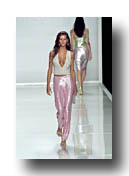

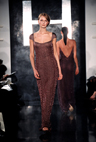
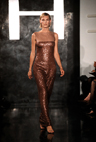

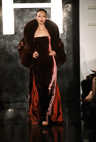

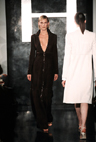
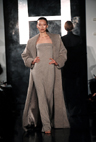
About the fall 1999 Halston collection:
This second Halston collection by designer Kevan Hall was inspired by architecture and environmental design. Eearly evening options included a belted, winter white trench with matching white-leg pant, and a long coffee-colored studded skirt worn with a dramatic cowl-back top. For after-5, the designer spins a pumice-colored beaded slink that looks as if it were kissed with a delicate spider web. And the theatrical garnet ombre velvet gown with matching fox-trimmed embroidered opera coat is truly a work of art.
Kevan Hall, current designer of the Halston label
He created clothes so simple and glamorous that he became the king of American fashion in the 1970s. In the '80s he lost everything, a result of bad business decisions and his own seedy lifestyle. But his name Halston never quite shed his luster. The task of restoring the Halston label to its former glory has fallen to Kevan Hall, a designer who formerly lived in Los Angeles who excels at luxurious, body-concious evening wear.
A lot is riding on his success, but the soft-spoken, always empeccably groomed designer never seems to sweat.
"I share the same esthetic as Halston the man," he said. "As a young design student, I feel like I cut my design teeth watching him do his simple, elegant collections. That's what I wanted to do. I did beautiful suitings and built a reputation doing evening dresses and seperates."
The Halston empire changed hands and management so often after its tumble that archives are slim. But Hall is still able to study his predecessor, partly through a huge collection of vintage Halston clothes owned by a Beverly Hills shop, and also by buying pieces at vintage fairs.
"Halston is one of the biggest collectibles," he said. "So many women have Halston gowns that don't even fit anymore, but they hold on to them because they like them."
Halston was famous for his wonderful draping, bias-cut dresses, halter tops and the use of comfortable, more casual fabrics such as cashmere and jersey. Both are liberally used in Hall's fall collection of 1999.
"Jersey is very sensual and fluid," said Hall, who has the marvellous facility of remembering that women are not mannequins. His jersey gowns come with smaller cut lining, which, he said "molds to your body, so the outer layer floats. It creates a wonderful look and enables women to wear it."
Hall gained firsthand experience in pleasing customers when he had his own business, Kevan Hall Couture, in Los Angeles. Hall designed a line of evening wear, cocktail dresses and suits, and marketed it with the help of his wife, Debbie, from 1982 to 1992. The line sold at Bergdorf Goodman and Neiman Marcus, and in designer boutiques.
In 1996, while Hall was working as a fashion consultant, the Halston clothing line was revived, with sportswear specialist Randolph Duke as head designer. The next year Duke asked Hall, a former classmate, the design the luxury line.
Duke breathed new life into the Halston label, but the company had internal problems. In 1998 the sportswear division was closed, and the Halston name was sold again. Duke was reportedly fired; he filed a breach of contract suit that was later settled out of court.
In July 1998 Hall, who had left the company for a few months, was brought back as head designer.
At that time he was unknown to most of the fashion world. He became an instant celebrity though, with his first Halston collection as head designer; the spring '99 show of gowns with an oceanic theme won raves of from fashion editors.
In his private life, Hall isn't much like the hard-partying Halston, who died in 1990 of complications from AIDS.
Hall, who has a home near Los Angeles and an apartment in Manhattan, said he likes to refnish furniture and take his two children fishing. He is redecorating his traditional house in a modernist style from the '30s, with "clean lines, beautiful woods and leathers," and a limestone and wood floor in the kitchen.
from: Scripps Howard News Service, 1999; article by Barbara Bradley