Ewheehon
 Nabcheh
Nabpheh Chinyoung Nabcheh
Nabpheh Chinyoung
It is a formality
that they send a Sajoo and receive
it because an engagement of
a young couple has been accomplished.
When the bridegroom-side receives
an engagement letter or a message
from the bride-side, the bridegroom-side
sends the Sajoo and a Nabchehmoon
which are wrapped in a red cloth
wrapper to the bride-side. They
estimate a fortune of the bridegroom
and bride and the bride-side
let the bridegroom know of a
wedding date. That is a Youngil.
Now a days they change a Nabcheh
to Nabpheh.
|
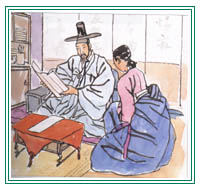
|
[The delivery
of the Sajoo]
When they send a Sajoo, the
host of the bridegroom-side
gets up early in the morning
and tells the Sadang to deliver
a letter to the bride-side.
In the bride-side a host who
is in full dress receives politely
the letter from the bridegroom
on a small dining table. The
host also tells the Sadang with
the letter. Then the host writes
a reply letter and gives the
man who took the letter a cordial
reception. Also the host of
bridegroom-side tells the Sadang
to deliver a reply letter to
the bridegroom-side. |
 Sajoo Sajoo
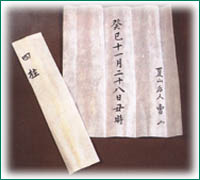
|
It folds a white paper-its
length is 40cm and width is
28cm- into five leaves and writes
date and time of the birth by
the sexagenary circle in the
middle of the white paper. That
is called a Sajoodanja. Then
he puts it into a white envelope
and folds the back of the envelope
without a seal. A Sajoo envelope
is cut longer about 1 cm more
than the length of the envelope
in up and down. Then he holds
it in a gap of the branch of
a Ssari tree and ties it up
from it's top without a knot
with red and blue Talea threads
as a picture on the right hand
side. After that he packs it
up with Sajoo-wrapper, put it
around a belt which he writes
a word, Geunbong, on the belt.
|

|
This is a Sajoo which
is wrapped with red and blue
cloth wrappers.
|
 A Sajoo
wrapper
A Sajoo
wrapper
|
Wrap Sajoo up in a
square silk wrapper in which
the outside is red and the inside
is blue. Golden color threads
are put up in four corners of
a Sajoo wrapper. |
The
Nabchehmoon 
The
Nabcheh is sent th the bridegroom's house
with the Sajoo, and put it a red wrapper.
This is the first stage to proposing a marriage
with good procedure.
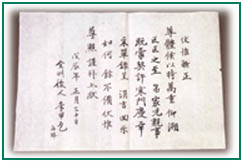
|
<Type>
Happy
New Year how is your health?
I am very thankful that you
accepted our proposal, it has
brought happiness to our house-hold.
I am sending a Sajoodanja so
could you decide the marriage
date and reply. We were unable
to be polite.
Sincerely,
Bride's
family
|
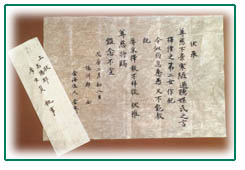
|
The
reply letter from bride house
to bridegroom house.
<Type>
You
have approved my __daughter
as your son's bride, who is
not smart, who is dull, who
is doesn't have much education.
You have trusted the matchmaker
words and not rejected our low
family with much love. How can
I not follow the arrangements
that has been made? Can you
please be thoughtful to our
family.
With
generosity
yy/mm/dd
(village)
sending
person |
The
Youngil
It
is a formality that the bride-side receives
the Sajoo, writes a wedding date on a white
paper and sends the Youngil letter with
the white paper to the bridegroom-side.
The bridegroom-side receives the Youngil
letter sends a Ewheejejang to bride-side.
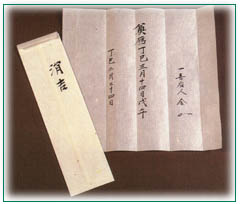
|
The
Youngil and an outside envelope
|
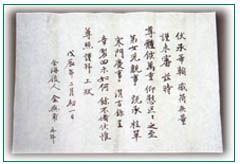
|
The
Youngil letter
<type>
I
am very thankful and pleased
of this lette that I have receved.
How have your health been? My
daughter has already received
Sajoodanja, which has brought
pleasure to our house hold.
We have already arranged a wedding
date. Please inform me of the
bridegroom's suit size.
Sincerely
Bride's
family |
|
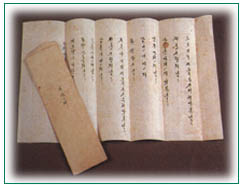
The
Ewheejejang
The bridegroom-side
which receives the Youngil letter
writes a length and a width
of the bridgroom cloth on a
paper. This paper is called
the Ewheejejang. This formality
is called Jangjephoisi. When
they send the Ewheejejang, they
inclose a letter in the Ewheejejang.
The envelope is same the envelope
of the Sajoodanja. They write
a word, Ewheejedongbong, on
the front of envelope. |
|