| ||||||
| | | ||||
|  | | ||||
| | | ||||
| |
|
Known World
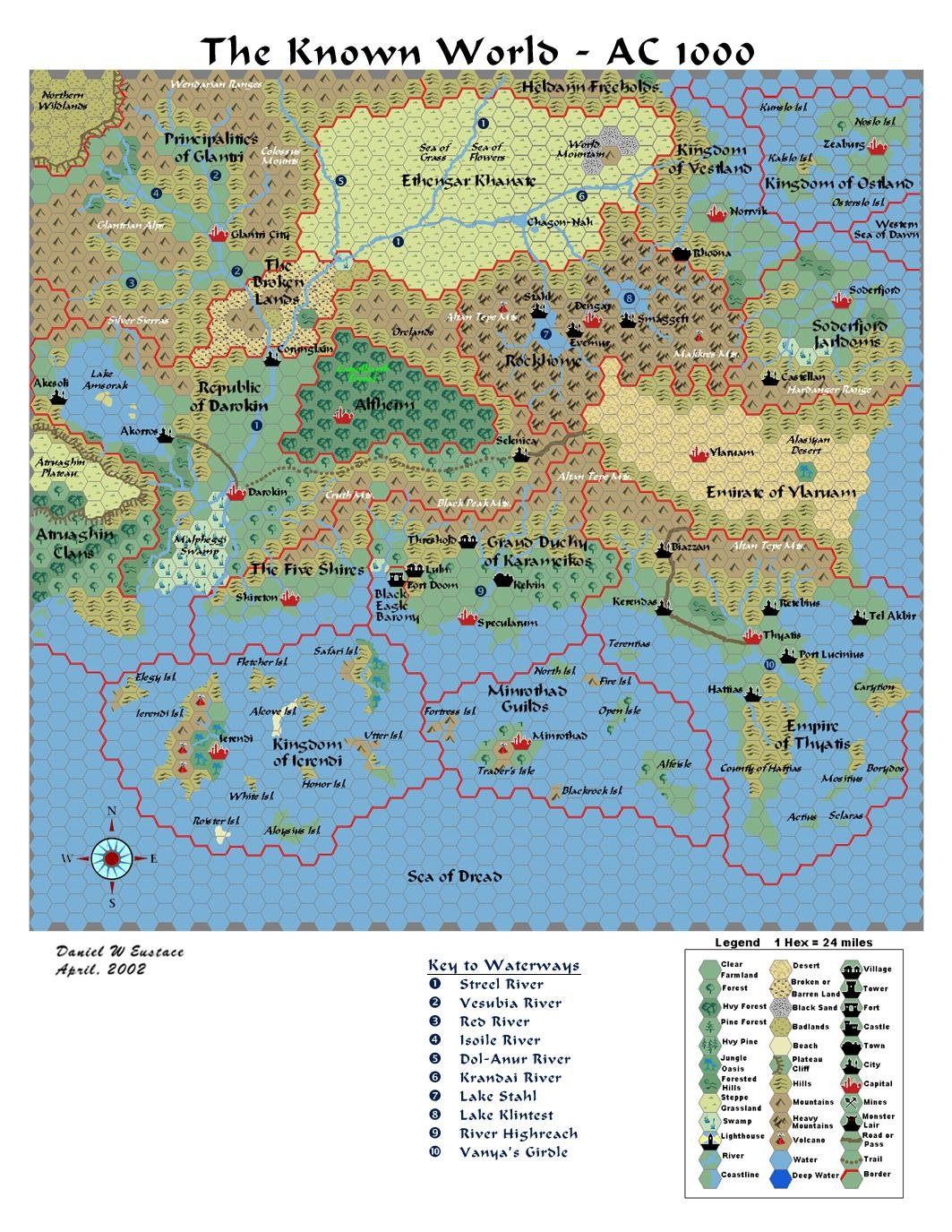
Atrughin (The Clans of the Plateau)South and west of Darokin the land rises in a sudden plateau with cliffs a half-mile high. This fertile plateau serves as the home of the Atruaghin peoples, a group similar to several of Earth�s native American cultures. Government: The Atruaghin peoples are broken down into several clans, each with its own territory and culture. The clans break down into smaller tribes, and tribes into individual families. Most easterners are familiar with the Bear Clan, which has the most dealings with Darokin and the world beyond. Languages: Each clan has its own language, but the most common, due to trade, is the Bear Clan tongue. Coinage: Most Atruaghin tribesmen have no need for money, trade being accomplished through barter. What few coins are used include the cloud (worth 5 sp) and the land (cp). The old ruins on the plateau and in the jungles at its southern foot do yield gold, but it is not valued beyond its decorative nature. Visitor Information: Most of the Atruaghin Plateau is unknown and unexplored by the nations to the east. The plateau is accessed by an ingenious �world elevator� constructed by the Bear Clan in conjunction with Darokin traders. A horse-powered winch draws a large platform (capable of carrying two wagons) to the top. It is this �world elevator� which has opened Atruaghin to the outside world. Unfortunately, this wonder of the world recently sustained damage and is currently under repair. Things to Remember: Atruaghin society is primal but not necessarily primitive, and it can be as perilous and intricate as the trading halls of Darokin and the court of Karameikos. As always, observe local customs, and be prepared to be treated as a curiosity. Darokin (The Kingdom of Gold)Darokin is Karameikos�s northern neighbor, and caravans regularly come down from Selenica, Darokin�s westernmost city, along the King�s Road into Karameikos. Darokin is the most mercantile nation in the Known World, and their traders are recognized far and wide for their sharp dealing and glib sales pitches. Once a peaceful, profitable nation, Darokin has now come under attack from pirates in the south, desert fanatics from the west, orcs from the Broken Lands in the north, and shadow elves in the east. Government: Darokin is a republic, at least on paper. In reality it is a plutocracy, where money talks and the golden rule is in force (�He who has the gold makes the rules�). The head of the Merchants� Council is a human named Corwyn Mantua, but most decisions are made with an eye toward the bottom line and how it will profit Darokin and its burgeoning merchant class. Languages: The common language is Thyatian, as it is in Karameikos, although the natives refer to their dialect as Darokinian. Coinage: The Darokinian gold piece is called a daro, its silver piece a tenrid, and its copper piece a passim. Darokin mints an electrum piece called a half-daro. Visitor Information: Darokin�s capital is located in the heart of the country and at the center of a web of major mercantile cities connected by good roads. While smaller than Mirros, Darokin City seems more bustling, active, and generally wealthier than the Karameikan capital. Darokin has a large middle class, and all within it try to advance their own ends. The nation of Darokin is made up of bits that have been unclaimed by other nations, and as a result sprawls over a vast amount of terrain, though most of its border expanses remain wild and uncontrolled. Things to Remember: Bring money. After making a deal with a Darokinian, count your change, your fingers, and the members of your party. Darokin is in no way as safe and secure as its prized Diplomatic Corps lets on. The natives of Darokin are as plotting and dangerous as their Glantrian neighbors, but they are more pleasant about it. Ethengar (Kingdom of Horsemen)Ethengar occupies a huge, grassy plain to the north of Darokin and to the east of Glantri. It is stark, open country occupied by powerful, dangerous horsemen whose culture resembles that of the Earthy Mongols of Genghis Khan. Government: Ethengar is a khanate � a loose federation of nomadic tribes led by chieftains, occasionally gathered (as they are at the present) under the command of a greater chieftain (a great khan). Often the various tribes war against each other when they aren�t fighting the Heldannic Knights, Ostland troops, or Glantrian wizards. Languages: The horsemen of the plains speak Ethengarian, an unrelated tongue to those of their neighbors, attesting to the fact that Ethengarians originate far from this area. Some speak Thyatian. Coinage: The Ethengarians use a variety of specialized coins called tangs, which are trade bars minted in gold, silver, copper, electrum, and platinum, and in 1-, 5- and 10-coin denominations. Greater denominations bear the mark of the great khan. Possession of �outsider� currency is punishable by death. (A lot of things involving outsiders are punishable by death.) Visitor Information: In the middle of Ethengar lies the Land of the Black Sand, dark, sinister badlands haunted by foul monsters and ripped by flesh-rending storms. In its center towers the fastness of the World Mountain, a singularly massive spur of stone dominating the blasted landscape around it. Here, the khans of the Ethengar people are interred, watched over by powerful spirits. Needless to say, this area is taboo, and trespassers are slain. Things to Remember: On the surface, Ethengar seems inhabited by savage, bloodthirsty, dangerous horsemen. Upon examination of their culture, however, one is struck by the fact that these deeply spiritual, reverent people live in harmony with their harsh, windswept land (and happen to be savage, bloodthirsty, and dangerous.) The Five Shires (The Hin Nation)The Shires are the home of the halfling people, also called the hin. Bright, adventurous, and intelligent, the hin generally have striven to live in peace with their neighbors. Government: A clan leader rules the hin in everyday matters. Each of the shires elects a representative sheriff, and the five sheriffs determine national policy. Such policy usually begins and ends at protecting hin interests throughout the Known World. Languages: The common language is Thyatian, in the Darokin dialect. Elders of the people speak an archaic tongue called Lalor. Coinage: The hin gold piece is called a yellow, its silver piece a star, and its copper piece a sunset. Simple names for items suit the hin people well. Visitor Information: The land resembles that of Karameikos, though a little more civilized, and the hin face the same problems as their neighbors (pirates from the sea, orcs from the mountains). Small farming communities dot the area. Things to remember: The hin are childlike, but not childish. They take pleasure in many common things and simple activities, but if angered prove to be tenacious and savage opponents. Don�t cross a hin unless you plan to leave the country immediately � imagine a nation of small pranksters who have all decided to get even with you simultaneously. Glantri (The Kingdom of Magic)Located to the north and west of Karameikos, beyond Darokin and the Broken Lands, Glantri is a magocracy - that is, a kingdom ruled by wizards, for the benefit of wizards. Glantrian wizards consider other classes and races inferior, particularly dwarves and all manner of priests, both of whom locals actively persecute. Most people in the Known World consider Glantrian mages the most advanced and powerful of all, while viewing Glantrian politics as Byzantine and treacherous. Government: Glantri is divided into principalities - small princedoms in which the prince�s rule is law. Humans (at least, most of the rest of the world hopes they�re humans) rule the majority of these principalities, but there are elves, lycanthropes, and even a kobold in charge as well. The rulers all have magical abilities and sit on a central council. Languages: The common language is Thyatian, as is the case in Karameikos, but Ethengarian, Traladaran, and Alphatian are spoken here as well. Coinage: The Glantrian gold piece is called a ducat, its silver piece a sovereign, and its copper piece a penny. Its platinum piece is known as a crown. Visitor Information: Glantri City is the largest community in the nation and is about the size of Mirros. Unlike Mirros, Glantri City was built over a swamp, such that the city is criss-crossed by canals and the gondola is the easiest method of transportation. Glantri City is also the nation�s seat of government and magical research. Things to Remember: Mages rule here, and furthermore they are everywhere; one cannot toss a small stone without striking a wizard, a familiar, or a magical creation. Magic is the national industry, but politics is the national passion. Everyone has an angle and very few have qualms about sacrificing their allies to reach their ends. The Heldannic Territories (Land of the Knights)Originally a group of Antalian Freeholds similar to the neighboring Northern Reaches, the territory was conquered by a group of Thyatian refugees from the island of Hattias who were too intolerant and violent for the Thyatian government�s tastes (which is saying a good deal in itself). These Heldannic Knights rule the territory with an iron hand, and they are always looking for new peoples to oppress. Government: The Heldannic Knights form a theocracy devoted to Hextor. They believe that Hextor has special plans for the transplanted Heldannic people, plans that involve world domination and subjugation of all non-Hattian peoples. Their high priest (and general villain) is Herr Wulf von Klagendorf. Languages: The common people speak Antalian, a dialect they call Heldannic. The language of court, trade, and war is Thyatian. Coinage: The pre-invasion coins of the Heldannic people have been confiscated, and their ownership is grounds for imprisonment. The official coins are the groshen (a 5-gp coin), the gleder (gp), the erzer (ep), the markshen (sp), and the fenneg (cp). All carry the face of Vanya on one side and the knights� black lion rampant on the other. Visitor Information: The Heldannic territories are among the most beautiful in the Known World - rolling hills and mountains covered with thick cloaks of pine and spruce and filled with wildlife like elk, moose, and wolf. Unfortunately, at the heart of this beauty is the rot of the Heldannic Knights, holed up in their main city of Freiburg. Freiburg, a gloomy, tightly-packed city of winding streets, lies tucked behind the mightiest walls in the Known World. Things to Remember: The Heldannic Knights are racist fools, but they are the racist fools in charge. How bad are they? The Black Eagle Baron�s niece, Anna von Hendriks, belongs to their number, and she is old Ludwig�s favorite niece. Give this place a miss unless you have a sure-fire plan for revolution or a taste for martyrdom. Ierendi (The Kingdom of Islands)Situated to the south and west of Karameikos, Ierendi is a loose confederation of islands, each with its own personality and attitudes. A chaotic coalition, the nation pulls together when threatened by outsiders. Government: Ierendi holds a yearly tournament, and the winner becomes the king or queen of the kingdom for the next year. Most of the real power rests in the hands of a bureaucracy and the local government, but choosing a new king remains a great excuse for a celebration. Languages: Most Ierendi speak Thyatian, with the halfling population using the Darokin/Five Shires dialect. The original language of the isles is Makai, still spoken by the long-time natives. Coinage: Ierendi loves foreign currency, and the locals themselves mint the pali (10 gp), the geleva (gp), the sana (sp), and the cokip (cp). Visitor Information: Ierendi thrives on a tourist trade, of all things � visitors from other nations come to Ierendi for fun, adventure, and the feeling of danger. Note the use of the word feeling � most of these visitors from Darokin, Karameikos, or Thyatis could find real danger not more than 20 miles from their houses, but in Ierendi adventure supposedly takes place in generally positive environments. The main event each year is the grand tournament for the crown. It is heavily weighted in favor of the warrior class, and the winner rules in the great, indefensible coral castle of Ierendi, throwing parties, making announcements, and generally being kept away from the mechanisms of real government. Things to Remember: Have fun. Ierendi is one of the most beautiful and leisurely places in the Known World. That is not to say it is without peril, but the dangers at least look good. Minrothad (The Kingdom of Sea Princes)Situated to the south and east of Karameikos, Minrothad is an organized coalition of seagoing merchants whose reach spans the Sea of Dread and the Sea of Dawn, some of their agents reaching as far west as the Red Steel lands. Government: Like Darokin, the other major trading nation, Minrothad is a plutocracy, ruled by the wealthier classes. Unlike Darokinians, the people of Minrothad have dispensed with the illusion of republican thought, and most power rests in the hands of an elected (for life) Guild Master. The current Ruling Guild Master is Oran Meditor. Languages: Most languages are spoken on the isles of Minrothad, including Thyatian. Among themselves and their crews, the natives of the islands speak a patois called Minrothaddan, made up of sentence fragments and structures cheerfully looted from their trading partners to the point of becoming a completely separate language. Coinage: Minrothad mints its own crona (a gp in the isles), the byd (ep), the quert (sp) and the plen (cp). Visitor Information: Citizens of Minrothad live for trade and trade to live. The seat of government is the city of Minrothad on Trader�s Isle, a bustling den of commerce and intrigue. Things to Remember: As in Darokin, money talks, but mere gold does not buy a place among the Minrothaddan merchant princes. The natives of Minrothad remain clannish and suspicious of strangers who pry too much. Ostland, Vestland, and the Soderfjords (The Northern Reaches)The nations of the Northern Reaches are located north of Ylaruam and Rockhome, along the coast of the Sea of Dawn. These three independent nations share a common ancestry, and as such may be considered together. All are dominated by the Antalians, who are similar in appearance and behavior to the Vikings of Earth. The people of Ostland are the most traditional (bloodthirsty), those of Vestland the most forward-thinking (western), and those of the Soderfjord Jarldoms the most chaotic (treacherous). Government: All three nations are monarchies, and both Vestland and Ostland trace their roots to a common ruler. The Ostland crown is heavily influenced by a traditional religious hierarchy. The Soderfjords are a collection of smaller competing baronies (or jarldoms) that choose one of their number as the war-leader or jarl � a thankless position that usually lasts only as long as the lesser jarls so choose. Languages: The common language uniting the Northern Reaches (and separating them from the more "civilized" south) is Antalian. There are some speakers of Thyatian common as well, primarily among the merchant class of Vestland. Coinage: All the nations of the Reaches mint their own coinage. In Ostland, it is the krona (gp), eyrir (sp) and oren (cp). In Soderfjord it is the markka (gp), penne (ep), gundar (sp), and oren (cp). In Vestland, they use the schilder (5 gp), guldan (gp), hellar (ep), floren (sp), and, of course, the oren (cp). Visitor Information: The Northern Reaches are strongly dedicated to a group of deities with names and attributes similar to the Norse Pantheon. Things to Remember: Natives of Vestland are the most forward-thinking and trade-oriented, and are usually the ones encountered away from the Reaches. The natives of Ostland are a bit savage (they only recently banned the practice of thralldom (enslavement of defeated enemies). Those of Soderfjord would be dangerous if they didn�t spend all their time quarreling among themselves. Rockhome (The Kingdom of the Dwarves)The homeland of the dwarves is nestled among the Altan Tepes Mountains north of Karameikos. Most of the dwarves of the Known World can track their ancestry back to this land. It is noted for towering peaks, ice-cold lakes, and great underground cities full of dwarves. Government: A dwarven king or queen rules Rockhome, heavily influenced by the powerful dwarven families or clans that operate through a senate in the Thyatian style. The current king is Everast XVI, newly enthroned. The passing of power involved a nasty civil war among the dwarves, and some resentment between the clans continues. Languages: The common language is dwarvish, with a Rockhome accent (though one would have to travel far to find a different accent). Merchants and surface humans also speak Thyatian. Coinage: The Rockhome gold piece is called a trader, its silver piece a moon, and its copper piece a stone. The dwarves also use a heavy, 10-gp gold coin called a sun. Visitor Information: Dengar is the dwarven capital built at the base of Mount Everast. It is separated into upper and lower cities, the upper region being a heavily fortified surface community, with the real power (and the bulk of the population) located in the caverns of Lower Dengar. Things to Remember: The dwarves run things here, so be prepared to do things on dwarven terms. The dwarves value craftsmanship, honesty, and family honor. They do not respect farmers or wizards (particularly Glantrian wizards). Do not admit to being either, even if it�s true. Sind (Kingdom of the Wastes)The western border of the civilized world, Sind is a relatively unpleasant land of salt swamps, deserts, and rocky wastes. Its population moved in and thrived during more pleasant times, and as a result packs itself tightly in teeming cities. The culture of Sind resembles that of Earth�s early Indian subcontinent. Government: Sind is currently under the control of a despot from even further west known as the Master of Hule. Under the Master�s directions, raids by lands and sea based out of Sind continue to assail western Darokin. Languages: The language of the Sind is Sindhi, a melodious, lilting tongue. Some traders speak Thyatian as well. Coinage: The Sind people mint a number of coins, including the guru (25 gp), the rupee (5 gp), the bhani (2 ep), the khundar (sp), and a piaster (cp). Visitor Information: Most interesting about Sind is not its overpacked cities or Hule-dominated government, but what lies farther west. Beyond the Sind Desert and the Plain of Fire sprawl the mythical lands of the Red Steel. Beginning with the mighty city of Slagovich and moving west, this region harbors great heroes and mighty magic. News comes infrequently from Slagovich, but what news does come brims with wondrous adventure and terrible monsters. Things to Remember: Sind is a dangerous, deadly place, made more so by the agents of the mysterious Master of Hule. Be polite, keep to well-traveled areas, and expect to defend yourself against thieves. Thyatis (The Empire)Thyatis has been a major player in the Known World for over a millennium, such that the official reckoning and common language throughout most of the land is Thyatian. Thyatis has had a knack for conquering various territories and then letting them get away. Government: An emperor rules Thyatis, kept in check by an elected senate. The recent death of Emperor Thincol I and the ascension of his son Eusebius I has thrown the traditional alliances in disarray, and Thyatian senators spend much of their efforts trying to get on the new emperor�s good side. They would do more good dealing with plagues, famines, and riots within their home territories, but their political foolishness is making a bad situation worse. Languages: The common language is Thyatian, but all tongues are heard within its borders. Coinage: The Thyatian gold piece is called a lucin, its silver piece an asterius, and its copper piece a denarius. Thyatis also mints a platinum coin worth 5 gp called an emperor, which is recognized in Karameikos as legal tender. Visitor Information: The heart of the empire is the city of Thyatis, which alone has a greater population than the nations of either Glantri or Karameikos. A huge, sprawling urban settlement barely contained within its great city walls, it boasts some of the most beautiful architecture and some of the most violent slums of any nation in the Known World. Things to Remember: Everything bad you�ve heard about Thyatians in Karameikos applies here in reality. They are corrupt, decadent, faddish, extremely pragmatic, and treacherous. Remember, the original Thyatian invaders of Karameikos were seeking to get away from this place. Wendar (The Elven Kingdom of the North)Tucked beyond the borders of Glantri and Ethengar, it has the otherworldly nature of a land still under the control of elven magics. Government: Wendar is a monarchy in the traditional elven manner. Gylharen the Wizard-King rules this land. Languages: The common language of Wendar is elvish, either with the native Wendarian dialect or that of Alfheim. Coinage: The elves of Wendar use the di (gp), the on (sp), and the teci (cp). Visitor Information: Until recently, Wendar had been forgotten by other nations of the Known World, due to its very remoteness. Things to Remember: If you�re an elf, you are welcomed as long lost kin. If you�re human, be very polite. A lot of warrior/wizards live in Wendar. Ylaruam (The Desert Kingdom)An arid region of rocky badlands and sandy wastes to the north of Thyatis and Karameikos, Ylaruam is the home of a proud desert-dwelling race of humans similar to the Earthly Bedouins of Arabia. Government: A sultan rules Ylaruam, advised by a grand vizier, who in turn oversees a large, organized bureaucracy of departments called voucheries. Ylaruam is divided into emirates to facilitate easy control of these voucheries. Unlike the bloated and corrupt bureaucracy of Thyatis to the south, the Ylari bureaucracy is well organized, devoted, and efficient. Languages: Ylaruam�s court officially speaks Ylari, the tongue of the native people. Many also speak Thyatian, but be warned - this is the language of one of the empires that historically oppressed and warred with the desert peoples. Coinage: The Ylari gold piece is called a dinar, its silver piece a dirham, and its copper piece a fal. Visitor Information: The most important site in Ylaruam is not the map, but in the heart. The natives of Ylaruam overthrew their colonial masters under the leadership of a great philosopher and warrior named Al-Kalim, who has since become a deity. Al-Kalim�s words, the Nameh, have become the guiding principles of his people, and encourage devotion, loyalty, honesty, and bravery. Even the oasis capital of Ylaruam pales before the shining example of Ylari belief. Things to Remember: Be polite and observe local customs. The Ylari respect storytellers, warriors, and scholars. They dislike mages, particularly Glantrians (there�s a pattern developing here) and those who use fire-based magics. Ylari hold grudges a long time so be prepared for retribution should you anger one.
|
| |
|
| | | ||||
| ||||||