|

Home
Birding
NCTX Hotspots
RBA
Maps
Photos
Cool Birds
Checklists
Books
Links
AZ Trip Report
Dallas
Audubon
Ft.Worth
Audubon
Prairie
& Timbers Audubon
Tall
Grass Prairie Audubon
TOS
TBRC
TPWD
North
Central Texas Birds

 Since
1/9/02 - 6/24/00 Since
1/9/02 - 6/24/00
Old Birding Texas website had 4014
visitors from 9/26/98 to 6/29/00
Send questions and comments to [email protected]
Golden-cheeked Warbler photo by Greg
Lasley
| |
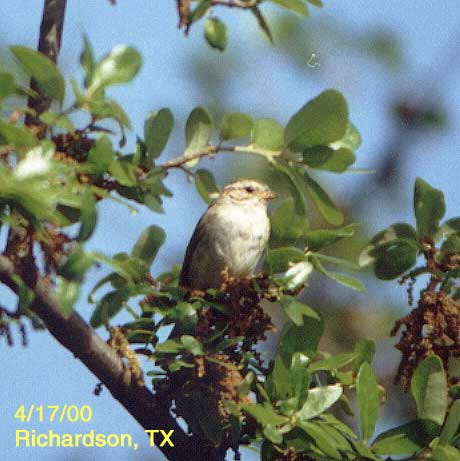
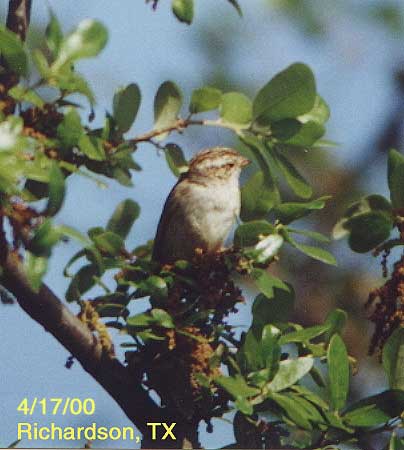
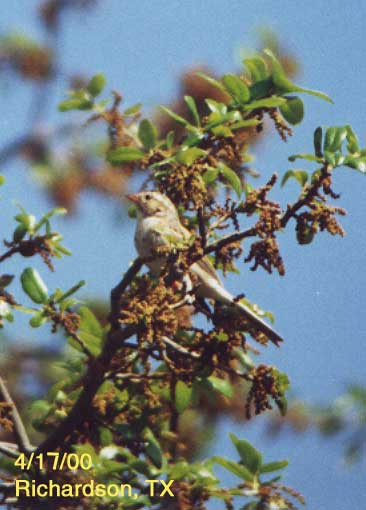
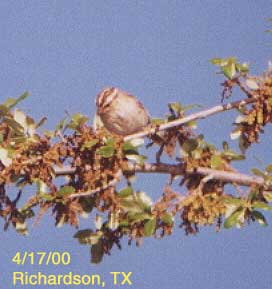
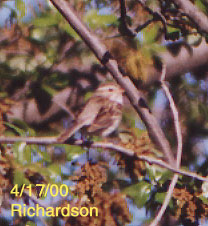
Mystery Spizella
This Spizella sparrow was photographed 4/17/00. What do you think it is: Brewer's or Clay-colored? A hybrid has been suggested,
such as Brewer's x Clay-colored, Clay-colored x Chipping, and even Chipping x Brewer's. Two sources claim that Clay-colored and
Brewer's may hybridize occasionally, but unfortunately I can't find any info on how to distinguish a hybrid.
E-mail comments to Derek Hill.
Face pattern was much duller than any Clay-colored I've seen, although this bird did have a narrow white median crown stripe on the
front half of the crown. Towards the back half it turned gray and blended in. In my previous experience with Clays, they have very
contrasty face pattern, with a big gray nape patch and some buffy at least on the sides of the breast. This bird had a much duller
face pattern. Sides of neck had small indistinct grayish areas, and nape was dull brown with fine dark streaking. Through binoculars,
I couldn't distinguish any dark lower border to the auricular patch, and the malar wasn't any whiter than the rest of the dingy grayish
white underparts. Postocular stripe was dusky or brown, relatively indistinct through binoculars. Eyebrow was dull gray-white, with
some very fine dusky smudges invading the eyebrow behind the eye. No buffy on the breast or flanks or anywhere else on body.
Plumage very dull and sandy. Rump is quite gray.
There were usually around 3 Chipping Sparrows sharing the same tree with this mystery bird. They were all in definite breeding
plumage, and all had conspicuously bright rufous upperparts (mantle, wings, etc), while the mystery bird had much duller gray-sandy
upperparts. The mystery bird even seemed a tad slimmer than the Chippies.
Song was odd. Different from books and CD's. I described it in my notes as:
At least 12 soft, varied buzzes and rattles, on varying pitches. Quality almost like a European Starling. Also gave a rapid
series of sharp chip notes...Maybe up to 20 buzzes and rattles, no two consecutive notes on same pitch. Also a series of high metallic
chatter. I observed the bird for 3 days, and it sang quite frequently.
|
