|
|
|
Old Birding Texas website had 4014 visitors from 9/26/98 to 6/29/00 Send questions and comments to [email protected] Golden-cheeked Warbler photo by Greg Lasley |
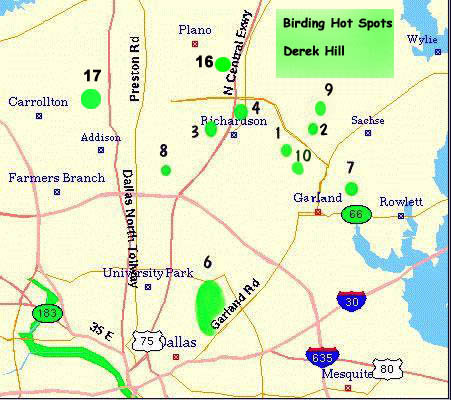
North Central Texas Birding Spots Updated 10/27/01 Click on a green numbered area in the map or select from the list below Right
click here to download a Microsoft Word
version
Rowlett Creek Preserve is a large park of various
habitats. Cyclists usually crowd the woodland paths, so it is best to stay off
of them. Redneck 4-wheelers sometimes drive through the fields, beware. This is
a good spot year round. Sparrows and hawks can be common during winter, with
Fox, Song, Harris's, Lincoln's, White-throated, Dark-eyed Junco, and Spotted
Towhee. I have seen both Barred and Great-horned Owls here. Migration is nice
too, with the usual warblers and vireos. During fall, this is the most reliable
spot for Mourning Warblers I know of. You can find them in the forest or
in the Osage-Orange clumps in the field northeast of the parking area. Baltimore
Orioles can also be very common during migration. I saw a flock of 25 on 9/4/97
in the osage-orange field. Best times to visit: September for Mourning Warblers,
late October to March for sparrows and winter residents, and May through
September for buntings, cuckoos, and other breeders.
To get there - Rowlett Creek Preserve is located at the
intersection of E. Centerville Road and Castle Drive, just north of Hwy 66, and
just south of Northeast Parkway.
Arapaho Park is a narrow cottonwood/willow
riparian area, which is very attractive to migrants. I have seen several species
of warblers here, including Blackburnian, Magnolia, Mourning, Nashville,
Wilson's, Black-throated Green, Yellow-breasted Chat, and the very common Yellow
Warbler. Look in the willows for the warblers; they generally stay out of the
cottonwoods. Other species I have seen here include Philadelphia, Blue-headed,
Red-eyed, and Warbling
Vireo, Clay-colored Sparrow, Baltimore and Orchard Orioles, Olive-sided
Flycatcher, Painted and Indigo Bunting, and others. Empidonax flycatchers are often
abundant during spring and fall migration. Arapaho Park is located off Meandering
Way, south of Arapaho Road, north of Beltline, and west of Coit.
Breckinridge Park is a large park consisting of
mostly soccer fields with a nice concrete path going around it. It is beautiful
in spring when there are fields of colorful wildflowers. When there is a
combination of rain puddles and shorebird migration, there are sometimes several
sandpiper species around the soccer fields. I have seen several Upland
Sandpipers walking around the soccer fields during migration, also. Warblers can
be good too. I have had Bay-breasted, Yellow, Nashville, Tennessee, and others.
Other migrating species here include Rose-breasted Grosbeak, Scarlet Tanager,
Indigo Bunting, and American Pipit. In winter I once saw a very large flock of
sparrows with up to 50 Harris' and 30 White-crowned. Eastern Bluebirds can be
numerous also, and I have seen Pine Warblers associating with these flocks.
Other winter residents include American Goldfinch, Brown Creeper, Eastern
Meadowlark, Dark-eyed Junco, Yellow-bellied Sapsucker, both kinglets, and
Sharp-shinned Hawk. There is a small lake which sometimes holds Blue-winged
Teal, Short-billed Dowitcher, Pied-billed Grebe, Double-crested Cormorant, and
huge flocks of Ring-billed Gulls.
Winters Park is a school and soccer field complex
with a nice wooded area behind it. Sparrows can be good, with Song,
White-throated, and Fox. Other winter residents include Yellow-bellied
Sapsucker, Northern Flicker, both kinglets, Hermit Thrush, Brown Thrasher, Cedar
Waxwing, Yellow-rumped Warbler, and American Goldfinch. I have seen Red-breasted
Nuthatch and Harlan's Hawk here also. Sharp-shinned and Red-tailed Hawks are
usually cruising through the open areas, searching for birds and mice. This park
may be worth a look during spring migration.
Hagerman National Wildlife Refuge is roughly an hour's drive north of Dallas, located along Lake Texoma on the Red River. Hagerman is well known for its large numbers of wintering ducks and geese, including White-fronted, Snow, Canada, and Ross's Geese. This is the best spot around to find Ross's Geese, where you can often find flocks with dozens of them. Sometimes they'll mix in with the Snow Geese, but usually they stick together in their own flocks. Loons, Hooded and Red-breasted Mergansers, scoters, and many other duck species use the lake in winter. Lake Texoma also has a good population of wintering Bald Eagles. In the surrounding fields and agricultural land, look for longspurs, Harris's Sparrow, Le Conte's Sparrow, and others during winter. Shorebirds are numerous during migration along the lake's mudflats. Least Tern, Grasshopper Sparrow, Prothonotary Warbler, Painted Bunting, Scissor-tailed Flycatcher, and many other species nest here. During the winter and early spring of '99-'00, the first Great Kiskadee recorded in North Central Texas stayed here, attracting many birders. The Refuge is open from dawn to dusk. Office hours 7:30am to 4:00pm weekdays. From Dallas, go north on US 75 to Sherman – FM 1417 exit, then north 13 miles on 1417 to refuge sign, and left 6 miles to Refuge entrance Hagerman NWR Headquarters - 6465 Refuge Road, Sherman, TX 75092. Phone # 903-786-2826.
12. Village Creek Drying Beds & Village Creek stirring tanks, Arlington
Village Creek Drying Beds was once one of the greatest spots in Texas for migrating shorebirds. Nowadays the ponds sometimes go dry and overgrown with plants, but still attract good numbers of migrating shorebirds and wintering waterfowl and gulls. A good percentage of rare birds reported in North Central Texas have been from Village Creek. A few highlights include Ruff, Sharp-tailed Sandpiper, American Black Duck, Barrow's Goldeneye, Whooping Crane, Common Ringed Plover, Mew, Little, California, Black-headed, and Thayer's Gulls, and Red Phalarope. Le Conte's Sparrows and Sedge Wrens are sometimes seen in good numbers. Virginia, King, and Sora Rail migrate through regularly. Most of the rare gulls are at Village Creek Headquarters stirring tanks, just down the road from the drying beds. The Village Creek Headquarters and stirring tanks are probably most well known for hosting one or two Black-headed Gulls for the past several winters. Bonaparte’s and Ring-billed Gulls often swarm around the nutrient rich sewage tanks. Village Creek Drying Beds and Village Creek Headquarters/Stirring Tanks are separate facilities but both are located along Green Oaks Blvd. in Arlington, just north of I-30. From Dallas, go west on I-30 past Six Flags, exit north at Fielder. Follow Fielder north until it stops at Green Oaks Blvd. To get to the drying beds turn right onto Green Oaks less than a mile and the entrance is on the left. The drying beds are just west of River Legacy Park. To get to the Headquarters/stirring tank from Fielder, turn left onto Green Oaks and drive a little ways until you see the Village Creek headquarters. Click here for the Village Creek website. River Legacy Park lies just east of Village Creek Drying Beds, along the West Fork of the Trinity River. Concrete and dirt trails offer excellent woodland birding. Songbird migration here is excellent. A pair of Broad-winged Hawks successfully nested along the river in the summer of 2000. To get there follow Green Oaks Blvd. just east of Village Creek to the park entrance.
13. LBJ National Grasslands, Decatur
LBJ National Grasslands is one of only two National Grasslands in the state of Texas. It is located north of Decatur, in Wise County. Habitat is mostly prairie, scrubby post oaks, and rocky ridges. Lark Sparrow, Grasshopper Sparrow, Painted Bunting, Blue Grosbeak, Summer Tanagers, and Broad-winged Hawk nest here. Cassin's Sparrows nest here also, a species that can be hard to find close to DFW. Greater Roadrunner, Bobwhite, and Wild Turkey can be seen along the dirt roads. Recently, park personnel have organized Black-capped Vireo surveys throughout the grasslands. Although this species has never been seen here, the habitat is good and some people suspect they might nest here. White-eyed Vireo is a common summer resident. LBJ Grasslands is also a good spot for finding snakes and lizards. Prairie wildflowers here are amazing.
14. Ray Roberts Lake State Park, Denton
The section of Ray Roberts Lake State Park that I usually visit is actually closer to Lewisville Lake. There is a nice parking lot and trail, just on the north side of highway 380 about 5 miles east of Denton. The wide dirt trail follows the Elm Fork of the Trinity River through great bottomland hardwood forest, with some of the most gigantic trees I've seen in North Central Texas, especially cottonwoods. Unique summer residents include nesting Northern Parula, Prothonotary Warbler, Black-and-white Warbler, White-breasted Nuthatch, Red-headed and Hairy Woodpeckers, Warbling, Red-eyed, and White-eyed Vireos, Indigo and Painted Buntings, Summer Tanagers, and Red-shouldered Hawks. The breeding Parulas and Prothonotary warblers are pretty common and conspicuous as long as you can recognize their songs to find them. There is a fee of $3 (I think) that you’re supposed to deposit in a lock box before you walk the trail, but there are no park personnel to enforce the fee. There are restrooms near the parking lot.
15. Lake Tawakoni, Rains/Van Zandt Counties
Lake Tawakoni is roughly an hour's drive east of Dallas. Most of the birding is usually done along FM 47 which runs along the dam at the south end of the lake. During winter, this is the only reliable spot in Texas to find Smith's Longspur. There are two different areas where they usually hang out - the grassy airstrip below the north end of the dam, and also in the overgrazed cow pasture at the end of FM 1475. Flocks of Lapland Longspurs fly over periodically, and should be found in the surrounding fields. Bald Eagles can also be seen along the dam in winter. Loons can be very numerous off the dam, sometimes with dozens of Common Loons. Pacific and Red-throated Loons show up every winter, but are rare. Just about every duck species expected in North Central Texas can be found at this lake during winter. There is usually a good size flock of Red-breasted Mergansers along the dam. Horned and Eared (uncommon) Grebes are also winter residents. Many rare birds have been found at the lake, including Snow Bunting (winter '99-'00), Western and Clark’s Grebes, Long-tailed Duck, Black Scoter, jaegers, Red-necked Grebe, Black-headed Gull, Black-legged Kittiwake, Sabine's Gull, Glaucous Gull, and Rock Wren. Le Conte's Sparrow and Sedge Wren can sometimes be found in good numbers in the grassy fields around the lake. Henslow's Sparrow has been found several times but is rare. Pileated Woodpecker is sometimes found in the woods below the spillway. Another good spot to scan the lake is Holiday Marina, just a little south of the dam off 47 - there is a sign by the side of the road pointing towards the marina. To get to Lake Tawakoni from Dallas, you can drive east on Hwy 80 to the small town of Will's Point, then go north on 47 for several miles to the dam.
16. Connemara Conservancy (map)
Connemara in Allen is 72 acres of prairie and riparian woodland habitat. There are extensive concrete trails. Dickcissels and Indigo and Painted Buntings nest there. I’ve also seen Blue Grosbeaks here, and it’s possible they nest. The habitat looks good for wintering sparrows and migrant passerines. To get there from Dallas, go north on US-75 to Legacy exit. Go west on Legacy for 1.3 miles to Alma. Turn right (north) on Alma and go for 1.5 miles to Hedgecoxe Drive. Go turn right (east) on Hedgecoxe until ends at the entrance to Connemara. Another route is going north on Alma to Tatum Road, a small dirt road on the right. You can bird along Tatum Road.
17. Arbor Hills Nature Preserve (map)
Arbor Hills is a new 125-acre park in west Plano. The facilities and trails were built just a couple years ago, so the park is well maintained. The park includes 2 miles of concrete trails, unpaved hiking paths and a bike trail, restrooms, pavilion, picnic tables, and grills. Habitat is mostly hilly, open, scrubby Blackland Prairie overgrown with mesquite, honey locust, sophora, cedar elm, toothache tree, and other species. Riparian woodlands along Indian Creek consist of willows, Osage orange, black walnut, pecan, and other species. There is over 80 feet of natural topography change. There is a nice willow-lined pond that should attract water birds and migrant passerines. Painted and Indigo Buntings summer here. Be on the lookout for Bell's Vireos. I saw one on 9/2/00 in some willows along the creek, and the habitat looks good for nesting. Ladder-backed Woodpecker may be a possibility because of the mesquite habitat. To get there from Dallas, go north on the Tollway to Parker Road, turn left on Parker and go past Midway to the entrance to the preserve. The address is 6701 W. Parker Rd., Plano.
Audubon Park & Duck Creek Greenbelt,
Garland– Oates @ O’Banion
The
Garland Landfill is an active solid waste facility managed by the City of
Garland in northeast Dallas County. It’s
located near Rowlett Creek along Castle Drive, just north of Northeast
Parkway/Hwy 190/Rowlett Rd. The
main entrance to the landfill is off Castle Drive, but Miles Road runs along the
edge of the landfill between Castle Drive and Pleasant Valley Road to the north.
I usually follow Miles Road to get good views of the landfill. I usually
see gulls swarming over the top of the landfill, but they’re too distant to
get good looks at them. It’s not the most birder-friendly spot, but I can park
at a tiny pulloff at a bend in Miles Road about a quarter mile southeast of
Pleasant Valley Road, hop the ditch, and walk the path along the lower edge of
the landfill. There are usually
puddles and ponds in this low area of the landfill where hundreds or thousands
of gulls roost at certain times of the day, and I have gotten pretty good
close-up views of the roosting gulls from the levee.
Most of them are Ring-bills, but I have seen a few Herring-type gulls and
I’m sure there are a few rare gulls mixed in sometimes.
The ponds also attract Shovelers, Green-winged Teal, Pintail, Least
Sandpipers, Greater Yellowlegs, and Killdeer in the winter, and I’ve seen a
Solitary Sandpiper here in January (extremely rare in winter).
I only recently discovered the bird life here, so I haven’t gotten a
chance to check during migration, but I’m sure these ponds must be excellent
for spring and fall shorebirds. On
certain days the landfill can be pretty busy with dump trucks, but so far I
haven’t had a problem. Be careful
though because this dirt path along the lower levee is adjacent to a private
shooting range. I’ve
heard the gunshots but so far I haven’t been hit. The open fields
surrounding the Allen water tower are known for wintering longspurs.
Lapland is the regular one, but keep your eyes and ears open for the
other 3 species. I haven’t birded
much out here, but I hear reports of longspurs every winter, and people have
seen Ferruginous Hawk flying over as well.
Sometimes the longspurs will even feed in the grassy road medians around
the tower, providing extreme close up views. The short grass fields also attract
meadowlarks and other ground huggers. Springfield Park – Rowlett, TX 75088 Springfield
Park is a large open area near Rowlett Creek and Lake Ray Hubbard, mainly
consisting of soccer fields and a few man-made ponds.
There are good water and restroom facilities at the park entrance.
Supposedly the park used to be a huge cattail marsh but today it’s just
mowed grass with a few puddles and a very few trees.
Despite the apparent lack of habitat I’ve seen some interesting birds
here. Perhaps the most interesting
characteristic is the number of Snipe that the park consistently hosts.
Every time I go during winter, I can find dozens of snipe feeding
throughout the wet grass. Almost
always I find a couple Greater Yellowlegs hanging out in winter along with the
snipe in the flooded fields. I have
seen Wigeon, Shoveler, Redhead, Gadwall, and others in the ponds, and one time
there was a flock of 200 Canada Geese in the field along with a single Ross’s
Goose. Sometimes there are hundreds
of Ring-billed Gulls around the ponds, probably the same birds that travel back
and forth between the Garland Landfill and Lake Ray Hubbard. Meadowlarks and
pipits can be found in the fields, and I’ve seen Horned Larks flying over.
The park ought to be checked in spring and fall for migrant shorebirds,
although I haven’t checked at the right times to find any.
The row of willow trees adjacent to the residential area sometimes
attract good numbers of blackbirds, and one day in fall I found 15 Rusty
Blackbirds mixed in. The park is located off Hwy 66/Ave. D near the
Garland/Rowlett border. Go east past Centerville Road, cross over Rowlett Creek,
and then turn left near the houses to the park entrance.
In winter, thousands of blackbirds, mostly Red-wings, swarm in at sunset
to roost in the nearby cattail marsh along Dexham Road.
This extensive cattail marsh can be found by continuing east on 66 a
short ways and turning left onto Dexham Road.
The cattails are next to Norma Dorsey Elementary School.
Unfortunately I’m not sure if the marsh is private property, and there
is no good access, but it’s a great spot for Swamp Sparrows, blackbirds, and
Common Yellowthroats, and I've found Virginia Rail and Sora in the cattails. Plano Outdoor Learning Center
Plano Outdoor Learning Center has nice concrete and dirt
paths winding through 15 acres of bottomland hardwood forest along Rowlett
Creek. The trails eventually lead
to a scenic spot on an area of high bluffs overlooking the creek.
The huge trees attract the typical woodland species of our area.
This ought to be an excellent spot for migrant songbirds. White-breasted
Nuthatch and Hairy Woodpecker are regular year-round, and Red-eyed and
White-eyed Vireos are common in summer. Purple
Finches have been seen in winter. In
their book Birding
Texas, Wauer and Elwonger claim that Yellow-throated Vireo, Northern
Parula, Yellow-throated Warbler, Wood Thrush, Gray Catbird, and Acadian Flycatcher
summer here. I haven’t seen
these, but the forest seems nice enough provide good habitat for them.
A White-tailed Kite showed up several years ago and was photographed.
The center is operated by the Plano Independent School District to teach
students about nature. It’s probably best to go when school groups aren’t
using the trails. To get there from US 75 exit east at Parker Road. Follow
Parker Rd. east a couple miles then turn South onto Jupiter Rd. Take Jupiter
south to Royal Oaks and follow Royal Oaks east to Shiloh Road and north one
block. I usually just park along
the side of a road somewhere and walk to the trail.
Elm Fork Nature Preserve, Carrollton
This is a 22
acre park in Carrollton, located along the Trinity River.
The dense woods have an interpretive nature trail.
I haven’t birded much here, but the Dallas
County Lepidopterists' Society usually has Fourth of July butterfly counts
here. Birding is pretty good,
and I’ve even seen White Ibis in some of the ponds back in the woods. More than one person has seen a total albino Red-tailed Hawk
hanging out in the area, which I saw a few years ago flying over the road.
The preserve is at the south end of McInnish Park, which includes sports
facilities, as well as ponds, woodlands, and prairie.
To get there from Dallas take I-35 North to Sandy Lake Rd. exit and go
west on Sandy Lake. Follow the
signs and turn left onto McInnish Park Drive past the athletic fields. For more
information call (972)
446-3667 or click
here. Woodland Basin
Nature Area @ Lake Ray Hubbard, Garland Woodland Basin used to be
one of the nicer parks in the area, until maintenance let down and the boardwalk
fell apart and was overgrown by the forest understory.
Hopefully the City of Garland will repair the trail one of these days,
because the 900 foot boardwalk and additional dirt paths provided good birding
opportunities in the willows and other bottomland hardwood forests along Rowlett
Creek. The park used to provide
views of the adjacent Lake Ray Hubbard and its extensive cattail marshes.
Migration was good here, especially with all the attractive willows.
The preserve is located on Rowlett Creek just south of Miller Road in
Garland (Mapsco 30E). For similar birding opportunities you ought to check
out the nearby Rowlett Trail just down the road. Rowlett Trail @ Lake Ray Hubbard,
Rowlett
Rowlett Trail
is a new addition to my personal list of local hotspots, and I have only been
there once. Some friends of mine
have birded there for years and claim some interesting species for the area.
There is an inconspicuous dirt parking lot on the south side of
Miller Road near the intersection with Dexham Road, just east of the Woodland
Basin Nature Area, less than a mile east of E. Centerville Road.
You can park in the lot and walk a 1.75 mile unpaved trail following the
shoreline of Lake Ray Hubbard with nice woods and huge cattail marshes. The trail borders some new residential areas, but birding is
still good despite the encroaching development. One day in early December I saw 48 species along the trail
including Carolina, House, Sedge, and Winter Wrens, Pine Warbler, Lincoln’s
and Swamp Sparrows, various ducks, and a Peregrine Falcon perched on a snag at
the water’s edge. I haven’t
gotten a chance to wade through all the cattails but they look good for rails,
Swamp Sparrows, and yellowthroats. This is a
22,745 acre lake impounded in 1970. Lake
birding is best in winter when the ducks, gulls, and loons show up, but summer
brings Neotropic Cormorants and a few lingering Forster’s Terns.
I have seen Buff-breasted Sandpiper and a few other shorebirds along the
shore during migration. Ospreys and
Bald Eagles hang out at the lake during migration and winter.
The lake attracts huge numbers of gulls in winter, and I have seen
hundreds of Bonaparte’s, thousands of Ring-billed Gulls, and double digit
Herring Gulls at a time. I
haven’t birded much here, but have seen Long-tailed Ducks and a Thayer’s
Gull on the lake. Little Gull has
been seen as well. This is a 3,050-acre lake
using primarily for power plant use, located southwest of Dallas near the
now-closed Dallas Naval Air Station. This
isn’t a real popular place for birders for some reason, but it can be
rewarding. In winter the lake can
be covered with thousands of gulls. I
have seen Common Loon, White Pelican, Eared Grebe, Common Goldeneye, and other
ducks here as well. Black-legged
Kittiwake has been seen here. To
get there from Dallas take I-30 west and exit south onto Loop 12.
Continue towards the 408 Spur and exit west at Mountain Creek Parkway to
the lake. Parkhill Prairie is a rare
55-acre native tallgrass prairie within a 436 acre preserve owned by Collin
County, about 50 miles northeast of Dallas.
Prairie grasses and wildflowers here are amazing, and birding can be good
as well. One of the most obvious
birds in summer is the Dickcissel, which sings from every other perch on the
prairie. Bobwhite, Lark Sparrows,
and Orchard Orioles can also be found in summer, and Grasshopper Sparrows are
probably around as well. I have
seen Short-eared Owl here in fall. To
get there take Texas 78 north from Dallas to U.S. 380, then east on 380 for
about six miles. Turn north on FM
36 for nine miles, then west on County Road 1130 for one mile to entrance.
For more information call Collin County at 214-548-4653. http://www.dallas.net/~dpierson/flora/parkhill.html Meridian State Park is about a 2 hour drive southwest of Dallas, located just west of the town of Meridian in Bosque County. The main attraction here is the breeding population of Golden-cheeked Warblers. Because it the nearest spot to find the warblers from Dallas, birders go here every spring and summer and hike the Shinnery Ridge Trail to find them singing. There are several nesting pairs throughout the park, but Shinnery Ridge Trail, a 1.64 mile hiking path, provides the best access through their favored old-growth Ashe Juniper habitat. The Golden-cheeks typically arrive around mid-March and the males sing from the tops of small trees into June or July, but singing dies down a bit once the young are out of the nest around late May and June. There is a 72 acre lake in the middle of the park, which sometimes has ducks. Several southwestern birds can be found here, including Ladder-backed Woodpecker, "Black-crested" Titmouse, and Canyon and Bewick's Wrens. White-eyed Vireo and Black-and-white Warblers breed here. Since it is a state park, there is an admission fee of $2 per person. If you go looking for the warblers, it is a good idea to stop by the headquarters building and they can tell you where the warblers have been reported recently. It's also good to report your own sightings on the way out. For more info and directions visit the Meridian State Park website. Dinosaur Valley State Park is about a 1.5 hour drive southwest of Dallas. The park is located just west of the town of Glen Rose, in Somervell County. The park is located along the Paluxy River, and much of the habitat and birds are similar to nearby Meridian State Park. The main attraction here is the fossilized dinosaur tracks along the creek, but for birders the attraction is the nesting Black-capped Vireo and Golden-cheeked Warbler. Golden-cheeks are probably easier to find at Meridian State Park, but for the Black-capped Vireos you'll have to check out Dinosaur Valley. Like Meridian SP, several southwestern bird species can be found here, including Common Poorwill, Black-chinned Hummingbird, Ladder-backed Woodpecker, Bell's Vireo, Rufous-crowned Sparrow, Canyon Wren, and Lesser Goldfinch. There is an admission fee of a few dollars per person. For more info and directions check out the Dinosaur Valley State Park website. Few birders venture out to the western counties (Throckmorton, Young, Palo Pinto, Stephens, Shackelford, Baylor, Archer, Wilbarger) of North Central Texas because it seems so remote, but birding here is very interesting because of the different habitat (Rolling Plains) and several bird species that cannot be found to the east. I recommend picking up a copy of The Roads of Texas (Shearer Publishing, $15) if you're going to try birding along the numerous back roads. Golden-cheeked Warblers breed throughout much of the juniper covered hills, especially in Palo Pinto County, but most of it is private property and therefore birding is limited to the roadsides. However, Possum Kingdom State Park in Palo Pinto County has nesting Black-capped Vireos and Golden-cheeked Warblers available to the public, for a small entrance fee. Other unique birds found in this region include Prairie Falcon (winter), Rough-legged and Ferruginous Hawks (winter), Golden Eagle (winter), Golden-fronted and Ladder-backed Woodpecker (mesquite), Ash-throated Flycatcher, Chihuahuan Raven, Cactus, Rock (winter), and Canyon Wrens, all three bluebirds (winter), Curve-billed Thrasher, Canyon Towhee (scarce), Cassin's Sparrow (weedy fields in summer), Rufous-crowned Sparrow (rocky hills), and Chestnut-collared, McCowns, and Lapland Longspurs (winter). Richland Creek Wildlife Management Area Richland Creek WMA is 13,796 acres of bottomland hardwood forest and open wetlands below Richland Chambers Reservoir. Richland Creek WMA is split into two separate sections, the North Unit, a large open area of marshes and fields, and the South Unit which is mostly bottomland hardwood forest. The breeding birds at the South Unit are typical of East Texas. Pileated and Red-headed Woodpeckers, Acadian Flycatcher, Northern Parula, Black-and-white, Prothonotary, Kentucky, and Swainson's Warblers, Summer Tanager, Indigo and Painted Buntings are all breeders. The South Unit has a single paved road through it, and two large parking areas. You can pull over anywhere along the road and look and listen for birds. The North Unit is quite a bit different, and is a great spot for waterbirds. Depending on the water level, waterbirds can be abundant or scarce. In summer, look for Great, Snowy, and Cattle Egrets, Little Blue, Great Blue, and Green Herons, and both Night-Herons. White Ibis can be common. Wood Storks show up in late summer and fall, sometimes in huge numbers. The most I've seen at once was a group of 200-300 birds. If you look closely you may find a Roseate Spoonbill or two mixed in. Common Yellowthroats breed in the marshes, and Dickcissels sing throughout the summer from the fields. Look also for Neotropic Cormorants in the ponds. I have never visited during winter, but the North Unit probably attracts waterfowl. Shorebirds may be present during migration if there is sufficient habitat (the mudflats often dry up or become overgrown with vegetation). To get there from Dallas, take I-45 south to Corsicana. Then take US-287 southeast, over the lake. To get to the North Unit (wetlands), continue on 287, just past the T-intersection with FM 488, and turn left (north) onto the dirt road into the North Unit. To get to the South Unit (forest) from US-287, turn south onto FM 488, and take FM 488 for about 2 miles to the entrance to the South Unit. The South Unit has a paved road, but the North Unit is all dirt roads, which can be rough and muddy after a good rain, so beware. Dallas Nature Center – hosted nesting Black-capped Vireos in southwest Dallas County until 1993. http://www.dallasnaturecenter.org/ Cedar
Hill State Park –
similar to Dallas Nature Center, with rolling hills covered in cedar, located by
Joe Pool Lake in southwest Dallas County http://www.tpwd.state.tx.us/park/cedarhil/cedarhil.htm More Websites: http://www.fwas.org/birding.htm
|