Places of Historic Interest.
The most interesting places in Kilcar are the religious buildings. Here is a list of
some the best.
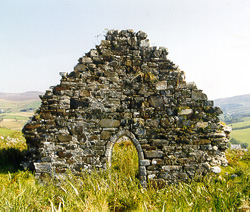
St. Cartha's Church.(630 - 1610 A.D.)
St.Cartha had a monestery in Rahan, Co. Westmeath but the Lord of the area, Blath Mac Aodh
Slaighne expelled him in about 630 A.D. St. Cartha made his way to Kilcar where he built this
church, in the townland now known as Churchtown. He died there on March 5th 637 A.D. There are
still some remains of the church standing.
Massrocks.(1610 - 1756 A.D.)
These are spread all over the parish. Travelling priest's said mass on these rocks during penal
law, when most churches were confiscated.
Spanish Church.(1756 - 1830 A.D.)
Money for this church was donated by a shipwrecked Spanish Sailor, whose cries for help were
heard by Father James Carr. The dying sailor, having received his last rites, asked Fr. Carr
to use his gold savings for the glory of God.
After he died Fr. Carr took the gold and built 3 simple churches one in Kilcar and two in
Glencolmcille. An exact replica of the one in Kilcar is situated on the original site in the
townland of Cashlings, on the main road to Carrick.
The Town Church.(1830 - 1904 A.D.)
This church was handy for church goers because it was situated in the town. It is now used as
the parish hall.
St. Cartha's New Church.(1904 - **** A.D.)
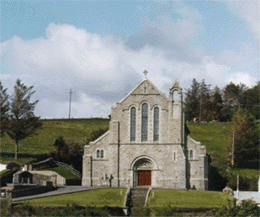
Built in Romanesque style with stone from Bavin and Mountcharles. The interior is Byzantine, with
a Bascillican plan.
It was refurbished in 1992. The present parish priest is Cannon John Gallagher, who does a very good
job of looking after it.
Other Places Of Interest.
- The Corn Mill.
- Burial Sites.
- Muckross Head.
The Corn Mill.
The mill was traditionally a place with alot of activity during the winter months when people
brought their oats here for grinding in to oatmeal. The mill was water driven and closed in 1960.
It is still however in an excellent state of preservation.
Burial Sites.
These sites are all over the parish, but the ones in the best condition are to be found in
Croagbeg and Shalvey.These are considered to be the oldest visible evidence of settlement in
Kilcar and date back as far as 3000 B.C. The early settlers left their records in stone and some
of these were excavated in the early 1970's by a group from Queen's University, Belfast. Some
items of archaeological value were found, and now are on display at the Ulster Museum in Belfast.
The burial galleries are constructed of hugh stones, with heavy slab-corbel and lintels. The
gallery at Shalvey had two chambers and is a fine example of a burial site.
Muckross Head.
Ruins of an old castle are to be seen here. A beautiful scenic area suitable for rock fishing
and climbing.
Index Page.
Where is Kilcar ?
Where to stay.(B&B's and Hostel's)
Activities.
Eating Out
Nightlife in Kilcar
General Information.