|

What is
dialysis ? |
What is Hemodialysis
? | How are you attached to Dialysis Machine
?
Does hemodialysis hurt ? | How long does
hemodialysis take ? | Where can hemodialysis be
done ?
What about proper nutrition ? |
What
other changes are needed with hemodialysys ?
Is travel possible on hemodialysis ? | What type
of dialysis treatement is best

Dialysis
is a treatment for people in the later stage of chronic renal
insufficiency (kidney
failure). This treatment cleans the blood and
removes wastes and excess water from the body. Normally, this work is
done by healthy kidneys.
Sometimes dialysis is a temporary treatment. However, when the loss of
kidney function is permanent (as in end-stage kidney failure), you must
continue to have dialysis on a regular basis. The only other treatment
for kidney failure is a kidney transplant.
There are two types of dialysis: hemodialysis and peritoneal
dialysis.
In hemodialysis, your blood is passed through an artificial kidney
machine to clean it. Peritoneal dialysis uses a filtration process
similar to hemodialysis, but the blood is cleaned inside your body
rather than in a machine.

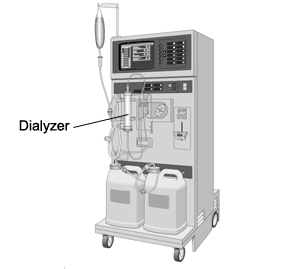
Hemodialysis means "cleaning the blood"-and that is
exactly what this treatment does. Blood is circulated through a machine
which contains a dialyzer (also called an artificial kidney). The dialyzer
has two spaces separated by a thin membrane. Blood passes on one side of
the membrane and dialysis fluid passes on the other. The wastes and excess
water pass from the blood through the membrane into the dialysis fluid
which is then discarded. The cleaned blood is returned to your
bloodstream.
HEMODIALYSIS
MACHINE

You
can be attached to the dialysis machine in different ways. The most common
method of providing permanent access to the bloodstream for hemodialysis
is an internal fistula in your arm. This involves having an artery
and a vein connected surgically. When they are joined, the stronger blood
flow from the artery causes the vein to become larger. Needles can be
inserted in the enlarged vein to connect you to the dialysis machine.
Another way to provide access to the bloodstream is to insert an internal graft
. In this procedure an artery is surgically connected to a vein with a
short piece of special tubing placed under the skin. Needles can be
inserted in this graft.
Sometimes, when it is necessary to gain access to the bloodstream quickly,
or when the veins in the arms are too small to provide enough blood for
hemodialysis, a central venous catheter is used. A soft tube is
surgically inserted into a large vein in the neck or near the collarbone.
This method is usually temporary until a permanent access site is ready.

Insertion
of the needles causes pain but only for a brief time. This can be
difficult for some people. Occasionally nausea, muscle cramps or dizziness
can occur due to the fast removal of extra water from your body which may
cause your blood pressure to drop.

Each hemodialysis treatment normally takes three to five
hours, and usually three treatments a week are needed. Only a small amount
of your blood is out of the body at one time. Therefore your blood must
circulate through the machine many times before it is cleaned.

Hemodialysis
may be done in a hospital dialysis unit, in a self-care centre (with some
assistance from the staff), or at home with the help of a partner or
nurse. Special training is needed for self-care or home hemodialysis.
DIALYSIS CENTERS :
Chennai
: Chennai Kaliappa Hospitals. Raja Annamalaipuram, Chennai - 600 028,
Phone : 4936098, 4936157
MIOT Hospitals : Mount Poonamallee Road, Manapakkam, Chennai - 600 089,
Phone : 2312288
Siliguri : Siliguri Dialysis Center, Sunrise Nursing Home, Sevoke
Road, Siliguri - 734 401, Phone : 531369
Nepal : Daan's Care Nursing Home, Kupondol, Lalitpur, Phone 523751
Contact
us for more information regarding these Dialysis Centers

You will need to learn appropriate food choices to meet
your nutritional needs and control the build-up of food wastes and water.
Your dietitian will work with you to design an individual eating plan that
is healthy and enjoyable. Medications and vitamins may also be prescribed.

You will need to plan your week around your hemodialysis
schedule. You may have to take time off work or school before you start
hemodialysis and when the treatments begin. However, once your health is
more stable, you should be able to return to your normal activities.
Depending on your energy level, you may have to make some adjustments in
your work situation or limit your activities.

There are dialysis units across Nepal, India and in many
parts of the world. They have suitable facilities for visitors who need
hemodialysis treatment. However, it is necessary to plan several months in
advance. Your dialysis unit and Nepal Health Foundation can provide more information and advise you about
travel costs and arrangements.
Contact
us for your travel plan.

The type of dialysis treatment you receive depends on what
is most appropriate for your particular needs. It may also depend on what
is available in your Country. Each type of dialysis has strengths and
limitations. We can provide information and support to
help you understand all the options and answer any questions you or your
family may have.
Mail us for more information and
details

|
