|

What
are the kidneys ? | What do
the kidneys do ? | What
is a kidney transplant ?
What types of kidney
transplants are possible ?
What does the transplant operation
involve? | What about rejection ?
What is involved in living with a new
kidney ?

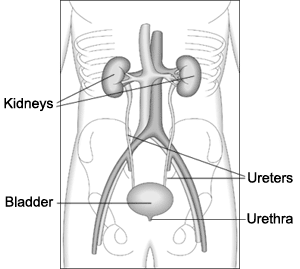
The kidneys are the master chemists of the body.
Normally, there are two of them, one on either side of the spine under
the lower ribs. They are reddish brown in colour and shaped like kidney
beans. Each kidney is about the size of your clenched fist.
LOCATION OF KIDNEYS

Healthy
kidneys do three essential things. They remove wastes from the blood via
the urine and return the cleaned blood back to the body. They regulate the
levels of water and different minerals needed by the body for good health.
They produce hormones that control other body functions. Many other organs
depend on the kidneys in order to work properly. When the kidneys no longer work well enough,
dialysis treatment or a
kidney transplant is required.

A
kidney transplant is a surgical procedure in which a healthy donated
kidney is transplanted into your body. A successful kidney transplant will
allow you to return to a more normal lifestyle and will free you from
dialysis treatments. However, a kidney transplant is not a cure. It is the
treatment of choice for chronic renal insufficiency for those who are
considered suitable candidates for a transplant. To find out if you are a
candidate, your healthcare team or we can perform a series of tests as part of
a complete medical assessment.

There are two types of kidney transplants: a living
donor transplant and a cadaveric transplant.
Living Donor Transplant
In a living donor transplant, a kidney
from a donor, usually a blood relative, is transplanted into your body.
The most suitable donors are usually members of your immediate family.
Sometimes a spouse, distant relative, or close friend can also be a
suitable donor. The donor's blood group and tissue type must be compatible with yours, and
extensive medical tests will be done to determine the health of the donor.
People who donate a kidney can live a normal life with one kidney and
there are few risks to healthy donors. For this type of transplant, there
is a shorter waiting period and the transplant operation is planned at a
time convenient for you and your donor. Living donor transplants have a 90 to 95% success
rate. That means that
after one year, 90 to 95 of every 100 transplanted kidneys are still
working.
Cadaveric Transplant
A transplant from a non-living donor is called a cadaveric
transplant. In this type of transplant, a healthy kidney from someone who
has died suddenly is transplanted into your body. Before a cadaveric
donor's organs can be transplanted, a series of medical tests is done to
determine if they are healthy. In addition, the family of the donor must
consent to organ donation. You will not know the identity of your donor.
After you have a series of tests, you will be put on a transplant waiting
list until a kidney is found that is compatible with your body. The length
of time you will have to wait is hard to predict because it depends on how
hard you are to match and how many kidneys become available.
Cadaveric transplants have an 80 to 85% success rate.

The transplant operation usually takes two to four hours.
The new kidney and ureter (the tube through which the urine flows into the
bladder) are placed in your lower abdomen near the groin. They are
surgically attached to your blood vessels and bladder. Your old kidneys
are not removed unless they are so large there is no room for the new
kidney, or they are chronically infected.
LOCATION OF TRANSPLANTED KIDNEY

A
catheter is placed in the bladder for a few days to drain the urine made
by the new kidney. Sometimes a drainage tube is placed near the
transplanted kidney to remove fluids that build up. In some cases, you may need dialysis following the transplant until the
new kidney starts to work. Fluids and medications are given through intravenous lines, often inserted
in the arm and neck.
After the transplant, you receive anti-rejection medication. Many tests
are done to make sure your new kidney is working properly and to watch for
any signs of rejection.

Rejection occurs when the body recognizes that the
transplanted kidney is not its own and mobilizes the immune system to
fight against it. Various anti-rejection medications (called immunosuppressives)
are used to prevent or treat rejection. They work by blocking the activity
of the immune system. Some of these medications may cause side effects.
Rejection is more common in the early months but can occur at any time
after the transplant. It may occur even when medications are taken
faithfully. Rejection episodes can usually be treated successfully. If the transplanted kidney stops working, you will be able to go back on
dialysis. The transplanted kidney may not be removed. You may qualify for
another kidney when you and your doctor think you are ready. It is hard to say how long a transplanted kidney will last. Many factors
influence its long term functioning. Some kidneys have lasted as long as
25 years and more.

Kidney transplantation is the only treatment that may
replace normal kidney function. The new kidney is able to do the work of
two healthy ones.
A kidney transplant may offer the best chance of returning to a more
normal life, but it is not suitable for everyone. Speak to your doctor to
see if a kidney transplant is right for you.
For detailed information regarding KIDNEY
TRANSPLANT please feel free to mail us. We are here to serve you at all
time.
 |