|

What
is dialysis | How does peritoneal dialysis work
? | How is access to the peritoneal cavity
established ?
What are the types of peritoneal dialysis ? | What
about proper nutrition
What changes are needed with peritoneal diaysis ?
| Is travel possible on peritoneal dialysis ?
What type of dialysis treatment is best ?

Dialysis is a treatment for people in the later stage of
chronic renal insufficiency (kidney failure). This treatment cleans the
blood and removes wastes and excess water from the body. Normally, healthy
kidneys do this work.
Sometimes dialysis is a temporary treatment. However, when the loss of
kidney function is permanent (as in end-stage kidney failure), you must
continue to have dialysis on a regular basis. The only other treatment for
kidney failure is a kidney transplant.
There are two types of dialysis: hemodialysis and peritoneal dialysis. In
hemodialysis, your blood is passed through an artificial kidney machine to
clean it. Peritoneal dialysis uses a filtration process similar to
hemodialysis, but the blood is cleaned inside your body rather than in a
machine.

The inside of your abdomen is called the peritoneal cavity
and it is lined with a thin membrane called the peritoneum. This membrane
surrounds the intestines and other internal organs. In peritoneal
dialysis, this cavity is filled with dialysis fluid which enters the body
through a permanently implanted catheter.
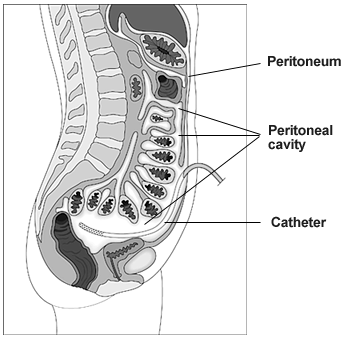
Excess
water and wastes pass from the blood through the peritoneum into the
dialysis fluid. This fluid is then drained from the body and discarded. In
most cases this treatment can be performed without assistance, at home or
at work.

A tube called a catheter, made of soft, non-irritating
plastic, is inserted in your abdomen below and to one side of your navel,
and stays there as long as you are using this type of dialysis. The
catheter may be inserted at the bedside using local anesthetic, or in the
operating room, depending on what is best for you. The dialysis fluid
flows into, and is drained out of, the peritoneal cavity through this
special tube.
The insertion of the catheter may cause discomfort for a brief period, but
peritoneal dialysis is not painful. However, care must be taken to avoid
infection.

Peritoneal dialysis is also called continuous peritoneal
dialysis (CPD). In CPD you always have dialysis fluid in your peritoneal
cavity, so your blood is constantly being cleaned. The fluid is changed at
regular intervals throughout the day.
There
are different types of peritoneal dialysis including:
·
Continuous ambulatory peritoneal dialysis (CAPD)
·
Assisted continuous ambulatory peritoneal dialysis (ACAPD)
·
Automated or cycler peritoneal dialysis (APD)
Continuous ambulatory peritoneal dialysis (CAPD)
In CAPD, you carry about 2.0 - 2.5 litres of dialysis fluid in your
peritoneal cavity all the time. An exchange is usually done four times a
day by draining out the old fluid and refilling your peritoneal cavity
with fresh fluid. The exchanges are often done early in the morning,
lunchtime, late in the afternoon and at bedtime. Each exchange takes about
30 to 45 minutes.
Assisted continuous ambulatory peritoneal dialysis (ACAPD)
Assisted CAPD involves the use of simple equipment so that an extra
exchange can be done while you sleep.
Automated or cycler peritoneal dialysis (APD)
In APD (previously called Continued Cycling Peritoneal Dialysis), a
machine called an automatic cycler performs exchanges every night while
you sleep. In the morning, when you come off the machine, about two litres
of dialysis fluid are left in your peritoneal cavity for the day. In the
evening, you drain this fluid out when you connect yourself to the
automatic cycler for the night. While APD allows you to do dialysis at
home with no interruptions to your day, it does require that you be
attached to the machine every night for eight to ten hours. Some people
may also do an additional exchange during the day to provide adequate
removal of waste products.
A special test called a PET test will help your healthcare team decide
which method of peritoneal dialysis is best for you.

Since peritoneal dialysis works continuously, you have
greater freedom in food choices than with hemodialysis. However, you will
need to learn about appropriate food choices to meet your nutritional
needs and control the build-up of food wastes and water. Your dietitian
will work with you to design an individual eating plan that is healthy and
enjoyable. Medications and vitamins may also be prescribed.

You will need to plan your week around your peritoneal
dialysis schedule. You may have to take time off work or school before you
start peritoneal dialysis and when the treatments begin. However, once
your health is more stable, you should be able to return to your normal
activities. Depending on your energy level, you may have to make some
adjustments in your work situation or limit your activities.

Travelling
is relatively easy on peritoneal dialysis and exchanges can be performed
almost anywhere that is clean. All you need to arrange is transportation
for your supplies, including dressings and your cycler, if needed.
Supplies can be carried with you as luggage, checked with your luggage or
shipped ahead as cargo. Some companies which furnish dialysis supplies
will arrange to deliver them to your destination.
Your healthcare team and Nepal Health Foundation can provide
information and advise you about travel costs and arrangements.
DIALYSIS
CENTERS :
Chennai
: Chennai Kaliappa Hospitals. Raja Annamalaipuram, Chennai - 600 028,
Phone : 4936098, 4936157
MIOT Hospitals : Mount Poonamallee Road, Manapakkam, Chennai - 600 089,
Phone : 2312288
Siliguri : Siliguri Dialysis Center, Sunrise Nursing Home, Sevoke
Road, Siliguri - 734 401, Phone : 531369
Nepal : Daan's Care Nursing Home, Kupondol, Lalitpur, Phone 523751
Contact
us for more information regarding these Dialysis Centers

In general, no one type of dialysis is superior and the type of dialysis
treatment you receive depends on what is most appropriate for your
particular needs. You can help to make this choice. It may also depend on
what is available in your community. Each type of dialysis has strengths
and limitations. Your healthcare team can provide information and support
to help you understand all the options and answer any questions you or
your family may have.
Mail us for more information and
details

|
