![[Under Construction]](images/undercon.gif)
Bride of Zen Preamplifier

INTRODUCTION
After constructing the BM Audio power amplifier, I realised that patience is the most important thing. Next, do not do too many part substitutions unless you are sure it will work. The cost of this preamp shouldn't be a limiting factor for anyone, plus a digital multimeter you should be able to construct it.
This preamp is surprisingly good and transparent, much like a tube preamp
actually. The sound takes a little getting used to, but some like the character
that it presents. I myself will be living with it for some time until the next
great sounding preamp catches my fancy.
DESCRIPTION
I have completed the preamp. Biasing is easy and no problems occured during construction. Due to the use of Mosfets, no thermal runaway occured even under stuffy conditions, but do not do this on purpose.For those of you who are curious, this preamp has been running for months flawlessly.
When I first listened to it, the sound was very poor. The preamp tended to distort when tuned to higher volumes. Later I realised this was caused by loading the output too heavily. I put the volume potentiometer (Noble) at the input, and the output had a 1kohm resistor to ground.
I switched the output resistor to a 7kohm Dale resistor and the sound
improved TREMENDOUSLY. Could be due to the Dale resistors, but more likely due
to the load change. The sound became much more open but treble was bright and
bass seems to have diminished a little.
The output impedance now approximates 1kohm.
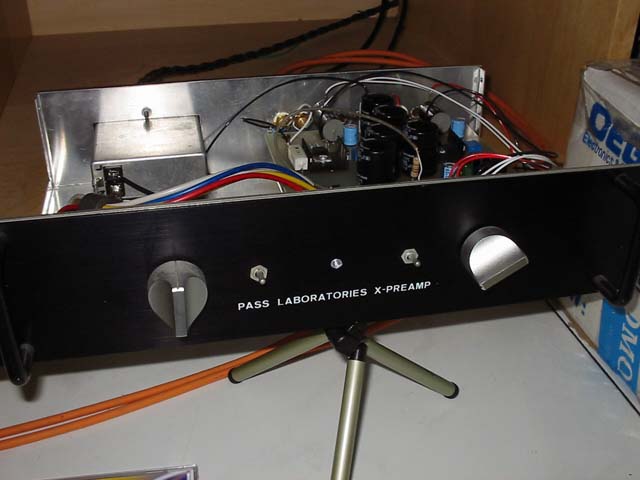
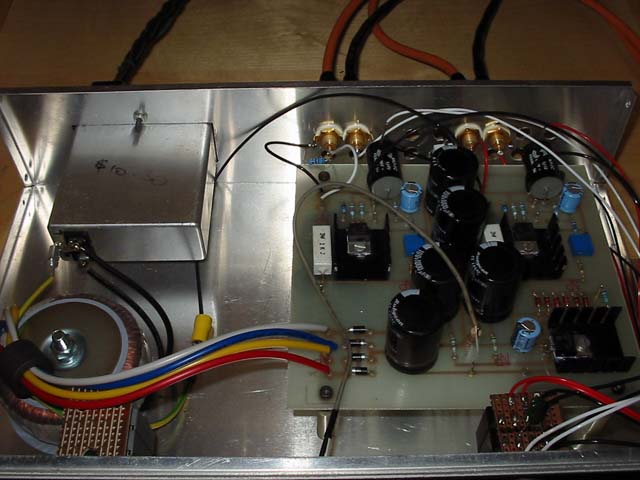
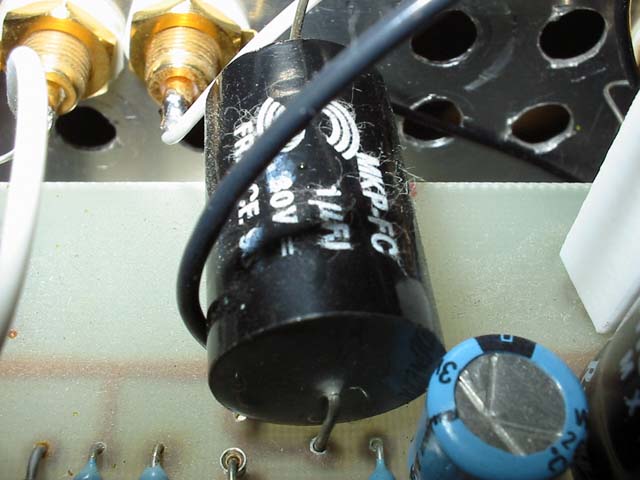
A few months later, I received an email regarding the BOZ preamp. The author of the email recommended a resistor in series (100kohm) with the input to prevent overloading. So I did just that and even replaced the input coupling capacitors with Solen 1uF Fast Capacitors. The sound after this was good but rather subjective. Firstly, treble brightness and harshness was completely eliminated and low level detail was much more apparent. Bass somehow seems to have diminished further. I am quite satisfied with this modification but am still trying to get used to this type of sound, usually associated with tube equipment.
Not willing to give up bass for lower distortion, I thought maybe changing the output capacitors would further improve the sound. And improve it did in spades! I used Solen 15uF Fast Caps as the output coupling capacitor and managed to get back the bass I wanted (greater definition too), as well as eliminating the input series resistor. Soundstage was wider and treble smoother and less metallic. I must say this has been a tremendous improvement over the first version. I will continue to put up more information when I do any more upgrades, but I do not update my homepage regularly, so it might be better to email me for the latest news.
Next, I replaced the EI transformer with a 50VA toroidal transformer and the
rectifying diodes with high speed equivalents. This brought about a great
increase in definition and detail which really astounded me. A mains filter
completes the design.
|
Note : Experience has shown that amateur constructors like to fondle their parts before constructing their projects. In this case, since the Mosfets can be damaged by static discharge, buying it first is not recommended. Also, get it from a reputable dealer if you can (e.g. catalogue order). It may cost a little more, but at least you get it intact. Other parts can be had easily. I got all from only one shop. Try to get 1% metal film resistors, 1W zener diodes, and good capacitors. This should be easy enough, and cost little. I would recommend good coupling capacitors. The price ranges from cheaper ones like Solen to the most expensive ones(and the best, too) like Wima Black Boxes. The PCB, in this case, should be printed last should you use substitute parts and want to change the layout a little. |
POWER
Use a small transformer, preferably 30VA, to minimize turn-on surges. This is only a preamp, it doesn't need a powerhouse! Thermisters, in my opinion, limit transient current to counter the effects of the high speed rectifying diodes. They may, however, be used to isolate the circuit ground from the chassis to prevent ground loops. Unless you are thinking more of a 100VA transformer, there should be no noticible turn-on thump.
The 60vac secondary may be hard to obtain, but catalogue order should have it (Especially toroidals). I ordered mine from Vellman components.
PERFORMANCE
After doing all the abovementioned mods, the preamp really does perform splendidly. It is very transparent in the mids and highs. The bass is not as tight as I desire, but I'm working on it......
This must be one of the easiest to build high-end preamps around. It follows the single ended tradition of tubes and simplicity for very transparent sound. It should also be quite similar to the commercial Pass single stage preamp. Some others have built this preamp too and I have not heard one complain about its sound quality. Nelson Pass of Pass Labs assures of good performance. Do read his article for construction notes.
MOSFET PECULARITIES
I have noticed a very funny characteristic of Mosfets, they are not only sensitive to static electricity, but also to noise and have higher distortion than bipolar transistors. But many still use it despite these flaws because it actually sounds better (subjective) than bipolars. Also, Mosfets are so sensitive to any interference that even a camera flash will send a spike to the amplifier and speakers. Just try to take a snapshot of someone's Mosfet preamp (internally) while it is playing and you better be running!
ENDING NOTE
If anyone is interested in this excellent preamp, feel free to e-mail me any time for discussions. Any other questions or comments can also be posted to me.
PICTURES