
However, most of the constructional information can only be accessed if you join the rat_ring at Yahoo Groups. You will find it an interesting and informative discussion group.
Contact the rat_ring group
The Remote Access Terminal or RAT is an expandable, low cost telecom device using PIC microcontrollers.
It was conceived out of the need for a very low cost device which could connect to the phone line, dial numbers, send and receive data and perform simple datalogging or control tasks just using an 8 bit microcontroller, without the cost of a separate modem.
The telephone interface allows the microcontroller to communicate with other RATs or PCs using the telephone network, using the V23 or Bell 202 modem standard - a 1200 baud FSK modulation, easily generated by the PIC.
The microcontroller can dial up a remote PC server, equipped with a modem, and send small amounts of data at regular intervals, for applications such as remote utility meter reading, temperature or weather monitoring or home security systems.
To allow safe interconnection to other equipment, the RAT_1 has an isolated serial interface allowing it to be connected directly to the PC serial port at up to 9600 baud.
RAT_1 can also be used as a telecom tone generator with tones being selected via the PC serial port.
RATs may be connected together using standard 2 wire house telephone extension wiring. An innovative communications technique LO_COMM allows several RATs to inter-communicate.
This allows them to be used, for example, as individual room thermostats, fitted with actuators for controling central heating valves etc.
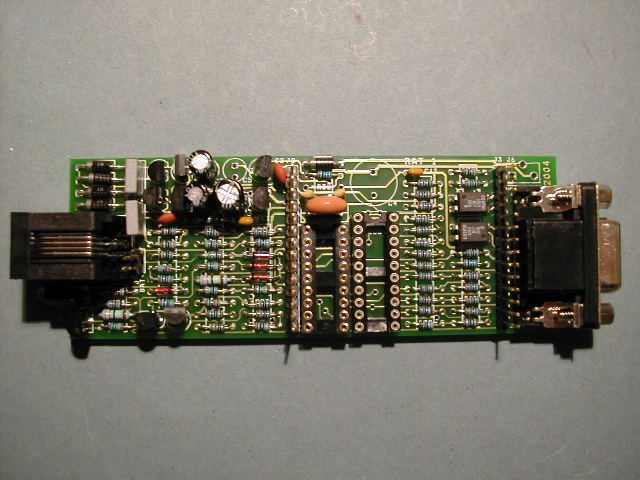
RAT_1 uses standard 0.1" expansion connectors allowing access to all the internal signals. Other equipment can be build up on stripboard, and the RAT_1 plugged straight in as the telecom communications interface.
This makes it easily expandable, and ideal for hobbyists, schools colleges and universities.
To get you started quickly, the home-build version of the RAT_1, shown above, is shortly to be available in kit form. Easily built in 2 to 3 hours, the RAT_1 kit makes an ideal electronics construction project for hobbyist, schools or colleges. In building the kit,, you will learn about interfacing the PIC to the phone line, and the techniques used to get the PIC to generate and decode the various tones in firmware.
Click Here to see what is included in the RAT_1 DIY Kit
Click Here to see the full Construction Guide
Some of your Questions and Answers on the RAT_1
Click Here to see the latest Downloads and Support information for RAT_1
It will also available as a bare pcb, a complete kit of parts or as a ready assembled and tested unit.
In each case the unit is supplied as a RAT_PACK, consisting of the printed circuit board, electronic parts and full documentation on CD rom. These include comprehensive build instructions, circuit diagrams, code examples and the "User's Guide to The RAT Project" - a 55 page tutorial document which tells you exactly how to build RAT_1 and understand how it works starting from first principles.
Click Here to download the RAT_PACK Documentation Pack.
Click Here to download the RAT_Tutorial
RAT_PACK Documentation also now available in Spanish:
Documentation en Espanol
Tutorial en Espanol
The tutorial introduces the techniques of tone generation and reception on the PIC and shows how these simple functions can be built into a full repertoire of telecoms routines.
Sections include how to power the PIC safely from the line, send and receive DTMF tones, how to use the PIC to generate and receive 1200 baud modem signals.
With RAT_1 you can dial out using DTMF and send outward short messages to a remote RAT or PC sent over the phone line using the V23 modem standard.
The V23 decoder also allows the RAT_1 to decode Caller ID signals and selectively answer incoming calls. The opto-isolated serial port hooks straight up to your PC.
RAT_1 can also be used for remote sensing, with its on board ADC, and Flash ROM, datalogging for example at a remote location and periodically sending the results back to a PC via the phone line.
It is ideal for Home Automation projects switching lights, central heating systems or security systems by activating them from a mobile phone.
All the telecom signals and the port pins are brought out to 0.1" pin headers allowing additional circuitry to be easily added using stripboard.
The Rat_Core kernel of firmware performs DTMF generation and reception and V23 modem tone generation and decoding. Innovative V23 decoding in firmware allows decoding of Caller ID and the potential for PSTN SMS reception.
Using a 16F88, 3000 bytes is available to the user for the application.
RAT_ 1 is the new DIY kit version using the 16F628/16F88. Either as a low cost pcb, kit or ready assembled - RAT_1 will be available in Summer 2004.
Here are a few things that you can do with a RAT!
Caller ID unit with PC interface
Educational Project for High School or College
Repertoire or Autodialler with PC interface
Remote Datalogger - RAT_1 is supplied with a simple voltmeter application
Central Heating remote control system
Low data rate modem
Telephone Interface for Home Security System
Telephone test tone generator
Short mesaging interface
Distributed Node Home Automation network
Remotely controlled power switch - turn equipment on and off remotely using your mobile phone
The rat_ring is a group of technology enthusiasts who have joined as a web based group to develop low cost telecom applications for microcontrollers. The group currently consists of more than 1000 members from all over the world.
The rat-ring project is a new experiment in global inter-working using the internet to co-develop ideas and solutions, to retrieve information and access goods online.
If you have particular skills such as hardware, firmware of application software development that you would like to contribute to the project please contact the group.
The group exists for several reasons:
1. To act as a knowledge base for applications of low cost microcontrollers in telephony and telecoms. This is an area of communications technology that has very little public domain information. The rat_ring hopes to change this.
2. To offer low cost technical soultions for those who want to remotely access or control equipment using the telephone system - but do not necessarily wish to use a PC and modem to do it! The rat_ring has developed a low cost kit as an introduction to the technology.
3. To offer assistance and information to those who want to learn about the techniques and applications used in developing such products.
4. To allow individuals free access to design information, software and applications - developed by group members for the benefit of the group.
5. For fun !
Discalaimer.
By its nature the RAT_1 is a telephone dialling device capable of rapidly dialling telephone numbers and digit sequences.
Stirling Services accepts no responsibility for nuisance calls, subsequential loss, damage or personal injury arising from incorrect construction or inappropriate application of the RAT_1.
All text tnformation, photographs and design of this page, the rat_ring name in lower case text with underscore, Remote Access Terminal, RAT_1, RAT_PACK, use of the RAT acronym and downloads remain the sole property of Stirling Services.
The RAT_1 design, pcb layout, interfaces, firmware and drivers are copyright (c) Stirling Services 2004.
Others may gain automatic licence to use the RAT_1 design by purchasing the RAT_1 PCB from Stirling Services.
Stirling Services retain the right to modify or upgrade the design at any time without notice.
For more information on the rat_ring or the RAT_1 unit please contact Stirling Services by email
