|
An average mushroom is made up of about
90% water. It is for this
reason that it has a short lifespan and soon decays. The flesh is made up
of hyphae, similar to the mycelium. This apparently simple construction of
hyphae can however produce a wide range of structure and
size.
FACT:
Africa has a mushroom species called
Termitomyces
titanicus
which can grow more than 1 metre across,
unlike thread fungi of some tropical rainforests which have caps less than
1mm across!
|
|
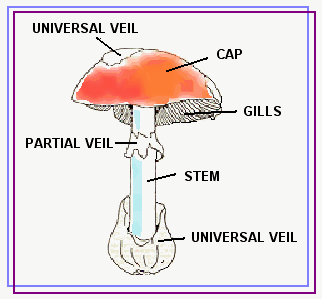 (BELOW) Diagram showing the main features
of a mature mushroom
THE CAP: protects the underlying spore producing gills,
mainly from rain. Hyphae grow out at the top of the button and spread radially
upward then downward. As the cap expands so the edge separates from the stem,
causing the underlying gills to be exposed. The cap surface can then develop
specialised structures and pigments.
THE STEM:
keeps the cap raised above the ground material so
the spores can be dispersed by the wind. It is the
first structure formed but does not lengthen until after the cap/gills are
fully formed. The stem can be tall
and cylindrical or short and squat, though is generally characteristic for
each genus.
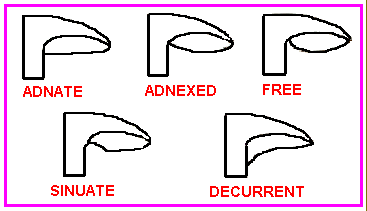
THE
GILLS: are
thin, vertical, radiating plates on the underside of the cap, (though Boletales,
have pores rather than gills), originating as ridges from the stem apex.
Sometimes lamellulae (secondary/tertiary smaller gills) are formed. The surface of
the gills are covered with a spore producing layer known as the
hymenium. While the
young gills are formed, the region is protected by one or more veil layers.
At maturity, gills may be widely spaced to densely crowded. Mushrooms can be identified better by looking at there mode of gill attachment to the stem apex.
(ABOVE) The five
different modes of gill attachment to the stem apex.
(BELOW)
Types of
fruitbody development
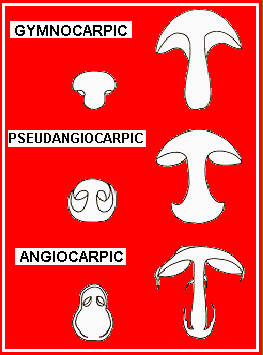
VEIL LAYERS:
are present in some mushrooms
when one or two protective mushrooms may cover the immature fruitbody. On
the stem of a mature mushroom, these are reduced to a ring (annulus), or loose scales on the cap
surface. The full compliment can be found on some species of
Amanita. The universal veil (Velum universale) envelops the
immature fruitbody but on expansion it breaks down, forming the cap scales
and a cup like volva at the stem base. The partial veil (Velum partiale) links the cap margin
to the stem apex, covering the immature gills, breaking down to form the
stem ring. Fruitbody development types are based on the layers shown on
the right. |