| |

News/Latest
What is
Fungi?
The
Lifecycle of a Mushroom
Structure of a mushroom
Edible and
Poisonous Fungi
Different
Species of Fungi
Fungi
Photos from Jersey
Strange
fungi pics
Game-Fungi
Attack
Fungi
Links
|
|
|
All fungi have the same basic
structure of hyphae, but their means of distributing the spores puts them in
one of two groups:
BASIDIOMYCETES :
they let there spores fall into
air currents, so their fruiting body has to be at least a short height off
the ground. They form there spores on stalks of cells known as
basida,
of which there are four per cell.
ASCOMYCETES :
they form their spores in tubes
called asci,
which point upwards. When the spores are ripe, they are ejected for a few
millimetres into the air. A change in humidity or air pressure is enough to
trigger the release. As many asci discharge at the same time, the spores
appear as a little puff of smoke.
FACT:
Luckily very few fungal spores ever
germinate, Langermannia gigantea,
the Giant Puffball, has been calculated to produce over 10 billion spores!!!
|
|
 |
|
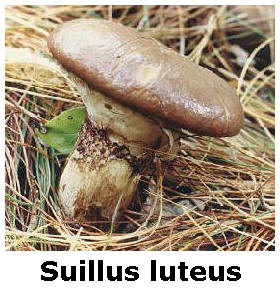
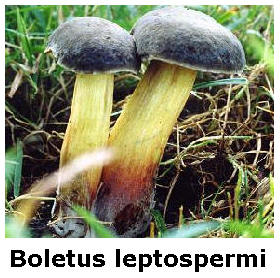
BOLETACEAE - All
Boleti grow on the ground. All form mycorrhizal associations with trees.
They have a typical toadstool shape, but under the cap are tubes instead of
gills. The flesh is usually white/cream in the cap, but if cut or bruised,
can dramatically change to blue/green. Genera in this group include:
Boletus – has a dry cap and stem that
may be covered with small dots of a fine net.
Suillus – has a cap that is slimy in
wet weather and a smooth stem.
Leccinum - has a dry cap and scaly
stem.
Tylopilus - has pink pores and a dark
net on the stem. |
 |
|
AGARICALES-
These have a typical toadstool shape, but with gills under the cap. The
spores are formed on the surface of the gills, from where they fall into
airstreams. Most are raised from the ground by a stem. Genera in this group
include:
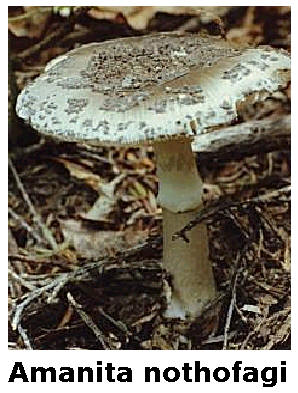
Amanita-
Some of the most poisonous fungi are in this genus. It has a volva, either
large, small, or as rings on the stem.
Lepotia - All are whitish with white
spores, have a scaly cap, white gills free of the stem and a ring. The large
edible ones are called Macrolepotia, small inedible ones retain the name
lepotia.
Collybia - These are responsible for
the breakdown of wood and leaves in woodland. The white gills free of or
lightly attached to the stem. There is no ring.
Clitocybe - Has white gills marked
decurrent. The cap is usually funnel shaped and the stem fairly short. They
grow in deciduous woodland.
Mycena - Small white gilled fungi,
adnate, usually with conical caps which may later open flat. The stems are
long and slim. Some, ooze out clear or coloured sap from the stem when cut.
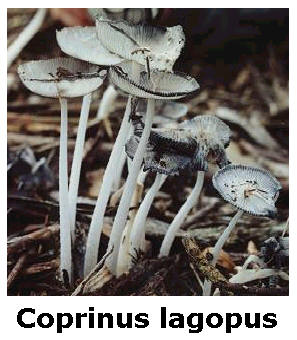
Coprinus - Their method of spore
dispersal is unusual. The gills and cap liquefy so the spores are washed
away by rain. Most live on buried wood so spores will end up on a suitable
substrate. Either white or brown and tall.
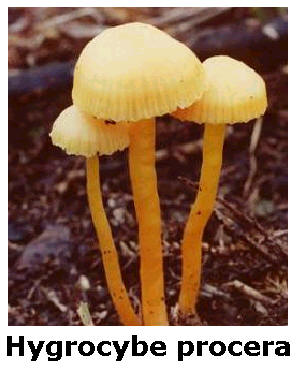
Hygrophorus and Hygrocybe - They form
the ‘wax-caps’. The gills are thick, well spaced and waxy looking. The pale
coloured species occurring in woodland are Hygrophorus, the grassland ones
are the Hygrocybe. They are the most brightly coloured fungi around. They
form a rounded cone cap. The cap is slippery when wet. |
 |
|
RUSSULACEAE-
The fungi in this group have crumbly flesh and are generally brighter
colours. Typically the gills extend to the stem, and the cap is usually
funnel shaped, having a depressed centre. Genera in this group include:
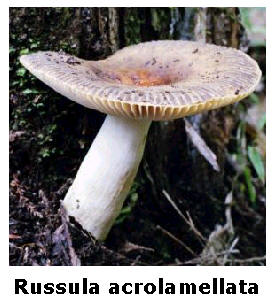
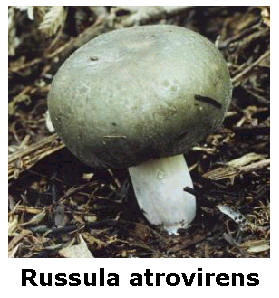
Russula- Hard, brittle fleshed with white
to yellow gills, most run from the stem to the edge of the cap. The cap is
fairly thick fleshed. The stems are medium to tall and usually white. The
spores range from white to saffron.
Lactarius - Known as the ‘milk-caps’.
If the cap or gills are broken, a milky juice oozes out. The colour of the
milk may change after a few minutes. It is non-toxic but hot in taste. Gills
are thick, adnate or decurrent, never free and the spores are white or
cream. Sturdy fungi.
|
 |
|
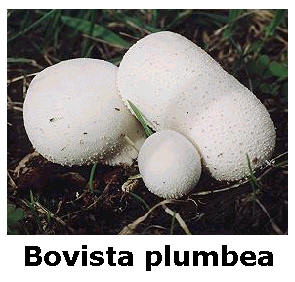
GASTROMYCETES–
The members of this mixed group form their spores on a network of hyphae and
basida which is initially contained in the fruitbody. These may be expelled
through a central opening, as in puffballs, or released by the casing
disintegrating. In Stinkhorns, a slime, containing spores is found on top of
a stem. Flies disperse these spores. Truffles are formed underground and
give off a scent attractive to animals. Animals eat this fungus and excrete
the spores. |
 |
|
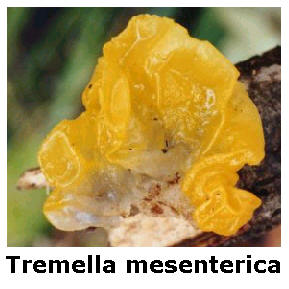
HETEROBASIDIOMYCETES-
This group is known as the ‘Jelly fungi’,
due to its elastic nature. The spores are formed internally . All are
parasitic or saprophytic on wood. The genus Tremella is characteristic of
this group. Most can dry out into skin like structures, which rehydrate when
wet. |
 |
|
APHYLLOPHORALES-
These are fungi without gills. The
genus Stereum, consists of horizontally disposed plates with the spore
bearing surface on the underside. |
|
|
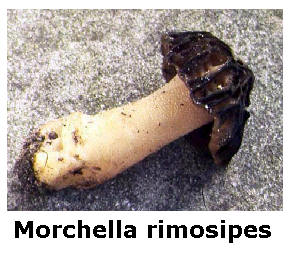
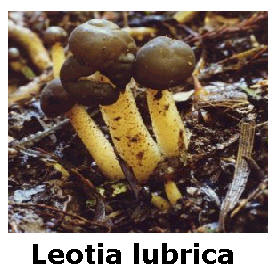
DISCOMYCETES-
Known as the ‘Disc fungi’ these are
saucer shaped and of various sizes, less than a millimetre to several
centimetres. The spore layer is on the upper surface. Some have a stem
carrying a convoluted head. Genera in this group include:
Morchellaceae- Morels are among the best
known mushrooms. They appear in spring. They have the characteristic
brain-like head. Morels occur where soil has been disturbed, and produce
mass fruitings after forest fires.
Leotiaceae - These are tiny, mostly
disc-shaped fungi, with spores in asci. Most are firm fleshed, almost
rubbery. Some species grow in swarms on rotten wood while others are hidden
among grass.
|
 |
|
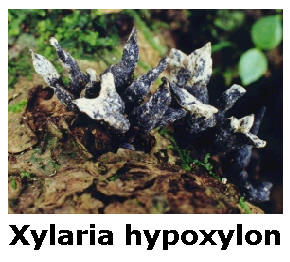
PYRENOMYCETES-
Generally have a black, crusty
appearance. They are known as ‘Flask fungi’. They are so called because the
spores develop within tiny flask shaped organs, and make their way to the
air through an opening in the flask. Also present on many is a white dust on
the fruitbody. |
 |
|