BERISSO KEBEDE


I graduated from the University of Goettingen, Germany, in 2000 (Msc.). Besides, I did further postgraduate studies in plant and animal genetics starting from January 2001 by attending several courses, laboratory practices and seminars in which I have tried to deepen my knowledge in applied molecular genetics. Since March 2003, I am employed in the department of crop science, section of plant genetics at the University of Goettingen, Germany. I am working in one of GABI (Genome Analysis for Biological System) http://www.gabi.de/ research project: genome analysis in oilseed rape (GARS). The project started in 1999 with the financial support of German Federal Ministry of Education and Research (BMBF) within the GABI program (Grant no. 0312286C). Since 2002, four German breeding companies namly: Deutsche Saatveredelung (DSV), Nord Deutsche Pflanzen Zucht: Hans-Georg Lembke KG (NPZ), KWS SAAT AG and Seed Hadmersleben GmbH (SH) are funding the project including my salary. The above companies conduct also field experiments and we conduct the field trials at location Goettingen

The research project:

Several methods are currently available to map QTL using a segregating population of F2, BC (Backcross), RILs (Recombinant Inbreed Lines) relaying on statistical method. However, the precision of estimating the number and effect of the QTL using the above populations and analytical methods is very low (Kearsey and Hyne 1994; Melchinger et al. 1998). Moreover, the effects of those few detected QTL can also be overestimated and strongly biased as the population size used for the QTL mapping decreases. Additionally, small QTL effects are not usually identified and effort to detect requires large population of upto 1000 lines leading to high costs of genotypic and phenotypic characterisations. Alternative to a segregating population QTL mapping can be applied in substitution lines carrying a single well defined segment of the donor parent in the pure genetic background of the recurrent genome (Eshed and Zamir 1994; 95). I am applying backcrossing (BC) approach and Marker Assisted Selection (MAS) to develop intervareital substitution lines from four varieties of oilseed rape. Intervarietal substitution lines or sometimes called near isogenic lines (NILs) are a set of lines with a complementary donor segments that are genetically identical except at one or a few loci of the donor parent. Therefore, in QTL mapping, genetic background interference can be avoided and the pure effect of those few loci can be estimated
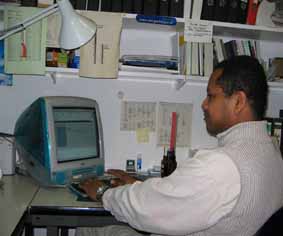
Pic of me in office
My Favorite Links:
Nature
Science AAAS
My CV
Pics in molecular lab.
Pics in biotechnology lab. & field
Poster 1
RAPD
RFLP
AFLP
My pics
Poster 2

We are developing two populations of substitution lines libraries. The donor parent in population I was a double haploid line from �Mansholt's Hamburger Raps', an old landrace characterized by high glucosinolate and high erucic acid content. A double haploid line from a canola quality French cultivar 'Samourai' released in 1989 was used as a recurrent parent. Intervarietal substitution candidate lines were selected in each generation from BC1 up to BC4 using MAS. A total of 164 AFLP markers covering a total of 1325 cM rapeseed genome were used. In population II: the donor parent was a resynthesized rapeseed. The recurrent parent was a inbreed line from 'Express', a cultivar with high oil content and double 00 canola quality released by NPZ GmbH in 1993. Intervarietal substitution candidate lines were selected in each generation from BC1 up to BC4 using MAS . Hier a total of 220 AFLP markers across 1327 cM of rapeseed genome were used.

From selected BC4 plants of population 1 ( 'Mansholt' x 'Samoura'), DH (double haploid) lines were generated using microspore culture. A total of 300 set of substitution lines with complementary donor segments in the genetic background of the recurrent parent were produced and they were analysed by markers for the donor segments. Field trials were conducted in 2 locations in year 2004/05 and 5 locations in year 2005/06 in Germany using 288 lines. The substitution lines contained a donor segment ranging in size from 0.5 cM up to 20 cM covering about 48% of the mapped rapeseed genome. ANOVA revealed that the lines were significantly variation for all traits. Mixed Model from PROC MIXED procedure of SAS (SAS version 9.1) was used to anayse the data in which traits were dependent variable, lines with the donor segment treated as independent variable, location and replication were nested as a random effect. QTL effect was analysed using Least Square Means (LSMEANS) of multiple comparisons to the control. Estimated difference between the phenotypic value of the substitution line and the control (Samourai) was tested for t-test adjusted according to dunnet for multiple comparisons. For substitution lines with two or more donor segments QTL to QTL interactions will be estimated.

I am well experienced in molecular genetics techniques such as data generation and analysis, tissue culture, field experiments and statistical analysis. The research project in which I am working is also part of my PhD thesis which I am intended to finish in the next few months


References
1. Eshed Y and Zamir D (1994) A genomic library of Lycopersicon penneilli in L. esculentum: a tool for fine mapping of genes. Euphytica 79: 175-179.
2. Eshed Y and Zamir D (1995) An introgression line population of Lycopersicon pennellii in the cultivated tomato enables the identification and fine mapping of yield- associated QTL. Genetics 141: 1147-1162
3. Kearsey MJ and Hyne V (1994) QTL analysis: a simple �marker regression� approach. Theor Appl Genet 89: 698-702
4. Melchinger AE, Utz HF, Sch�n CC (1998) Quantitative trait locus (QTL) mapping using different testers and independent population samples in maize reveals low power of QTL detection and large bias in estimates of QTL effects. Genetics 149: 383�403

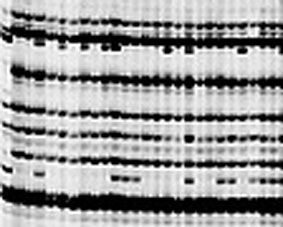
This is a part of AFLP marker image which I am using in Marker Assisted Selection (MAS). AFLP (Amplified- Fragment- Length Polymorphism), is a molecular marker brought forth by the Keygene N.V. and some of the co-dominantly scored marker we had, were analysed using AFLP-Quantar-Pro, a software licensed by the Keygene, The Netherlands. keygene N.V, The Netherlands


Thanks for visiting my home page.You can also look to my CV's and my pictures for additional information.

To contact me:
Name: Berisso Kebede [email protected]
Hosted by www.Geocities.ws

Counter

1