|
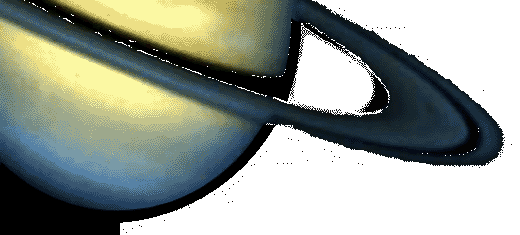
Saturn is the sixth planet from the sun and the second largest. Saturn is the only planet less dense that water, meaning it
could float (if there were some way to put it in an ocean.) Like Jupiter, Saturn also has a ring system. Saturn's, however, is much more pronounced, being visible here on earth. Also, like Jupiter, Saturn has a large
number of moons, 18 to be exact.Saturn is visibly flattened at its poles. This is a result of the planet's incredibly fast rotation. A day on Saturn only takes about 11 hours to complete. Saturn is also marked by
banding similar to Jupiter's, resulting from strong winds on the planet, some reaching speed in excess of 1,100 miles per hour. Another similarity between the two planets is that Saturn has a similar auroral effect by
its poles as well. What makes Saturn special is truly its ring system. Saturn is one of the most spectacular objects to view in the night sky. Much, however, remains unknown about Saturn's rings. We hope to discover
more about the planet during the Cassini mission, scheduled to reach the planet in July, 2004. For now, we can only theorize about the origins of the rings. It would appear that the rings may be the remnants of former
moons of the planet, shattered by impacts from asteroids. What is known is that the rings show a significant amount of water, all frozen of course. The rings themselves seem to be formed by many tiny droplets, ranging
from a few centimeters to a few meters in diameter.
Mass 5.7e+26 kg Equatorial radius 60,268 km Mean density 0.7 gm/cm^3 Mean distance from the Sun 1,429,400,000 km Rotational period 10.23 hours
Orbital period 29.46 years Tilt of axis 25.00 degrees Equatorial surface gravity 9..1 m/sec^2 Mean Cloud Temperature -125°C Atmospheric composition: Hydrogen 97% Atmospheric composition :Helium 3%
|
|