Neptune
Home
About Author
My CD Rack
My Comic Shelf
In The Sky
My GuestBook
Saturn
Uranus
Neptune
Pluto

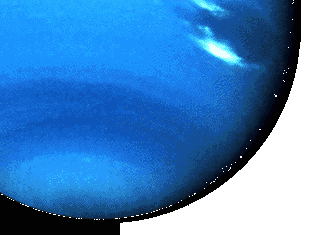
Neptune, discovered in 1846 by Johann Gottfried Galle, is the last of the Jovian planets. Like Uranus, the methane in Neptune's atmosphere absorbs red light and gives the planet its blue color. Like the other Jovian planets, Neptune has a faint ring system surrounding it similar to Jupiter's and Uranus'. Neptune, like Jupiter, has raging storms on the planet as well. The Great Dark Spot is one such storm easily visible on the planet. Another storm, discovered by Voyager 2, is much smaller and circles the planet approximately every 16 hours.

    Discovered by Johann Gotfried Galle

    Date of Discovery September 23, 1846

    Mass 1.0e+26 km

    Equatorial radius 24,746 km

    Mean density 1.6 gm/cm^3

    Mean distance from the Sun 4,504,300,000 km

    Rotational period 16.11 hr

    Orbital period 164.79 years

    Tilt of axis 28.00 degrees

    Equatorial surface gravity 11.0 m/sec^2

    Mean cloud temperature -173°C

    Atmospheric composition: Hydrogen 85%

    Atmospheric composition : Helium 13%

    Atmospheric composition : Methane 2%

[Home] [About Author] [My CD Rack] [My Comic Shelf] [In The Sky] [My GuestBook]
Hosted by www.Geocities.ws

1