Mars
Home
About Author
My CD Rack
My Comic Shelf
In The Sky
My GuestBook
Our Earth
Mars
Jupiter
Part 3

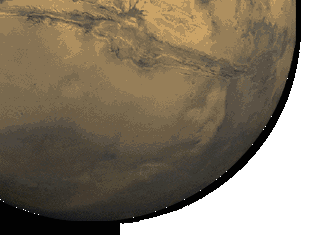
Mars receives its name for its deep red, war-like appearance in the sky. Until recent years, Mars was believed to harbor extraterrestrial life. Astronomers viewed straight lines on the planet's surface and believed them to be irrigation canals. Another feature leading to hope that life existed on the planet was that appeared to go through seasonal changes very similar to the earth's.

Recent images of the planet, however, show a barren, dust covered landscape with no signs of any irrigation canals. In fact, there is no signs of running water on the planet at all. Scientists believe that the lack of water, and Mars constant bombardment by ultra-violet radiation from the sun leave little chance of life as we know it existing on the planet. There are, however, gorges and canyons that may have been carved by running water millions of years ago when the planet's atmosphere was stronger. Even now it appears that there may still be water on the planet, frozen in the polar caps.

    Mass 6.4e+23 kg

    Equatorial radius 3,397.2 km

    Mean density 3.9 gm.cm^3

    Mean distance from the Sun 227,940,000 km

    Rotational period 1.03 days

    Orbital period 686.98 days

    Tilt of axis 25.00 degrees

    Equatorial surface gravity 3.7 m/sec^2

    Equatorial escape velocity 4.25 km/sec

    Mean surface temperature -63°C

    Maximum surface temperature 20°C

    Minimum surface temperature -140°C

    Atmospheric composition: Carbon Dioxide 95.32%

    Atmospheric composition :Nitrogen 2.7%

    Atmospheric composition : Argon 1.6%

    Traces of:
    Oxygen, Carbon Monoxide, Water, Neon, Krypton, Xenon and Ozone

More information on Mars

[Home] [About Author] [My CD Rack] [My Comic Shelf] [In The Sky] [My GuestBook]
Hosted by www.Geocities.ws

1