|
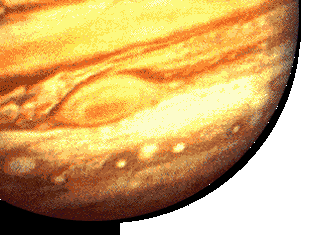
Jupiter, king of the Gods, is by far the largest planet in our solar system, making the name quite fitting. The sun contains an
estimated 98% of the mass of the entire solar system. Jupiter contains and estimated 98% of what remains. Similar in composition to the sun, Jupiter's atmosphere is made up of mostly Hydrogen and Helium. The pressure is
so great near the planet's core that the electrons are separated from the protons of the Hydrogen atoms.The banding that is often associated with Jupiter is the result of a very complex weather system on the planet.
Winds and storms buffet the planet constantly. The Great Red Spot that can be easily seen on Jupiter is actually a very complex storm raging on the planet. Lightning has also been observed on the planet, although much
more powerful than the lightning experienced on earth. Auroral effects, similar to those on earth, have also been seen on the planet. Jupiter does contain a ring system, like Saturn, although they are all but
invisible here on earth. They were first discovered by Voyager 1 in 1979 as it passed by the planet. They are not nearly as complex as the ring systems found around Saturn. They are made mostly of particles of dust from
asteroids that smashed into the inner moons of Jupiter. Unlike the terrestrial planets, the Jovian planets tend to attract a large number of satellites. This is, in part, because of their much stronger gravitational
fields. Jupiter has 16 such satellites, four of which (Callisto, Europa, Ganymede, and Io) were large enough to be discovered by Galileo in 1610. The other 12 moons are relatively small compared to this and are believed
to have been captured by Jupiter's gravitational pull rather than have formed with the planet itself.
Mass 1.9e+27 kg Equatorial radius 71,492 km Mean density 1.3 gm/cm^3 Mean distance from the Sun 778,330,000 km Rotational period 0.41 days
Orbital period 4332.71 days Tilt of axis 3.00 degrees Equatorial surface gravity 22.9 m/sec^2 Mean cloud temperature -121°C Atmospheric composition: Hydrogen 90% Atmospheric composition :Helium 10%
|