UP NEWS: Early Clash between Political Parties
posted on February 11, 2009
Election time seemed to have come early this year. Instead of starting room-to-room campaigns in February, parties entered and campaigned in classrooms the minute the classes resumed from the Christmas break. But the campaigns were not about the upcoming election but about the referendum on the Codified Rules on the Student Regent Selection (CRSRS, which is a guideline in the nomination of candidates for the Student Regent and in the process of choosing one.
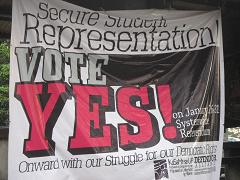
According to the new University of the Philippines Charter, the rules on selecting the Student Regent (SR) must be voted for by the majority of students in the UP system. Thus the 13 year-old CRSRS must pass through a referendum before it can be applied in the next SR selection. If the existing CRSRS will not reach a majority vote of 50% plus one student in the entire UP system, the SR selection would be postponed until a new CRSRS will be passed. The current SR Shahana Abdulwahid will continue to serve as the SR.
The University Student Council and various student councils vigorously campaigned to students to vote in the CRSRS Referendum that was held last January 26 to 31. However, the three major political parties had conflicting views on the ratification of the existing CRSRS.
The STAND-UP promoted the �yes� vote to ratify the existing CRSRS or the �Defend the Office of the Student Regent (OSR)� while the ALYANSA and KAISA advocated the �no� vote to the existing CRSRS or the �Choose to Know �.
The �Choose to Know� campaign was promoted by the two parties to pass five amendments in the CRSRS. In the past years, these amendments were fervently presented to the General Assembly of Student Council (GASC), where student councils from various UP units nominate and select the SR, by the two parties but were always rejected. The reforms wished to be passed by the �Choose to Know� groups are the following:
- The inclusion of a minimum academic requirement as a qualification for nomination as SR;
- The inclusion of an express enumeration of powers and responsibilities of the SR;
- The democratization of the voting structure of the SR to take into account the relative sizes of the units without sacrificing the interests of smaller UP units;
- The de-politicization of the SR selection process by deleting in the rules the KASAMA sa UP, a political alliance composed of several student councils; and
- The rationalization of the selection process by extending the effectivity of the rules to at least 3 years, instead of the current system of annual amendment.
See the Manifesto of Protest and Apeal
SR Abulwahid said in an interview with Bulatlat.com that these groups see the referendum as an opportunity to pass their amendments.
Room-to-room campaigns were done by both sides, discussions in various colleges and dormitories were held, posters and tarpaulins were set up in strategic areas, and websites and blogs were created. While student leaders debated against each other, the issue informed the UP students on how important the Student Regent is. It is not surprising that most students are not even aware of the existence of the Student Regent and the duties the SR performs.
The Student Regent is the only representative of the students to the Board of Regents (BOR), which is the highest policy-making body of the UP system. The SR serves as the only voice and ears of the students in the Board, participates in the debates in policies and defends the students� rights and welfare. Although it is considered to be only one vote, the SR has the persuasive power in the Board which is the threat of student action.
�Defend the OSR� groups stated that if the referendum fails, there is a threat the students will lose their only representative to the BOR. The �Choose to Know� however, contends that the Office is not at risk and amendments that will ensure a democratic process in choosing the SR will be passed. Accusations of misinformation, partisanship, and selfish motives were hurled at each other. Heated conversations and debates whether face-to-face or online transpired.
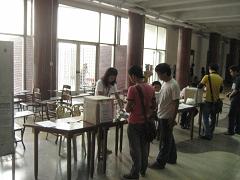
Low voters� turnout in the first days of the referendum only stalled the conflict. The Philippine Collegian reported that in various UP units, the referendum was cancelled for a few days due to technical difficulties. It was a slow process to obtain a 50% plus one student voters� turnout. Only on the last day of the referendum was the majority vote obtained.
The final results were published in the Philippine Collegian last February 6. The paper reported that more than 55% of the student population voted in the referendum, of which 73% voted to ratify the existing CRSRS. The �yes� vote won in all UP units.
In an interview with Andrew Parungao, a fourth year History major and an ALYANSA member, he said that the ALYANSA recognize and respect the students� choice on the CRSRS. ALYANSA, he said, would still push for the reforms in the CRSRS and that they would like to know the reasons why the majority voted yes.
Krissy Conti, a first year Law student and a STAND-UP member, said that the reforms being pushed by the other party had been presented to the GASC since 2001 when she attended the GASC in her undergraduate years. She said that it was good that these reforms were able to �survive the test of time� but the debates have not developed. By campaigning for the �no� vote, �we would have created a physical impossibility� of putting a student in the OSR.
The arguments have existed for years and the debates are postponed until the GASC meet in October this year. But the students, who were oblivious all these years were finally aware of the issues revolving the SR. There is happy ending to the story after all.
|