
HISTORY OF THE MARTIAL ART
It is widely accepted that the Ryukyu Islands are the cradle of karate. The small archipelago lies between the Japan's south coast and Taiwan. Okinawa is its biggest island.
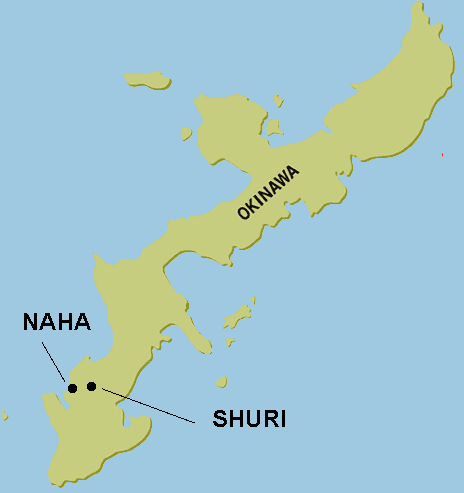
Okinawa Island |
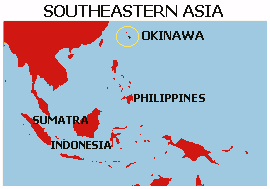
Okinawa lies in the Pacific |
The first settlement in Okinawa dates back to the 4th century b.C.. Colonists coming from China and the northern Japanese islands began farming and fishing.
Between VI and IX a.C. successive japanese invasions encouraged different villages to organize into tribes led by chief warriors. Consequently, in 1340 the island was already divided into three rival kingdoms. A martial art known as "te" was developed.
During the following ten years the major kingdom established formal relations with China. Thus in exchange of tributary payments the noblemen of Okinawa gained access to the imperial court. Some of them were allowed to attend schools in Beijing were they were taught chinese culture, art and science. This situation was very convenient for Japan - China's eternal rival - because it was a process by which commercial and political bonds could discreetly be maintained. For this reason the system of tributary payments was encouraged by the japanese shoguns (generals).
In 1429 after several internal skirmishes, the tribes of Okinawa united under one king. Thus began the Sho dynasty, which would rule during the most prosperous years. During this period a solid trading network was established, spreading as far as Indo-China,Thailand, Malaysia, Borneo, Indonesia and the Philippines. The exchange of rare woods, spices, incense, rhinoceros horn, ivory, tin and sugar from the south of Asia for the fine ceramics, textiles, medicinal herbs and precious metals of Japan, Korea and Chinamade made Okinawa be known as the Venice or Genoa of the East.
Naturally, the contact with other cultures brought the adoption of new habits and certainly also new techniques coming from all sorts of martial arts.
|
Sho Shin |
Around 1470, the Sho dynasty
saw its end. Seven years of violent disputes led to a second Sho dynasty.
The new king Sho Shin, needing to control rebellious war lords, banned the
carrying of swords by all - peasants or nobles, ordered the collection of
all weapons, and brought the noblemen to his castle in Shuri where, living
under his roof, they could be kept in order.
In 1609 the Ryukyu islands were annexed to Japan. The rulings of Sho Shin were maintained, with the sole exception of the japanese samurai (noblemen warriors), who could carry weapons. Despite this fact, the natives continued to develop other combat techniques. The peasants improved weapons systems based on the combative use of tools and agricultural implements: flails (hand threshing tools), grindstone handles, sickles, horse bridles and boat paddles - this is known as Ryukyu bujutsu (Ryukyu weapon arts). On the other hand, the noblemen continued to develop "te". |
The practice of both armed and unarmed arts was done in the small hours of the morning by small groups, usually family, and under secret. This fact added to the geographic dispersion justifies the spreading of several variations of "te" in the islands. Each island ended up having its own. However two "te" variations excelled: in the cities of Shuri and Naha, the Shuri-te and the Naha-te.
Later, several fusions of these two appeared, Shito-Ryu being the most famous. The Shukokai style derives precisely from Shito-Ryu.
Meanwhile, the names of "te" changed a lot. In the 19th century, it became T’ang-te (Chinese hand), and in the 20th karate (empty hand).


[ KARATE ]
[ History of Karate ] [ Ethics ] [ "Kiai" ] [ Belts Colours ] [ Competition ]
[ HOME ] [ KARATE ] [ SHUKOKAI ] [ PORTUGAL ] [ DOWNLOADS ] [ LINKS ] [ GLOSSARY ] [ MAP OF THE SITE ]


