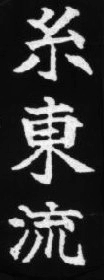
"TE"
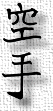
"Te" means "hand" in the dialect of Okinawa.
Through
te, the human body comprises all the weapons necessary to self-defence.
This martial art is the product of two circumstances: the need to defend against foreign invasions and the shortage of arm supplies. In the 15th and 16th centuries it was under the influence of other oriental martial arts. However the distinct character remained: the preferential use of the closed fist.
THE MAJOR STYLES OF TE
Shuri-te
|
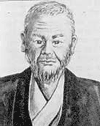
Sensei Yasutsune Itosu |
Shuri, the city
where the royal court was, gave name to the Shuri-te style, later known as
Shorin-ryu. It was developed by the monks of Shaolin, in China ("Shorin"
means Shaolin in Japanese). The "flexible pine school", as it it
also known, is very offensive and stresses on impact.
One of the greatest masters of Shuri-te was sensei Yasutsune Itosu (1830-1925). Born in Shuri, sensei Itosu was famous for the outstanding force of his arms and legs. It was said at the time that he practised daily his punches against the walls of the imperial cemitary. He believed that the human body must be trained to endure the harshest situations. Today, the karateka who follow his teachings face a very strenuous physical and mental practice. |
| The Shaolin temple dates from the 6th century a.C.. At the time a monk named Bodihdharma (or Ta Mo, in chinese) travelled across India and China teaching Zen buddhism. Arriving at the temple, he realised that due to too much of meditation and too little exercise the monks were in very bad shape. Because Zen buddhism itself is very physically demanding, the teachings of Bodihdharma, known as “The Eighteen Shapes of Lohan”, were probably the origin of the martial art developed over the centuries in this temple. |
|
Naha-te
| In the port town
Naha, the local master Higaonna Kanrio (1853-1915) developed the Naha-te,
a style with taoist influences, such as breathing
and controlling the chi (vital energy), that
uses circular movements. It has a rather defensive character, oriented
towards "keys" and projections (sweeps).
This style was further
developed by his pupil Chojun Miyagi, and is the origin of the widely
known Goju-ryu, Goju-ryu meaning "the hard and soft school". |
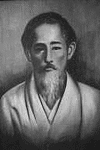
Sensei Higaonna Kanrio |
Meanwhile both styles merged into a new one called Shito-Ryu.
Shito-ryu
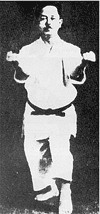
Sensei Kenwa Mabuni |
Soke Kenwa Mabuni (1890-1952) was sensei Itosu's student since he was 13 years old. Over the years they became close friends. When sensei Itosu died, Kenwa Mabuni was entrusted with the improvement of his masters' Shuri-te style. During his adolescence the young Mabuni had also studied Naha-te under the guidance of sensei Higaonna Kanrio, by influence of his friend Chojun Miyagi. Later during the twenties he learned kung-fu in the Fukien province with a tea salesman named Woo Yin Gue. Shito-ryu is the name sensei Mabuni gave to his own style during the thirties. "Shito" comes from parts of the names of his two greatest teachers: Itosu e Higaonna Kanrio (in Japanese, Shi is written with the same letter used for Ito, and To with the same letter used for Higa). Sensei Ricardo Teixeira describes Shito-Ryu as a style that combines power and strength with speed and grace". |
|
The reasons for the different karate styles that exist today lay in the secrecy and the geographic dispersion. The most significant styles today are (considering the number of students, of course) Shotokan, Goju-Ryu, Shito-Ryu and Wado-Ryu.
The names changed a great deal over the centuries. During the 19th it was called T'ang-te (chinese hand) and later in the 20th karate (empty hand).


[ KARATE ]
[ History of Karate ] [ Ethics ] [ "Kiai" ] [ Belts Colours ] [ Competition ]
[ HOME ] [ KARATE ] [ SHUKOKAI ] [ PORTUGAL ] [ DOWNLOADS ] [ LINKS ] [ GLOSSARY ] [ MAP OF THE SITE ]