|
Home |
|

Despite their differences, the members of
the solar system probably form a common family. They seem to have
originated at the same time; few indications exist of bodies joining the
solar system, captured later from other stars or interstellar space.
Early attempts to explain the origin of this system include the nebular
hypothesis of the German philosopher Immanuel Kant and the French
astronomer and mathematician Pierre Simon de Laplace, according to which a
cloud of gas broke into rings that condensed to form planets. Doubts about
the stability of such rings led some scientists to consider various
catastrophic hypotheses, such as a close encounter of the Sun with another
star. Such encounters are extremely rare, and the hot, tidally disrupted
gases would dissipate rather than condense to form planets.
Current theories connect the formation of the solar system with the
formation of the Sun itself, about 4.7 billion years ago. The
fragmentation and gravitational collapse of an interstellar cloud of gas
and dust, triggered perhaps by nearby supernova explosions, may have led
to the formation of a primordial solar nebula. The Sun would then form in
the densest, central region. It is so hot close to the Sun that even
silicates, which are relatively dense, have difficulty forming there. This
phenomenon may account for the presence near the Sun of a planet such as
Mercury, having a relatively small silicate crust and a larger than usual,
dense iron core. (It is easier for iron dust and vapor to coalesce near
the central region of a solar nebula than it is for lighter silicates to
do so.) At larger distances from the center of the solar nebula, gases
condense into solids such as are found today from Jupiter outward.
Evidence of a possible preformation supernova explosion appears as traces
of anomalous isotopes in tiny inclusions in some meteorites. This
association of planet formation with star formation suggests that billions
of other stars in our galaxy may also have planets. The high frequency of
binary and multiple stars, as well as the large satellite systems around
Jupiter and Saturn, attest to the tendency of collapsing gas clouds to
fragment into multibody systems.
EXOBIOLOGY
Exobiology, study of the origin, evolution
and distribution of life in the universe. Exobiologists investigate
how the formation of stars and solar systems led to the existence of
planets suitable for life, how life originated on Earth and perhaps
elsewhere, and which factors influenced biological evolution. The
understanding of these events shape the study of how life arises and
evolves in the universe.
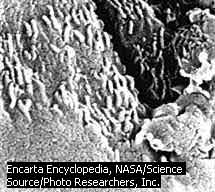 Martian Meteorite ALH84001 Martian Meteorite ALH84001
This meteorite was probably blasted off
of the surface of the planet Mars about 16 million years ago by an impact
with an asteroid and travelled through space to the earth, where it landed
on Antarctica about 13,000 years ago. Some scientists believe that the
rod-shaped structures across the top and center of this image may be tiny
fossilized bacteria. Many other scientists believe that the structures
were formed by processes other than life.
NASA/Science Source/Photo
Researchers, Inc.
Earth is the only planet that we know harbors life. Exobiologists can
use their knowledge about life on Earth to begin their search for life
elsewhere. All known life on Earth is based on the element carbon.
Carbon, hydrogen, oxygen, nitrogen, and phosphorous are elements that
exist in all organisms on Earth. Exobiologists can conceive of
organisms that would not rely on those elements, but those elements
are among the most abundant elements in the universe and would
probably be available elsewhere as a basis for living systems. Carbon
is particularly important to life because it forms three-dimensional
molecules of large size and complexity in organic (carbon-containing)
compounds. Large organic molecules include
amino acids, enzymes, sugars, and other chemicals vital to life on
Earth. Organic molecules can become complex enough to store genetic
information, as in deoxyribonucleic acid (DNA). Carbon molecules are
also capable of an amazing variety of chemical reactions in liquid
water. The presence of water vastly increases the number of possible
organic molecules, increasing the likelihood that the right
combination of molecules for life can form. Based on the available
evidence, there is no reason to believe that carbon-based life should
be limited to Earth alone.
|
|
