|
|||
|
THE SUN |
|||
| Home |

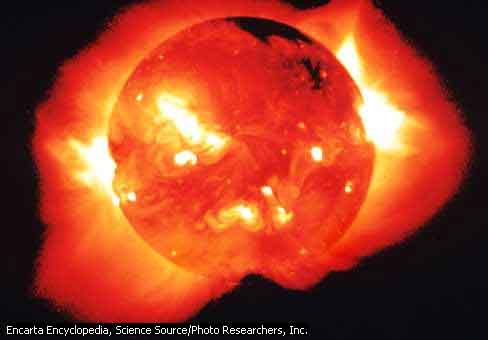
INTRODUCTION ROLE IN THE SOLAR SYSTEM The Sun�s gravitational pull holds the
solar system together. The planets, asteroids, comets, and dust that make
up our solar system are strongly attracted to the Sun�s huge mass. This
gravitational attraction keeps these bodies in orbit around the Sun. The
Sun also influences the solar system with its diffuse outer atmosphere,
which expands outward in all directions. This expanding atmosphere fills
the solar system with a constant flow of tiny, fast, electrically charged
particles. This flow is called the solar wind. The region through which
the solar wind blows is called the heliosphere. The heliosphere extends
outward from the Sun to about 150 times the distance between Earth and the
Sun. Interstellar winds may give the heliosphere an egg shape. The solar
wind spreads out as it leaves the Sun. The point at which the solar wind
is so diffuse that it stops having an effect on its surroundings is called
the heliopause. The heliopause marks the outer edge of the solar system.
|
||
| Our Solar System | |||
| The Sun | |||
| The Major Planets | |||
| Other Orbiting Bodies | |||
| Movements of Planets | |||
| Theories of Origin | |||
|
| FAQS | JUSTIFICATION | SITEMAP | SECURITY | ABOUT ME | |
|||