 |
||||
|
THE MAJOR PLANETS |
||||
| Home |
Mercury |
|||
| Our Solar System |
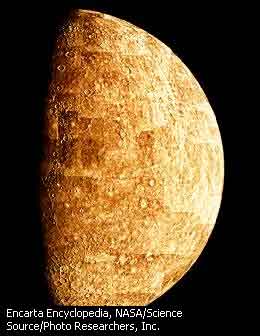 |

Mercury orbits closer to the sun than any other planet, making it dry,
hot, and virtually airless. Although the planet�s cratered surface
resembles that of the Moon, it is believed that the interior is actually
similar to Earth�s, consisting primarily of iron and other heavy elements.
This composite photograph was taken in 1974 by Mariner 10, the first probe
to study Mercury in detail. |
||
| The Sun | ||||
| The Major Planets | ||||
| Other Orbiting Bodies | ||||
| Movements of Planets | ||||
| Theories of Origin | ||||
| Venus | ||||
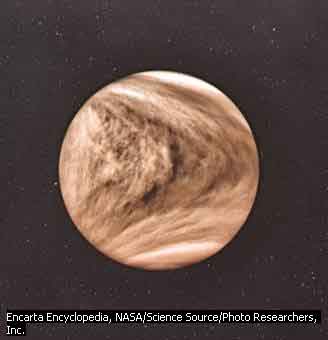 |
Venus is the brightest object in our sky, after the sun and moon. Swirling
clouds of sulfur and sulfuric acid obscure Venus�s surface and inhibited
study of the planet from Earth until technology permitted space vehicles,
outfitted with probes, to visit it. These probes determined that Venus is
the hottest of the planets, with a surface temperature of about 460� C
(about 860� F). Scientists believe that a greenhouse effect causes the
extreme temperature, hypothesizing that the planet�s thick clouds and
dense atmosphere trap energy from the sun. NASA/Science Source/Photo Researchers, Inc. Microsoft� Encarta� Reference Library 2003. � 1993-2002 Microsoft Corporation. All rights reserved. |
|||
|
Earth |
||||
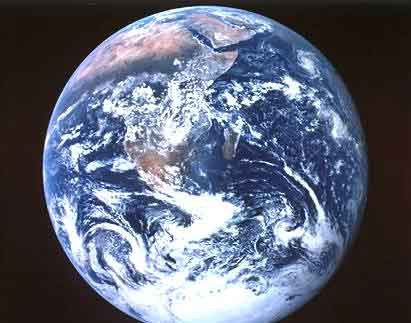 |
An oxygen-rich and protective atmosphere, moderate temperatures, abundant
water, and a varied chemical composition allow earth to support life, the
only planet to do so. The slightly oblate planet is composed of rock and
metal, which are present in molten form beneath its surface. This
photograph, taken by the Apollo 17 spacecraft in 1972, shows Arabia, the
African continent, and Antarctica (most of the white area near the bottom). NASA/Science Source/Photo Researchers, Inc. Microsoft� Encarta� Reference Library 2003. � 1993-2002 Microsoft Corporation. All rights reserved. |
|||
| Mars | ||||
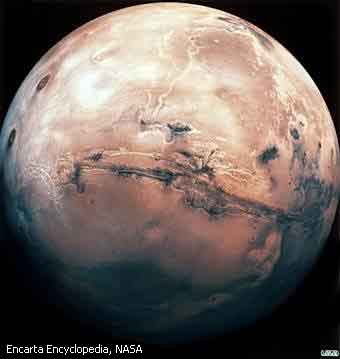 |
The most detailed information available
about Mars has come from unpiloted spacecraft sent to the planet by the
United States between 1964 and 1976. From this data, scientists have
determined that the planet�s atmosphere consists primarily of carbon
dioxide, with small amounts of nitrogen, oxygen, water vapor, and other
gases. Because the atmosphere is extremely thin, daily temperatures can
vary as much as 100 Celsius degrees. In general, surface temperatures are
too cold and surface pressures too low for water to exist in a liquid
state on Mars. The planet resembles a cold, high-altitude desert. Microsoft� Encarta� Reference Library 2003. � 1993-2002 Microsoft Corporation. All rights reserved. |
|||
| Jupiter | ||||
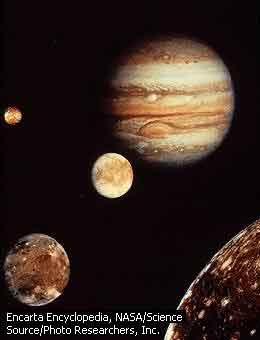 |
Jupiter is the largest of the planets, with a volume 1400 times greater
than that of the earth. Jupiter�s colorful bands are caused by strong
atmospheric currents and accentuated by a dense cloud cover. The massive
planet, upper right, is shown here with the four largest of its sixteen
satellites: Europa, center, nearest Jupiter, Io upper left, Callisto lower
left, and Ganymede lower right. NASA/Science Source/Photo Researchers, Inc. Microsoft� Encarta� Reference Library 2003. � 1993-2002 Microsoft Corporation. All rights reserved. |
|||
| Saturn | ||||
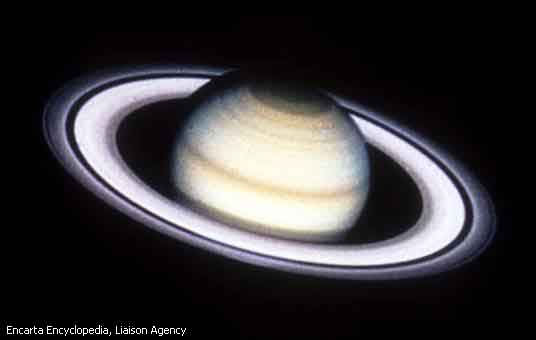 |
Saturn, distinguished by its rings, ranks as
the second largest planet�Jupiter is the largest�in the solar system. In
1610 the Italian physicist and astronomer Galileo discovered the ring
system using one of the first telescopes ever made. Although the planet
formed more than 4 billion years ago, it continues to settle and contract,
generating three times as much heat as it receives from the sun. The
Hubble Space Telescope obtained this image of Saturn on August 26, 1990. Liaison Agency Microsoft� Encarta� Reference Library 2003. � 1993-2002 Microsoft Corporation. All rights reserved. |
|||
| Uranus | ||||
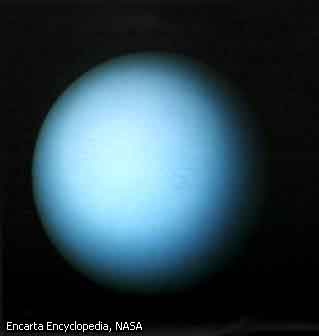 |
Uranus�s blue-green color comes from the
methane gas present in its cold, clear atmosphere. The dark shadings at
the right edge of the sphere correspond to the day-night boundary on the
planet. Beyond this boundary, Uranus�s northern hemisphere remains in a
four decade-long period of darkness because of the way the planet rotates.
Scientists compiled this view of Uranus from images returned from Voyager
2 in 1986, when the probe was 9.1 million km (5.7 million mi) away from
the planet. NASA Microsoft� Encarta� Reference Library 2003. � 1993-2002 Microsoft Corporation. All rights reserved. |
|||
| Neptune | ||||
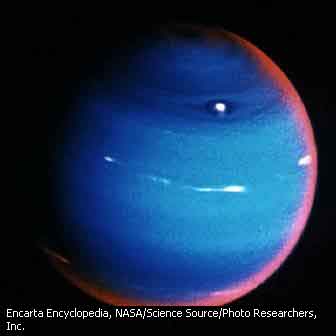 |
The 1989 Voyager 2 mission produced this false-color image of Neptune
showing the different components of Neptune�s atmosphere. The red layer
shows scattered sunlight from a haze around the planet, the blue/green
indicates methane, and the white areas are high-level clouds that reflect
sunlight above the atmosphere. NASA/Science Source/Photo Researchers, Inc. Microsoft� Encarta� Reference Library 2003. � 1993-2002 Microsoft Corporation. All rights reserved. |
|||
| Pluto | ||||
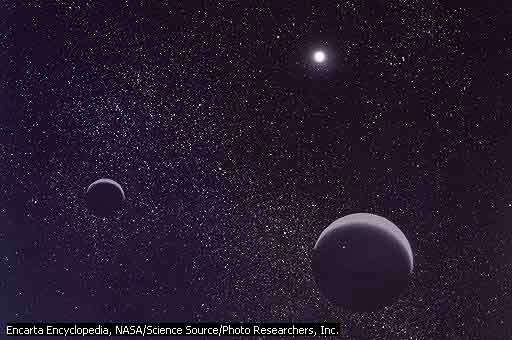 |
Pluto is farther from the sun than the other
planets in the solar system, although it occasionally moves in closer than
Neptune due to an irregular orbit. The small, rocky, and cold planet takes
247.7 years to revolve around the sun. This artist's rendition depicts
Pluto, foreground; its moon, Charon, background; and the distant sun,
upper right. NASA/Science Source/Photo Researchers, Inc. Microsoft� Encarta� Reference Library 2003. � 1993-2002 Microsoft Corporation. All rights reserved. |
|||
|
| FAQS | JUSTIFICATION | SITEMAP | SECURITY | ABOUT ME | |
||||