|
|
Characteristics:
Advanced QoS
Prioritizes
traffic to improve network performance, ensures critical needs are met
first, and enables IP telephony, voice, and video; includes DSCP and WRR
Rate Limiting
Controls
the amount of bandwidth across any configured interface to ensure
appropriate distribution of network resources
Security Filters
Polices
incoming traffic flows based on Layer 2, Layer 3, or Layer 4 access
control parameters (ACPs) to prevent unauthorized data flows
Cluster Management Suite Software
Saves tremendous time and resources by
simplifying network management tasks, with Web-based interfaces, wizards,
and other tools that enable simultaneous configuration of up to 16
clustered switches
Multicast Management
Monitors and manages bandwidth for multicast
applications such as video conferencing, distance learning, and software
distribution with IGMP snooping and broadcast and unicast storm control
Where to deploy:
For telco/data communications network (DCN)
environments:
Cisco Catalyst
2950G-24-DC; Stackable 10/100 switching, GBIC-based gigabit connectivity,
advanced intelligent services, and clustering capabilities
For advanced desktop connectivity:
Cisco Catalyst 2950G-12/24/48/24-DC; Stackable
10/100 switching, GBIC-based gigabit connectivity, advanced intelligent
services, and clustering capabilities
For desktop connectivity over fiber:
Cisco Catalyst 2950C-24; Wire-speed standalone
10/100 switching, 100BASE-FX uplinks, advanced intelligent services, and
clustering capabilities
For Gigabit migration over copper backbones:
Cisco Catalyst 2950T-24; Wire-speed standalone
10/100 switching, 10/100/1000BASE-T uplinks, advanced intelligent
services, and clustering capabilities
Product Name Product -->Number Product
Catalyst 2950G-12 (EI)--> WS-C2950G-12-EI
•
12 10/100 ports and two fixed GBIC-based 1000BaseX uplink ports
• 1
rack unit (RU) stackable switch Delivers intelligent services to the
network edge
• Enhanced Software Image (EI) installed
Catalyst
2950G-24 (EI)--> WS-C2950G-24-EI
• 24 10/100 ports and two fixed
GBIC-based 1000BaseX uplink ports
• 1 RU stackable switch
• Delivers
intelligent services to the network edge
• Enhanced Software Image (EI)
installed
Catalyst 2950G-48 (EI)--> WS-C2950G-48-EI
• 48
10/100 ports and two fixed GBIC-based 1000BaseX uplink ports
• 1 RU
stackable switch
• Delivers intelligent services to the network
edge
• Enhanced Software Image (EI) installed
Catalyst
2950G-24-DC (EI)--> WS-C2950G-24-EI-DC
• 24 10/100 ports and two
fixed 1000BaseX uplink ports
• 1 RU stackable, DC-powered switch
•
Delivers intelligent services to the network edge
• Enhanced Software
Image (EI) installed
Catalyst 2950T-24--> WS-C2950T-24
• 24
10/100 ports and two fixed 10/100/1000BaseT uplink ports
• 1 RU
switch
• Delivers intelligent services to the network edge
•
Upgradable to Enhanced Software Image (EI)
Catalyst 2950C-24-->
WS-C2950C-24
• 24 10/100 ports and two fixed 100BaseFX uplink
ports
• 1 RU switch
• Delivers intelligent services to the network
edge
• Upgradable to Enhanced Software Image (EI)
Catalyst
2950-24--> WS-C2950-24
• 24 10/100 ports
• 1 RU
switch
Catalyst 2950-12 -->WS-C2950-12
• 12 10/100
ports
• 1 RU switch
FAQ
Q. What
devices comprise the Cisco Catalyst ® 2950 Series switches?
A.
Catalyst 2950C-24, 2950T-24 —Existing members of the Cisco Catalyst 2950
Series of high-performance, standalone, 10/100 auto-sensing Fast Ethernet
and Gigabit Ethernet switches. The Catalyst 2950C-24 provides 24 10/100
ports plus two fixed 100BaseFX ports. The Catalyst 2950T-24 switch offers
mid-sized enterprises an easy migration path to Gigabit by using existing
copper cabling infrastructure with 24 10/100 ports plus two fixed
10/100/1000BaseT uplinks.
Catalyst 2950G-12 (EI), 2950G-24 (EI),
2950G-48 (EI), 2950G-24-DC (EI) —Most recently, the Cisco Catalyst 2950
Series expanded to include these new Catalyst Intelligent Ethernet
switches with Gigabit Interface Converter (GBIC) uplinks. The new products
are stackable switches that offer wire-speed connectivity to the desktop
and Gigabit uplink connectivity using a variety of optional GBICs. These
products, as well as the Catalyst 2950T-24 and 2950C-24 switches, deliver
intelligent services, such as
advanced quality of service,
rate-limiting, security filters, and multicast management, to the network
edge—using the simple, Cisco Cluster Management Suite (CMS) Software
Web-based interface. These switches, along with the Catalyst 2950T-24 and
2950C-24 switches, come with the Enhanced Software Image (EI) installed to
provide intelligent services.
Catalyst 2950-24, 2950-12 —Standalone,
fixed-configuration, managed 10/100 switches providing user connectivity
for small to mid-sized networks. These wire-speed desktop switches offer
Cisco IOS ® functionality for basic data, video and voice services at the
edge of the network. Embedded in the Catalyst 2950 Series is the Cisco
Cluster Management Suite (CMS) Software, which allows users to
simultaneously configure and troubleshoot multiple Catalyst desktop
switches using a standard Web browser.
Q. What is the
Enhanced Software Image (EI)?
A. The Cisco Catalyst 2950T-24,
2950C-24, 2950G switches are installed with the Enhanced Software Image
(EI), which
delivers intelligent services, such as advanced quality of
service, rate-limiting, security filters, and multicast management, to the
network edge.
Q. Can Catalyst 2950 Series switches be
upgraded to enable IP routing?
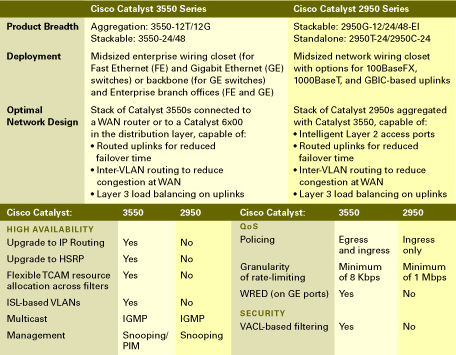
A. No. None of the Catalyst
2950 Series switches can be upgraded to enable IP routing. Cisco Catalyst
3550 Series switches
have the capability to enable IP
routing.
Q. Do Catalyst 2950 Series switches support
Gigabit Ethernet connectivity? Do they support GBIC-based
uplinks?
A. Catalyst 2950 Series switches support Gigabit
Ethernet connectivity via either fixed 10/100/1000 ports or GBIC
ports.
The following GBICs are supported: 1000BaseSX, 1000BaseLX,
1000BaseZX, and the GigaStack ® Stacking GBIC.
The Catalyst 2950T-24
provides 24 10/100 ports with two fixed 10/100/1000BaseT uplink ports. The
10/100/1000BaseT ports on the Catalyst 2950T-24 Switch can be connected to
other switches that support 1000BaseT GBICs or used as uplinks to copper
gigabit-enabled servers.
The Catalyst 2950G-12, 2950G-24, 2950G-48, and
2950G-24-DC each have 10/100 ports with two GBIC ports. The
1000BaseSX,
1000BaseLX, and 1000BaseZX GBICs can be used in the GBIC ports to provide
gigabit-speed uplinks using
fiber cabling.
Q. Do the
Catalyst 2950G switches support the Cisco 1000BaseT GBIC? When will it be
supported?
A. At FCS, Catalyst 2950G switches do not currently
support the existing Cisco 1000BaseT GBIC (WS-G5482). However,
Catalyst
2950G switches will provide 1000BaseT support shortly in a future
release.
Q. What are the highlights of the new Cisco
fixed-configuration, 1000BaseT (Gigabit Ethernet over copper)
mid-sized
business and enterprise branch solution?
A. When
combined with a Cisco Catalyst 3550 Switch with IP routing, the Catalyst
2950 Series Intelligent Ethernet Switches
are an affordable way to
complete a LAN solution that deploys intelligent services such as advanced
quality of service,
rate limiting, security, and multicast management
to the edge of a network. The combination is optimized for
Gigabit
Ethernet-over-copper aggregation and enables mid-sized business
and enterprise branch customers to move from Fast
Ethernet to a higher
performance Gigabit Ethernet backbone using existing Category 5 copper
cabling.
Q. What software features are available on the
Catalyst 2950 Series Intelligent Ethernet switches?
A. The
Catalyst 2950 software feature set is now expanded to deliver intelligent
services to the edge of the network. Key
additions to the feature set
include advanced QoS with an ability to map DiffServ Code Point (DSCP) to
class of service (CoS)
or vice versa; rate limiting based on a wide
range of access control parameters (ACPs) such as source/destination IP
address,
source/destination Media Access Control (MAC) and
TCP/User-Datagram-Protocol (UDP) port number; and
sophisticated
security through filtering. In addition to Layer 3/4
lookups, the Catalyst 2950 Series offers new ease of use and
deployment
features such Dynamic Trunking Protocol (DTP), Port
Aggregation Protocol (PAgP), dynamic virtual LANs (VLANs) and
VLAN
Trunking Protocol (VTP) pruning.
The Catalyst 2950-24 and Catalyst
2950-12 do not support the intelligent services described above. These
products—aimed
at the price sensitive customer—deliver a superior
LAN-edge Layer 2 QoS (unmatched in its class of products in the
industry),
superior multicast management via Internet Group Management
Protocol (IGMP) snooping in hardware, and wire-speed
performance.
All Catalyst 2950 Series switches support all traditional wiring
closet features such as a Web management interface, Network
Timing
Protocol (NTP), port-based virtual LANs (VLANs), Fast EtherChannel ®
/Gigabit EtherChannel technologies, 802.1Q
VLAN tagging support, VLAN
Trunking Protocol (VTP), UplinkFast, Per VLAN Spanning Tree Plus (PVST+),
and Terminal
Access Controller Access Control System
(TACACS+).
Q. Do Cisco Catalyst 2950 switches support
Switch Clustering?
A. Yes. Catalyst 2950 switches can be
managed using the Web-based Cisco Cluster Management Suite (CMS)
Software,
which uses Cisco Switch Clustering technology. Cisco CMS
allows network administrators to manage up to 16 interconnected Catalyst
2950, 3550, 3500 XL, 2900 XL, 2900 LRE XL, and 1900 switches through a
single IP address.
The switches can be in different locations and not
physically located in the same wiring closet. Furthermore, the
cluster
software upgrade feature in Cisco CMS allows the user
automatically upgrade the Cisco IOS Software on a group of
Catalyst
3550, 2950, 3500 XL, 2900 XL, 2900 LRE XL, and 1900 switches.
In
addition, Cisco CMS delivers voice and video templates, resource monitors,
and other new tools that greatly simplify the
deployment and
prioritization of voice, video and mission-critical data on a network-wide
basis for mid-sized enterprises.
Product Transitions
Q.
Are the new Cisco Catalyst 2950 switches compatible with the Catalyst 3500
XL platform?
A. The Catalyst 2950 Series switches are
compatible with the Catalyst 3500 XL and 2900 XL switches in every
way.
Committed to protecting customer investments in desktop switches,
Cisco has ensured that all desktop switching
platforms—Catalyst 2950,
3550, 3500 XL, 2900 XL, 2900 LRE XL and 1900—can be used together and
managed using
the Cisco Cluster Management Suite (CMS) Software already
embedded and supported in these switches.
Q. What
advantages does the Catalyst 2950 Series offer over the Catalyst 1900 and
FastHub 400 Series of products?
A. Catalyst 2950 switches
offer the ideal solution for customers migrating from Switched Ethernet or
Shared 10/100 in their
LANs to Switched Fast Ethernet/Gigabit Ethernet.
For customers who have Catalyst 1924-A or 1924-EN switches installed
in
their LANs, the Catalyst 2950T-24 Switch offers the most appropriate
migration path. The Catalyst 2950T-24 offers 24
10/100 desktop ports
and two fixed 10/100/1000BaseT uplink ports, thereby providing an easy
migration path to Fast and
Gigabit Ethernet using existing Category 5
cabling. For those customers who are looking for robust connectivity to
the
desktop, the Catalyst 2950-24 also offers an affordable alternative
to the Catalyst 1924-A and Catalyst 1924-EN.
For ordering purposes,
please note that the Catalyst 2950 has no distinction between the
Enterprise versus Standard edition
of software. Customers should choose
the platform with the feature set that is more applicable to their network
needs (for
example, fixed-configuration models versus models with
uplinks).
Q. Does the Cisco Catalyst 2950 Series support
Inter-Switch Link (ISL) trunking? Are there any plans to support ISL in
the future?
A. No. The Catalyst 2950 Series does not support
ISL trunking, and there are no plans to support ISL trunking on
the
Catalyst 2950 platform. For those customers with a requirement to
deploy ISL trunking, Catalyst 3550 switches support
both ISL and 802.1Q
trunks. A recommended migration to the ISL trunking standard while still
implementing the
Catalyst 2950 is to place an ISL/dot1Q-capable device
between the ISL-supported device and the Catalyst 2950
Switch.
Q. Does Cisco offer five packs or multi-packs of
the new Cisco Catalyst 2950 switches?
A. No. Cisco does not
offer five packs or other multi-packs for the Catalyst 2950 platform.
|
|
|
|
|
Characteristics:
IP Routing
Increases
availability through redundancy and rapid failover; increases scalability
through improved traffic management; includes Routing Information Protocol
(RIP), Open Shortest Path First (OSPF), Interior Gateway Routing Protocol
(IGRP), Enhanced IGRP (EIGRP), inter-VLAN routing, Protocol Independent
Multicast (PIM), and Hot Standby Router Protocol (HSRP)
Advanced Quality of Service (QoS)
Prioritizes traffic to improve network
performance, ensures critical needs are met first, and optimizes IP
telephony, voice, and video applications; includes differentiated services
code point (DSCP), strict priority scheduling, Weighted Round Robin (WRR),
and Weighted Random Early Detection (WRED)
Granular Rate Limiting
Controls the amount of bandwidth across any
configured interface to ensure appropriate distribution of network
resources at increments as low as 8Kbps, giving administrators very
granular control of network bandwidth
Security Access Control Lists (ACLs)
Governs access to all packets, either within
or between VLANs, for additional security against internal and external
threats without compromising performance
Cluster Management Suite Software
Saves tremendous time and resources by
simplifying network management tasks, with Web-based interfaces, wizards,
and other tools that enable simultaneous configuration of up to 16
clustered switches
Multicast Management
Eases and improves delivery of multicast
applications such as videoconferencing, corporate communications, distance
learning, and software distribution through Cisco Group Management
Protocol (GMP)/Internet Group Management Protocol (IGMP) snooping, GMP
server, and PIM
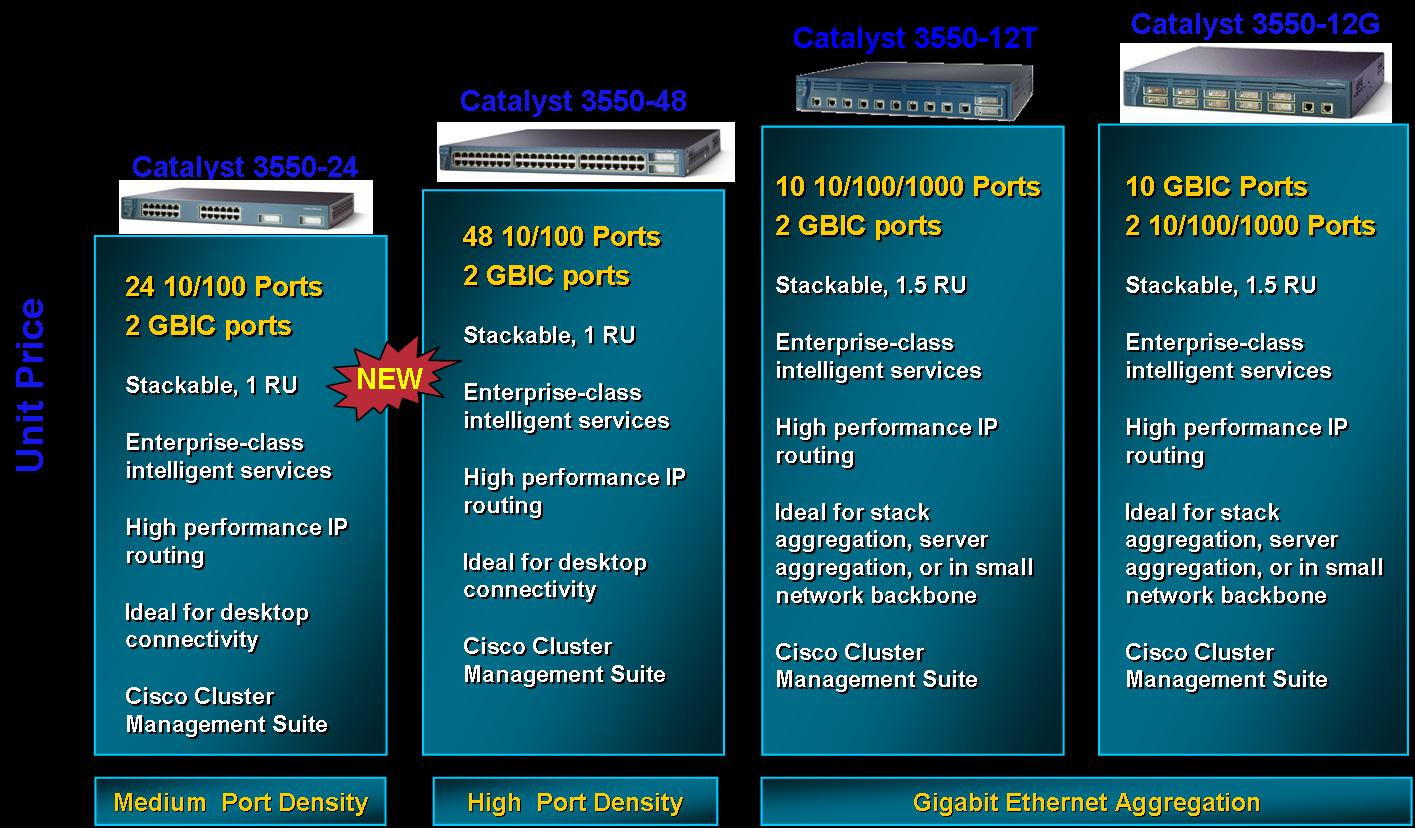
Table above - Cisco catalyst 3550 series products
Where to deploy:
For stack aggregation, server aggregation, or small network backbones:
Cisco Catalyst 3550-12G or 3550-12T; Stackable
10/100 and Gigabit Ethernet configurations, high-performance switching and
routing, enterprise-class intelligent services, and clustering
capabilities
For unsurpassed desktop connectivity:
Cisco Catalyst 3550-24/48; Stackable 10/100
and Gigabit Ethernet configurations, high-performance switching and
routing, enterprise-class intelligent services, and clustering
capabilities
For IP telephony:
Cisco Catalyst 3524-PWR
XL; Stackable 10/100 switching, Gigabit Interface Converter (GBIC)-based
gigabit connectivity, advanced intelligent services, integrated inline
power, clustering capabilities
Product Name
--> Part Number
Catalyst
3550 --> 48 WS-C3550-48-EMI
• 48 10/100 ports and 2 GBIC-based
Gigabit Ethernet ports
• 1 rack unit (RU) stackable, multilayer
switch
• Delivers enterprise-class intelligent services to the network
edge
• Enhanced Multilayer Software Image (EMI) installed
• Provides
full dynamic IP routing
Catalyst 3550-48 -->
WS-C3550-48-SMI
• 48 10/100 ports and 2 GBIC-based Gigabit Ethernet
ports
• 1 RU stackable, multilayer switch
• Delivers
enterprise-class intelligent services to the network edge
• Standard
Multilayer Software Image (SMI) installed, upgradeable to full dynamic IP
routing
Catalyst 3550-24--> WS-C3550-24-EMI
• 24 10/100 ports
and 2 GBIC-based Gigabit Ethernet ports
• 1 RU stackable multilayer
switch
• Delivers enterprise-class intelligent services to the network
edge
• Enhanced Multilayer Software Image (EMI) installed
• Provides
full dynamic IP routing
Catalyst 3550-24 --> WS-C3550-24-SMI
• 24 10/100 ports and 2 GBIC-based Gigabit Ethernet ports
• 1 RU
stackable, multilayer switch
• Delivers enterprise-class intelligent
services to the network edge
• Standard Multilayer Software Image (SMI)
installed, upgradeabl to full dynamic IP routing
Catalyst 3550-12G
--> WS-C3550-12G
• 10 GBIC-based Gigabit Ethernet ports and 2
10/100/1000 ports
• 1.5 RU stackable, multilayer Gigabit Ethernet
switch
• Delivers enterprise-class intelligent services to the network
edge
• Provides full dynamic IP routing
Catalyst 3550-12T -->
WS-C3550-12T
• 10 10/100/1000 ports and 2 GBIC-based Gigabit Ethernet
ports
• 1.5 rack unit (RU) stackable, multilayer Gigabit Ethernet
switch
• Delivers enterprise-class intelligent services to the network
edge
• Provides full dynamic IP routing
Enhanced Multilayer
Software Image (EMI)Upgrade Kit --> CD-3550-EMI=
• Enhanced
Multilayer Software Image (EMI) upgrade kit for the
standard versions
of the Catalyst 3550-24 and 3550-48 switches
• Provides full dynamic IP
routing
3550 SMI Vs 3550
EMI
Standard Multilayer Software Image
(SMI)
• Enterprise-class intelligent services
– Layer 3
QoS, rate-limiting, multicast management, security ACLs
• Available on
the Catalyst 3550-24 and 3550-48
Enhanced Multilayer Software
Image (EMI)
• SMI feature set plus more functionality
including
– Static Routing
– Dynamic IP unicast and multicast
routing
– Inter-VLAN routing
– Routed ACLs
– HSRP
FAQ
Q. What
is the difference between the Enhanced Multilayer Software Image (EMI) and
the Standard Multilayer Software
Image (SMI)?
A. The Cisco
Catalyst 3550-24 and 3550-48 switches are available with the Standard
Multilayer Software Image (SMI) or
the Enhanced Multilayer Software
Image (EMI). The Enhanced Multilayer Software Image enables a richer set
of
enterprise-class features including, hardware-based IP unicast and
multicast routing, inter-VLAN routing, Routed access
control lists
(RACLs), and the Hot Standby Router Protocol (HSRP). Flexibility to
upgrade to the Enhanced Multilayer
Software Image after the initial
deployment is provided through an Enhanced Multilayer Software Image
upgrade kit. The
Cisco Catalyst 3550-12T and 3550-12G switches come
installed with the Enhanced Multilayer Software Image.
Additional
details about the differences between the Standard
Multilayer Software Image and the Enhanced Multilayer Software
Image
are provided later in this document.
Q. Can I
enable static IP routing using the Standard Multilayer Software Image
(SMI)?
A. No, there is not support for static or dynamic
routing using the Standard Multilayer Software Image (SMI). Only
the
Enhanced Multilayer Software Image (EMI) allows for IP
routing.
Q. Is the Enhanced Multilayer Software Image (EMI)
required to allow Layer 3 and Layer 4 lookups for QoS and
Security?
A. No. Both the Standard Multilayer Software Image
(SMI) and the Enhanced Multilayer Software Image (EMI) allow for
Layer
3 and Layer 4 lookups for QoS and Security.
Q. Why do I
need intelligence at the edge of my network?
A. Networks of
today are evolving to address four new developments at the network
edge:
• Increase in desktop computing power
• Introduction of
bandwidth-intensive applications
• Expansion of highly sensitive data
on the network
• Presence of multiple device types, such as IP phones
and wireless LAN access points
These new demands are contending for
resources with many existing mission-critical applications. As a result,
IT
professionals must view the edge of the network as critical to
effectively manage the delivery of information and applications.
As
companies increasingly rely on networks as the strategic business
infrastructure, it is more important than ever to ensure
their high
availability, security, scalability and control. By adding Cisco
intelligent functionality to the wiring closet,
customers can now
deploy network-wide intelligent services that address these requirements
in a consistent way from the
desktop to the core and through the
WAN.
With Cisco Catalyst Intelligent Ethernet switches, Cisco enables
companies to realize the full benefits of adding intelligent
services
into their networks. Deploying capabilities that make the network
infrastructure highly available to accommodate
time-critical needs,
scalable to accommodate growth, secure enough to protect confidential
information, and capable of
differentiating and controlling traffic
flows are key to further optimizing network operations.
Q.
Can you provide more details on how an intelligent switch from Cisco will
help my network?
A. New applications are requiring higher
bandwidth and the need to differentiate and control the traffic flow.
Applications
such as ERP (Oracle, SAP, and so on.), voice (IP telephony
traffic) and CAD/CAM require prioritization over less
time-sensitive
applications such as FTP or e-mail (SMTP). It would be highly undesirable
to have a large file download
destined to one port on a wiring closet
switch and have quality implications such as increased latency in voice
traffic, destined
to another port on this switch. This condition is
avoided by ensuring that voice traffic is properly classified and
prioritized
throughout the network. Cisco Intelligent Ethernet switches
implement superior QoS to ensure that network traffic is
classified,
prioritized, and congestion is avoided.
Q. What about
handling the security needs of a network?
A. With the rise in
internal threats to a network, Cisco Intelligent Ethernet switches enhance
data security through the use
of access control lists (ACLs). By
denying packets based on source and destination Media Access Control (MAC)
addresses,
IP addresses, or Transmission Control Protocol (TCP)/User
Datagram Protocol (UDP) ports, users can be restricted from
sensitive
portions of the network. Also, due to the fact that all ACL lookups are
done in hardware, forwarding and routing
performance is not compromised
when implementing ACL-based security in the network. In addition, the
Catalyst 3550
switches will support 802.1x user-based authentication
via a future software release.
Q. Do the Cisco Catalyst
3550 switches support Cisco Switch Clustering technology?
A.
Yes, the Catalyst 3550 switches can be managed using theWeb-based Cisco
Cluster Management Suite (CMS) Software,
which uses Cisco Switch
Clustering technology. Cisco CMS isWeb-based software that is embedded in
Catalyst 3550, 2950,
3500 XL, 2900 XL, 2900 LRE XL, and 1900 switches.
Through Cisco Switch Clustering technology, users access Cisco CMS
with
any standardWeb browser to manage up to 16 of these switches at once,
regardless of their geographic proximity—with
the option of using a
single IP address if desired.With the addition of the Catalyst 3550
switches, Cisco CMS can now extend
beyond routed boundaries for even
more flexibility in managing a Cisco cluster.
Cisco CMS provides an
integrated management interface for delivering intelligent services,
enabling users to manage their
entire LAN with one robust tool. By
bringing the simplicity of traditional LAN switching to intelligent
services such as
multilayer switching, QoS, multicast, and security
access control lists (ACLs), Cisco CMS allows administrators to
take
advantage of benefits formerly reserved for only the most complex
networks. The new Guide Mode in Cisco CMS leads the
user step-by-step
through the configuration of high-end features and provides enhanced
online help for context-sensitive
assistance. In addition, a Solution
Wizard provides automated configuration of the switch for video streaming
or
videoconferencing. Future software will provide Solution Wizards for
voice over IP (VoIP), mission-critical applications,
and
security.
Cisco CMS supports standards-based connectivity options such
as Ethernet, Fast Ethernet, Fast EtherChannel®, Gigabit
Ethernet, and
Gigabit EtherChannel connectivity. Because Cisco Switch Clustering
technology is not limited by proprietary
stacking modules, stacking
cables or interconnection media, Cisco CMS expands the traditional cluster
domain beyond a
single wiring closet and lets users mix and match
interconnections to meet specific management, performance, and
cost
requirements.
Cisco Catalyst 3550 switches can be configured
either as command or member switches in a Cisco switch cluster. Cisco
CMS
also allows the network administrator to designate a standby or
redundant command switch, which takes the commander
duties should the
primary command switch fail. Other key features include the ability to
configure multiple ports and
switches simultaneously, as well as
perform software updates across the entire cluster at once. Bandwidth
graphs and link
reports provide useful diagnostic information and the
topology map gives network administrators a quick view of the
network
status.
Q. What Gigabit Interface Converters (GBICs) are
supported on the Catalyst 3550 switches?
A. Catalyst 3550
switches support the following Cisco GBICs: 1000BaseSX, 1000BaseLX/LH,
1000BaseZX, 1000BaseT,
and the GigaStack™ Stacking
GBIC.
Q. Is there any limit to the number of a particular
GBIC or combination of different GBICs that can be used on a Catalyst 3550
switch?
A. No. Users can populate all the GBIC ports of any
Catalyst 3550 switch with the same GBIC or with a combination
of
different GBICs.
Q. Do the Catalyst 3550 switches
have redundant power system (RPS) support?
A. Yes, the Cisco
Redundant Power System (RPS) 300 supports Catalyst 3550 switches. The
Cisco RPS 300 provides
superior internal power source redundancy for up
to six Cisco networking devices resulting in improved fault tolerance
and
network uptime.
Q. Do the Catalyst 3550 switches
support Inter-Switch Link (ISL) virtual LAN (VLAN)
trunking?
A. Yes, the Catalyst 3550 switches support both
802.1Q trunking and ISL trunking. VLAN trunks can be created from
any
port using either standards-based 802.1Q tagging or the Cisco ISL
VLAN architecture. Additionally, Dynamic Trunking
Protocol (DTP) can be
used to automatically negotiate trunk type and mode.
Q.
Does it cost more for a Layer 3 or special-features
license?
A. The Catalyst 3550-24-EMI, 3550-48-EMI, 3550-12T,
and 3550-12G are loaded with the Enhanced Multilayer Software
Image, so
all feature license fees are part of the standard list price. However, the
Catalyst 3550-24-SMI and 3550-48-SMI
switches are loaded with the
Standard Multilayer Software Image; these two switches can be upgraded to
the Enhanced
Multilayer Software Image with the purchase of the
Enhanced Multilayer Software Image upgrade kit (part
number
CD-3550-EMI=).
Q. What features are only
supported on the Enhanced Multilayer Software Image (EMI)?
A.
The following features and functionality are supported with the Enhanced
Multilayer Software Image:
• IP routing protocols for load balancing
and constructing scalable LANs:
– Routing Information Protocol (RIP)
versions 1 and 2
– Open Shortest Path First (OSPF)
– Interior
Gateway Routing Protocol (IGRP) and Enhanced IGRP (EIGRP)
• IP routing
for full Layer 3 routing between two or more VLANs using Switched Virtual
Interfaces (SVIs) or routed ports
• Static IP routing for manually
building a routing table of network path information
• Equal-cost
routing for load balancing and redundancy
• Cisco standard and extended
IP security Router access control lists (RACLs) for defining security
policies on routed
interfaces for control plane and data plane
traffic
• Fallback bridging for forwarding of non-IP traffic between
two or more VLANs
• Cisco Hot Standby Router Protocol (HSRP) to create
redundant failsafe routing topologies
• Protocol-Independent Multicast
(PIM) for IP multicast routing within a network that enables the network
to receive the
multicast feed requested and for switches not
participating in the multicast to be pruned—support for PIM sparse
mode
(PIM-SM), PIM dense mode (PIM-DM), and PIM sparse-dense mode
•
Distance Vector Multicast Routing Protocol (DVMRP) tunneling for
interconnecting two multicast-enabled networks
across non multicast
networks
• Dynamic Host Configuration Protocol (DHCP) relay for
allowing broadcast DHCP requests to be forwarded to the
network DHCP
server
Q. Are there five packs or multi-packs for the Cisco
Catalyst 3550 switches?
A. No.
Q. What is the
positioning of the Catalyst 3550 Series Intelligent Ethernet switches
relative to the Catalyst 3500 XL
switches?
A. The Catalyst
3550 switches are expected to be deployed in similar topological positions
in the network as the Catalyst
3500 XL switches. These positions
include in the access layer and network backbone of enterprise wiring
closets and branch
office networks. The Catalyst 3550 switches are
ideal for those networks requiring multilayer services like IP
routing,
advanced quality of service, multicast management, and
security access control lists.
Q. What is the positioning
of the Catalyst 3550 Series Intelligent Ethernet switches relative to the
Catalyst 2950 Series
Intelligent Ethernet switches?
A. The
Catalyst 3550 switches and the Catalyst 2950G switches are capable of
delivering intelligent services such as advanced quality of service,
rate-limiting, security filtering, and multicast management to the network
edge. The Catalyst 3550 switches are the premium fixed-configuration
switches and offer greater product family breadth, a richer set of
enterprise-class features, and a platform that supports dynamic,
hardware-based IP routing.
Q. Are the Catalyst 3550 Series
Intelligent Ethernet switches compatible with the Catalyst 3500 Series XL
switches?
A. The Catalyst 3550 switches are completely
compatible with the Catalyst 3500 XL family. Committed to protecting
customers’ investments in desktop switches, Cisco has ensured that all
desktop switching platforms including the Catalyst 3550, 2950, 3500 XL,
2900 XL, 2900 LRE XL, and 1900 can be mixed and managed using the Cisco
Cluster Management Suite (CMS) Software. Additionally, the GBIC ports on
the Catalyst 3550 support the Cisco GigaStack GBIC for point-to-point or
cascade stacking configurations. These investments provide a guarantee of
investment value over time for Cisco customers.
|