Julio Austria Paintings
MARCH 2006 ONE MAN EXHIBIT
MAY 2005 ONE MAN EXHIBIT
Works on Galleries
Budji Living, Bangkok
Paintings on Canvas
Paintings on Exhibit
"Urban Jungle"
First posted 11:13pm (Mla time) June 12, 2005
By Constantino Tejero
Inquirer News Service
| NOW starting to
make its presence felt in the local art world is what we'd call
abstract social realism, a certain way of depicting urban reality
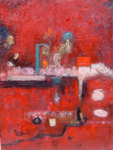
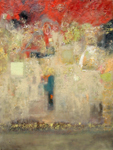
with no image in sight but chiefly through texture and chromatics. Another of its exponent is Julio Austria. The 26-year-old artist declares this affinity in his first solo exhibit "Urban Jungle," nine pieces in mixed media and oil on canvas, until June 19 in Pasilyo Victorio Edades, 4/F, Cultural Center of the Philippines. Here the artist has necessarily limited his palette to near-monochrome, mostly gray and brown with streaks and splotches of ochre, blue, yellow, red, orange, green, pink. And he works on shaped canvases, irregular formats of unusual materials, approximating the Post-Painterly artists. Curator Bobi Valenzuela, whom Austria acknowledges as a major influence, describes the young man's vision of the city as "a horrid landscape showing signs of decay due to lack of cohesive planning, intelligent zoning, sound design and sheer ignorance of the environment. Instead of a habitable place for its residents, he gives us a mish-mash of residential areas, office spaces, industrial zones, slum areas lumped into one and tangled together in a spaghetti-like mess of electric and telephone wires, highways, overpasses, sidewalks with gaping manholes risking lives and limbs of both inhabitants and commuters." As with any abstraction, the viewer wouldn't know the subject until he reads the title. And the titles reveal all that's chaotic about living in the Big City: "Rush-Hour Chaos," "Dysfunctional Living," "Divided and Distorted." "The Air We Breathe," with its billowing smoke-gray and the canvas peaked like gables and rooftops, is presumably about pollution. "Undergrounds" must be the underpasses, while "Obstructive Patterns" would be either those giant billboards or the MMDA's road obstructions and street railings. The exhibit is not totally abstract, however, as a few pieces hint at image, such as "Crooked Streets," the most colorful of the lot. Dominated by flame-red, it shows a blue outline of lamppost, a cross, and a crooked line which could be a contour of a street or a slithering serpent. In "Cablelution," the image becomes literally palpable, as the artist has integrated electrical cables into the piece until it then becomes a combine painting or a painted relief. The centerpiece is "Urban Jungle," an impressive work of predominantly gray geometric shapes constructed on canvas and metal sheets, its textures ranging from rough to smooth. The impression is one of seeing a row of tenements, a condominium, a cathedral, with buntings in the sky. Austria is a member of the Cavite-based artists' group Anting-anting. A graduate of Fine Arts, major in Painting, from University of Santo Tomas, he counts among his favorites De Kooning, Joya, T…pies, Miro, Lao Lianben, Gus Albor. This young man is ripening into a fine artist. And he has the depth to back it up.
|