Julio Austria Paintings
MARCH 2006 ONE MAN EXHIBIT
MAY 2005 ONE MAN EXHIBIT
Works on Galleries
Budji Living, Bangkok
Paintings on Canvas
Paintings on Exhibit
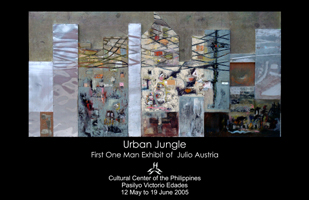
Julio Austria's Urban Jungle
A Band Player’s Solo
by Aileen Legaspi-Ramirez
There is a sense of the unfinished in the paintings of Julio Austria and the idea that the city he paints is in itself a work in progress sits comfortably within this personal aesthetic.
Austria’s present oeuvre is a mapping of this transformation—of his own shift from the introspective self-indulgence of early student work to a present abstraction hinged upon the politically incriminating, amidst an urban landscape constantly witness to the staking, re-taking and territorialization of the physical and social.
All through our drive to his studio just off San Francisco del Monte, a far north to his family’s residence in Cavite, we happen on a number of the many indices of his daily commute since surfaced in his art—anaesthecized, over painted candy-colored double-decked shacks, multiple-leveled billboard installations, ubiquitous urbane refuse, unwieldy motorists and pedestrians, and the web-like protrusions of phone and electric cables that haphazardly wire up communities squeezed into the minutest of barely-living spaces.
Like most earnest artists, Austria’s are keen eyes, sharp ears and a restless mind that have cued him into how his own bodily presence has made him as much a part of the spaces he moves through just as he finds he may be able to pitch into how these competing claims pan and encroach upon his locus.
Logically, this erstwhile saxophone player of countless hotel and bar gigs, weddings, wakes and fiestas, knows what it takes to blend into the woodwork, to toe the line, to shift into inconspicuous team member mode. It is a nuanced past that has allowed the artist to consciously adopt a ready vulnerability to unexpected exchanges and to changes brought on by encounters outside oneself.
Austria had initially intended to image a sweeping, panoramic, ergo god-like view of the city but ironically and perhaps fortuitously, the Cultural Center of the Philippines’ own spatial concerns impinged upon this show’s physical logistics. His recourse was to summon the city iconographically, through shaped canvases peppered with urban detritus.
As his brother’s spotter for buy-and-sell cars, Austria inscribes his intent musings on meandering in a meticulously kept artist’s journal now bearing sketches and photos that have become the base of pieces built up with tactile and visual elements—textured paint, taped over lines, scratched planes, bus tickets and reversed street maps—in a process reminiscent of juvenile dreams of making physical structures signaling his own virtual assumption of architect status.
Austria’s present work demonstrates how form generates meaning, and how formalism-abstraction-social realism divides have indeed been rendered untenable--of how color, texture and stroke become analogous to the layered existence of the weary urbanite while still indulging the artist’s passionate proclivity to the paring down afforded by degrees of non-representation. Austria’s Urban Jungle adopts a despairing tone in a continuing painting series he hopes to cap in an ultimately more celebratory mood.
Tangentially, Urban Jungle nudges us to reckon with how architecture is still primarily about the colonizing and apportioning of social space—how built form is purposive even when projected as whimsical, and how urban planning remains political rather than mythically pure bureaucratic fodder. In these works, Austria attempts to implicate both space and occupant as well as the powers which impose order and devise governance for publics simultaneously resistant and complicit.
Even in his still youngish 20s, Austria is already wary of having his work come across as superficially cosmetic, and cognizant of the schizophrenic pull between theme and form. Apart from looking to the work of Antoni Tapies, Joan Miro, Willem de Kooning, Lao Lianben, Gus Albor and Joya, Austria candidly traces his roots to the generous mentoring of Bobi Valenzuela and fellow Anting-Anting members Wilfredo Alicdan, Emmanuel Garibay and Joseph Lofranco—all this on top of the seminal influence of an uncle-priest who curiously opened him up to modern art and the heart-rending tales of Europe-based Filipino overseas contract workers in one unexpected sweep of events.
His has been a creative path drawn in the nexus of deliberation and happenstance — just as his music plays out in the cities of his visions.