|
|
learning a language by social reinforcement of correct speech habits. The emphasis is on the mechanistic development
of motor skills, of orally over learning the sounds and patterns of the language through extensive oral pattern drill.
Advocates of change in the teaching of English in Japan point out that the present system is not working well, and that
if the audio-lingual method works so well int. United States, we ought to try it here.
Unfortunately, the audio-lingual method has not worked out so well in the United States, and it is presently
under as much attack there, as the grammar-translation method is under attack in Japan. Before the Second World
War, the United States utilised the grammar translation method in much of its foreign language training. The result
was that during the early stages of the war, there were few people who could understand or speak the sound form of
the language. The war demanded the use of the sound language. New methods were called for in order to teach the
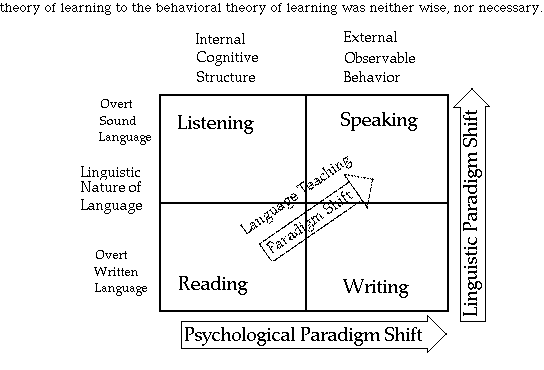
sound language. The response was the method known today as the audio lingual method. But the shift at that time,
was not just a shift from the written form to the sound form, it was also a shift of psychological principles of learning
from cognitive theory to behavioral S-R theory. See fig. 1. It now appears that the second shift, from a cognitive
|
|
|
|
|
Even in the early days of its use, there was some question about the effectiveness and efficiency of the new
audio-lingual approach with its emphasis on speaking. Simon Belasco stated that at the end of the 1960-1961
Pennsylvania State University French Institute, he was "jolted by the realisation that it is possible to develop so-called
'speaking' ability (vocalising) and yet be virtually incompetent in understanding the spoken language"3In practical
terms listening comprehension is of paramount significance. As Belasco puts it, "Conversation involves both sending
and receiving. And if one has difficulty receiving--not perceiving, but actually understanding a message being sent--
then conversation stops right there. " 4
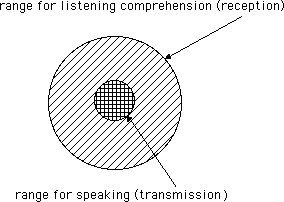
In order to handle a conversation, an individual must have a much broader competency in listening
comprehension than in speaking. When speaking a language, a learner can manipulate a relatively narrow range of
vocabulary at his own pace to express an idea. However, when listening to the reply, he no longer controls the choice
of vocabulary, the structure employed, nor the rate of delivery. He must be prepared to assimilate those words which
are part of the speaker's active vocabulary and he must adjust to the speaker's rate of speaking. This requires much
greater fluency in listening than in speaking. This is especially the case when conversing with a native speaker of that
language. In terms of the range of lexicon and structure, the comparable capabilities might be illustrated by the areas
of two concentric circles:
|
|


 1
2
3
4
5
6
7
8
1
2
3
4
5
6
7
8